The Sovereignty Series (Part 3 of 5): A System With No Single Point of Failure

Sovereignty Series 13th Dec 2025 Martin-Peter Lambert
The Sovereignty Series (Part 3 of 5): A System With No Single Point of Failure

The Sovereignty Series (Part 3 of 5): A System With No Single Point Of Failure

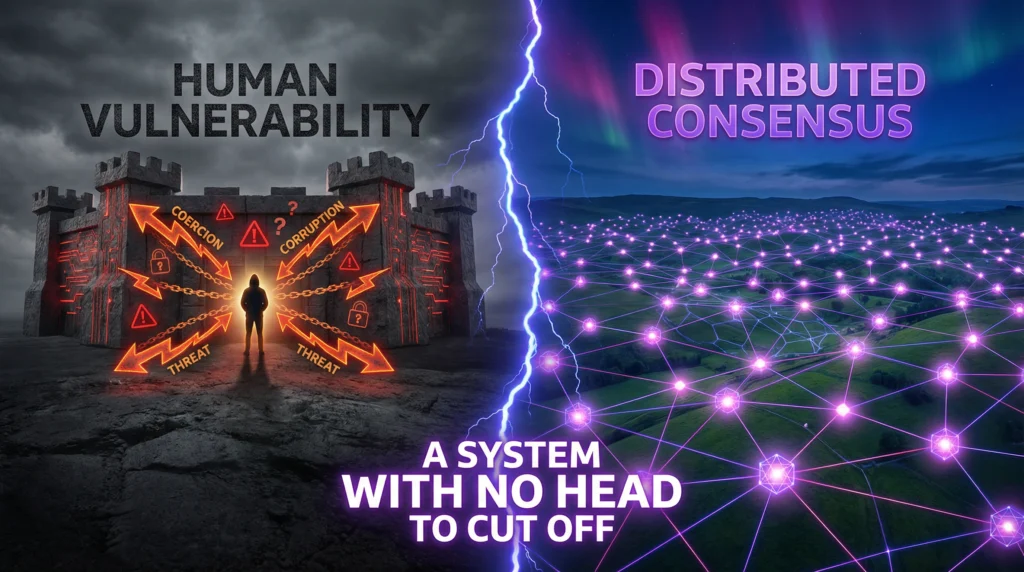
In this series, we first accepted the harsh reality that all digital systems will be breached. Then, we embraced a new security philosophy—Zero Trust—where we assume breach and verify everything, all the time. But even a perfect Zero Trust system can have a fatal flaw if it has a centralized core. If a system has a single brain, a single heart, or a single control panel, it has a single point of failure. And a single point of failure is a single point of control for an adversary.

To build a truly sovereign digital Europe, we must do more than just change our security philosophy. We must fundamentally change the architecture of our digital world. We must move from centralized systems to decentralized ones. We must build a system with no head to cut off.

The Centralization Trap
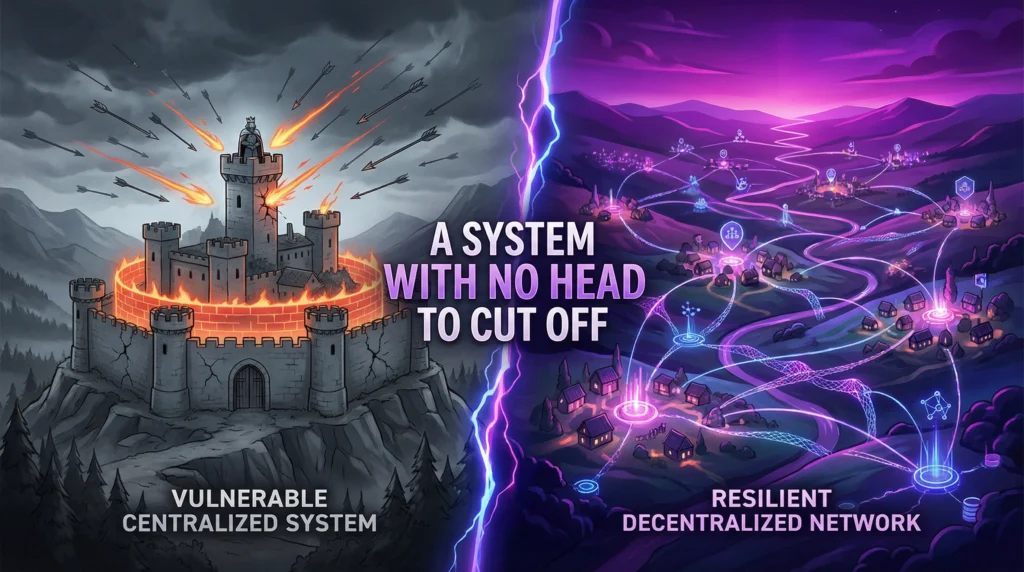
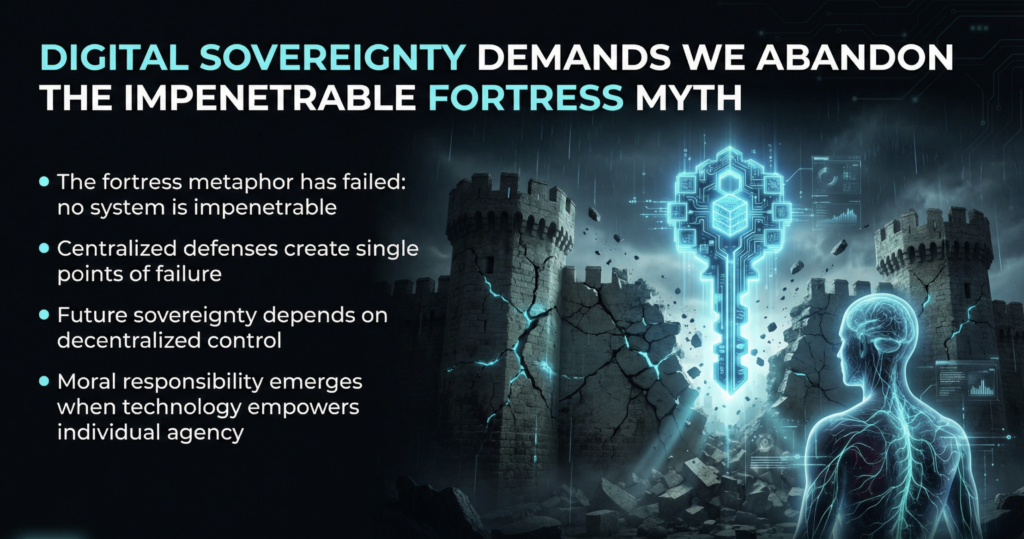
For the past thirty years, the internet has evolved towards centralization. Our data, our identities, and our digital lives are concentrated in the hands of a few massive corporations and government agencies. We have built a digital world that mirrors the structure of a medieval kingdom: a central castle (the data center) protected by high walls (the firewalls), where a single king (the system administrator) holds absolute power.

As we discussed in the first post, this model is a security nightmare. It creates a single, irresistible target for our adversaries. But the danger is even more profound. A centralized system is not just vulnerable to attack; it is vulnerable to control. A government can compel a company to hand over user data. A malicious insider can alter records. A single bug in the central system can bring the entire network to its knees. This is not sovereignty. It is dependence on a fragile, powerful, and ultimately untrustworthy core.

The Power of the Swarm: What is Decentralization?
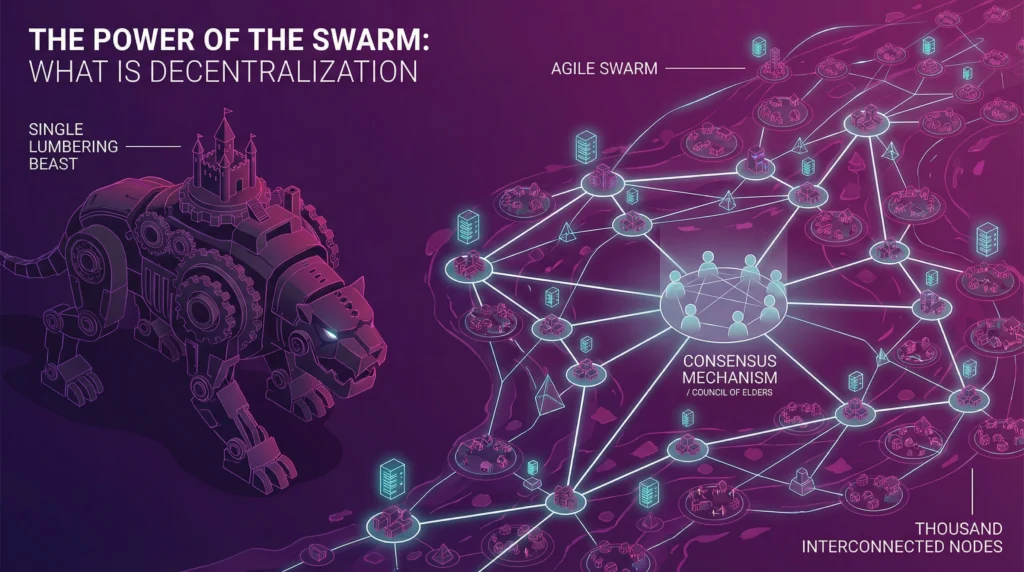
Decentralization means breaking up this central point of control and distributing it across a network of peers. Instead of a single castle, imagine a thousand interconnected villages. Instead of a single king, imagine a council of elders who must reach a consensus. This is the difference between a single, lumbering beast and a resilient, adaptable swarm.

In a decentralized system, there is no single entity in charge. Data is not stored in one place; it is replicated and synchronized across many different nodes in the network. Decisions are not made by a single administrator; they are made through a consensus mechanism, where a majority of participants must agree on the state of the system. This architecture has profound implications for security and sovereignty.

Resilience by Design
A decentralized system is inherently resilient — since it does not have a centrally point of “all control“.
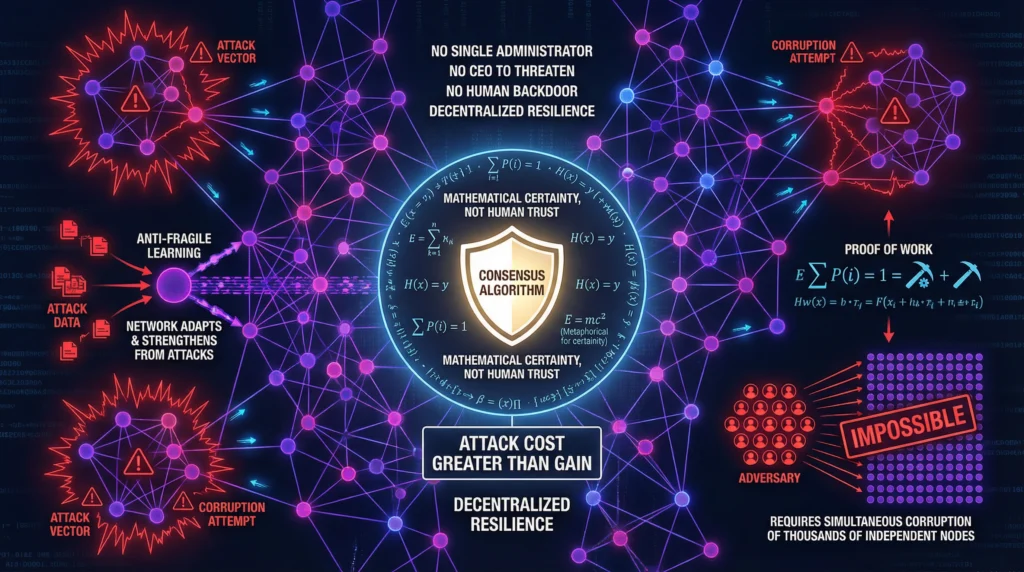
First, it has no single point of failure. If a dozen nodes in the network are attacked, flooded, or simply go offline, the network as a whole continues to function seamlessly. The system is anti-fragile; it can withstand and even learn from attacks on its individual components.

Second, it presents a terrible target for an adversary. Why would a state-level attacker spend millions of euros to compromise a single node in a network of thousands, when doing so grants them no control over the system and their malicious changes would be instantly rejected by the rest of the network? Decentralization diffuses the threat by making a successful attack economically and logistically infeasible.

Finally, it is resistant to corruption and coercion. In a decentralized system, there is no single administrator to bribe, no CEO to threaten, and no politician to pressure. To manipulate the system, you would need to corrupt a majority of the thousands of independent participants simultaneously—a near-impossible task. Trust is not placed in a person or an institution; it is placed in the mathematical certainty of the consensus algorithm.

The Unbreakable Record

This is made possible by the invention of distributed ledger technology (DLT), most famously represented by blockchain. A distributed ledger is a shared, immutable record of transactions that is maintained by a network of computers, not a central authority. Every transaction is cryptographically signed and linked to the previous one, creating a chain of verifiable truth that, once written, cannot be altered without being detected.

This technology allows us to have a shared source of truth without having to trust a central intermediary. It is the architectural backbone of a system where trust is distributed, and power is decentralized.

In our journey towards digital sovereignty, decentralization is not just a technical preference; it is a political necessity. It is the only way to build a digital infrastructure that is truly resilient, censorship-resistant, and free from the control of any single entity, whether it be a foreign power, a tech giant, or even our own government.

But a decentralized software layer is only as secure as the foundation it is built on. In our next post, we will travel to the very bottom of the stack and explore why true sovereignty must begin with the silicon itself: Hardware Security.
The Sovereignty Series (Part 1 of 5): The Myth of the Impenetrable Fortress

Sovereignty Series 11th Dec 2025 Martin-Peter Lambert
The Sovereignty Series (Part 1 of 5): The Myth of the Impenetrable Fortress

The introduction of The Sovereignty Series part 1 delves into the concept of cybersecurity long viewed as a fortress. For decades, we’ve been told a simple story about cybersecurity: it’s like building a fortress. To stay safe, we must build higher walls, deeper moats, and stronger gates than our adversaries. We invest in firewalls, intrusion detection systems, and complex passwords—all in an effort to keep the bad guys out. This model, known as perimeter security, has dominated our thinking for a generation. And for a generation, it has been failing. In The Sovereignty Series part 1, we begin to question these outdated models.

In the quest for true digital sovereignty, for an independent Europe that controls its own digital destiny, our first and most critical step is to abandon this flawed metaphor. We must accept a fundamental, uncomfortable truth. All systems will be compromised. As explained in The Sovereignty Series part 1, it is not a matter of if, but when.

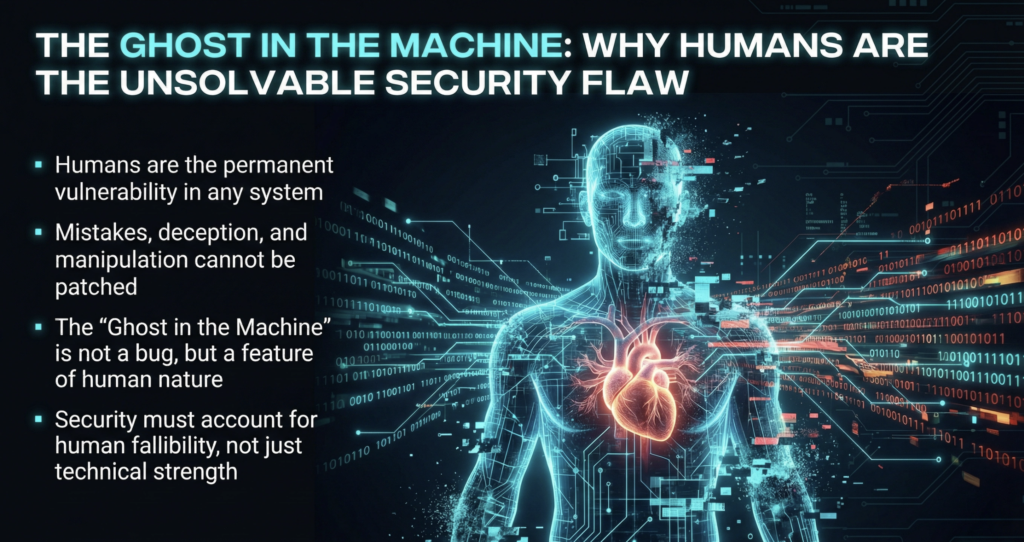
The Human Element: The Ghost in the Machine

The greatest vulnerability in any digital fortress is not in the code or the cryptography; it is in the people who build, maintain, and use it. The human element is a permanent, unsolvable security flaw. Why?

First, humans make mistakes. A simple misconfiguration, a bug in a line of code, or a forgotten security patch—these are the unlocked backdoors through which attackers waltz. The Sovereignty Series part 1 highlights how, in a complex system, the number of potential mistakes is nearly infinite.

Second, humans are susceptible to love and fear. In a centralized system, a handful of administrators hold the keys to the kingdom. These individuals become high-value targets for bribery, extortion, or blackmail. The Families of those even more so! A foreign power doesn’t need to crack a complex algorithm. They can simply buy the password from a worried parent getting a call from his wife. This makes the entire system fragile, resting on the assumption of unwavering human integrity. An assumption that history has repeatedly proven false. He who ever holds the key to the caste, will be a prime target for forces unbound by moral.

Finally, humans are vulnerable to deception. Phishing attacks, which trick users into revealing their credentials, remain one of the most effective infiltration methods. This is because they target human psychology, not technical defenses. No firewall can patch human curiosity or fear. The Series part 1 on sovereignty intensively highlights this aspect.

Finally, a little nudge, a little help here or there, might have a very big effect. Once the state would have central control and a real intractability for low transaction sums, the contradictions in a central system are absolute. A lot of untraceable little transactions will make a theft untraceable.

A central point of being able to trace everything will make the system worse. Since you only have to corrupt one person. Just by knowing who has what where, you can always visit them in the night. And have him gladly pay for the life of his loved ones — a little bit of special motivation granted. But those individuals are good and ruthless in ways of making you happily pay, as explained in The Sovereignty Series part 1.

The Centralization Problem: All Our Eggs in One Broken Basket

Our current digital infrastructure is overwhelmingly centralized. Our data, our identities, and our communications are stored in massive, centralized databases. These are controlled by a few large corporations or government agencies. This architectural choice creates two critical vulnerabilities.

First, it creates a single point of failure. When all your critical data is in one place, that place becomes a target of immense value. The Sovereignty Series part 1 also discusses that a successful breach at the center means a complete, catastrophic failure for the entire system. The attacker doesn’t need to defeat a thousand different defenses. They only need to find one way into the one place that matters.

Second, it makes these systems an irresistible target. For state-sponsored hackers, criminal organizations, and industrial spies, a centralized database of citizen information, financial records, or intellectual property is the ultimate prize. The potential reward is so great that it justifies an almost unlimited investment in time and resources to breach it.

A New Philosophy: Assume Breach

If the fortress model is broken, if the human element is an unsolvable vulnerability, and if centralization creates irresistible targets, then we must conclude that the goal of preventing a breach is futile. In The Series focused on sovereignty, part 1 reveals that the most sophisticated defenses will eventually be bypassed. The most loyal administrator can be compromised. The most secure perimeter will, one day, be crossed.

This realization is not a cause for despair, but for a radical shift in thinking. If we cannot stop attackers from getting in, we must design systems that are secure even when they are compromised. We must build a world where an attacker who has breached the perimeter finds they have gained nothing of value and can do no harm. Stay tuned for further insights in The Sovereignty Series part 1, where this topic is further explored.

This is the foundational principle of a truly sovereign digital future. It requires us to throw out the old blueprints and start fresh. In our next post, we will explore the revolutionary security philosophy that makes this possible: Zero Trust.