Microsoft Fabric: The Definitive Guide for 2026

AI In The Public Sector, Microsoft Fabric:, Sovereignty Series 16th Jan 2026 Martin-Peter Lambert

A complete walkthrough of architecture, governance, security, and best practices for building a unified data platform.

A unified data platform concept for Microsoft Fabric.

Meta title (SEO): Microsoft Fabric Definitive Guide (2026): OneLake, Security, Governance, Architecture & Best Practices

Meta description: The most practical, end-to-end guide to Microsoft Fabric for business and technical leaders. Learn how to unify data engineering, warehousing, real-time analytics, data science, and BI on OneLake.

Primary keywords: Microsoft Fabric, OneLake, Lakehouse, Data Warehouse, Real-Time Intelligence, Power BI, Microsoft Purview, Fabric security, Fabric capacity, data platform architecture, data sprawl, medallion architecture

Key Takeaways

  • Microsoft Fabric is a unified analytics platform that aims to solve the problem of data platform sprawl by integrating various data services into a single SaaS offering.
  • OneLake is the centerpiece of Fabric, acting as a single, logical data lake for the entire organization, similar to OneDrive for data.
  • Fabric offers different “experiences” for various roles, such as data engineering, data science, and business intelligence, all built on a shared foundation.
  • The platform uses a capacity-based pricing model, which allows for scalable and predictable costs.
  • Security and governance are built-in, with features like Microsoft Purview integration, fine-grained access controls, and private links.
  • A well-defined rollout plan is crucial for a successful Fabric adoption, starting with a discovery phase, followed by a pilot, and then a full production rollout.

Who is this guide for?

This guide is for business and technical leaders who are evaluating or implementing Microsoft Fabric. It provides a comprehensive overview of the platform, from its core concepts to a practical rollout plan. Whether you are a CIO, a data architect, or a BI manager, this guide will help you understand how to leverage Fabric to build a modern, scalable, and secure data platform.

Why Microsoft Fabric exists (in plain language)

Most organizations don’t have a “data problem”—they have a data platform sprawl problem:

  • Multiple tools for ingestion, transformation, and reporting
  • Duplicate data copies across lakes/warehouses/marts
  • Inconsistent security rules between engines
  • A governance gap (lineage, classification, ownership)
  • Cost surprises when teams scale

Microsoft Fabric was designed to reduce that sprawl by delivering an end-to-end analytics platform as a SaaS service: ingestion → transformation → storage → real-time → science → BI, all integrated.

If your goal is a platform that business teams can trust and technical teams can scale, Fabric is fundamentally about unification: common storage, integrated experiences, shared governance, and a capacity model you can manage centrally.

What is Microsoft Fabric? (the one-paragraph definition)

Microsoft Fabric is an analytics platform that supports end-to-end data workflows—data ingestion, transformation, real-time processing, analytics, and reporting—through integrated experiences such as Data Engineering, Data Factory, Data Science, Real-Time Intelligence, Data Warehouse, Databases, and Power BI, operating over a shared compute and storage model with OneLake as the centralized data lake.

The Fabric mental model: the 6 building blocks that matter

1) OneLake = the “OneDrive for data”

OneLake is Fabric’s single logical data lake. Fabric stores items like lakehouses and warehouses in OneLake, similar to how Office stores files in OneDrive. Under the hood, OneLake is built on ADLS Gen2 concepts and supports many file types.

OneLake acts as a single, logical data lake for the entire organization.

Why this matters: OneLake is the anchor that makes “one platform” real—shared storage, consistent access patterns, fewer duplicate copies.

2) Experiences (workloads) = role-based tools on the same foundation

Fabric exposes different “experiences” depending on what you’re doing—engineering, integration, warehousing, real-time, BI—without making you stitch together separate products.

3) Items = the concrete things teams build

In Fabric, you build “items” inside workspaces (think: lakehouse, warehouse, pipelines, notebooks, eventstreams, dashboards, semantic models). OneLake stores the data behind these items.

4) Capacity = the knob you scale (and govern)

Fabric uses a capacity-based model (F SKUs). You can scale up/down dynamically and even pause capacity (pay-as-you-go model).

5) Governance = make it discoverable, trusted, compliant

Fabric includes governance and compliance capabilities to manage and protect your data estate, improve discoverability, and meet regulatory requirements.

6) Security = consistent controls across engines

Fabric has a layered permission model (workspace roles, item permissions, compute permissions, and data-plane controls like OneLake security).

Choosing the right storage: Lakehouse vs Warehouse vs “other”

This is where many Fabric projects either become elegant—or messy.

A visual comparison of the flexible Lakehouse and the structured Data Warehouse.

Lakehouse (best when you want flexibility + Spark + open lake patterns)

Use a Lakehouse when:

  • You’re doing heavy data engineering and transformations
  • You want medallion patterns (bronze/silver/gold)
  • You’ll mix structured + semi-structured data
  • You want Spark-native developer workflows

Warehouse (best when you want SQL-first analytics and managed warehousing)

Fabric Data Warehouse is positioned as a “lake warehouse” with two warehousing items (warehouse item + SQL analytics endpoint) and includes replication to OneLake files for external access.

Real-Time Intelligence (best for streaming events, telemetry, “data in motion”)

Real-Time Intelligence is an end-to-end solution for event-driven scenarios—handling ingestion, transformation, storage, analytics, visualization, and real-time actions.

Eventstreams can ingest and route events without code and can expose Kafka endpoints for Kafka protocol connectivity.

Discovery: how to decide if Fabric is the right platform (business + technical)

Step 1 — Identify 3–5 “lighthouse” use cases

Pick use cases that prove the platform across the lifecycle:

  • Executive BI: certified metrics + governed semantic model
  • Operational analytics: near-real-time dashboards + alerts
  • Data engineering: ingestion + transformations + orchestration
  • Governance: lineage + sensitivity labeling + access controls

Step 2 — Score your current pain (and expected value)

Use a simple scoring matrix:

  • Time-to-insight (days → hours?)
  • Data trust (single source of truth?)
  • Security consistency (one model vs many?)
  • Cost predictability (capacity governance?)
  • Reuse (shared datasets and pipelines?)

Step 3 — Confirm your constraints early (these change architecture)

  • Data residency and tenant requirements
  • Identity model (Entra ID groups, RBAC approach)
  • Network posture (public internet vs private links)
  • Licensing & consumption model (broad internal distribution?)

The reference architecture: a unified Fabric platform that scales

Here’s a proven blueprint that works for most organizations.

A 5-layer reference architecture for a unified data platform in Microsoft Fabric.

Layer 1 — Landing + ingestion

Goal: bring data in reliably, with minimal coupling.

  • Use Data Factory style ingestion/orchestration (pipelines, connectors, scheduling)
  • Land raw data into OneLake (often “Bronze”)
  • Keep ingestion contracts explicit (schemas, SLAs, source owners)

Layer 2 — Transformation (medallion pattern)

Goal: create reusable, tested datasets.

The Medallion Architecture (Bronze, Silver, Gold) for data transformation.

  • Bronze: raw, append-only, immutable where possible
  • Silver: cleaned, conformed, deduplicated
  • Gold: curated, analytics-ready, business-friendly

Layer 3 — Serving & semantics

Goal: standardize definitions so the business stops arguing about numbers.

Gold tables feed:

  • Warehouse / SQL endpoints for SQL-first analytics
  • Power BI semantic models for governed metrics and reports (within Fabric’s unified environment)

Layer 4 — Real-time lane (optional but powerful)

Goal: detect and act on events quickly (minutes/seconds).

  • Ingest with Eventstreams
  • Store/query using Real-Time Intelligence components
  • Trigger actions with Activator (no/low-code event detection and triggers)

Layer 5 — Governance & security plane (always on)

Goal: everything is discoverable, classifiable, and controlled.

  • Microsoft Purview integration for governance
  • Fabric governance and compliance capabilities (lineage, protection, discoverability)

Security: how to build “secure by default” without slowing teams down

Understand the Fabric permission layers

Fabric uses multiple permission types (workspace roles, item permissions, compute permissions, and OneLake security) that work together.

A layered security permission model in Microsoft Fabric.

Practical rule:

  • Workspace roles govern “who can do what” in a workspace
  • Item permissions refine access per artifact
  • OneLake security governs data-plane access consistently

OneLake Security (fine-grained, data-plane controls)

OneLake security enables granular, role-based security on data stored in OneLake and is designed to be enforced consistently across Fabric compute engines (not per engine). It is currently in preview.

Network controls: private connectivity + outbound restrictions

If your organization needs tighter network posture:

  • Fabric supports Private Links at tenant and workspace levels, routing traffic through Microsoft’s private backbone.
  • You can enable workspace outbound access protection to block outbound connections by default, then allow only approved external connections (managed private endpoints or rules).

Governance & compliance capabilities

Fabric provides governance/compliance features to manage, protect, monitor, and improve discoverability of sensitive information.

A “good default” governance model:

  • Standard workspace taxonomy (by domain/product, not by team names)
  • Defined data owners + stewards
  • Certified datasets + endorsed metrics
  • Mandatory sensitivity labels for curated/gold assets (where applicable)

Capacity & licensing: the essentials (what leaders actually need to know)

Fabric uses capacity SKUs and also has important Power BI licensing implications.

Key official points from Microsoft’s pricing documentation:

  • Fabric capacity can be scaled up/down and paused (pay-as-you-go approach).
  • Power BI Pro licensing requirements extend to Fabric capacity for publishing/consuming Power BI content; however, with F64 (Premium P1 equivalent) or larger, report consumers may not require Pro licenses (per Microsoft’s licensing guidance).

How to translate this into planning decisions:

  • If your strategy includes broad internal distribution of BI content, licensing and capacity sizing should be evaluated together—not separately.
  • Treat capacity as shared infrastructure: define which workloads get priority, and put guardrails around dev/test/prod usage.

AI & Copilot in Fabric: what it is (and how to adopt responsibly)

Copilot in Fabric introduces generative AI experiences to help transform/analyze data and create insights, visualizations, and reports; availability varies by experience and feature state (some are preview).

Adoption best practices:

  • Enable it deliberately (not “turn it on everywhere”)
  • Create usage guidelines (data privacy, human review, approved datasets)
  • Start with low-risk scenarios (documentation, SQL drafts, exploration)

OneLake shortcuts: unify without copying (and why this changes migrations)

Shortcuts let you “virtualize” data across domains/clouds/accounts by making OneLake a single virtual data lake; Fabric engines can connect through a unified namespace, and OneLake manages permissions/credentials so you don’t have to configure each workload separately.

  • You can reduce duplicate staging copies
  • You can incrementally migrate legacy lakes/warehouses
  • You can allow teams to keep data where it is (temporarily) while centralizing governance

A practical end-to-end rollout plan (discovery → pilot → production)

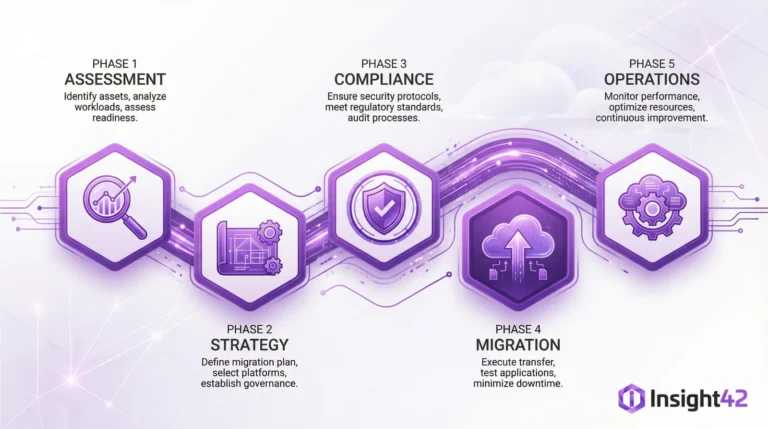
Phase 1 — 2–4 weeks: Discovery & platform blueprint

Deliverables:

  • Target architecture (lakehouse/warehouse/real-time lanes)
  • Workspace strategy and naming standards
  • Security model (groups, roles, data access patterns)
  • Governance model (ownership, certification, lineage expectations)
  • Initial capacity sizing hypothesis

Phase 2 — 4–8 weeks: Pilot (“thin slice” end-to-end)

Pick one lighthouse use case and implement the full lifecycle:

  • Ingest → bronze → silver → gold
  • One governed semantic model and 2–3 business reports
  • Data quality checks + monitoring
  • Role-based access + audit-ready governance story

Success criteria (be explicit):

  • Reduced manual steps
  • Clear lineage and ownership
  • Faster cycle time for new datasets
  • A repeatable pattern others can copy

Phase 3 — 8–16 weeks: Production foundation

  • Separate dev/test/prod workspaces (or clear release flows)
  • CI/CD and deployment patterns (whatever your org standard is)
  • Cost controls: capacity scheduling, workload prioritization, usage monitoring
  • Network posture: Private Links and outbound rules if required

Phase 4 — Scale: domain rollout + self-service enablement

  • Create “golden paths” (templates for pipelines, lakehouses, semantic models)
  • Training by persona: analysts (Power BI + governance), engineers (lakehouse patterns, orchestration), ops/admins (security, capacity, monitoring)
  • Establish a data product operating model (ownership, SLAs, versioning)

Common pitfalls (and how to avoid them)

1. Treating Fabric like “just a BI tool”

Fabric is a full analytics platform; plan governance, engineering standards, and an operating model from day one.

2. Not deciding Lakehouse vs Warehouse intentionally

Use Microsoft’s decision guidance and align by workload/persona.

3. Inconsistent security between workspaces and data

Define a single permission strategy and understand how Fabric’s permission layers interact.

4. Underestimating network requirements

If your org is private-network-first, plan Private Links and outbound restrictions early.

5. Capacity without FinOps

Capacity is shared—without guardrails, “noisy neighbor” problems appear fast. Establish policies, monitoring, and environment separation.

The “done right” Fabric checklist (copy/paste)

Strategy

☐ 3–5 lighthouse use cases with measurable outcomes

☐ Target architecture and workload mapping

☐ Capacity model + distribution/licensing plan

Platform foundation

☐ Workspace taxonomy and naming standards

☐ Dev/test/prod separation

☐ CI/CD or release process defined

Data architecture

☐ Bronze/Silver/Gold pattern defined

☐ Lakehouse vs Warehouse decisions documented

☐ Real-time lane (if needed) using Eventstreams/RTI

Security & governance

☐ Permission model documented (roles, items, compute, OneLake)

☐ OneLake security strategy (where applicable)

☐ Purview governance integration approach

☐ Network posture (Private Links / outbound rules) if required

Conclusion

Microsoft Fabric represents a significant shift in the data platform landscape. By unifying the entire analytics lifecycle, from data ingestion to business intelligence, Fabric has the potential to eliminate data sprawl, simplify governance, and empower organizations to make better, faster decisions. However, a successful Fabric adoption requires careful planning, a clear understanding of its core concepts, and a phased rollout approach. By following the best practices outlined in this guide, you can unlock the full potential of Microsoft Fabric and build a data platform that is both powerful and future-proof.

Call to Action

Ready to start your Microsoft Fabric journey? Contact us today for a free consultation and learn how we can help you design and implement a successful Fabric solution.

References

[1] What is Microsoft Fabric – Microsoft Fabric | Microsoft Learn: https://learn.microsoft.com/en-us/fabric/fundamentals/microsoft-fabric-overview

[2] OneLake, the OneDrive for data – Microsoft Fabric: https://learn.microsoft.com/en-us/fabric/onelake/onelake-overview

[3] Microsoft Fabric – Pricing | Microsoft Azure: https://azure.microsoft.com/en-us/pricing/details/microsoft-fabric/

[4] Governance and compliance in Microsoft Fabric: https://learn.microsoft.com/en-us/fabric/governance/governance-compliance-overview

[5] Permission model – Microsoft Fabric | Microsoft Learn: https://learn.microsoft.com/en-us/fabric/security/permission-model

[6] Microsoft Fabric decision guide: Choose between Warehouse and Lakehouse: https://learn.microsoft.com/en-us/fabric/fundamentals/decision-guide-lakehouse-warehouse

[7] What Is Fabric Data Warehouse? – Microsoft Fabric: https://learn.microsoft.com/en-us/fabric/data-warehouse/data-warehousing

[8] Real-Time Intelligence documentation in Microsoft Fabric: https://learn.microsoft.com/en-us/fabric/real-time-intelligence/

[9] Microsoft Fabric Eventstreams Overview: https://learn.microsoft.com/en-us/fabric/real-time-intelligence/event-streams/overview

[10] What is Fabric Activator? – Microsoft Fabric: https://learn.microsoft.com/en-us/fabric/real-time-intelligence/data-activator/activator-introduction

[11] Use Microsoft Purview to govern Microsoft Fabric: https://learn.microsoft.com/en-us/fabric/governance/microsoft-purview-fabric

[12] OneLake security overview – Microsoft Fabric: https://learn.microsoft.com/en-us/fabric/onelake/security/get-started-security

[13] About private Links for secure access to Fabric: https://learn.microsoft.com/en-us/fabric/security/security-private-links-overview

[14] Enable workspace outbound access protection: https://learn.microsoft.com/en-us/fabric/security/workspace-outbound-access-protection-set-up

[15] Overview of Copilot in Fabric – Microsoft Fabric: https://learn.microsoft.com/en-us/fabric/fundamentals/copilot-fabric-overview

[16] Unify data sources with OneLake shortcuts: https://learn.microsoft.com/en-us/fabric/onelake/onelake-shortcuts

MicrosoftFabric #OneLake #PowerBI #DataPlatform #DataAnalytics #AnalyticsPlatform #Lakehouse #DataWarehouse #DataEngineering #DataIntegration #DataFactory #DataPipelines #ETL #ELT #RealTimeIntelligence #RealTimeAnalytics #Eventstreams #StreamingAnalytics #DataGovernance #MicrosoftPurview #DataLineage #DataSecurity #RBAC #EntraID #Compliance #FinOps #CapacityPlanning #DataQuality #CloudAnalytics #DataModernization

Code Signing in Professional Software

AI In The Public Sector, Azure CAF & Cloud Migration, Resilience, Sovereignty Series 12th Jan 2026 Martin-Peter Lambert
Code Signing in Professional Software

Stop Git Impersonation, Strengthen Supply Chain Security, Meet US & EU Compliance

If you build software professionally, you don’t just need secure code—you need verifiable proof of who changed it and whether it was altered before release. Code Signing & Signed Commits play a crucial role in preventing Git impersonation and meeting US/EU compliance requirements such as NIS2, GDPR, and CRA. That’s why code signing (including Git signed commits) has become a baseline control for software supply chain security, DevSecOps, and compliance.

It also directly addresses a common risk: a developer (or attacker) committing code while pretending to be someone else. With unsigned commits, names and emails can be faked. With signed commits, identity becomes cryptographically verifiable.

This matters even more if you operate in the US and Europe, where cybersecurity requirements increasingly expect strong controls—and where the EU, in particular, attaches explicit, high penalties for non-compliance (NIS2, GDPR, and the Cyber Resilience Act). (EUR-Lex)

What is “code signing” (and what customers actually mean by it)?

In industry conversations, code signing usually means a chain of trust across your entire delivery pipeline:

  • Signed commits (Git commit signing): proves the author/committer identity for each change
  • Signed tags / signed releases: proves a release point (e.g., v2.7.0) wasn’t forged
  • Signed build artifacts: proves your binaries, containers, and packages weren’t tampered with
  • Signed provenance / attestations: proves what source + CI/CD pipeline produced the artifact (a growing expectation in supply chain security programs)

The goal is simple: integrity + identity + traceability from developer laptop to production.

Why signed commits prevent “commit impersonation”

Without signing, Git identity is just text. Anyone can set an author name/email to match a colleague and push code that looks legitimate.

Signed commits add a cryptographic signature that platforms can verify. When you enforce signed commits (especially on protected branches):

  • fake author names don’t pass verification
  • only commits signed by trusted keys are accepted
  • auditors and incident responders get a reliable attribution trail

In other words: Git commit signing is one of the cleanest ways to prevent developers (or attackers) from committing as someone else.

Code Signing = Better Security + Cleaner Audits

Customers in regulated industries (finance, critical infrastructure, healthcare, manufacturing, government vendors) frequently search for:

  • software supply chain security
  • CI/CD security controls
  • secure SDLC evidence
  • audit trail for code changes

Code signing helps because it creates durable evidence for:

  • change control (who changed what)
  • integrity (tamper-evidence)
  • accountability (strong attribution)
  • faster incident response and forensics

That’s why code signing is often positioned as a compliance accelerator: it reduces the cost and friction of proving good practices.

US Compliance View: Why Code Signing Supports Federal and Enterprise Security Requirements

In the US, the big push is secure software development and software supply chain assurance—especially for vendors selling into government and regulated sectors.

Executive Order 14028 + software attestations

Executive Order 14028 drove major follow-on guidance around supply chain security and secure software development expectations. (NIST)
OMB guidance (including updates like M-23-16) establishes timelines and expectations for collecting secure software development attestations from software producers. (The White House)
Procurement artifacts like the GSA secure software development attestation reflect this direction in practice. (gsa.gov)

NIST SSDF (SP 800-218) as the common language

Many organizations align their secure SDLC programs to the NIST Secure Software Development Framework (SSDF). (csrc.nist.gov)

Where code signing fits: it’s a practical control that supports identity, integrity, and traceability—exactly the kinds of things customers and auditors ask for when validating secure development practices.

(In the US, the “penalty” is often commercial: failed vendor security reviews, procurement blockers, contract risk, and higher liability after an incident—especially if your controls can’t be evidenced.)

EU Compliance View: NIS2, GDPR, and the Cyber Resilience Act (CRA) Penalties

Europe is where penalties become very concrete—and where customers increasingly ask vendors about NIS2 compliance, GDPR security, and Cyber Resilience Act compliance.

NIS2 penalties (explicit fines)

NIS2 includes an administrative fine framework that can reach:

  • Essential entities: up to €10,000,000 or 2% of worldwide annual turnover (whichever is higher)
  • Important entities: up to €7,000,000 or 1.4% of worldwide annual turnover (whichever is higher) (EUR-Lex)

Why code signing matters for NIS2 readiness: it supports strong controls around integrity, accountability, and change management—key building blocks for cybersecurity governance in professional environments.

GDPR penalties (security failures can get expensive fast)

GDPR allows administrative fines up to €20,000,000 or 4% of global annual turnover (whichever is higher) for certain serious infringements. (GDPR)

Code signing doesn’t “solve GDPR,” but it reduces the risk of supply-chain compromise and improves your ability to demonstrate security controls and traceability after an incident.

Cyber Resilience Act (CRA) penalties + timelines

The CRA (Regulation (EU) 2024/2847) introduces horizontal cybersecurity requirements for products with digital elements. Its penalty article states that certain non-compliance can be fined up to:

  • €15,000,000 or 2.5% worldwide annual turnover (whichever is higher), and other tiers including
  • €10,000,000 or 2%, and €5,000,000 or 1% depending on the type of breach. (EUR-Lex)

Timing also matters: the CRA applies from 11 December 2027, with earlier dates for specific obligations (e.g., some reporting obligations from 11 September 2026 and some provisions from 11 June 2026). (EUR-Lex)

For vendors, this translates into a customer question you should expect to hear more often:

“How do you prove the integrity and origin of what you ship?”

Your best answer includes code signing + signed releases + signed artifacts + verifiable provenance.

Implementation Checklist: Code Signing Best Practices (Practical + Auditable)

If you want code signing that actually holds up in audits and real incidents, implement it as a system—not a developer “nice-to-have”.

1) Enforce Git signed commits

  • Require signed commits on protected branches (main, release/*)
  • Block merges if commits are not verified
  • Require signed tags for releases

2) Secure developer signing keys

  • Prefer hardware-backed keys (or secure enclaves)
  • Require MFA/SSO on developer accounts
  • Rotate keys and remove trust when people change roles or leave

3) Sign what you ship (artifact signing)

  • Sign containers, packages, and binaries
  • Verify signatures in CI/CD and at deploy time

4) Add provenance (supply chain proof)

  • Produce build attestations/provenance so you can prove which pipeline built which artifact from which source

Is Git commit signing the same as code signing?
Git commit signing proves identity and integrity at the source-control level. Code signing often also includes release and artifact signing for what you ship.

Does signed commits stop a compromised developer laptop?
It helps with attribution and tamper-evidence, but you still need endpoint security, key protection, least privilege, reviews, and CI/CD hardening.

What’s the business value?
Less impersonation risk, stronger software supply chain security, faster audits, clearer incident response, and a better compliance posture for US and EU customers.

Takeaway

If you sell software into regulated or security-sensitive markets, code signing and signed commits are no longer optional. They directly prevent commit impersonation, strengthen software supply chain security, and support compliance conversations—especially in the EU where NIS2, GDPR, and CRA penalties can be severe. (EUR-Lex)

If you want, I can also provide:

  • an SEO-focused FAQ expansion (10–15 more questions),
  • a one-page “Code Signing Policy” template,
  • or platform-specific enforcement steps (GitHub / GitLab / Azure DevOps / Bitbucket) written in a customer-friendly way.

#CodeSigning #SignedCommits #GitSecurity #SoftwareSupplyChain #SupplyChainSecurity #DevSecOps #SecureSDLC #CICDSecurity #NIS2 #GDPR #CyberResilienceAct #Compliance #RegTech #RiskManagement #CybersecurityGovernance #SoftwareIntegrity #CodeIntegrity #IdentitySecurity #NonRepudiation #ZeroTrust #SecurityControls #ChangeManagement #GitHubSecurity #GitLabSecurity #SBOM #SLSA #SoftwareProvenance #ArtifactSigning #ReleaseSigning #EnterpriseSecurity #CloudSecurity #SecurityLeadership #CISO #SecurityEngineering #ProductSecurity #SecurityCompliance

The Monopoly of Progress

AI In The Public Sector, Growth, Resilience, Sovereignty Series 3rd Jan 2026 Martin-Peter Lambert
The Monopoly of Progress

Why Abundance, Security, and Free Markets are the Only True Catalysts for Innovation

Introduction: The Paradox of Creation

In the modern economic narrative, competition is lionized as the engine of progress. We are taught that a fierce marketplace, where rivals battle for supremacy, drives innovation, lowers prices, and ultimately benefits society. However, a closer examination of the last three decades of technological advancement reveals a startling paradox: true, transformative innovation—the kind that leaps from zero to one—rarely emerges from the bloody trenches of perfect competition. This notion supports the idea that perfect competition stifles progress and creativity, leading us to question why abundance, security, and free markets are the only true catalysts for innovation, as these environments often look far more like a monopoly with long-term vision rather than a cutthroat market.

This thesis, most forcefully articulated by entrepreneur and investor Peter Thiel in his seminal work, Zero to One, argues that progress is not a product of incremental improvements in a crowded field, but of bold new creations that establish temporary monopolies [1]. This article will explore Thiel’s framework, arguing that the capacity for radical innovation is contingent upon the financial security and long-term planning horizons that only sustained profitability can provide.

The Two Types of Progress

We will then turn our lens to the European Union, particularly Germany, to diagnose why the continent has failed to produce world-dominating technology companies in recent decades, attributing this failure to a culture of short-termism, stifling regulation, and punitive taxation.

Finally, we will dismantle the notion that the state can act as an effective substitute for the market in allocating capital for innovation. Drawing on the work of Nobel Prize-winning economists like Friedrich Hayek and the laureates recognized for their work on creative destruction, we will demonstrate that centralized planning is, and has always been, the most inefficient allocator of resources, fundamentally at odds with the chaotic, decentralized, and often wasteful process that defines true invention.

The Thiel Doctrine: Competition is for Losers

Peter Thiel’s provocative assertion that “competition is for losers” is not an endorsement of anti-competitive practices but a fundamental critique of how we perceive value creation. He draws a sharp distinction between “0 to 1” innovation, which involves creating something entirely new, and “1 to n” innovation, which consists of copying or iterating on existing models. While globalization represents the latter, spreading existing technologies and ideas, true progress is defined by the former.

To understand this, Thiel contrasts two economic models: perfect competition and monopoly.

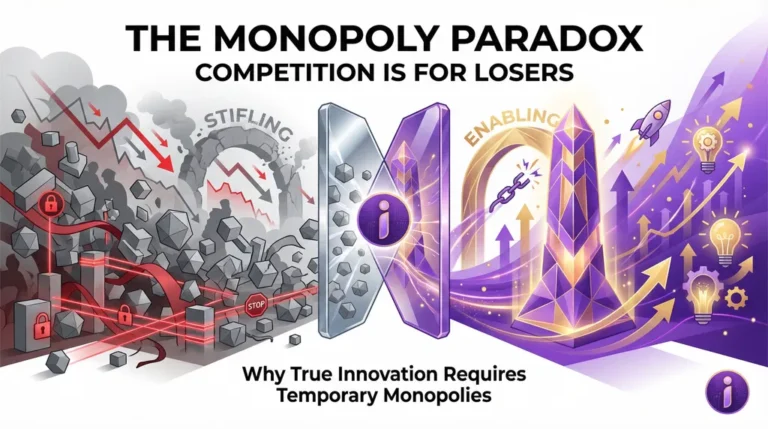
The Innovation Paradox: Competition vs Monopoly

In a state of perfect competition, no company makes an economic profit in the long run. Firms are undifferentiated, selling at whatever price the market dictates. If there is money to be made, new firms enter, supply increases, prices fall, and the profit is competed away. In this brutal struggle for survival, companies are forced into a short-term, defensive crouch. Their focus is on marginal gains and cost-cutting, not on ambitious, long-term research and development projects that may not pay off for years, if ever [1].

The U.S. airline industry serves as a prime example. Despite creating immense value by transporting millions of passengers, the industry’s intense competition drives profits to near zero. In 2012, for instance, the average airfare was $178, yet the airlines made only 37 cents per passenger trip [1]. This leaves no room for the “waste” and “slack” necessary for bold experimentation.

In stark contrast, a company that achieves a monopoly—not through illegal means, but by creating a product or service so unique and superior that it has no close substitute—can generate sustained profits. These profits are not a sign of market failure but a reward for creating something new and valuable. Google, for example, established a monopoly in search in the early 2000s. Its resulting profitability allowed it to invest in ambitious “moonshot” projects like self-driving cars and artificial intelligence, endeavors that a company struggling for survival could never contemplate.

This environment of abundance and security is the fertile ground from which “Zero to One” innovations spring. It allows a company to think beyond immediate survival and plan for a decade or more into the future, accepting the necessity of financial
waste and the high probability of failure in the pursuit of groundbreaking discoveries. This is the core of the Thiel doctrine: progress requires the security that only a monopoly, however temporary, can provide.

The European Malaise: A Continent of Incrementalism

For the past three decades, a glaring question has haunted the economic landscape: where are Europe’s Googles, Amazons, or Apples? Despite a highly educated workforce, strong industrial base, and significant government investment in R&D, the European Union, and Germany in particular, has failed to produce a single technology company that dominates its global market. The continent’s tech scene is characterized by a plethora of “hidden champions”—highly successful, niche-focused SMEs—but it lacks the breakout, world-shaping giants that have defined the digital age. This is not an accident of history but a direct consequence of a political and economic culture that is fundamentally hostile to the principles of “Zero to One” innovation.

The Triple Constraint: Regulation, Taxation, and Short-Termism

The European innovation deficit can be attributed to a trifecta of self-imposed constraints:

EU Innovation Triple Constraint
  1. A Culture of Precautionary Regulation: The EU’s regulatory philosophy is governed by the “precautionary principle,” which prioritizes risk avoidance over seizing opportunities. This manifests in sprawling, complex regulations like the General Data Protection Regulation (GDPR) and the AI Act. While well-intentioned, these frameworks impose immense compliance burdens, especially on startups and smaller firms. A 2021 study found that GDPR led to a measurable decline in venture capital investment and reduced firm profitability and innovation output, as resources were diverted from R&D to legal and compliance departments [2]. The AI Act, with its risk-based categories and strict mandates, creates further bureaucratic hurdles that stifle the rapid, iterative experimentation necessary for AI development. This risk-averse environment encourages incremental improvements within established paradigms rather than the disruptive breakthroughs that challenge them.
  2. Punitive Taxation and the Demand for Premature Profitability: European tax policies, particularly in countries like Germany where the average corporate tax burden is around 30%, create a significant disadvantage for innovation-focused companies [3]. High taxes on corporate profits and wealth disincentivize the long-term, high-risk investments that drive transformative innovation. Furthermore, the European venture capital ecosystem is less developed and more risk-averse than its U.S. counterpart. Startups often rely on bank lending, which demands a clear and rapid path to profitability. This pressure to become profitable quickly is antithetical to the “wasteful” and often decade-long process of developing truly novel technologies. As a result, many of Europe’s most promising startups, such as UiPath and Dataiku, have relocated to the U.S. to access larger markets, deeper capital pools, and a more favorable regulatory environment [2].
  3. A Fragmented Market: Despite the ideal of a single market, the EU remains a patchwork of 27 different national laws and regulatory interpretations. This fragmentation prevents European companies from achieving the scale necessary to compete with their American and Chinese rivals. A startup in one member state may face entirely different compliance requirements in another, creating significant barriers to expansion. This stands in stark contrast to the unified markets of the U.S. and China, where companies can scale rapidly to achieve national and then global dominance.

This combination of overregulation, high taxation, and market fragmentation creates an environment where it is nearly impossible for companies to achieve the sustained profitability and security necessary for “Zero to One” innovation. The European model, in essence, enforces a state of perfect competition, trapping its companies in a cycle of incrementalism and ensuring that the next generation of technological giants will be born elsewhere.

The State as Innovator: A Proven Failure

Faced with this innovation deficit, some policymakers in Europe and elsewhere have been tempted by the siren song of industrial planning.

Capital Allocation: The Knowledge Problem

The argument is that the state, with its vast resources and ability to direct investment, can strategically guide innovation and pick winners. This is a dangerous and historically discredited idea. The 2025 Nobel Prize in Economics, awarded to Philippe Aghion, Peter Howitt, and Joel Mokyr for their work on innovation-led growth, serves as a powerful reminder that prosperity comes not from stability and central planning, but from the chaotic and unpredictable process of “creative destruction” [4].

The Knowledge Problem and the Price System

Nobel laureate Friedrich Hayek, in his seminal work, dismantled the socialist belief that a central authority could ever effectively direct an economy. He argued that the knowledge required for rational economic planning is not concentrated in a single mind or committee but is dispersed among millions of individuals, each with their own unique understanding of their particular circumstances. The market, through the price system, acts as a vast, decentralized information-processing mechanism, coordinating the actions of these individuals without any central direction [5].

As Hayek wrote, “The economic problem of society is thus not merely a problem of how to allocate ‘given’ resources—if ‘given’ is taken to mean given to a single mind which could solve the problem set by these ‘data.’ It is rather a problem of how to secure the best use of resources known to any of the members of society, for ends whose relative importance only these individuals know” [5].

State-led innovation initiatives inevitably fail because they are blind to this dispersed knowledge. A government committee, no matter how well-informed, cannot possibly possess the information necessary to make the millions of interconnected decisions required to bring a new technology to market. The historical record is littered with the failures of central planning, from the economic collapse of the Soviet Union to the stagnation of countless state-owned enterprises.

Creative Destruction: The Engine of Progress

The work of the 2025 Nobel laureates reinforces Hayek’s critique. Joel Mokyr’s historical analysis of the Industrial Revolution reveals that it was not the product of government programs but of a cultural shift towards open inquiry, merit-based debate, and the free exchange of ideas. The political fragmentation of Europe, which allowed innovators to flee repressive regimes, was a key factor in this process [4].

Aghion and Howitt’s model of “growth through creative destruction” shows that a dynamic economy depends on a constant process of experimentation, entry, and replacement. New, innovative firms challenge and displace established ones, driving progress. This process is inherently messy and unpredictable. It cannot be “engineered” or “guided” by a central planner. Attempts to protect incumbents or strategically direct innovation only serve to entrench mediocrity and stifle the very dynamism that drives growth.

Policies like Europe’s employment protection laws, which make it difficult and expensive to restructure or downsize a failing venture, work directly against this process. A dynamic economy requires that entrepreneurs be free to enter the market, fail, and try again without asking for the state’s permission or being cushioned from the consequences of failure.

The Market at Work: Three Stories of Innovation and Regulation

To make the abstract principles of market dynamics and regulatory friction concrete, consider three powerful stories of technologies that share common roots but followed radically different cost trajectories. These case studies vividly illustrate how free, competitive markets drive costs down and quality up, while regulated, third-party-payer systems often achieve the opposite.

Story 1: LASIK—A Clear View of the Free Market

LASIK eye surgery is a modern medical miracle, yet it operates almost entirely outside the conventional health insurance system. As an elective procedure, it is a cash-pay service where consumers act as true customers, shopping for the best value. The results are a textbook example of free-market success. In the late 1990s, the procedure cost around $2,000 per eye in today’s dollars. A quarter-century later, the price has not only failed to rise with medical inflation but has actually fallen in real terms, with the average cost remaining around $1,500-$2,500 per eye [6].

More importantly, the quality has soared. Today’s all-laser, topography-guided custom LASIK is orders of magnitude safer, more precise, and more effective than the original microkeratome blade-based procedures. This combination of falling prices and rising quality is what we expect from every other technology sector, from televisions to smartphones. It happens in LASIK for one simple reason: providers compete directly for customers who are spending their own money. There are no insurance middlemen, no complex billing codes, and no government price controls to distort the market. The result is relentless innovation and price discipline.

Story 2: The Genome Revolution—Faster Than Moore’s Law

The most stunning example of technology-driven cost reduction in human history is not in computing, but in genomics. When the Human Genome Project was completed in 2003, the cost to sequence a single human genome was nearly $100 million. By 2008, with the advent of next-generation sequencing, that cost had fallen to around $10 million. Then, something incredible happened. The cost began to plummet at a rate that far outpaced Moore’s Law, the famous benchmark for progress in computing. By 2014, the coveted “$1,000 genome” was a reality. Today, a human genome can be sequenced for as little as $200 [7].

This 99.9998% cost reduction occurred in a field driven by fierce technological competition between companies like Illumina, Pacific Biosciences, and Oxford Nanopore. It was a race to innovate, fueled by research and consumer demand, largely unencumbered by the regulatory thicket of the traditional medical device market. While the interpretation of genomic data for clinical diagnosis is regulated, the underlying technology of sequencing itself has been free to follow the logic of the market, delivering exponential gains at an ever-lower cost.

Story 3: The Insulin Tragedy—A Century of Regulatory Failure

In stark contrast to LASIK and genomics stands the story of insulin, a life-saving drug discovered over a century ago. The basic technology for producing insulin is well-established and inexpensive; a vial costs between $3 and $10 to manufacture. Yet, in the heavily regulated U.S. healthcare market, the price has become a national scandal. The list price of Humalog, a common insulin analog, skyrocketed from $21 a vial in 1996 to over $332 in 2019—a more than 1,500% increase [8].

How is this possible? The answer lies in a web of regulatory capture and market distortion. The U.S. patent system allows for “evergreening,” where minor tweaks to delivery devices or formulations extend monopolies. The FDA’s classification of insulin as a “biologic” has historically made it nearly impossible for cheaper generics to enter the market. Most critically, a shadowy ecosystem of Pharmacy Benefit Managers (PBMs) negotiates secret rebates with manufacturers, creating perverse incentives to favor high-list-price drugs. The FTC even sued several PBMs in 2024 for artificially inflating insulin prices [9]. In this system, the consumer is not the customer; the PBM is. The result is a market where a century-old, life-saving technology has become a luxury good, a tragic testament to the failure of a market that is anything but free.

These three stories—of sight, of self-knowledge, and of survival—tell a single, coherent tale. Where markets are free, transparent, and competitive, innovation flourishes and costs fall. Where they are burdened by regulation, obscured by middlemen, and captured by entrenched interests, the consumer pays the price, both literally and figuratively.

Conclusion: Embracing the Monopoly of Progress

The evidence is clear we have a conundrum: true, transformative innovation is not a product of competition alone but in its’ results – not in ensuring same suboptimal outcome by regulated process. It requires an environment of abundance and security where companies can afford to think long-term, embrace risk, and invest in the “wasteful” process of discovery. Peter Thiel’s framework, far from being a defense of predatory monopolies, is a call to recognize the conditions necessary for human progress.

The failure of the EU and Germany to produce world-leading technology companies is a direct result of their hostility to these conditions. A culture of precautionary regulation, punitive taxation, and short-term profitability has created a continent of incrementalism (keep it the same – if not, we cannot deal with setbacks), where the fear of failure outweighs the ambition to create something new. The temptation to solve this problem through state-led industrial planning is a dangerous illusion that ignores the fundamental lessons of economic history.

If we are to unlock the next wave of human progress, we must abandon the comforting but false narrative of perfect competition and embrace the messy, unpredictable, and often monopolistic reality of innovation. This means creating an ecosystem that rewards bold bets and tolerates failure. It means light regulation, competitive taxation, and a culture that celebrates the entrepreneur, not the bureaucrat. The path to a better future is not paved with the good intentions of central planners but with the creative destruction of the free market. It is a path that leads, paradoxically, through the monopoly of progress.

In essence – we need the right balance. The EU has the most potential to maximize output by a minimal input! The US has to catch up on food safety and non capitalistic and predatory capitalism.
We all can learn something from each other – including not mentioned global super powers!

#Insight42 #PublicSectorInnovation #DigitalSovereignty #ZeroToOne #ThielDoctrine #GovTech #DigitalTransformation #GermanyDigital #EUTech #InnovationStrategy #PublicProcurement #SovereignTech #RegulatoryReform #CreativeDestruction #EconomicGrowth #DigitalDecade #SmartGovernment #PublicAdmin #TechPolicy #FutureOfGovernment

References

[1] Peter Thiel, “Competition is for Losers,” Wall Street Journal, September 12, 2014

[9] Federal Trade Commission, “FTC Sues Prescription Drug Middlemen for Artificially Inflating Insulin Drug Prices,” September 20, 2024

Related Topics:
https://insight42.com/unleash-the-european-bull/

Part 3 – The Public Sector AI: Procurement

AI In The Public Sector 28th Dec 2025 Martin-Peter Lambert
Part 3 – The Public Sector AI: Procurement

Playbook: Fast, Secure, Sovereign

A 3-Part Blog Series on AI Procurement for Government Digital Transformation
By Insight 42 UG | www.insight42.com

Meta Description: A practical 4-step playbook for public sector AI procurement. This guide provides best practices for fast, secure, and sovereign AI solutions for government digital transformation.

Focus Keywords: Public Sector AI Procurement, AI Procurement Guide, Government AI Strategy, Public Sector Automation

Welcome to the final installment of our AI procurement guide for the public sector. In Part 1, we established the critical importance of sovereign AI.

In Part 2, we presented the data showing why agile, smaller vendors consistently outperform large tech intermediaries in public sector AI implementation.

Now, let’s translate these insights into a practical, actionable playbook. How do you, a public sector leader, avoid the 95% failure rate and build a government AI strategy that is fast, secure, and truly serves your citizens? This is your step-by-step guide.

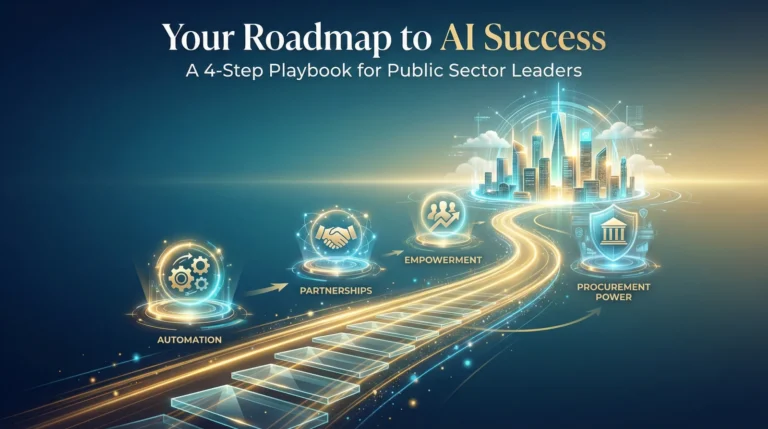
The Four-Step Playbook for Sovereign AI Procurement

This isn’t about boiling the ocean or launching a massive, multi-year overhaul. It’s about making smart, strategic moves that build momentum and deliver measurable value. The original SAP paper put it perfectly: start with the “low-hanging fruit” [1].

Step 1: Target Back-Office Bottlenecks for High-ROI Automation

Forget the flashy, headline-grabbing AI chatbot for now. The MIT report was unequivocal: the biggest and fastest ROI comes from public sector automation in the back office [2]. Begin by identifying your most tedious, repetitive, and resource-intensive internal processes.

Prime candidates include:

  • Data entry and migration
  • Document processing and classification
  • Internal helpdesk and IT support tickets
  • Invoice processing and financial reconciliation
  • Scheduling and resource allocation

These projects are the ideal starting point for your government AI adoption journey because they are low-risk, high-impact, and the gains are easy to measure. You’re not just saving money; you’re freeing up your talented public servants to focus on the high-value, citizen-facing work they were hired to do. This approach builds confidence, demonstrates the practical power of AI to internal skeptics, and creates the momentum needed for more ambitious projects.

Step 2: Buy, Don’t Build: A Core Tenet of Agile AI Procurement

The data is conclusive. Organizations that purchase specialized AI tools from expert vendors see a 67% success rate, while those that attempt to build everything in-house fail two-thirds of the time [2]. The impulse to build a proprietary system is strong in government, but it’s a trap. You will burn through your budget and political capital reinventing the wheel.

Instead, embrace agile AI procurement by partnering with the Davids. Find the domestic, specialized companies that have already built proven solutions for your specific pain points. Your AI vendor selection criteria should prioritize:

What to Look ForWhy It Matters for Public Sector AI Procurement
Open-weight modelsPrevents vendor lock-in; allows for customization and inspection.
InteroperabilityIntegrates with your existing systems; avoids creating new data silos.
Local data residencyEnsures compliance with GDPR and national data protection laws.
Transparent pricingAvoids hidden fees and escalating costs as you scale.
Proven track recordDemand case studies and references within the public sector.

This is your best defense against AI vendor lock-in. As the McKinsey report on European AI sovereignty argues, the goal is to create a “single market for AI” built on open standards and partnerships, not isolated fortresses [3].

Step 3: Empower Your Frontline Managers to Drive Adoption

A common mistake in large organizations is centralizing all AI expertise in a remote “innovation lab” that is disconnected from day-to-day operational realities. This creates a chasm between the people building AI solutions and the people who actually need them.

A successful government AI strategy takes the opposite approach: it empowers frontline managers to drive adoption from the ground up [2].

Your department heads and team leads know where the real problems are. Give them the budget and authority to find and implement AI tools that solve their teams’ specific challenges. This decentralized approach fosters a culture of innovation and ensures that AI is adopted in a way that is practical, relevant, and immediately useful.

Step 4: Use Your Procurement Power to Anchor the Sovereign AI Ecosystem

Here’s a secret weapon that public sector leaders often overlook: you are a massive market maker.


Strategic procurement can act as a powerful catalyst, nurturing a thriving local ecosystem of agile and sovereign AI innovators.

Government procurement is one of the largest sources of demand in any economy. When you choose to buy a product or service, you’re not just solving your own problem; you’re sending a powerful signal to the market. You’re telling innovators, “This is what we need. Build more of this.”

McKinsey suggests that European governments could earmark at least 10% of their digital transformation budgets for sovereign AI solutions [3]. This creates the stable, anchor demand that allows smaller, domestic AI companies to scale and compete with global giants.

By consciously choosing to partner with local innovators, you are not just solving your own problems; you are building a robust, sovereign AI ecosystem in your own backyard.

The Future of Government is Agile

The digital transformation of government is not primarily a technical challenge; it’s a strategic one. It’s about resisting the siren song of the big intermediaries and making a conscious choice to be agile, independent, and sovereign.

By focusing on practical problems, partnering with specialized innovators, empowering your people, and using your procurement power strategically, you can build an AI-powered public sector that is more efficient, more responsive, and more resilient.

Summary: The Insight 42 AI Procurement Checklist

StepActionKey Metric
1Target back-office bottlenecks for automationHours saved per week
2Buy specialized tools from agile, sovereign partners67% success rate vs. 22% for internal builds
3Empower frontline managers to drive adoptionNumber of use cases identified by teams
4Use procurement power to support local AI ecosystem% of AI budget spent on sovereign solutions

Thank you for reading this series. If you’re ready to take the next step in your public sector AI procurement journey, Insight 42 UG is here to help.

References

[1] Public Sector Network & SAP. “AI in the Public Sector.” 2025.

[2] Estrada, Sheryl. “MIT report: 95% of generative AI pilots at companies are failing.” Fortune, August 18, 2025.

[3] McKinsey & Company. “Accelerating Europe’s AI adoption: The role of sovereign AI capabilities.” December 19, 2025.

Insight 42 UG helps public sector organizations navigate the AI transition with speed, security, and sovereignty. Learn more at www.insight42.com

Part 2 – The Public Sector AI: Agile vs. Goliath in Government AI

AI In The Public Sector 26th Dec 2025 Martin-Peter Lambert
Part 2 – The Public Sector AI: Agile vs. Goliath in Government AI

A Procurement Guide

A 3-Part Blog Series on AI Procurement for Government Digital Transformation
By Insight 42 UG | www.insight42.com

Meta Description: 95% of enterprise AI projects fail. Learn why agile, smaller AI vendors outperform big tech in government procurement and public sector AI implementation. A guide for public sector leaders.

Focus Keywords: Government AI Procurement, Public Sector AI Implementation, Agile AI Procurement, AI Vendor Selection Government

Innovation vs. Bureaucracy: The battle for the future of Government AI.
The battle for the future of government AI isn’t about budget; it’s about bureaucracy vs. innovation.

In Part 1 of our guide, we established a new imperative for AI in the public sector: the future is sovereign. We highlighted the risks of AI vendor lock-in and the need for a government AI strategy that prioritizes data control and independence.

Now, let’s examine the data that should change how every public procurement officer approaches government AI procurement. We will explore why the lumbering Goliaths of the tech world, despite their vast resources, are being consistently outmaneuvered by the nimble Davids of the innovation ecosystem.

The 95% Failure Rate: A Tale of Two AI Implementation Strategies

Here is a statistic that should be central to every public sector AI implementation plan: a recent MIT report found that a jaw-dropping 95% of enterprise generative AI pilots fail to deliver any return on investment [1].

95% of Enterprise AI Projects Fail
Data from MIT shows a staggering 95% failure rate for enterprise AI pilots, a clear warning for public sector procurement.

Let that sink in.

Nineteen out of every twenty large-scale AI projects are stuck in “pilot purgatory,” consuming millions in public funds with no measurable impact. The MIT report, based on extensive research including 150 leadership interviews and 300 public AI deployment analyses, identifies the root cause not as a failure of technology, but as a failure of strategy. Large organizations are attempting to build complex, monolithic tools from scratch, getting bogged down in internal bureaucracy, and misallocating resources on cosmetic front-end projects instead of focusing on high-ROI public sector automation in the back office.

As the lead author of the MIT report noted:

“Almost everywhere we went, enterprises were trying to build their own tool… but the data showed purchased solutions delivered more reliable results.”

– Aditya Challapally, MIT NANDA Initiative [1]

Now, contrast this with the small business sector. A recent survey featured in the Los Angeles Times found that an incredible 92% of small businesses have already integrated AI into their operations—a massive leap from just 20% in 2023 [2]. They are, according to the report, “operationalizing it faster and more pragmatically than many large enterprises.”

The Tale of the Tape: A Clear Choice for AI Vendor Selection

This head-to-head comparison provides a clear framework for AI vendor selection in government:

MetricLarge Enterprises (The Goliaths)Small & Medium Businesses (The Davids)
AI Pilot Success Rate5% deliver ROI [1]92% have integrated AI [2]
Primary ApproachBuild complex, internal toolsBuy specialized, proven solutions
Key ObstacleInternal bureaucracy, flawed integrationLimited resources (overcome by agility)
Typical Outcome“Pilot Purgatory”Rapid, pragmatic operationalization
Success with Purchased Tools67% [1]High (default approach)
Success with Internal Builds~22% [1]N/A

This data reveals a clear pattern. The Goliaths are trapped by their own scale. Their size, once a strength, has become a liability. They are intermediaries caught in their own interests, while the Davids are on the front lines, directly connected to the source of innovation and laser-focused on solving real-world problems. This makes a compelling case for agile AI procurement.

The Agility Advantage: From Concept to Nationwide Deployment in Three Weeks

Agility vs. Bureaucracy in Government Procurement
Agile partners can deliver solutions in weeks, while large enterprises can be stuck in bureaucratic red tape for years.

Need proof that agility trumps scale in public sector AI implementation? Look no further than the case study in the original SAP document that inspired this series.

When the pandemic hit Germany, the city of Hamburg needed to distribute aid to struggling artists—fast. Did they enter a multi-year procurement cycle with a tech behemoth? No. They partnered with an agile team and launched a fully functional aid-application platform in just three weeks—and then rolled it out across all 16 German states [3].

Three weeks. That is the agility advantage in action.

Small, domestic partners who understand the local regulatory landscape can move at the speed of need. They are not bogged down by layers of management or a product roadmap set years in advance by a committee on another continent. They are built to be responsive, to iterate quickly, and to deliver value—not just billable hours.

The European Renaissance and Open-Source AI

This trend is accelerating across Europe. While US giants focus on closed, proprietary models that lead to AI vendor lock-in, France’s Mistral AI has become a European champion by releasing powerful, open-weight models that offer developers greater control and transparency [4]. In June 2025, Mistral launched Europe’s first AI reasoning model, proving that you don’t need to be a trillion-dollar company to lead in AI innovation [5].

This highlights the core advantages of partnering with smaller, specialized vendors:

  1. Direct Connection to the Source: Small innovators are the source of the technology, not just resellers.
  2. Domestic Agility: They understand local regulations like GDPR and the EU AI Act, and can move quickly.
  3. Aligned Incentives: Their success depends on delivering real value to you, not on maximizing contract size.

The Clear Choice for Your Next Procurement Cycle

The choice for public sector leaders is clear. Do you bet on the Goliath, with their 95% failure rate and lock-in contracts? Or do you embrace agile AI procurement and partner with the Davids—the sovereign, innovative companies that are actually getting the job done?

In our final post, we will provide a practical playbook for making that transition: how to choose the right partners, where to focus your efforts, and how to build a fast, secure, and sovereign AI future for your organization.


Coming Up Next:
Part 3: The Public Sector AI Procurement Playbook: Fast, Secure, Sovereign
Previous:
Part 1 – Public Sector AI: A Guide to Sovereign AI in the Public Sector


References

[1] Estrada, Sheryl. “MIT report: 95% of generative AI pilots at companies are failing.” Fortune, August 18, 2025.

[2] Williams, Paul. “AI for Small Business: 92% Adoption Rate Drives Growth.” Los Angeles Times, December 14, 2025.

[3] Public Sector Network & SAP. “AI in the Public Sector.” 2025.

[4] Open Source Initiative. “Open Source and the future of European AI sovereignty.” June 18, 2025.

[5] Reuters. “France’s Mistral launches Europe’s first AI reasoning model.” June 10, 2025.


Insight 42 UG provides expert guidance for public sector organizations navigating the AI transition. Our focus is on fast, secure, and sovereign AI solutions. Learn more at www.insight42.com

#AI2025 #GovTech2025 #DigitalSovereignty #AIforGood #FutureOfGovernment #SmartGovernment #AIleadership #PublicInnovation #TechPolicy #AIgovernance #AIadoption #SmallBusinessAI #EnterpriseAI #OpenSourceAI #EuropeanAI #MistralAI #AIinnovation #DigitalTransformation #AIvendor #TechProcurement

Unleash the European Bull

AI In The Public Sector, Resilience, Sovereignty Series 24th Dec 2025 Martin-Peter Lambert
Unleash the European Bull

Unleashing Innovation in the Age of Integrated Platforms – and Rediscovery of Free Discovery!

In the global arena of technological dominance, the United States soars as the Eagle, Russia stands as the formidable Bear, and China commands as the mythical Dragon. The European Union, with its rich history of innovation and immense economic power, is the Bull—a symbol of strength and potential, yet currently tethered by its own well-intentioned constraints. This post explores how the EU can unleash its inherent creativity and forge a new path to digital sovereignty, not by abandoning its principles, but by embracing a new model of innovation inspired by the very giants it seeks to rival.

The Palantir Paradigm: Integration as the New Frontier

At the heart of the modern software landscape lies a powerful paradigm, exemplified by companies like Palantir. Their genius is not in reinventing the wheel, but in masterfully integrating existing, high-quality open-source components into a single, seamless platform. Technologies like Apache Spark, Kubernetes, and various open-source databases are the building blocks, but the true value—and the competitive advantage—lies in the proprietary integration layer that connects them.

Palantir Integration Model

This integrated approach creates a powerful synergy, transforming a collection of disparate tools into a cohesive, intelligent system. It’s a model that delivers immense value to users, who are shielded from the underlying complexity and can focus on solving their business problems. This is the new frontier of software innovation: not just creating new components, but artfully combining existing ones to create something far greater than the sum of its parts.

In contrast, the European tech landscape, while boasting a wealth of world-class open-source projects and brilliant developers, remains fragmented. It’s a collection of individual gems that have yet to be set into a crown.

Fragmented EU Landscape

The European Paradox: Drowning in Regulation, Starving for Innovation

The legendary management consultant Peter Drucker famously stated, “Business has only two functions — marketing and innovation.” He argued that these two functions produce results, while all other activities are simply costs. This profound insight cuts to the heart of the European paradox. The EU’s commitment to data privacy and ethical technology is laudable, but its current regulatory approach has created a system where it excels at managing costs (regulation) rather than producing results (innovation).

Regulations like the GDPR and the AI Act, while designed to protect citizens, have inadvertently erected barriers to innovation, particularly for the small and medium-sized enterprises (SMEs) that are the lifeblood of the European economy. When a continent is more focused on perfecting regulation than fostering innovation, it finds itself in an untenable position: it can only market products that it does not have.

This “one-size-fits-all” regulatory framework creates a natural imbalance. Large, non-EU tech giants have the vast resources and legal teams to navigate the complex compliance landscape, effectively turning regulation into a competitive moat. Meanwhile, European startups and SMEs are forced to divert precious resources from innovation to compliance, stifling their growth and ability to compete on a global scale.

Regulatory Imbalance

This is the European paradox: a continent rich in talent and technology, yet constrained by a system that favors established giants over homegrown innovators. The result is a landscape where the EU excels at creating rules but struggles to create world-beating products. To get back to innovation, Europe must shift its focus from simply regulating to actively enabling the creation of new technologies.

Unleashing the Bull: A New Path for European Tech Sovereignty

To break free from this paradox, the EU must forge a new path—one that balances its regulatory ideals with the pragmatic need for innovation. The solution lies in the creation of secure innovation zones, or regulatory sandboxes. These are controlled environments where startups and developers can experiment, build, and iterate rapidly, free from the immediate weight of full regulatory compliance.

Innovation Pathway

This approach is not about abandoning regulation, but about applying it at the right stage of the innovation lifecycle. It’s about prioritizing potential benefits and viability first, allowing new ideas to flourish before subjecting them to the full force of regulatory scrutiny. By creating these safe harbors for innovation, the EU can empower its brightest minds to build the integrated platforms of the future, turning its fragmented open-source landscape into a cohesive, competitive advantage.

The Vision: A Sovereign and Innovative Europe

Imagine a future where the European Bull is unleashed. A future where a vibrant ecosystem of homegrown tech companies thrives, building on the continent’s rich open-source heritage to create innovative, integrated platforms. A future where the EU is not just a regulator, but a leading force in the global technology landscape.

The European Bull Unleashed

This vision is within reach. The EU has the talent, the technology, and the values to build a digital future that is both innovative and humane. By embracing a new model of innovation—one that fosters experimentation, prioritizes integration, and applies regulation with wisdom and foresight—the European Bull can take its rightful place as a global leader in the digital age.

References

[1] Palantir and Open-Source Software
[2] Open source software strategy – European Commission
[3] New Study Finds EU Digital Regulations Cost U.S. Companies Up To $97.6 Billion Annually
[4] EU AI Act takes effect, and startups push back. Here’s what you need to know

#DigitalSovereignty #EUTech #DigitalTransformation #Innovation #Technology #EuropeanUnion #DigitalEurope #TechPolicy #OpenSource #PlatformIntegration #CloudSovereignty #DataSovereignty #EnterpriseArchitecture #DigitalStrategy #TechInnovation #EUInnovation #EUProcurement #PublicSector #DigitalAutonomy #TechConsulting #AIAct #GDPR #RegulatoryInnovation #EuropeanTech

Part 1 – Public Sector AI: A Guide to Sovereign AI in the Public Sector

AI In The Public Sector 23rd Dec 2025 Martin-Peter Lambert
Part 1 – Public Sector AI: A Guide to Sovereign AI in the Public Sector

The Revolution Will Be Sovereign

A 3-Part Blog Series on AI Procurement for Government Digital Transformation
By Insight 42 UG | www.insight42.com

Meta Description: Discover why sovereign AI is the future of public sector digital transformation. This guide covers how to avoid vendor lock-in and maintain control of your government data during AI procurement.

Focus Keywords: Sovereign AI, Public Sector AI Procurement, Digital Transformation Government, AI Vendor Lock-in

Welcome to the new era of digital transformation in government. If you are a public sector leader, you are likely navigating the complex landscape of AI in the public sector. The pressure is immense: citizens demand better digital services, budgets are perpetually tight, and every technology vendor is promoting a new “generative AI” solution as the ultimate answer.
The key challenge one: “Your AI is quietly old, not specialized and already out of date”
The key challenge two: “It is no longer if you should pursue government AI adoption, but how – while Bureaucracy is optimized to making you produce paperwork before really having done any meaningful tests or experience that you desperately need!”

This guide argues that the AI revolution in government will not be a flashy, televised event. It will be a quiet, strategic shift towards a powerful new concept: sovereign AI

The Sovereignty Imperative: Your Data, Your Rules in Public Sector AI

Across Europe, the groundbreaking EU AI Act has established a new global standard for AI governance. This is more than just regulation; it is a declaration of digital independence [1]. This legislation is accelerating a fundamental shift towards sovereign AI—the capability for a nation, region, or organization to develop, deploy, and control its own AI systems. This ensures that critical government data, AI models, and the future of public services are not outsourced to the highest bidder in another hemisphere [2].

Why is this the cornerstone of any effective government AI strategy? When you are responsible for sensitive citizen data—from healthcare records to tax information—you cannot simply transfer it to a hyperscaler whose business model is opaque and whose priorities may not align with the public good. A recent McKinsey report highlights that a staggering 44% of technology leaders are delaying public cloud adoption due to data security concerns [3]. Another 31% state that data residency requirements prevent them from using public cloud services altogether. These leaders understand that true sovereignty is non-negotiable.

This is not about digital isolationism. It is about securing optionality and control. It is about ensuring the AI systems shaping your public services are aligned with your values, your laws, and your citizens’ best interests—not the quarterly earnings report of a foreign tech giant. The potential prize is enormous. McKinsey estimates that a successful sovereign AI strategy could unlock up to €480 billion in value annually by 2030 for Europe alone [3].

The Siren Song of Big Tech: Avoiding AI Vendor Lock-in

The major technology players are, of course, eager to assist in your public sector digital transformation. They arrive with compelling presentations, promising to solve every challenge with their one-size-fits-all AI platforms. They offer the comfort of a familiar brand and the promise of an easy button for your AI journey. It is a tempting offer.

It is also a trap.

The original PDF that inspired this series, a joint publication by SAP and the Public Sector Network, explicitly warns about the critical risk of AI vendor lock-in [4]. This is the digital equivalent of quicksand. Once you are in, every attempt to escape only pulls you deeper. Your data is ingested into proprietary formats, your workflows become dependent on their specific tools, and your ability to innovate is shackled to their product roadmap and pricing structure.

“When choosing products and services, public sector organizations should also be aware of the risk of vendor lock-in, especially in a rapidly evolving market in which LLMs are being commoditized. We’re already seeing some finely-tuned models outperform more sophisticated, general-purpose models in particular domains and tasks.”

AI in the Public Sector, SAP/Public Sector Network [4]

This quote reveals a crucial trend: specialized, nimble models are already outperforming the giants. The market is shifting, and the large intermediaries are struggling to adapt. Once locked in, you are no longer a partner; you are a hostage. The very intermediaries promising to accelerate your AI transition become the biggest bottleneck, caught in their own sprawling processes and self-interest.

The Central Question for Your AI Procurement Strategy

This leads to an uncomfortable but essential question for every public procurement officer: If the big players are the undisputed leaders in AI, why are their own enterprise AI projects failing at a rate of 95%? (We will dissect this shocking statistic in Part 2.)

And if small businesses are achieving government AI adoption faster and more effectively, what does that signal about where true innovation lies?

The answer is clear: The future of AI in the public sector belongs to the small, the agile, and the sovereign – decentralization will make you antifragile!

In our next post, we will explore why the Davids are beating the Goliaths—and what that means for your public sector AI procurement strategy.


Coming Up Next:
Part 2: Agile vs. Goliath in Government AI: A Procurement Guide


References

[1] European Commission. “European approach to artificial intelligence.” https://digital-strategy.ec.europa.eu/en/policies/european-approach-artificial-intelligence

[2] Accenture. “Europe Seeking Greater AI Sovereignty, Accenture Report Finds.” November 3, 2025. https://newsroom.accenture.com/news/2025/europe-seeking-greater-ai-sovereignty-accenture-report-finds

[3] McKinsey & Company. “Accelerating Europe’s AI adoption: The role of sovereign AI capabilities.” December 19, 2025. https://www.mckinsey.com/industries/technology-media-and-telecommunications/our-insights/accelerating-europes-ai-adoption-the-role-of-sovereign-ai

[4] Public Sector Network & SAP. “AI in the Public Sector.” 2025.


Insight 42 UG provides expert guidance for public sector organizations navigating the AI transition. Our focus is on fast, secure, and sovereign AI solutions. Learn more at www.insight42.com

#SovereignAI #PublicSectorAI #GovernmentAI #AIVendorLockIn #DigitalTransformation #AIGovernance #EUAIAct #SovereignCapabilities #PublicSectorDigital #DataSecurity #AIStrategy #SpecializedAI #GovernmentProcurement #AgileAI #GovernmentProcurementStrategy