Azure CAF & Cloud Migration 15th Jan 2026Martin-Peter Lambert
Wave 5: Optimize & Scale – The Journey to Continuous Value
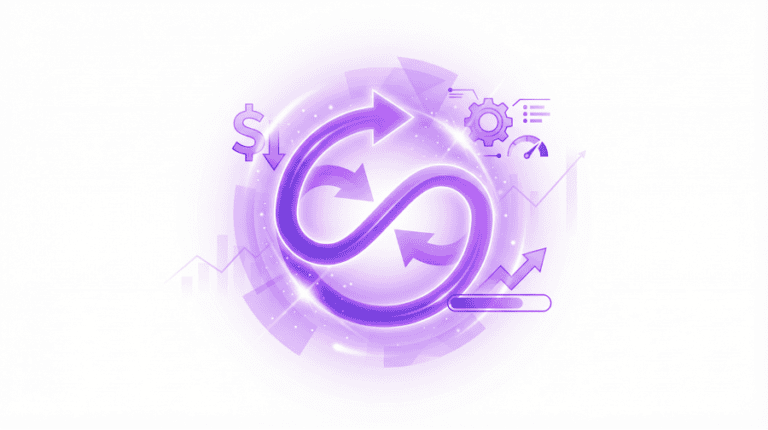
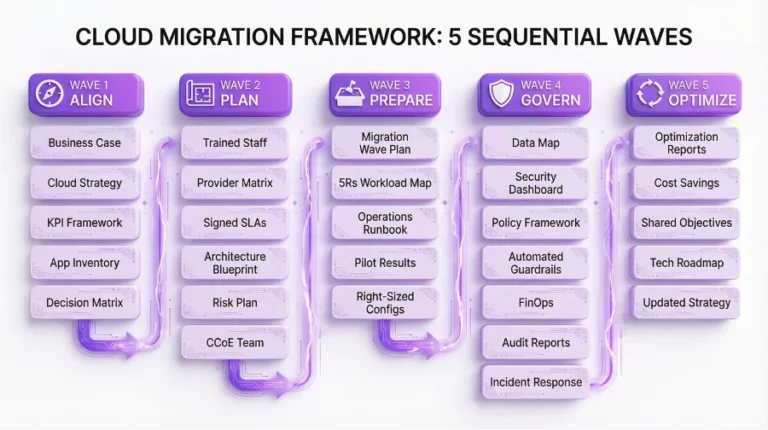
Cloud migration is not a one-time project with a finish line. It is the beginning of a new operating model—one that thrives on continuous improvement. In fact, you could say it’s a journey to continuous value, which is epitomized in Wave 5: Optimize & Scale. This is the final, ongoing wave where you transition from a migration-focused mindset to a value-focused one. This is where you realize the full promise of the cloud: an agile, efficient, and innovative engine for business growth.
This wave is a continuous cycle of analyzing, optimizing, and innovating. It ensures that your cloud environment doesn’t just run; it evolves. It gets smarter, faster, and more cost-effective over time, creating a powerful feedback loop that feeds directly back into your business strategy.
Step 1: Analyze Performance and Usage
You cannot optimize what you cannot measure. This step involves leveraging the rich monitoring and observability tools available in the cloud to gain deep insights into your environment. It’s about moving beyond simple uptime metrics to analyze:
Application Performance: Are your applications meeting their performance targets? Where are the bottlenecks?
Resource Utilization: Are your instances right-sized? Are you paying for idle resources?
Usage Patterns: How are users interacting with your applications? When are your peak and off-peak hours?
Through this analysis within the journey to optimize and scale, captured in Optimization Reports, provides the data-driven foundation for all subsequent optimization efforts.
Step 2: Implement Cost and Performance Optimization
Armed with data, you can now begin the work of optimization. This is a continuous process, not a one-off task. It involves a combination of technical and financial levers:
Right-Sizing: Adjusting instance sizes to match the actual performance needs of the application.
Autoscaling: Automatically scaling resources up or down to meet demand, ensuring you only pay for what you need.
Reserved Instances/Savings Plans: Committing to long-term usage in exchange for significant discounts.
Storage Tiering: Moving infrequently accessed data to lower-cost storage tiers.
These efforts along your journey to scale and optimize value, driven by your FinOps team, lead to Realized Savings and improved performance.
Step 3: Foster a Culture of Collaboration
Optimization is a team sport. This step is about breaking down the silos between development, operations, and finance. By providing shared dashboards and common goals (shared objectives), you empower teams to take ownership of their cloud consumption. When developers can see the cost implications of their code in real-time, they are incentivized to build more efficient applications. This collaborative culture is integral to the journey of continuous value.
Step 4: Evaluate and Adopt Emerging Technologies
The cloud is constantly evolving. New services and capabilities are released every day. This step involves creating a formal process for evaluating and adopting these emerging technologies. Your CCoE should continuously scan the horizon for new tools—like serverless, containers, AI/ML platforms, and edge computing—that could deliver a competitive advantage. Adopting these advances complements Wave 5’s goal to optimize and scale, resulting in an updated Technology Roadmap that keeps your architecture modern and effective.
Step 5: Iterate on the Cloud Strategy
Finally, the insights gained from this entire wave—from performance analysis to technology evaluation—are used to iterate on your core cloud strategy. The cloud is not a static destination. As your business changes, your cloud strategy must change with it. Optimizing and scaling in step five further enhances the journey to continuous value. The Updated Strategy from this step becomes the direct input for a new cycle of Wave 1: Align Objectives.
This is the self-improving feedback loop that makes the cloud so powerful. It transforms your IT organization from a cost center into a strategic enabler of business innovation, ensuring your cloud journey delivers ever-increasing value over time.
Azure CAF & Cloud Migration 14th Jan 2026Martin-Peter Lambert
Wave 4: Establish Governance – Enabling Speed with Safety
As you begin to scale your cloud presence, the complexity of managing it grows exponentially. Without a strong governance framework, organizations often face a difficult choice: move fast and break things, or move slow and miss opportunities. Wave 4: Establish Governance – Enabling Speed with Safety is designed to eliminate this trade-off, allowing you to establish governance which ensures both speed and safety. It’s about creating a system of automated controls and clear policies that allow your teams to innovate with speed, while ensuring the entire environment remains secure, compliant, and cost-effective.
Effective governance is not about restricting access; it’s about providing a safe and efficient path forward, establishing governance while enabling speed and safety simultaneously. It’s the digital guardrails that keep your cloud journey on track.
Step 1: Implement Automated Guardrails
The cornerstone of modern cloud governance is automation. Instead of relying on manual reviews and approvals, you can codify your policies and enforce them automatically. These Automated Guardrails, often implemented using Infrastructure as Code (IaC) tools like Terraform or native cloud services, can:
Prevent the creation of non-compliant resources (e.g., publicly exposed storage buckets).
Ensure all resources are tagged correctly for cost allocation.
Automatically remediate common security misconfigurations.
This approach, known as Governance as Code, aligns with Wave 4’s focus on enabling speed without compromising safety.
Step 2: Define and Enforce Security Policies
Your security posture is only as strong as the policies that define it. This step involves creating a comprehensive set of Cloud Security Policies that cover every layer of the environment. This is not a one-size-fits-all exercise; policies must be tailored to your organization’s risk appetite and regulatory requirements. Key areas to cover include:
Identity and Access Management (IAM): Who can access what, and under what conditions?
Data Encryption: Ensuring data is encrypted both at rest and in transit.
Network Security: Defining firewall rules, network segmentation, and threat detection.
Incident Response: A clear plan for how to respond to a security event.
These policies should be centrally managed and automatically enforced by the guardrails you’ve built, enabling the governance wave to drive both speed and safety without missing opportunities.
Step 3: Establish Financial Governance (FinOps)
Cloud costs can spiral out of control without disciplined financial management. FinOps, or Cloud Financial Operations, is the practice of bringing financial accountability to the variable spend model of the cloud. This involves:
Cost Visibility: Creating dashboards that give teams real-time insight into their cloud spend.
Cost Allocation: Using a robust tagging strategy to allocate costs back to the appropriate business units or projects.
Cost Optimization: Continuously identifying and eliminating waste, such as idle resources or oversized instances.
A mature FinOps practice ensures financial governance that maximizes business value while enabling speed and ensuring safety.
Step 4: Automate Compliance and Auditing
For many organizations, especially those in regulated industries, proving compliance is a constant challenge. The cloud offers the opportunity to automate much of this process. By using specialized tools, you can continuously monitor your environment against hundreds of compliance controls (like CIS, NIST, PCI DSS, or HIPAA). This Automated Compliance Auditing provides real-time visibility into your compliance posture and dramatically simplifies the audit process, turning a weeks-long manual effort into an on-demand report.
By the end of Wave 4, you have built a well-governed cloud factory. You have the systems in place to manage risk, control costs, and ensure compliance without slowing down your developers. This robust governance framework naturally establishes speed with safety, providing confidence in cloud adoption.
Azure CAF & Cloud Migration 13th Jan 2026Martin-Peter Lambert
Wave 3: Prepare for Execution – De-Risking the Migration
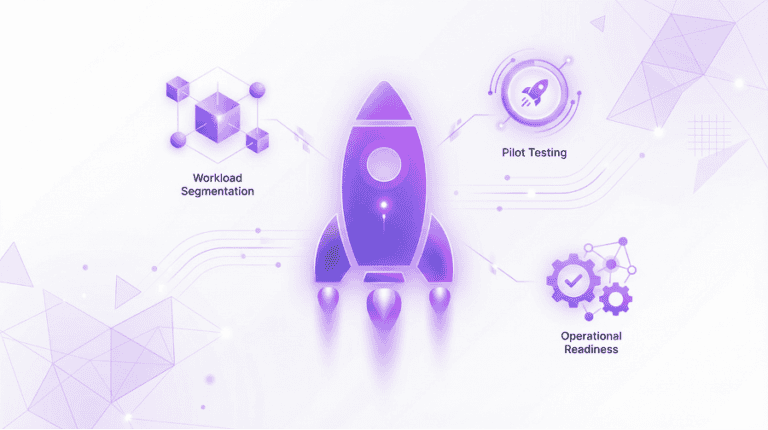
After meticulous planning in the first two waves, Wave 3: Prepare for Execution – De-Risking the Migration is where the rubber meets the road. This is the final stage of preparation before the full-scale migration begins. The primary goal of this wave is to de-risk the process by testing your assumptions, refining your methods, and ensuring your team and environment are fully prepared for the transition.
Think of this as the final dress rehearsal. Wave 3: Prepare for Execution – De-Risking the Migration offers your opportunity to identify and resolve potential issues in a controlled environment, rather than in the middle of a critical production migration. This wave is all about building confidence and momentum.
Step 1: Establish the Landing Zone
The first and most critical step is to build out the Landing Zone designed in Wave 2. This is your secure, compliant, and production-ready cloud environment. It’s a pre-configured space with all the necessary accounts, networking, security policies, and identity management controls in place. Deploying a well-architected landing zone from the start prevents costly and complex rework later on. It ensures that all future workloads are deployed into an environment that is secure and governed by default, all vital for Wave 3: Prepare for Execution – De-Risking the Migration.
Step 2: Select and Execute a Pilot Migration
With the landing zone in place, it’s time to test your migration process with a Pilot Migration. The pilot should involve a small number of low-risk, non-critical applications. The goal is not just to move the applications, but to validate the entire process, including:
Migration Tools: Are the selected tools performing as expected?
Team Skills: Can the team execute the migration playbook effectively?
Operational Readiness: Are your monitoring, logging, and incident response procedures working in the new environment?
The lessons learned from the pilot are captured in a Pilot Retrospective Report, which is used to refine the migration plan before proceeding.
Step 3: Refine the Migration Plan with the 5Rs
The application inventory from Wave 1 provides the list of what to move, but the 5Rs framework (also known as the 6Rs, including Retire) dictates how each application will move. Based on the pilot results and a deeper analysis, you will now finalize the migration strategy for each application:
Rehost (Lift and Shift): Move the application as-is to an Infrastructure-as-a-Service (IaaS) platform. Fastest, but least optimized.
Revise (Re-platform): Make minor modifications to take advantage of cloud services, like moving from a self-managed database to a managed database service (PaaS).
Rearchitect: Fundamentally change the application’s architecture to be cloud-native, often by moving to microservices.
Rebuild: Decommission the existing application and build a new one from scratch on a cloud-native platform.
Replace: Discard the application entirely and move to a Software-as-a-Service (SaaS) solution.
This Finalized Migration Plan details the chosen “R” for each application and the justification for the decision. Integral to this is understanding Wave 3: Prepare for Execution – De-Risking the Migration requirements.
Step 4: Finalize the Business & Operational Readiness Plan
Technical readiness is only half the battle. This step ensures the business is prepared for the change. The Operational Readiness Plan confirms that support teams are trained, runbooks are updated, and communication plans are in place to manage any potential disruption. It ensures that once an application is migrated, the business knows how to support it, and users know what to expect.
By completing Wave 3, you have replaced uncertainty with proven experience. You have a battle-tested migration process, a team that has successfully executed it, and a production-ready environment. You are now prepared to begin the full-scale migration with the highest possible chance of success, entirely aligned with Wave 3: Prepare for Execution – De-Risking the Migration.
Azure CAF & Cloud Migration 12th Jan 2026Martin-Peter Lambert
Wave 2: Develop Plan of Action – From Strategy to Blueprint
With the strategic foundation set in Wave 1, it’s time to translate your “why” into a concrete “how.” Wave 2: Develop Plan of Action – From Strategy to Blueprint is where the high-level vision transforms into an actionable blueprint. This is the master plan for your migration, detailing the partners, skills, and architecture required for a successful journey. Skipping this wave is like starting a cross-country road trip with no map, no driver, and no car.
This wave is about making critical decisions that will shape the technical and financial realities of your cloud environment for years to come. It ensures you have the right team, the right partners, and the right design before you begin the heavy lifting of migration.
Step 1: Select Cloud Vendors & Partners
Choosing a cloud provider is one of the most significant decisions in the entire process. This step leverages the Decision Matrix from Wave 1 to objectively evaluate the major cloud platforms (like AWS, Azure, and Google Cloud) against your specific business and technical requirements. Key evaluation criteria include:
Service Offerings: Do their services match your needs for compute, data, AI/ML, etc.?
Cost Model: How does their pricing structure align with your financial projections?
Compliance & Security: Can they meet your industry-specific regulatory requirements?
Ecosystem & Support: How strong is their partner network and enterprise support?
The output is a Vendor Selection Document that justifies your choice and outlines the partnership model.
Step 2: Build a Cloud Center of Excellence (CCoE)
A successful cloud program is not an IT-only initiative; it’s a company-wide transformation. The Cloud Center of Excellence (CCoE) is the cross-functional team responsible for leading this change. This is your core team of cloud champions, comprised of individuals from:
IT/Operations: To manage infrastructure and reliability.
Security: To embed security into every stage.
Finance (FinOps): To ensure financial accountability and cost optimization.
Application Development: To guide cloud-native development practices.
This team will create the CCoE Charter, defining their roles, responsibilities, and governance model.
Step 3: Design the Target Architecture
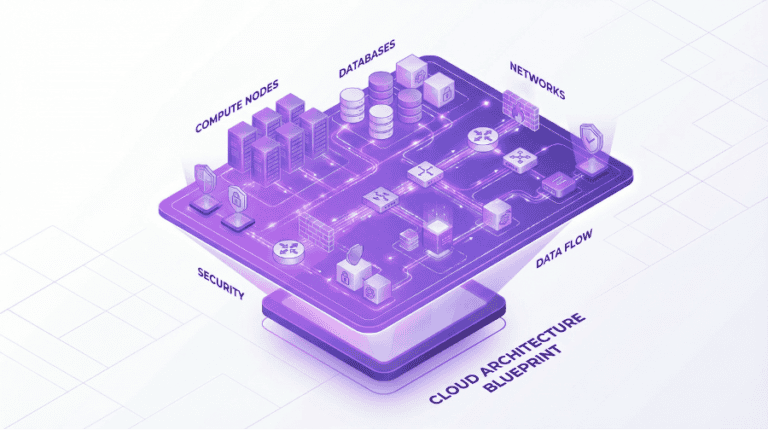
This is where the architectural vision comes to life. Based on the application portfolio analysis and vendor selection, your team will design the high-level Target Architecture. This blueprint defines how your applications will run in the cloud. It includes designing the landing zone—a pre-configured, secure, and scalable environment where you can deploy your workloads. This design must account for networking, identity and access management, security controls, and operational monitoring.
Step 4: Develop the Migration Roadmap
With the architecture defined, you can now create a detailed Migration Roadmap. This isn’t a simple list of applications; it’s a strategic plan that sequences the migration in logical waves or phases. The roadmap prioritizes applications based on business impact, technical feasibility, and dependencies. It outlines which applications will be migrated when, using which of the 5Rs strategies, and defines the expected timeline and resource requirements for each phase.
Step 5: Create the Skills Development Plan
Your existing team may not have all the skills required to operate effectively in the cloud. This step involves conducting a skills gap analysis and creating a comprehensive Skills Development Plan. This plan outlines the training, certification, and hiring strategies needed to build the necessary cloud competencies within your organization. Investing in your people is just as critical as investing in the technology.
By the end of Wave 2, you have a complete flight plan. You know who your partners are, who is on the team, what the destination looks like, how you’re going to get there, and that your crew is trained for the journey. This detailed preparation is what separates a smooth, predictable migration from a turbulent, costly one.
AI In The Public Sector, Azure CAF & Cloud Migration, Resilience, Sovereignty Series 12th Jan 2026Martin-Peter Lambert
Stop Git Impersonation, Strengthen Supply Chain Security, Meet US & EU Compliance
If you build software professionally, you don’t just need secure code—you need verifiable proof of who changed it and whether it was altered before release. Code Signing & Signed Commits play a crucial role in preventing Git impersonation and meeting US/EU compliance requirements such as NIS2, GDPR, and CRA. That’s why code signing (including Git signed commits) has become a baseline control for software supply chain security, DevSecOps, and compliance.
It also directly addresses a common risk: a developer (or attacker) committing code while pretending to be someone else. With unsigned commits, names and emails can be faked. With signed commits, identity becomes cryptographically verifiable.
This matters even more if you operate in the US and Europe, where cybersecurity requirements increasingly expect strong controls—and where the EU, in particular, attaches explicit, high penalties for non-compliance (NIS2, GDPR, and the Cyber Resilience Act). (EUR-Lex)
What is “code signing” (and what customers actually mean by it)?
In industry conversations, code signing usually means a chain of trust across your entire delivery pipeline:
Signed commits (Git commit signing): proves the author/committer identity for each change
Signed tags / signed releases: proves a release point (e.g., v2.7.0) wasn’t forged
Signed build artifacts: proves your binaries, containers, and packages weren’t tampered with
Signed provenance / attestations: proves what source + CI/CD pipeline produced the artifact (a growing expectation in supply chain security programs)
The goal is simple: integrity + identity + traceability from developer laptop to production.
Why signed commits prevent “commit impersonation”
Without signing, Git identity is just text. Anyone can set an author name/email to match a colleague and push code that looks legitimate.
Signed commits add a cryptographic signature that platforms can verify. When you enforce signed commits (especially on protected branches):
fake author names don’t pass verification
only commits signed by trusted keys are accepted
auditors and incident responders get a reliable attribution trail
In other words: Git commit signing is one of the cleanest ways to prevent developers (or attackers) from committing as someone else.
Code Signing = Better Security + Cleaner Audits
Customers in regulated industries (finance, critical infrastructure, healthcare, manufacturing, government vendors) frequently search for:
“software supply chain security”
“CI/CD security controls”
“secure SDLC evidence”
“audit trail for code changes”
Code signing helps because it creates durable evidence for:
change control (who changed what)
integrity (tamper-evidence)
accountability (strong attribution)
faster incident response and forensics
That’s why code signing is often positioned as a compliance accelerator: it reduces the cost and friction of proving good practices.
US Compliance View: Why Code Signing Supports Federal and Enterprise Security Requirements
In the US, the big push is secure software development and software supply chain assurance—especially for vendors selling into government and regulated sectors.
Executive Order 14028 + software attestations
Executive Order 14028 drove major follow-on guidance around supply chain security and secure software development expectations. (NIST) OMB guidance (including updates like M-23-16) establishes timelines and expectations for collecting secure software development attestations from software producers. (The White House) Procurement artifacts like the GSA secure software development attestation reflect this direction in practice. (gsa.gov)
NIST SSDF (SP 800-218) as the common language
Many organizations align their secure SDLC programs to the NIST Secure Software Development Framework (SSDF). (csrc.nist.gov)
Where code signing fits: it’s a practical control that supports identity, integrity, and traceability—exactly the kinds of things customers and auditors ask for when validating secure development practices.
(In the US, the “penalty” is often commercial: failed vendor security reviews, procurement blockers, contract risk, and higher liability after an incident—especially if your controls can’t be evidenced.)
EU Compliance View: NIS2, GDPR, and the Cyber Resilience Act (CRA) Penalties
Europe is where penalties become very concrete—and where customers increasingly ask vendors about NIS2 compliance, GDPR security, and Cyber Resilience Act compliance.
NIS2 penalties (explicit fines)
NIS2 includes an administrative fine framework that can reach:
Essential entities: up to €10,000,000 or 2% of worldwide annual turnover (whichever is higher)
Important entities: up to €7,000,000 or 1.4% of worldwide annual turnover (whichever is higher) (EUR-Lex)
Why code signing matters for NIS2 readiness: it supports strong controls around integrity, accountability, and change management—key building blocks for cybersecurity governance in professional environments.
GDPR penalties (security failures can get expensive fast)
GDPR allows administrative fines up to €20,000,000 or 4% of global annual turnover (whichever is higher) for certain serious infringements. (GDPR)
Code signing doesn’t “solve GDPR,” but it reduces the risk of supply-chain compromise and improves your ability to demonstrate security controls and traceability after an incident.
Cyber Resilience Act (CRA) penalties + timelines
The CRA (Regulation (EU) 2024/2847) introduces horizontal cybersecurity requirements for products with digital elements. Its penalty article states that certain non-compliance can be fined up to:
€15,000,000 or 2.5% worldwide annual turnover (whichever is higher), and other tiers including
€10,000,000 or 2%, and €5,000,000 or 1% depending on the type of breach. (EUR-Lex)
Timing also matters: the CRA applies from 11 December 2027, with earlier dates for specific obligations (e.g., some reporting obligations from 11 September 2026 and some provisions from 11 June 2026). (EUR-Lex)
For vendors, this translates into a customer question you should expect to hear more often:
“How do you prove the integrity and origin of what you ship?”
Your best answer includes code signing + signed releases + signed artifacts + verifiable provenance.
Implementation Checklist: Code Signing Best Practices (Practical + Auditable)
If you want code signing that actually holds up in audits and real incidents, implement it as a system—not a developer “nice-to-have”.
1) Enforce Git signed commits
Require signed commits on protected branches (main, release/*)
Block merges if commits are not verified
Require signed tags for releases
2) Secure developer signing keys
Prefer hardware-backed keys (or secure enclaves)
Require MFA/SSO on developer accounts
Rotate keys and remove trust when people change roles or leave
3) Sign what you ship (artifact signing)
Sign containers, packages, and binaries
Verify signatures in CI/CD and at deploy time
4) Add provenance (supply chain proof)
Produce build attestations/provenance so you can prove which pipeline built which artifact from which source
FAQ (high-intent keywords customers search)
Is Git commit signing the same as code signing? Git commit signing proves identity and integrity at the source-control level. Code signing often also includes release and artifact signing for what you ship.
Does signed commits stop a compromised developer laptop? It helps with attribution and tamper-evidence, but you still need endpoint security, key protection, least privilege, reviews, and CI/CD hardening.
What’s the business value? Less impersonation risk, stronger software supply chain security, faster audits, clearer incident response, and a better compliance posture for US and EU customers.
Takeaway
If you sell software into regulated or security-sensitive markets, code signing and signed commits are no longer optional. They directly prevent commit impersonation, strengthen software supply chain security, and support compliance conversations—especially in the EU where NIS2, GDPR, and CRA penalties can be severe. (EUR-Lex)
If you want, I can also provide:
an SEO-focused FAQ expansion (10–15 more questions),
a one-page “Code Signing Policy” template,
or platform-specific enforcement steps (GitHub / GitLab / Azure DevOps / Bitbucket) written in a customer-friendly way.
Azure CAF & Cloud Migration 9th Jan 2026Martin-Peter Lambert
Wave 1: Align Objectives – The Foundation of Cloud Success
In the race to the cloud, many organizations stumble before they even start. Wave 1: Align Objectives – The Foundation of Cloud Success is crucial in avoiding the “Implement to Fail” trap. They fall into this trap, mesmerized by the promise of new technology without a clear understanding of the business value they aim to achieve. According to Gartner, migrations that skip the crucial pre-work of strategy and planning are far more likely to fail, resulting in budget overruns, security vulnerabilities, and a solution that doesn’t meet business needs [1].
Wave 1: Align Objectives is the antidote to this common pitfall. It’s a disciplined, five-step process designed to build a rock-solid business case and a unified vision for your cloud journey. This foundational wave ensures that every subsequent action is tied to a measurable business outcome.
Step 1: Assess Business Drivers & Create the Business Case
Before a single server is provisioned, you must answer the fundamental question: “Why are we doing this?” Is it to increase agility, reduce operational costs, accelerate innovation, or enhance security? The answer is rarely just one of these. This step involves engaging with stakeholders across the business—from finance to marketing to operations—to build a comprehensive Business Case Document.
This isn’t about technology for technology’s sake. It’s about translating technical capabilities into tangible business value. A strong business case becomes your North Star, guiding decisions throughout the migration.
Step 2: Define the Cloud Vision & Strategy
With a clear “why,” you can now define the “what.” The Cloud Strategy Document outlines the high-level vision for your cloud adoption. Will you be cloud-first? Multi-cloud? Hybrid? This document sets the guiding principles for your entire program. It defines the desired end-state and articulates how the cloud will function as an enabler of your broader business strategy.
Step 3: Establish Success Metrics (KPIs)
How will you know if you’ve succeeded? A vision without metrics is just a dream. This step is about defining the Key Performance Indicators (KPIs) that will measure the success of your migration against the business drivers identified in Step 1. A robust KPI Framework should include metrics across several domains:
Financial: Cloud spend vs. budget, Total Cost of Ownership (TCO) reduction.
Business: Time-to-market for new features, customer satisfaction scores.
Step 4: Analyze the Application Portfolio
Not all applications are created equal, and not all of them belong in the cloud. This step involves a thorough analysis of your existing applications to determine their suitability for migration. The result is a detailed Application Inventory that categorizes applications based on their business value, technical complexity, and interdependencies. This inventory is the primary input for the 5Rs analysis (Rehost, Revise, Rearchitect, Rebuild, Replace) that occurs in Wave 3.
Step 5: Craft Decision Principles
Finally, to ensure consistency and speed in decision-making, Wave 1 concludes with the creation of a Decision Matrix. This framework provides a clear, agreed-upon set of principles for making key choices throughout the migration. It answers questions like:
How will we select a primary cloud vendor?
What are our security and compliance non-negotiables?
How do we prioritize which applications to migrate first?
By the end of Wave 1, you don’t just have a plan; you have a coalition. You have a shared understanding of the value, a clear vision for the future, and a framework for making sound decisions. This alignment is the single most important factor in de-risking your cloud migration and ensuring it delivers lasting value.
References
[1] Gartner, “IT Roadmap for Cloud Migration,” Gartner, Accessed Jan 08, 2026.
Azure CAF & Cloud Migration 8th Jan 2026Martin-Peter Lambert
Stop searching, Start Finding
The cloud is not a destination; it’s a new way of operating. Yet too many organizations treat cloud migration like a frantic relocation. They pack up their old problems and race to a new address. Unfortunately, they find themselves in a more expensive and complex mess than the one they left behind. Utilizing the Cloud Adoption Framework in Practice (CAF-Roadmap) can prevent them from falling victim to the “Implement to Fail” trap—a costly, chaotic cycle born from a single, critical mistake. They skip the pre-work. Thus, the Cloud Adoption Framework in Practice (CAF-Roadmap) becomes vital in managing this transition effectively.
According to Gartner, the leading cause of migration failure isn’t technology; it’s a lack of strategy. Rushing into the cloud without a clear plan is like setting sail without a map. You also need a compass or a crew. Otherwise, you’re adrift in a sea of complexity. This leaves you vulnerable to budget overruns, security breaches, and a disconnect between technical effort and business value. Utilizing the Cloud Adoption Framework in Practice (CAF-Roadmap) is essential to navigate these challenges.
The Antidote: A Disciplined, Five-Wave Framework
There is a better way. A successful cloud journey is not a mad dash; it’s a disciplined, strategic progression. It’s about building a solid foundation before you lay the first brick. To demystify this process, we’ve structured the entire journey into a Five-Wave Framework. This is a proven methodology that transforms a complex migration into manageable, value-driven stages, as outlined in the Cloud Adoption Framework in Practice (CAF-Roadmap) to ensure seamless progress.
This framework is your roadmap to success. Each wave builds upon the last, creating a chain of outputs. These outputs become the inputs for the next stage. This ensures that every action is deliberate. Every decision is informed, and every dollar spent is tied to a measurable business outcome, as guided by the Cloud Adoption Framework in Practice (CAF-Roadmap).
Why This Framework Matters
In our upcoming five-part series, we will dive deep into each of these waves, providing a detailed blueprint for you to follow. You will learn:
Wave 1: Align – How to build an undeniable business case and forge a unified vision, supported by the Cloud Adoption Framework in Practice (CAF-Roadmap).
Wave 2: Plan – How to choose the right partners, design your architecture, and train your team.
Wave 3: Prepare – How to de-risk your migration with a pilot and finalize your execution plan.
Wave 4: Govern – How to enable speed with safety through automated guardrails and financial controls, following Cloud Adoption Framework in Practice (CAF-Roadmap) guidelines.
Wave 5: Optimize – How to turn your cloud environment into a self-improving engine of continuous value.
By investing the time upfront in Waves 1 and 2, you don’t just avoid failure; you build the foundation for profound success. You ensure that when you move to the cloud, you don’t just show up—you arrive prepared, confident, and ready to win, utilizing the Cloud Adoption Framework in Practice (CAF-Roadmap).
Join us as we unpack this framework, wave by wave, and learn how to make your cloud migration a strategic triumph with the Cloud Adoption Framework in Practice (CAF-Roadmap).
Cloud Migration Strategy, Cloud Adoption Framework, IT Strategy, Digital Transformation, Cloud Governance, FinOps, Cloud Center of Excellence (CCoE), Gartner Cloud, Migration Planning, Cloud ROI, Application Portfolio Management, Cloud Best Practices
Azure Cloud Adoption Framework: A Structured Approach to Cloud Success
Azure CAF & Cloud Migration 27th Oct 2025Martin-Peter Lambert
Azure Cloud Adoption Framework: A Structured Approach to Cloud Success
The Microsoft Azure Cloud Adoption Framework (CAF) is a comprehensive methodology designed to guide organizations through their cloud adoption journey. It encompasses best practices, tools, and documentation to align business and technical strategies, ensuring seamless migration and innovation in the cloud. The framework is structured into eight interconnected phases: Strategy, Plan, Ready, Migrate, Innovate, Govern, Manage, and Secure. Each phase addresses specific aspects of cloud adoption, enabling organizations to achieve their desired business outcomes effectively.
The Strategy phase focuses on defining business justifications and expected outcomes for cloud adoption. In the Plan phase, actionable steps are aligned with business goals. The Ready phase ensures that the cloud environment is prepared for planned changes by setting up foundational infrastructure. The Migrate phase involves transferring workloads to Azure while modernizing them for optimal performance.
Innovation is at the heart of the Innovate phase, where organizations develop new cloud-native or hybrid solutions. The Govern phase establishes guardrails to manage risks and ensure compliance with organizational policies. The Manage phase focuses on operational excellence by maintaining cloud resources efficiently. Finally, the Secure phase emphasizes enhancing security measures to protect data and workloads over time.
This structured approach empowers organizations to navigate the complexities of cloud adoption while maximizing their Azure investments. The Azure CAF is suitable for businesses at any stage of their cloud journey, providing a robust roadmap for achieving scalability, efficiency, and innovation.
Below is a visual representation of the Azure Cloud Adoption Framework lifecycle:
The diagram illustrates the eight phases of the framework as a continuous cycle, emphasizing their interconnectivity and iterative nature. By following this proven methodology, organizations can confidently adopt Azure’s capabilities to drive business transformation.
What is Azure Cloud Adoption Framework (CAF):
The Azure Cloud Adoption Framework (CAF) is a comprehensive, industry-recognized methodology developed by Microsoft to streamline an organization’s journey to the cloud. It provides a structured approach, combining best practices, tools, and documentation to help organizations align their business and technical strategies while adopting Azure cloud services. The framework is designed to address every phase of the cloud adoption lifecycle, including strategy, planning, readiness, migration, innovation, governance, management, and security.
CAF enables businesses to define clear goals for cloud adoption, mitigate risks, optimize costs, and ensure compliance with organizational policies. By offering actionable guidance and templates such as governance benchmarks and architecture reviews, it simplifies the complexities of cloud adoption.
How Can Azure CAF Help Companies
Azure CAF provides several key benefits to organizations:
Business Alignment: It ensures that cloud adoption strategies are aligned with broader business objectives for long-term success.
Risk Mitigation: The framework includes tools and methodologies to identify and address potential risks during the migration process.
Cost Optimization: CAF offers insights into resource management and cost control to prevent overspending on cloud services.
Enhanced Governance: It establishes robust governance frameworks to maintain compliance and operational integrity.
Innovation Enablement: By leveraging cloud-native technologies, companies can innovate faster and modernize their IT infrastructure effectively.
How Insight 42 Can Help You Onboard to Azure CAF
At AMCA, we specialize in making your transition to Azure seamless by leveraging the Azure Cloud Adoption Framework. Here’s how we can assist:
Customized Strategy Development: We work with your team to define clear business goals and create a tailored cloud adoption strategy.
Comprehensive Planning: Our experts design detailed migration roadmaps while addressing compliance and security requirements.
End-to-End Support: From preparing your environment to migrating workloads and optimizing operations, we ensure a smooth transition.
Governance & Cost Management: We implement robust governance policies and provide cost optimization strategies for efficient resource utilization.
Continuous Monitoring & Innovation: Post-migration, AMCA offers ongoing support to manage workloads and foster innovation using Azure’s advanced capabilities.
With AMCA as your partner, you can confidently adopt Azure CAF while minimizing risks and maximizing returns on your cloud investment. Let us guide you through every step of your cloud journey.
To provide the best experiences, we use technologies like cookies to store and/or access device information. Consenting to these technologies will allow us to process data such as browsing behavior or unique IDs on this site. Not consenting or withdrawing consent, may adversely affect certain features and functions.
Functional
Always active
The technical storage or access is strictly necessary for the legitimate purpose of enabling the use of a specific service explicitly requested by the subscriber or user, or for the sole purpose of carrying out the transmission of a communication over an electronic communications network.
Preferences
The technical storage or access is necessary for the legitimate purpose of storing preferences that are not requested by the subscriber or user.
Statistics
The technical storage or access that is used exclusively for statistical purposes.The technical storage or access that is used exclusively for anonymous statistical purposes. Without a subpoena, voluntary compliance on the part of your Internet Service Provider, or additional records from a third party, information stored or retrieved for this purpose alone cannot usually be used to identify you.
Marketing
The technical storage or access is required to create user profiles to send advertising, or to track the user on a website or across several websites for similar marketing purposes.