BSI C5 Cloud Certification

Resilience, SECURITY, Sovereignty Series 20th Feb 2026 Martin-Peter Lambert
BSI C5 Cloud Certification

A Guide for Public Authorities

Meta Description: BSI C5 Cloud certification for the public sector. Audit readiness, compliance requirements, and the BSI-compliant cloud security concept.

What is BSI C5?

BSI C5 is the German standard for cloud security, developed by the Federal Office for Information Security (BSI). It defines minimum requirements for cloud services and is often mandatory for the public sector.

Is cloud migration for the public sector possible without BSI C5? It’s risky. Tenders for cloud migration usually demand it, and the procurement process for cloud service providers verifies the certification.

The Structure of BSI C5

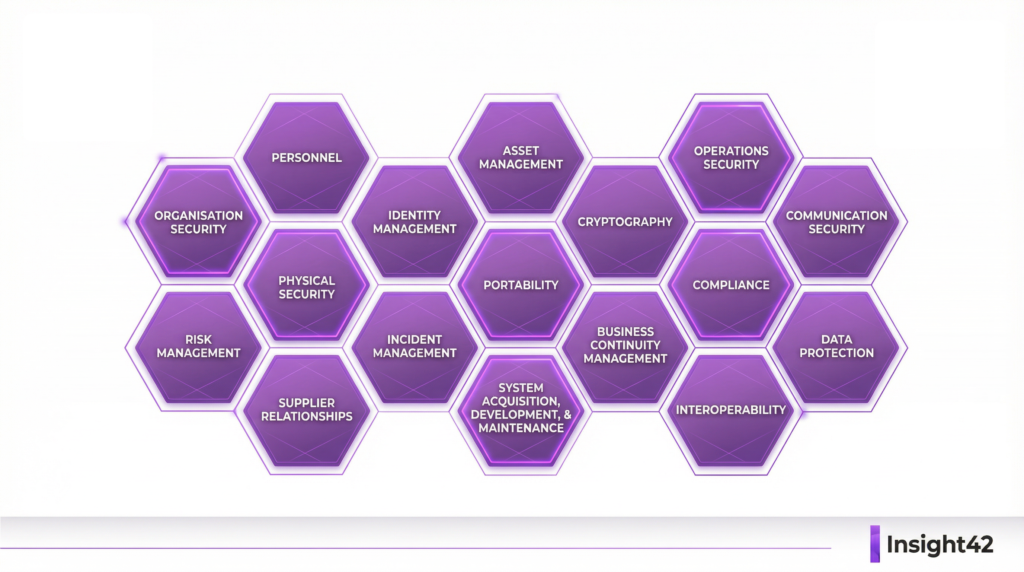
BSI C5 comprises 17 requirement domains, from organization to incident management. Each domain contains specific controls that must be demonstrated.

The 17 Domains at a Glance:

Information Security Organization, Security Policies, Human Resources, Asset Management, Physical Security, Operations Security, Identity and Access Management, Cryptography, Communication Security, Portability and Interoperability, Procurement and Development, Supplier Relationships, Security Incident Management, Compliance, Data Protection, Product Security, Interoperability.

Type 1 vs. Type 2 Attestation

BSI C5 has two attestation types, and the difference is important.

Type 1 Attestation

This assesses the appropriateness of the controls at a specific point in time.
– Are the controls designed?
– Are they implemented?

Type 2 Attestation

This assesses the effectiveness of the controls over a period of at least six months.
– Do the controls work?
– Are they being followed?

For public authorities, a Type 2 attestation is usually required. It offers more security and demonstrates continuous compliance.

Quick Checklist: BSI C5 Readiness

DomainCheckpointStatus
OrganizationISMS Established
PoliciesSecurity Policies Documented
PersonnelAwareness Training Conducted
AssetsInventory Complete
AccessIAM Implemented
CryptographyEncryption Active
LoggingLogging Enabled
IncidentProcess Defined

To-Do List for BSI C5 Certification

  1. Month 1: Conduct a gap analysis.
  2. Month 2: Create an action plan.
  3. Months 3-6: Implement controls.
  4. Month 7: Perform an internal audit.
  5. Month 8: Conduct an external pre-audit.
  6. Months 9-10: Undergo the Type 1 audit.
  7. Months 11-16: Operational phase.
  8. Month 17: Undergo the Type 2 audit.

The Path to Attestation

Becoming BSI C5 compliant is a project. It requires planning, resources, and expertise.

Step 1: Gap Analysis

Where do you stand today? Which controls are missing? IT baseline protection consulting helps with the assessment. The gap analysis shows the way forward.

Step 2: Action Planning

  • What measures are necessary?
  • In what order? With what budget?
  • The action plan is created and when is it due?

Step 3: Implementation

  • Controls are introduced
  • Processes are established
  • Documentation is created
  • The BSI-compliant cloud security concept is developed

Step 4: Audit

An auditor conducts the review. The controls are tested. Evidence is collected. The attestation is issued.

Cloud Providers and BSI C5

Major cloud providers like Azure, GCP, and AWS have BSI C5 attestations. But that’s not enough to claim that using them makes you compliant—quite the opposite. Because of the shared responsibility model, you still need to implement the right controls and operate them correctly. Only then can you be C5-compliant.

Azure migration and GCP migration must consider BSI C5. An Azure Landing Zone and a GCP Landing Zone should incorporate BSI C5 controls. The Cloud Adoption Framework for Azure helps with this.

Insight42 BSI C5 Services

We guide public authorities to BSI C5 compliance, from gap analysis to the audit. By provide the BSI-compliant cloud security concept from a single source and the implementation of those, we make your life easy, compliant and reliable.

Our cloud consulting services for authorities with a BSI C5 focus and cloud managed services for continuous compliance are delivered on Critical (KRITIS) level and have been withstanding audits and security challenges.

Become BSI C5 compliant. Contact us.

Figure: The Path to BSI C5 Certification

Blog Post 2: Preparing for a BSI C5 Audit – Practical Tips for the Public Sector

Meta Description: BSI C5 audit preparation for public authorities. Practical tips, documentation, and evidence collection. Create a BSI-compliant cloud security concept.

The Audit is Approaching

You have decided on BSI C5. Implementation is underway. Now comes the audit. How do you prepare? What can you expect?

BSI C5 audits are thorough. Auditors want to see evidence, not just documents, but also established practices. This article prepares you.

Documentation is Everything

No attestation without documentation. Auditors can only audit what is documented. Every control needs evidence. Every process needs a description.

What must be documented:
Security policies and their approval, process descriptions with responsibilities, configuration standards and their implementation, employee training records, and logs as proof.

The Most Common Audit Findings

Preparation also means avoiding mistakes. These findings are common:

Incomplete Documentation

Controls exist but are not documented, or the documentation is outdated. Solution: Keep documentation current by automising it via IT, BI & AI. We do that all the time, ensuring reality and documentation are always in sync.

Missing Evidence

Processes are followed but not logged.
Solution: Enable logging and recording.

Inconsistent Implementation

Policies exist but are not followed.
Solution: Conduct regular internal audits.

Unclear Responsibilities

No one feels responsible. Solution: Create a RACI matrix.

Quick Checklist: Audit Preparation

DocumentContentCurrent?
ISMS ManualOverall Security Overview
Security PoliciesAll Policies
Risk AnalysisCurrent Assessment
Asset RegisterComplete Inventory
Access MatrixPermissions Documented
Incident LogIncidents Logged
Training RecordsAll Employees
Audit TrailChanges Traceable

To-Do List for Audit Readiness

  • 8 weeks prior: Fully review documentation.
  • 6 weeks prior: Conduct an internal pre-audit.
  • 4 weeks prior: Remediate findings.
  • 2 weeks prior: Compile evidence.
  • 1 week prior: Brief interview partners.
  • Audit Day: Stay calm, cooperate.
  • After Audit: Remediate findings promptly.

The BSI-Compliant Cloud Security Concept

The security concept is the centerpiece. It comprehensively describes your cloud security. Auditors will read it carefully.

Contents of the Security Concept:

Scope and demarcation of cloud use, risk analysis and assessment, technical and organizational measures, responsibilities and processes, and emergency and business continuity management.

IT baseline protection consulting helps with its creation. ISO 27001 based on IT-Grundschutz provides the structure. The result: an audit-proof document.

Mastering Interviews

Auditors conduct interviews. They want to understand how controls are put into practice.
Preparation is of the utmost importance!

Continuous Compliance

BSI C5 is not a one-time project; it is a continuous process. After the audit is before the audit.

Cloud managed services for authorities help with this through continuous monitoring, regular reviews, and automated compliance checks.

Azure managed services and GCP operations provide support with dashboards showing compliance status and alerts for deviations.

Insight42 Audit Support

We guide you through the audit: preparation, execution, and follow-up, with experienced consultants by your side.

We create the BSI-compliant cloud security concept together. IT baseline protection consulting is our core business. BSI C5 compliance is our goal.

Pass your audit. Talk to us.

Figure: BSI C5 Audit Preparation Overview

#BSIC5 #CloudSecurity #Audit #Compliance #PublicSector #GovTech #SecurityConcept #ITBaselineProtection #CloudMigration #Certification #InfoSec #ISMS #CloudFirst #AzureMigration #GCPMigration #ManagedServices #DigitalTransformation #Cybersecurity #Insight42 #Germany

Insight42 – Cloud Migration & Security Consulting

www.insight42.de
Azure ExpressRoute for Public Authorities –

AI In The Public Sector, Resilience, Sovereignty Series 16th Feb 2026 Martin-Peter Lambert

A Secure Connection to the Cloud

Meta Description: Azure ExpressRoute setup for the public sector. Secure connectivity, BSI C5 compliant, and datacenter migration to Azure with a dedicated line.

Why ExpressRoute is Essential for Public Authorities

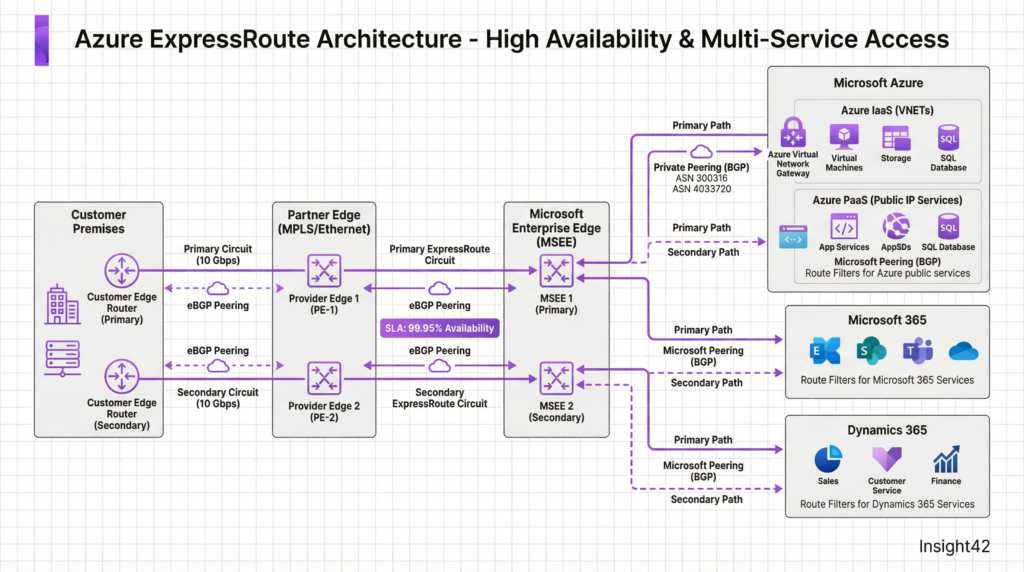
The public internet is not an option. Sensitive government data requires dedicated connections. An Azure ExpressRoute setup provides this security through private lines, guaranteed bandwidth, and low latency.

Cloud migration for the public sector demands reliable connectivity. A datacenter migration to Azure only works with a stable connection. ExpressRoute delivers both: security and performance.

What Azure ExpressRoute Offers

ExpressRoute is a private connection that completely bypasses the internet. Data flows over dedicated lines, with carrier partners providing the infrastructure.

For the public sector, this means BSI C5 cloud requirements are met. The BSI-compliant cloud security concept can point to secure connectivity, strengthening KRITIS cloud security.

Understanding the Architecture

ExpressRoute Circuit

The circuit is the physical connection linking your data center to Microsoft. Various bandwidths are available, from 50 Mbps to 100 Gbps.

Peering Types

Private Peering connects to Azure VNets, while Microsoft Peering reaches Microsoft 365. Both can be used in parallel.

Redundancy

High availability requires redundancy. Two circuits at different locations ensure automatic failover in case of an outage, meeting government SLAs.

Quick Checklist: ExpressRoute Setup

StepTaskResponsible
1Determine Bandwidth NeedsIT Department
2Select Carrier PartnerProcurement
3Order CircuitCarrier
4Configure AzureCloud Team
5Set Up RoutingNetwork Team
6Implement RedundancyCloud Team
7Activate MonitoringOperations

To-Do List for Secure Connectivity

  1. Today: Analyze current bandwidth usage.
  2. This Week: Research carrier options.
  3. This Month: Create the ExpressRoute design.
  4. Quarter 1: Commission the circuit.
  5. Quarter 2: Start migration over ExpressRoute.

Mastering Hybrid Scenarios

Not everything moves to the cloud at once. Hybrid architectures are a reality. ExpressRoute connects both worlds, allowing on-premises and Azure to work together.

A VMware to Azure migration particularly benefits, as large data volumes are transferred quickly. Replication runs in the background, and the cutover occurs without significant downtime.

Security at All Levels

ExpressRoute is secure by design, but additional measures are possible, such as encryption over the line and IPsec tunnels for extra protection.

IT baseline protection consulting recommends defense in depth. Multiple security layers, with ExpressRoute being one, are complemented by firewalls and segmentation.

Costs and Procurement

Azure ExpressRoute has two cost components: Microsoft charges for the circuit, and the carrier charges for the line. Both must be budgeted.

A cloud framework agreement can simplify procurement. A cloud migration tender should include connectivity. Cloud migration costs become transparent.

Insight42 Connectivity Services

We plan and implement ExpressRoute, from needs analysis to operation. Azure migration consulting includes connectivity.

Azure managed services monitor the connection with proactive monitoring and rapid response to issues, ensuring SLA-compliant operation.

Connect securely. Contact us.

Azure ExpressRoute Architecture

Figure: Azure ExpressRoute Architecture for Public Authorities

Blog Post 2: Multi-Cloud Connectivity – Combining ExpressRoute and Cloud Interconnect

Meta Description: Multi-cloud connectivity with Azure ExpressRoute and Google Cloud Interconnect. Secure connections for the federal multi-cloud strategy.

Multi-Cloud Needs Multi-Connectivity

The federal multi-cloud strategy is a reality. Azure and GCP are used in parallel. But how do you connect them securely? The answer: dedicated lines to both clouds.

Azure ExpressRoute for Microsoft and Google Cloud Interconnect for GCP. Both operate on similar principles and offer enterprise-grade security.

Understanding Google Cloud Interconnect

Cloud Interconnect is Google’s equivalent of ExpressRoute. Dedicated Interconnect provides physical connections, while Partner Interconnect uses carrier infrastructure.

Interconnect is crucial for GCP migration. Large data volumes must be transferred. GKE migration benefits from low latency. Google Cloud migration partners recommend dedicated connections.

The Architecture for Multi-Cloud

Central Network Hub

A hub connects everything: on-premises, Azure, and GCP. Routing is centrally controlled, and security is uniformly enforced.

ExpressRoute to the Azure Hub

Private Peering connects to Azure VNets. A hub-and-spoke topology distributes traffic. The Azure Landing Zone is the destination.

Interconnect to the GCP Hub

Use either Dedicated or Partner Interconnect. A Shared VPC receives the traffic. The GCP Landing Zone takes over.

Inter-Cloud Connection

Azure and GCP can also be connected directly through partner solutions or the central hub.

Quick Checklist: Multi-Cloud Connectivity

CloudConnection TypeBandwidthRedundancy
AzureExpressRouteAs neededDual Circuit
GCPDedicated InterconnectAs neededDual Attachment
Inter-CloudPartner/HubAs neededActive-Active

To-Do List for a Multi-Cloud Network

  • Week 1: Conduct a traffic analysis.
  • Week 2: Create a connectivity design.
  • Week 3: Prepare the carrier tender.
  • Month 1: Order ExpressRoute.
  • Month 2: Order Interconnect.
  • Month 3: Optimize routing.
  • Month 4: Establish monitoring.

VPN as a Backup and Entry Point

Not every authority needs dedicated lines immediately. VPN is a valid entry point. A Site-to-Site VPN connects securely at a lower cost.

Azure VPN Gateway and Cloud VPN from GCP both support IPsec and offer high availability. They are often sufficient for smaller workloads.

The transition to ExpressRoute or Interconnect can happen later when bandwidth or latency become critical. Cloud migration consulting helps with the decision.

Connectivity Compliance

Being BSI C5 compliant also means secure connections. The BSI-compliant cloud security concept must address connectivity. Encryption is mandatory, even on dedicated lines.

A Data Protection Impact Assessment (DPIA) for the cloud considers data flows. Where does data flow? Via which paths? These questions must be answered.

Optimizing Costs

Multi-cloud connectivity is not cheap, but it is necessary. FinOps approaches help with optimization. Traffic routing is analyzed, and costs are allocated.

A fixed-price for cloud migration can include connectivity. A cloud migration offer should be transparent. IT service providers for the public sector know the requirements.

Insight42 Multi-Cloud Network Services

We design multi-cloud networks, providing ExpressRoute and Interconnect from a single source for secure, performant, and cost-effective solutions.

Cloud managed services for authorities monitor the connections with proactive monitoring and rapid troubleshooting, guaranteed by SLAs.

Connect your clouds. Talk to us.

Figure: Multi-Cloud Connectivity with ExpressRoute and Interconnect

#AzureExpressRoute #CloudInterconnect #MultiCloud #SecureConnectivity #VPN #BSIC5 #GovTech #CloudMigration #Networking #HybridCloud #GCPMigration #AzureMigration #Connectivity #ITSecurity #PublicSector #Datacenter #CloudFirst #ManagedServices #Insight42 #DigitalTransformation

Insight42 – Cloud Migration & Security Consulting

www.insight42.de
IT Baseline Protection – ISO 27001 (Based on IT Baseline Protection)

Resilience, SECURITY 15th Feb 2026 Martin-Peter Lambert
IT Baseline Protection – ISO 27001 (Based on IT Baseline Protection)

ISO 27001 Based on IT Baseline Protection – The Royal Road for Public Authorities

Meta Description: ISO 27001 certification based on IT Baseline Protection (IT-Grundschutz). The proven path for the public sector. BSI-compliant, secure, and efficient.

Why IT Baseline Protection is the Standard for Public Authorities

The BSI’s IT Baseline Protection is more than a recommendation; it is the de facto standard for information security in German public administration. It offers concrete measures, field-tested building blocks, and a clear methodology, which makes it incredibly valuable.

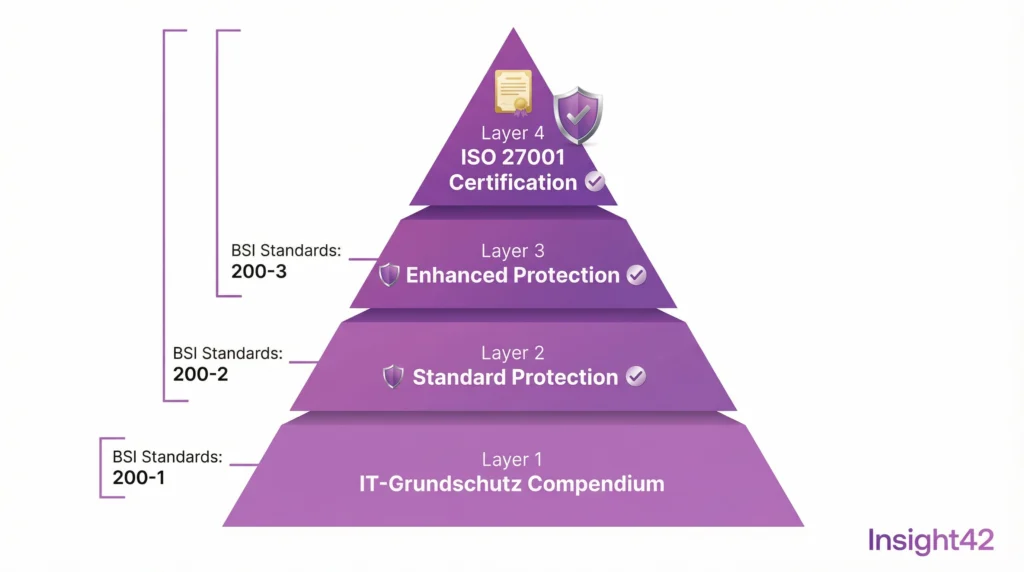
An ISO 27001 certification is internationally recognized and demonstrates a functioning Information Security Management System (ISMS). Combining these two worlds is ideal: the specific guidelines of IT Baseline Protection fulfill the abstract requirements of ISO 27001.

The Synergy of IT Baseline Protection and ISO 27001

ISO 27001 requires an ISMS but does not specify how to implement it. IT Baseline Protection provides exactly that: a detailed guide. Those who implement IT Baseline Protection have already done most of the work for an ISO 27001 certification.

The advantages of this combination:

  • Concrete and Field-Tested: IT Baseline Protection offers ready-made building blocks.
  • BSI-Recognized: The methodology is well-established within the German public sector.
  • Efficient: It avoids duplication of effort.
  • Internationally Recognized: The ISO 27001 certification builds trust.

The Path to Certification

Step 1: Structural Analysis

Which information, processes, and IT systems need protection? The structural analysis defines the scope of the ISMS.

Step 2: Protection Needs Assessment

How critical is the data? Normal, high, or very high? The protection needs assessment evaluates the requirements for confidentiality, integrity, and availability.

Step 3: Modeling According to IT Baseline Protection

The identified systems are mapped to the building blocks of the IT-Grundschutz Compendium. The result is a list of relevant requirements.

Step 4: Basic Security Check

This is a gap analysis. Which requirements are already implemented? Where are the gaps? The basic security check identifies the need for action.

Step 5: Implementation and Audit

The gaps are closed. The ISMS is put into practice. An external auditor verifies conformity and issues the ISO 27001 certificate.

Quick Checklist: ISO 27001 Based on IT Baseline Protection

PhaseTaskStatus
1. PreparationDefine Scope
2. AnalysisConduct Structural Analysis
3. AssessmentDetermine Protection Needs
4. ModelingMap IT Baseline Protection Building Blocks
5. Gap AnalysisPerform Basic Security Check
6. ImplementationExecute Action Plan
7. AuditCertification Audit

To-Do List for Project Managers

  1. Immediately: Secure management commitment.
  2. Week 1: Appoint an ISMS team.
  3. Week 2: Commission IT Baseline Protection consulting.
  4. Month 1: Start the structural analysis.
  5. Month 2: Complete the protection needs assessment.
  6. Quarter 2: Conduct the basic security check.
  7. Quarters 3-4: Implement measures.
  8. Next Year: Plan the certification audit.

IT Baseline Protection in the Cloud

The principles of IT Baseline Protection also apply in the cloud, but the implementation differs. Responsibility is shared. Cloud providers (Azure, GCP) deliver a secure foundation, while the authority is responsible for secure configuration and use (Shared Responsibility Model).

An ISO 27001 certification based on IT Baseline Protection for cloud workloads is possible. It requires a clear understanding of responsibilities. BSI C5 Cloud requirements are also integrated here. The BSI-compliant cloud security concept documents the implementation.

Insight42: Your Partner for IT Baseline Protection

We are experts in ISO 27001 based on IT Baseline Protection. We understand the requirements of the public sector. Our IT Baseline Protection consulting is field-tested and efficient.

We guide you from the initial analysis to successful certification and beyond, with managed services for continuous security and compliance.

Start on the secure path. Contact us.

Figure: The Synergy of IT Baseline Protection and ISO 27001

Blog Post 2: IT Baseline Protection in the Cloud – Practical Implementation in Azure and GCP

Meta Description: Practically implement IT Baseline Protection in the cloud. ISO 27001 based on IT-Grundschutz for Azure and GCP. BSI C5 compliant, secure, and for public authorities.

IT Baseline Protection Meets the Cloud

IT Baseline Protection is not limited to on-premises environments. Its principles are universal, but implementation in the cloud requires a new way of thinking. The Shared Responsibility Model is key. Who is responsible for what? This question must be answered clearly.

For the public sector, cloud migration means reinterpreting IT Baseline Protection. The building blocks do not change, but the way the requirements are met does. Automation and cloud-native tools play a central role.

The Shared Responsibility Model in Detail

  • Cloud Provider (e.g., Azure, GCP): Responsible for the security of the cloud. This includes the physical security of data centers, the security of the virtualization layer, and the basic infrastructure.
  • Customer (Authority): Responsible for security in the cloud. This includes service configuration, identity and access management, data protection, and operating system patching.

IT Baseline Protection consulting helps to define this demarcation clearly. The BSI-compliant cloud security concept documents it.

Implementing Baseline Protection Building Blocks in the Cloud

OPS.1.1.5: Logging

  • Azure: Azure Monitor, Log Analytics, Microsoft Sentinel
  • GCP: Cloud Logging, Cloud Monitoring, Chronicle SIEM
  • Implementation: Enable logging for all services. Define retention periods. Automate analysis.

CON.1: Cryptography

  • Azure: Azure Key Vault, Always Encrypted, Transparent Data Encryption
  • GCP: Cloud Key Management Service, Confidential Computing
  • Implementation: Enforce data-in-transit and data-at-rest encryption. Centralize key management.

ORP.4: Identity and Access Management

  • Azure: Entra ID, Conditional Access, Privileged Identity Management (PIM)
  • GCP: Cloud Identity, Identity-Aware Proxy (IAP), IAM Conditions
  • Implementation: Apply Zero Trust principles. Enforce MFA. Implement least privilege.

NET.1.1: Network Architecture

  • Azure: Virtual Network, Network Security Groups, Azure Firewall
  • GCP: Virtual Private Cloud (VPC), Firewall Rules, Cloud Armor
  • Implementation: Use hub-and-spoke or VPC peering. Enforce network segmentation. Activate DDoS protection.

Quick Checklist: IT Baseline Protection in the Cloud

Baseline Protection Building BlockCloud Tool (Azure Example)Implemented?
ORP.4 (IAM)Entra ID, PIM
CON.1 (Crypto)Key Vault, TDE
OPS.1.1.5 (Logging)Log Analytics, Sentinel
NET.1.1 (Network)VNet, NSGs, Firewall
SYS.1.1 (Server)Azure Policy, Defender for Cloud
DER.1 (Secure Development)Azure DevOps Security

To-Do List for Cloud Baseline Protection

  • Week 1: Understand and document the Shared Responsibility Model.
  • Week 2: Conduct a cloud-specific risk analysis.
  • Month 1: Create a mapping of Baseline Protection building blocks to cloud services.
  • Month 2: Build a landing zone with Baseline Protection configurations (Policy-as-Code).
  • Month 3: Centralize logging and monitoring.
  • Ongoing: Monitor compliance status with cloud tools (e.g., Defender for Cloud).

The Role of BSI C5

BSI C5 and IT Baseline Protection are complementary. BSI C5 is a requirements catalog specifically for cloud services. Many C5 requirements can be met directly with Baseline Protection measures. Anyone implementing IT Baseline Protection in the cloud is well on their way to BSI C5 compliance.

The BSI-compliant cloud security concept should integrate both frameworks. It demonstrates how the requirements of C5 and Baseline Protection are met through technical and organizational measures in the cloud.

Insight42: Your Partner for Cloud Security

We translate IT Baseline Protection for the cloud. We show you how to operate Azure and GCP securely and compliantly. Our IT Baseline Protection consulting is specialized for cloud scenarios.

We build secure landing zones that incorporate ISO 27001 and BSI C5 requirements from the start. With Cloud Managed Services, we ensure ongoing secure operations.

Make your cloud Baseline Protection-compliant. Talk to us.

Figure: Implementing IT Baseline Protection Principles in a Cloud Architecture

#ITBaselineProtection #ISO27001 #CloudSecurity #BSIC5 #PublicSector #GovTech #InfoSec #ISMS #Azure #GCP #CloudMigration #Compliance #Cybersecurity #SecurityConcept #CloudFirst #ManagedServices #Insight42 #DigitalTransformation

Cloud Strategy & Migration Roadmap (Multi-Cloud)

AI In The Public Sector, Resilience, Sovereignty Series 9th Feb 2026 Martin-Peter Lambert
Cloud Strategy & Migration Roadmap (Multi-Cloud)

Cloud Migration Roadmap for the Public Sector – The Path to Digital Sovereignty

Meta Description: Learn how public authorities can develop a successful Cloud Strategy & Migration Roadmap (Multi-Cloud). Achieve BSI C5 compliance with a sovereign cloud and a federal multi-cloud strategy.

Why Public Authorities Need a Cloud Strategy Now

The digital transformation of public administration is at a turning point. A cloud-first approach is no longer an option; it is a necessity. German authorities must act, and time is of the essence.

A well-designed Cloud Migration Roadmap provides the foundation. It connects technical requirements with regulatory mandates, placing BSI C5 compliance at the core. The ultimate goal is to achieve digital sovereignty in the cloud.

Understanding the Challenge

Public institutions face unique hurdles. A Data Protection Impact Assessment (DPIA) for the cloud is mandatory. IT baseline protection consulting (IT-Grundschutz) must be involved from the start. The procurement of cloud service providers follows strict regulations.

A federal multi-cloud strategy offers flexibility. Azure migration and GCP migration can proceed in parallel. The Cloud Adoption Framework for Azure provides proven methodologies, while Google Cloud migration partners complete the ecosystem.

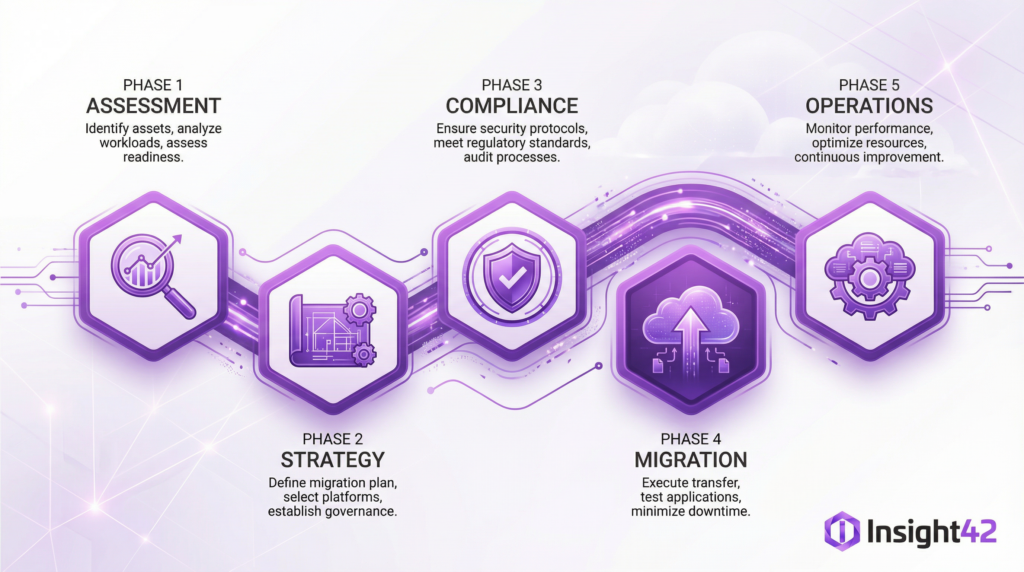
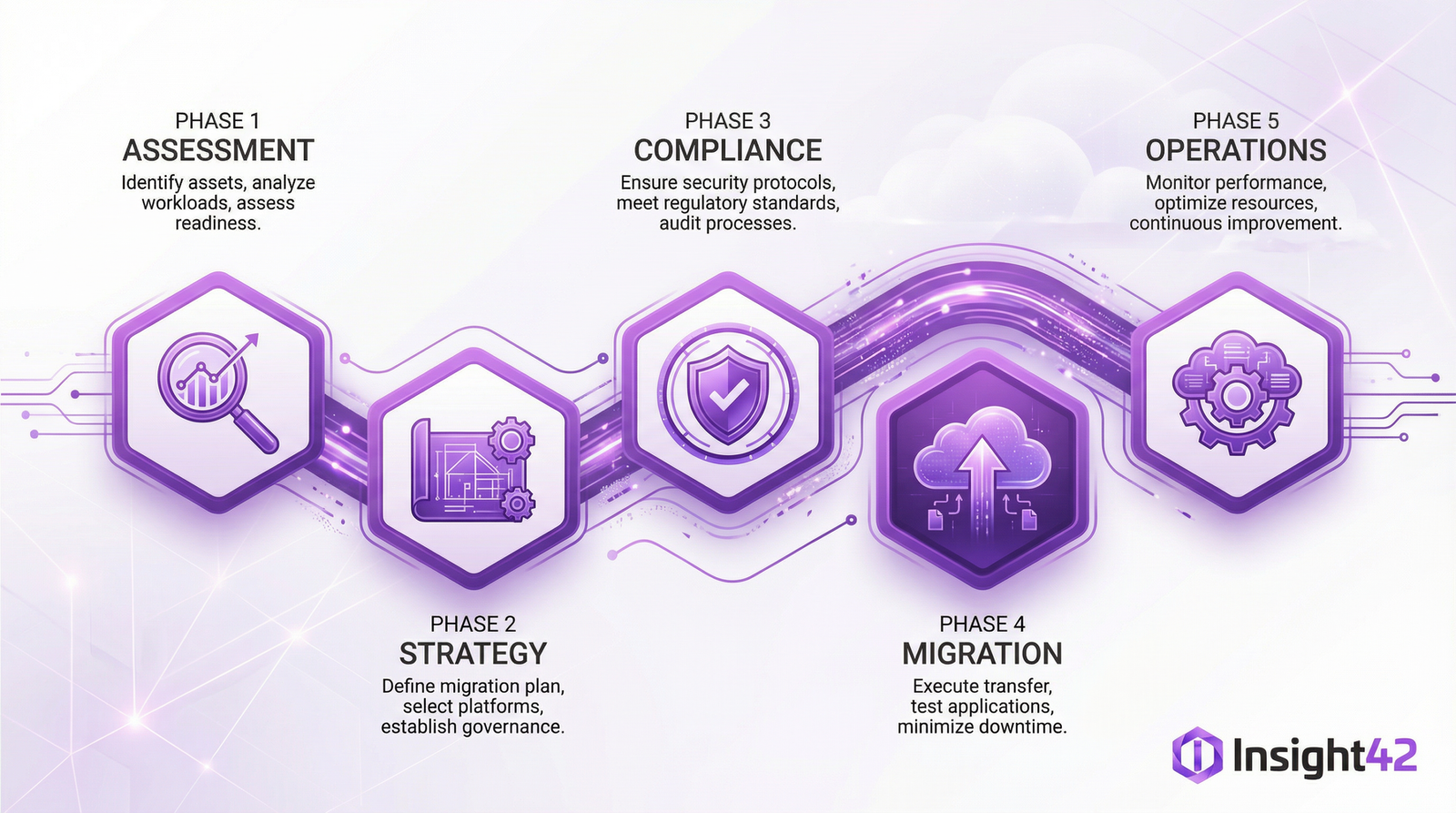
The 5-Phase Approach to Cloud Migration

Phase 1: Assessment and Analysis

Every successful migration begins with an inventory. What workloads exist? What are the dependencies? Cloud migration consulting provides clarity.

Phase 2: Strategy and Architecture

This is where the actual roadmap is developed. Azure Landing Zone or GCP Landing Zone? Often, the answer is both. Multi-cloud migration enables freedom of choice.

Phase 3: Compliance and Security

BSI C5 cloud requirements are defined. A BSI-compliant cloud security concept is created. ISO 27001 based on IT-Grundschutz forms the basis.

Phase 4: Migration and Implementation

A datacenter migration to Azure is performed step-by-step. A VMware to Azure migration utilizes proven tools. A fixed-price cloud migration offer provides planning security.

Phase 5: Operations and Optimization

Cloud managed services for authorities take over routine operations. Azure managed services ensure availability. Continuous improvement becomes the standard.

Quick Checklist: Cloud Migration Roadmap

StepActionTimeline
1Create Workload InventoryWeek 1-2
2Document Compliance RequirementsWeek 2-3
3Evaluate Cloud ProvidersWeek 3-4
4Plan Landing ZoneWeek 4-6
5Launch Pilot ProjectWeek 6-8
6Finalize Rollout PlanWeek 8-10

To-Do List for Decision-Makers

  1. Today: Appoint an internal cloud champion.
  2. This Week: Initiate an IT landscape assessment.
  3. This Month: Commission cloud consulting for public authorities.
  4. Quarter 1: Conduct a BSI C5 gap analysis.
  5. Quarter 2: Prepare the cloud migration tender.

Why Multi-Cloud Makes Sense for Public Authorities

A sovereign cloud in Germany alone is often not enough. Specialized services require flexibility. The German Administration Cloud (Deutsche Verwaltungscloud) can be combined with Azure and GCP.

The advantages are clear: no vendor lock-in and the best solution for every use case. A cloud framework agreement enables rapid procurement.

Cloud migration costs remain predictable. Cloud migration offers can be compared. IT service providers for the public sector understand the requirements.

The Next Step

A professional Cloud Migration Roadmap is complex. It requires expertise in technology and procurement law. Azure migration partners and Google Cloud migration partners bring both.

Insight42 supports public authorities on this journey, from the initial analysis to ongoing operations. BSI C5 compliant, KRITIS cloud security included, and NIS2 compliance consulting as standard.

Ready for the first step? Contact us for a non-binding initial consultation.

Cloud Migration Roadmap Visualization

Figure: The 5 Phases of Cloud Migration for the Public Sector

Blog Post 2: Multi-Cloud Strategy for the Federal Government – Flexibility Meets Compliance

Meta Description: Federal Multi-Cloud Strategy: Combine Azure and GCP. Implement a cloud-first administration with BSI C5, digital sovereignty, and a cloud framework agreement.

Multi-Cloud is the Future of Public Sector IT

Single cloud providers have their limits. A federal multi-cloud strategy overcomes them. Azure migration and GCP migration complement each other. The result: maximum flexibility with full compliance.

The public sector benefits particularly. Cloud migration for public administration becomes simpler. Specialized workloads find their optimal platform. Digital sovereignty in the cloud is maintained.

What Multi-Cloud Really Means

Multi-cloud is more than just using two providers. It is a strategy, an architecture, and an operating model. The Cloud Adoption Framework for Azure provides the methodology; a GCP Landing Zone provides the structure.

Each workload is analyzed. Where does it run best? Azure? GCP? A sovereign cloud in Germany? The answer is often: it depends.

The Building Blocks of a Multi-Cloud Architecture

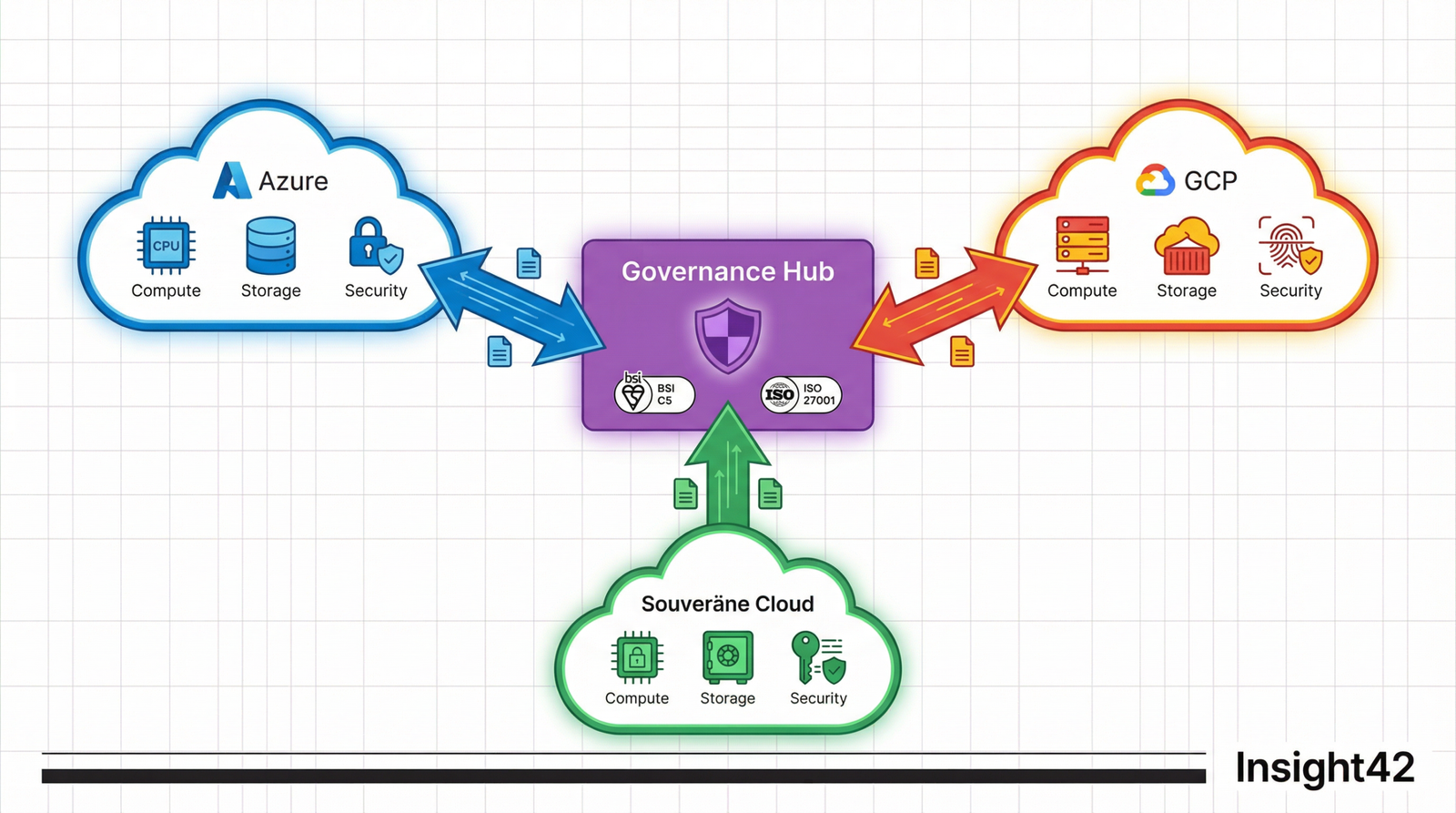
Governance Layer

Centralized control is essential. An Azure Landing Zone and a GCP Landing Zone follow common principles: uniform policies, consistent monitoring, and end-to-end security.

Connectivity Layer

An Azure ExpressRoute setup connects data centers. Google Cloud Interconnect complements it. Hybrid scenarios become possible. A datacenter migration to Azure proceeds without interruption.

Security Layer

The BSI C5 cloud standard applies across the board. The BSI-compliant cloud security concept is uniform. IT baseline protection consulting considers all platforms. ISO 27001 based on IT-Grundschutz remains the standard.

Application Layer

This is where multi-cloud shows its strength. Kubernetes runs on both AKS and GKE. Containers are portable. Vendor lock-in is avoided.

Quick Checklist: Multi-Cloud Readiness

AreaCheckpointStatus
GovernanceCentral Policy Engine Defined
NetworkConnectivity Concept Created
SecurityBSI C5 Mapping for All Clouds
IdentityCentralized IAM Planned
CostsFinOps Process Established
OperationsMulti-Cloud Monitoring Active

To-Do List for Multi-Cloud Success

  1. Immediately: Conduct a cloud strategy workshop.
  2. Week 1: Start workload classification.
  3. Week 2: Create a compliance matrix.
  4. Month 1: Build landing zones in parallel.
  5. Month 2: Migrate pilot workloads.
  6. Month 3: Establish governance processes.

Structuring Tenders and Procurement Correctly

A cloud migration tender requires expertise. The procurement of cloud service providers follows public procurement law. A cloud framework agreement accelerates procurement.

IT service providers for the public sector know these processes. Cloud consulting for authorities begins before the tender. Cloud migration offers are designed to be comparable.

Cloud migration costs vary widely. A fixed-price for cloud migration creates certainty. Azure migration consulting and GCP migration partners work hand in hand.

Compliance as an Enabler

Being BSI C5 compliant is not an obstacle; it is a mark of quality. KRITIS cloud security becomes the standard. NIS2 compliance consulting integrates European requirements.

A Data Protection Impact Assessment (DPIA) for the cloud is mandatory. It protects citizens and the authority. The German Administration Cloud (Deutsche Verwaltungscloud) meets the highest standards.

The Insight42 Approach

We understand multi-cloud. We understand public authorities. We understand procurement law. This combination makes the difference.

From strategy to operations, we offer cloud managed services for authorities as a complete package. Azure managed services and GCP operations from a single source.

Start now. The cloud is not waiting. Neither are your citizens.


Multi-Cloud Architecture Visualization

Figure: Multi-Cloud Architecture for the Public Sector


#CloudMigration #PublicSector #MultiCloud #BSIC5 #DigitalSovereignty #AzureMigration #GCPMigration #CloudFirst #ITBaselineProtection #GovTech #DigitalTransformation #CloudStrategy #GermanCloud #NIS2 #Compliance #CloudConsulting #LandingZone 

2. https://insight42.com/multi-cloud-security/

3. https://insight42.com/part-1-a-guide-to-sovereign-ai-in-the-public-sector-the-revolution-will-be-sovereign/