Entra ID Migration for Public Authorities

AI In The Public Sector, Azure CAF & Cloud Migration, Growth, Resilience, Sovereignty Series 18th Feb 2026 Martin-Peter Lambert
Entra ID Migration for Public Authorities

The Path to Zero Trust

Meta Description: Entra ID Migration for Public Authorities is essential for organisations in the public sector seeking to implement SSO, MFA, and Zero Trust. BSI C5 compliant and IT-Grundschutz ready.

Identity is the New Perimeter

Firewalls alone are no longer enough. Employees work from anywhere. Cloud services are distributed. Identity has become the central security anchor. Zero Trust is the answer.

This is particularly relevant for the public sector. Sensitive data must be protected. An Entra ID migration creates the foundation. BSI C5 Cloud requirements are met.

What Zero Trust Means

Zero Trust is a security model: never trust, always verify. Every access attempt is checked. Every identity is validated.

It sounds strict, and it is. But it works. Attacks are made more difficult. Lateral movement is prevented. The BSI-compliant cloud security concept recommends this approach.

The Pillars of Zero Trust

Verify Identity

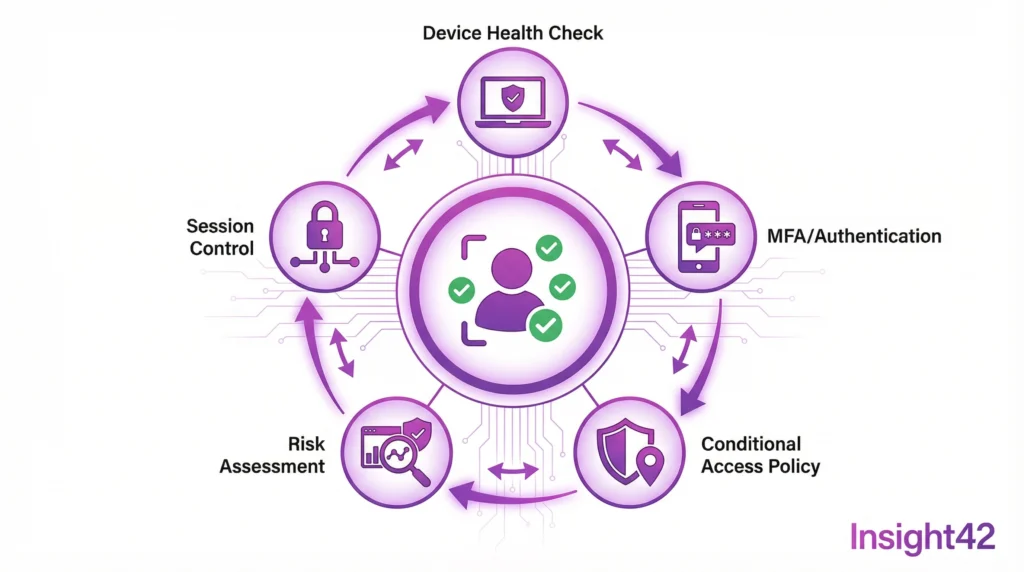
Who is accessing the resource? Is the person who they claim to be? Multi-Factor Authentication is mandatory. Passwords alone are not enough.

Validate Device

From which device is the access coming? Is it managed? Is it compliant? Conditional Access checks these factors.

Minimize Access

The principle of least privilege applies. Only necessary rights, only for the necessary time. Just-in-Time access becomes the standard.

Monitor Activities

Every access is logged. Anomalies are detected. Automated responses are triggered.

Quick Checklist: Zero Trust Implementation

ComponentActionPriority
MFAEnable for all usersCritical
SSOSet up Single Sign-OnHigh
Conditional AccessCreate baseline policiesHigh
PIMImplement Privileged Identity ManagementHigh
Device ComplianceDefine device policiesMedium
App ProtectionConfigure application protectionMedium
MonitoringMonitor sign-in logsMedium

To-Do List for Entra ID Migration

  1. Immediately: Enable MFA for administrators.
  2. Week 1: Take inventory of identities.
  3. Week 2: Define the SSO strategy.
  4. Week 3: Plan Conditional Access policies.
  5. Month 1: Migrate a pilot group.
  6. Month 2: Roll out to all users.
  7. Month 3: Implement PIM.

SSO Simplifies and Secures

Single Sign-On is not a luxury; it is a security feature. Fewer passwords mean less risk. Users use strong passwords because they only need one.

Entra ID enables SSO for thousands of applications, both in the cloud and on-premises. SAML, OAuth, and OpenID Connect are all supported.

SSO is essential for public sector cloud migration. Azure migration and GCP migration benefit. Users work seamlessly while security is maintained.

Implementing MFA Correctly

Multi-Factor Authentication is mandatory. BSI C5 compliance without MFA? Impossible. IT baseline protection consulting requires it, as does NIS2 compliance consulting.

But MFA must be user-friendly. Authenticator apps are standard. Biometrics where possible. Hardware tokens for high security.

Conditional Access makes MFA intelligent. Not for every login, only when there is a risk. Unknown device? MFA. Unusual location? MFA.

Protecting Privileged Identities

Administrators are prime targets. Their accounts have extensive rights. Privileged Identity Management (PIM) protects them.

The principle is Just-in-Time access. Rights are activated only when needed, for a limited time, and with approval.

The BSI-compliant cloud security concept demands these controls. KRITIS cloud security requires them. Insight42 implements them.

Insight42 Identity Services

We are experts in Entra ID migration. Zero Trust is our standard. BSI C5 compliance is our promise.

From strategy to operation, we offer cloud managed services for identity for public authorities, including Azure managed services.

Secure your identities. Contact us.

[Image: Zero Trust Architecture]

Figure: Zero Trust Identity Architecture for Public Authorities

Blog Post 2: Conditional Access and MFA – Intelligent Access Control for Public Administration

Meta Description: Conditional Access and MFA for public authorities. Intelligent, BSI C5 compliant, and IT-Grundschutz-based access control. Secure and user-friendly.

Rethinking Access Control

Old models are obsolete. Once authenticated, always trusted? Dangerous. Conditional Access changes the game. Every access is evaluated. Context is key.

This is revolutionary for the public sector. Security becomes dynamic. User-friendliness is maintained. A cloud-first administration becomes secure.

What Conditional Access Does

Conditional Access is a policy framework that evaluates access in real-time. Who? From where? With what device? To what? These questions are answered.

Based on the answers, decisions are made: allow access, block access, require MFA, or restrict the session.

Understanding the Signals

User and Group

Who is accessing? Administrators have different rules than standard users. Externals different from internals.

Location

Where is the access coming from? Known networks are more trustworthy. Unknown countries are blocked.

Device

Is the device managed? Is it compliant? Unknown devices require additional verification.

Application

Which app is being accessed? Sensitive applications need stronger protection.

Risk

Entra ID automatically assesses risk. Unusual behavior is detected. Compromised accounts are locked.

Quick Checklist: Conditional Access Policies

PolicyGoalAction
MFA for AdminsProtect privileged accountsEnforce MFA
Blocked CountriesStop attacks from high-risk regionsBlock access
Compliant DevicesAllow only secure devicesRequire compliance
Block Legacy AuthPrevent insecure protocolsBlock
Session TimeoutReduce risk during inactivityLimit session
App ProtectionProtect sensitive appsRequire MFA + Compliance

To-Do List for Conditional Access

  • Day 1: Activate report-only mode.
  • Week 1: Define baseline policies.
  • Week 2: Enforce MFA for all admins.
  • Week 3: Block legacy authentication.
  • Month 1: Introduce device compliance.
  • Month 2: Implement location-based policies.
  • Month 3: Implement risk-based policies.

Comparing MFA Methods

Not all MFA methods are equal. Some are more secure, others more user-friendly. The right choice depends on the context.

Microsoft Authenticator

Push notifications are simple. Number matching increases security. Passwordless login is possible.

FIDO2 Security Keys

Hardware-based and phishing-resistant. Ideal for high-security environments. Slightly higher cost.

SMS and Phone

Easy to implement, but less secure. Recommended only as a fallback.

Windows Hello

On-device biometrics. Very user-friendly. Requires compatible hardware.

Meeting Compliance Requirements

BSI C5 Cloud demands strong authentication. Conditional Access delivers it. IT baseline protection consulting confirms compliance.

ISO 27001 based on IT-Grundschutz requires access control. Conditional Access documents every access. Audits are passed.

NIS2 compliance consulting recommends Zero Trust. Conditional Access is a core component. It supports the Data Protection Impact Assessment for the cloud.

Integration with Other Services

Conditional Access does not stand alone. It integrates with Microsoft Defender, uses Intune for device compliance, and connects to SIEM for monitoring.

Public sector cloud migration benefits from this integration. The Azure Landing Zone includes Conditional Access. Azure managed services monitor the policies.

Insight42 Conditional Access Services

We design Conditional Access strategies tailored for public authorities. BSI C5 compliant and user-friendly.

From analysis to implementation, we provide cloud consulting for authorities with a focus on identity and cloud managed services for operations.

Control access intelligently. Talk to us.

www.insight42.de
IT Baseline Protection – ISO 27001 (Based on IT Baseline Protection)

Resilience, SECURITY 15th Feb 2026 Martin-Peter Lambert
IT Baseline Protection – ISO 27001 (Based on IT Baseline Protection)

ISO 27001 Based on IT Baseline Protection – The Royal Road for Public Authorities

Meta Description: ISO 27001 certification based on IT Baseline Protection (IT-Grundschutz). The proven path for the public sector. BSI-compliant, secure, and efficient.

Why IT Baseline Protection is the Standard for Public Authorities

The BSI’s IT Baseline Protection is more than a recommendation; it is the de facto standard for information security in German public administration. It offers concrete measures, field-tested building blocks, and a clear methodology, which makes it incredibly valuable.

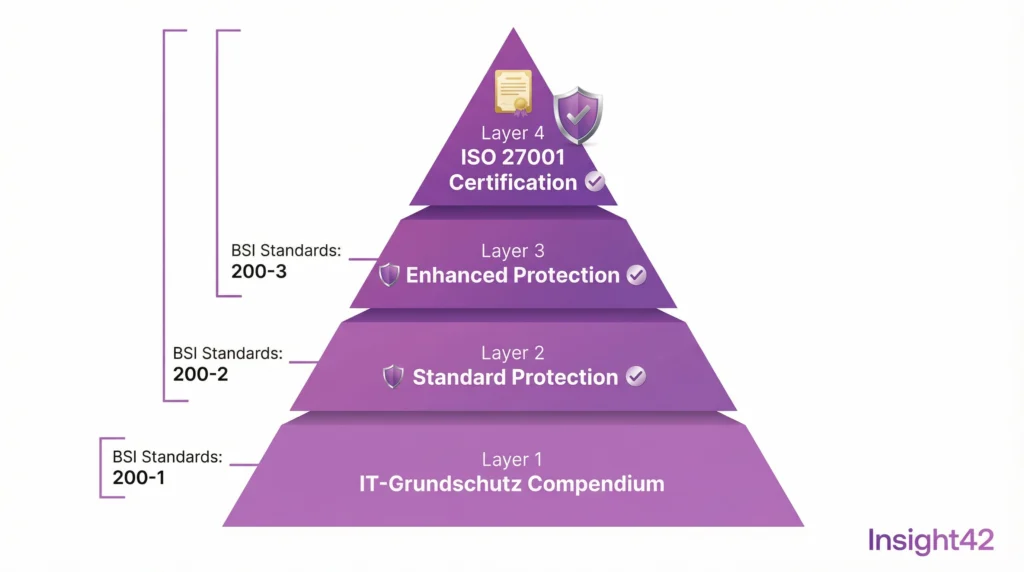
An ISO 27001 certification is internationally recognized and demonstrates a functioning Information Security Management System (ISMS). Combining these two worlds is ideal: the specific guidelines of IT Baseline Protection fulfill the abstract requirements of ISO 27001.

The Synergy of IT Baseline Protection and ISO 27001

ISO 27001 requires an ISMS but does not specify how to implement it. IT Baseline Protection provides exactly that: a detailed guide. Those who implement IT Baseline Protection have already done most of the work for an ISO 27001 certification.

The advantages of this combination:

  • Concrete and Field-Tested: IT Baseline Protection offers ready-made building blocks.
  • BSI-Recognized: The methodology is well-established within the German public sector.
  • Efficient: It avoids duplication of effort.
  • Internationally Recognized: The ISO 27001 certification builds trust.

The Path to Certification

Step 1: Structural Analysis

Which information, processes, and IT systems need protection? The structural analysis defines the scope of the ISMS.

Step 2: Protection Needs Assessment

How critical is the data? Normal, high, or very high? The protection needs assessment evaluates the requirements for confidentiality, integrity, and availability.

Step 3: Modeling According to IT Baseline Protection

The identified systems are mapped to the building blocks of the IT-Grundschutz Compendium. The result is a list of relevant requirements.

Step 4: Basic Security Check

This is a gap analysis. Which requirements are already implemented? Where are the gaps? The basic security check identifies the need for action.

Step 5: Implementation and Audit

The gaps are closed. The ISMS is put into practice. An external auditor verifies conformity and issues the ISO 27001 certificate.

Quick Checklist: ISO 27001 Based on IT Baseline Protection

PhaseTaskStatus
1. PreparationDefine Scope
2. AnalysisConduct Structural Analysis
3. AssessmentDetermine Protection Needs
4. ModelingMap IT Baseline Protection Building Blocks
5. Gap AnalysisPerform Basic Security Check
6. ImplementationExecute Action Plan
7. AuditCertification Audit

To-Do List for Project Managers

  1. Immediately: Secure management commitment.
  2. Week 1: Appoint an ISMS team.
  3. Week 2: Commission IT Baseline Protection consulting.
  4. Month 1: Start the structural analysis.
  5. Month 2: Complete the protection needs assessment.
  6. Quarter 2: Conduct the basic security check.
  7. Quarters 3-4: Implement measures.
  8. Next Year: Plan the certification audit.

IT Baseline Protection in the Cloud

The principles of IT Baseline Protection also apply in the cloud, but the implementation differs. Responsibility is shared. Cloud providers (Azure, GCP) deliver a secure foundation, while the authority is responsible for secure configuration and use (Shared Responsibility Model).

An ISO 27001 certification based on IT Baseline Protection for cloud workloads is possible. It requires a clear understanding of responsibilities. BSI C5 Cloud requirements are also integrated here. The BSI-compliant cloud security concept documents the implementation.

Insight42: Your Partner for IT Baseline Protection

We are experts in ISO 27001 based on IT Baseline Protection. We understand the requirements of the public sector. Our IT Baseline Protection consulting is field-tested and efficient.

We guide you from the initial analysis to successful certification and beyond, with managed services for continuous security and compliance.

Start on the secure path. Contact us.

Figure: The Synergy of IT Baseline Protection and ISO 27001

Blog Post 2: IT Baseline Protection in the Cloud – Practical Implementation in Azure and GCP

Meta Description: Practically implement IT Baseline Protection in the cloud. ISO 27001 based on IT-Grundschutz for Azure and GCP. BSI C5 compliant, secure, and for public authorities.

IT Baseline Protection Meets the Cloud

IT Baseline Protection is not limited to on-premises environments. Its principles are universal, but implementation in the cloud requires a new way of thinking. The Shared Responsibility Model is key. Who is responsible for what? This question must be answered clearly.

For the public sector, cloud migration means reinterpreting IT Baseline Protection. The building blocks do not change, but the way the requirements are met does. Automation and cloud-native tools play a central role.

The Shared Responsibility Model in Detail

  • Cloud Provider (e.g., Azure, GCP): Responsible for the security of the cloud. This includes the physical security of data centers, the security of the virtualization layer, and the basic infrastructure.
  • Customer (Authority): Responsible for security in the cloud. This includes service configuration, identity and access management, data protection, and operating system patching.

IT Baseline Protection consulting helps to define this demarcation clearly. The BSI-compliant cloud security concept documents it.

Implementing Baseline Protection Building Blocks in the Cloud

OPS.1.1.5: Logging

  • Azure: Azure Monitor, Log Analytics, Microsoft Sentinel
  • GCP: Cloud Logging, Cloud Monitoring, Chronicle SIEM
  • Implementation: Enable logging for all services. Define retention periods. Automate analysis.

CON.1: Cryptography

  • Azure: Azure Key Vault, Always Encrypted, Transparent Data Encryption
  • GCP: Cloud Key Management Service, Confidential Computing
  • Implementation: Enforce data-in-transit and data-at-rest encryption. Centralize key management.

ORP.4: Identity and Access Management

  • Azure: Entra ID, Conditional Access, Privileged Identity Management (PIM)
  • GCP: Cloud Identity, Identity-Aware Proxy (IAP), IAM Conditions
  • Implementation: Apply Zero Trust principles. Enforce MFA. Implement least privilege.

NET.1.1: Network Architecture

  • Azure: Virtual Network, Network Security Groups, Azure Firewall
  • GCP: Virtual Private Cloud (VPC), Firewall Rules, Cloud Armor
  • Implementation: Use hub-and-spoke or VPC peering. Enforce network segmentation. Activate DDoS protection.

Quick Checklist: IT Baseline Protection in the Cloud

Baseline Protection Building BlockCloud Tool (Azure Example)Implemented?
ORP.4 (IAM)Entra ID, PIM
CON.1 (Crypto)Key Vault, TDE
OPS.1.1.5 (Logging)Log Analytics, Sentinel
NET.1.1 (Network)VNet, NSGs, Firewall
SYS.1.1 (Server)Azure Policy, Defender for Cloud
DER.1 (Secure Development)Azure DevOps Security

To-Do List for Cloud Baseline Protection

  • Week 1: Understand and document the Shared Responsibility Model.
  • Week 2: Conduct a cloud-specific risk analysis.
  • Month 1: Create a mapping of Baseline Protection building blocks to cloud services.
  • Month 2: Build a landing zone with Baseline Protection configurations (Policy-as-Code).
  • Month 3: Centralize logging and monitoring.
  • Ongoing: Monitor compliance status with cloud tools (e.g., Defender for Cloud).

The Role of BSI C5

BSI C5 and IT Baseline Protection are complementary. BSI C5 is a requirements catalog specifically for cloud services. Many C5 requirements can be met directly with Baseline Protection measures. Anyone implementing IT Baseline Protection in the cloud is well on their way to BSI C5 compliance.

The BSI-compliant cloud security concept should integrate both frameworks. It demonstrates how the requirements of C5 and Baseline Protection are met through technical and organizational measures in the cloud.

Insight42: Your Partner for Cloud Security

We translate IT Baseline Protection for the cloud. We show you how to operate Azure and GCP securely and compliantly. Our IT Baseline Protection consulting is specialized for cloud scenarios.

We build secure landing zones that incorporate ISO 27001 and BSI C5 requirements from the start. With Cloud Managed Services, we ensure ongoing secure operations.

Make your cloud Baseline Protection-compliant. Talk to us.

Figure: Implementing IT Baseline Protection Principles in a Cloud Architecture

#ITBaselineProtection #ISO27001 #CloudSecurity #BSIC5 #PublicSector #GovTech #InfoSec #ISMS #Azure #GCP #CloudMigration #Compliance #Cybersecurity #SecurityConcept #CloudFirst #ManagedServices #Insight42 #DigitalTransformation