The Sovereignty Series (Part 4 of 5): Building on Bedrock, Not Sand

Sovereignty Series 13th Dec 2025 Martin-Peter Lambert
The Sovereignty Series (Part 4 of 5): Building on Bedrock, Not Sand

The Sovereignty Series (Part 4 of 5): Building on Bedrock, Not Sand

So far in our journey toward digital sovereignty, we have established a powerful new philosophy. We began by accepting that all systems will be compromised, forcing us to adopt a Zero Trust model of constant, cryptographic verification. We then made this model resilient by embracing Decentralization, creating a system with no single point of failure. We have designed a beautiful, secure house. But we have ignored the most important question of all: what is it built on?

All the sophisticated cryptography, decentralized consensus, and zero-knowledge proofs in the world are utterly meaningless if the hardware they run on is compromised. If the silicon itself is lying to you, then the entire structure is built on sand. For Europe to be truly sovereign, it cannot just control its software and its networks; it must be able to trust the physical chips that form the foundation of its digital world.

The Black Box Problem
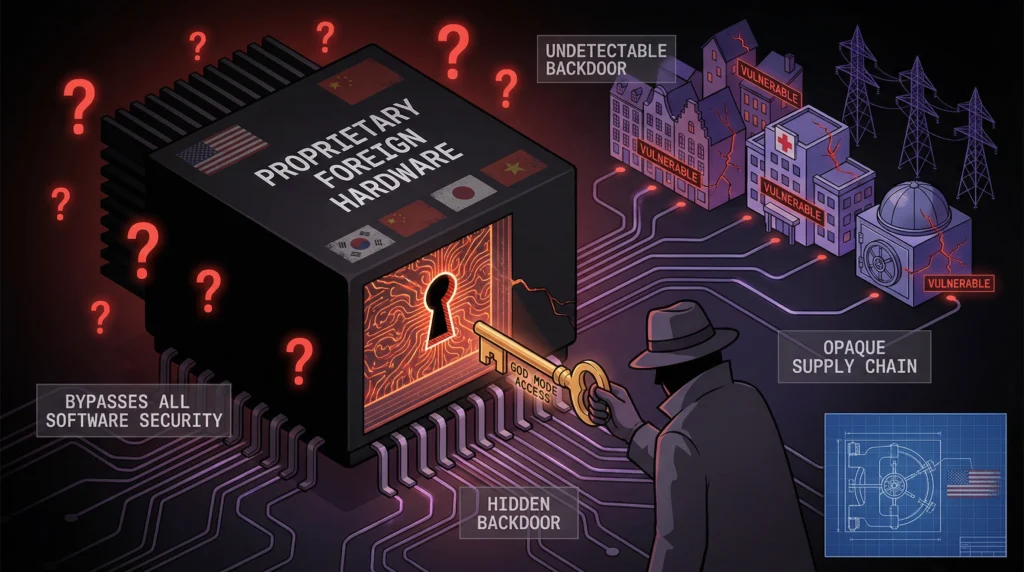
Today, Europe’s digital infrastructure runs almost entirely on hardware designed and manufactured elsewhere, primarily in the United States and Asia. These chips are, for all intents and purposes, black boxes. Their internal designs are proprietary trade secrets, and their complex global supply chains are opaque and impossible to fully audit. This creates a terrifying and unacceptable vulnerability.

A malicious backdoor could be etched directly into the silicon during the manufacturing process. This kind of hardware-level compromise is the holy grail for an intelligence agency. It is persistent, it is virtually undetectable by any software, and it can be used to bypass all other security measures. It gives the manufacturer—and by extension, their government—a permanent “god mode” access to the system. Relying on foreign, black-box hardware for our critical infrastructure is the digital equivalent of building a national bank and letting a rival nation design the vault.

The Hardware Root of Trust

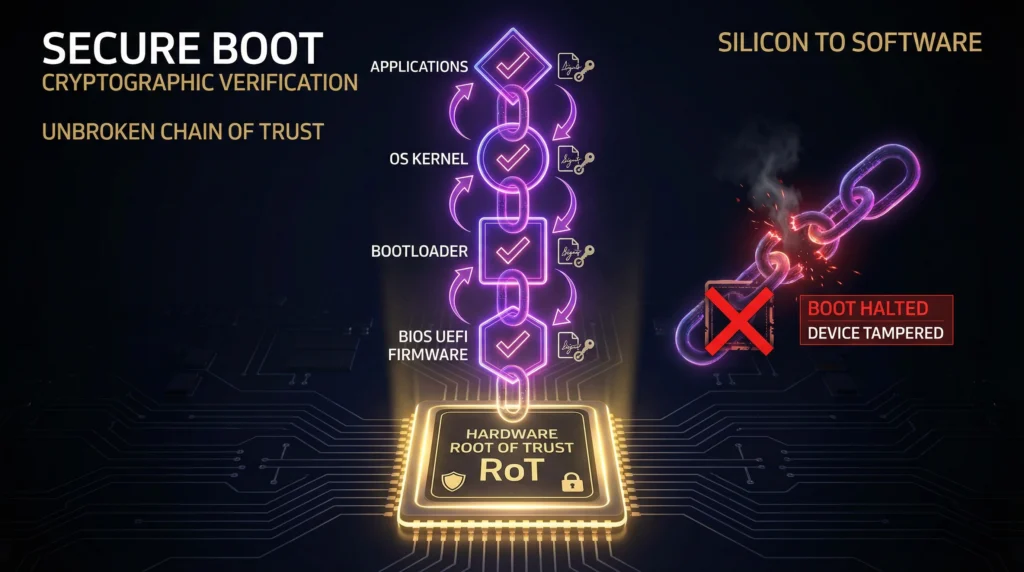
To solve this, we must establish trust at the lowest possible level. We need a Hardware Root of Trust (RoT)—a component that is inherently trustworthy and can serve as the anchor for the security of the entire system. A RoT is a secure, isolated environment within a processor that can perform cryptographic functions and attest to the state of the device. It is the first link in a secure chain.

When a device with a RoT powers on, it doesn’t just blindly start loading software. It begins a process called Secure Boot. The RoT first verifies the cryptographic signature of the initial firmware (the BIOS/UEFI). If and only if that signature is valid, the firmware is allowed to run. The firmware then verifies the signature of the operating system bootloader, which in turn verifies the OS kernel, and so on. This creates an unbroken, verifiable chain of trust from the silicon to the software. If any component in that chain has been tampered with, the boot process halts, and the system refuses to start.
The Only Solutions: Open-Source Hardware

But how can we trust the Root of Trust itself? If the RoT chip is another black box from a foreign supplier, we have only moved the problem down one level. The only way to truly trust the hardware is to be able to see exactly how it is designed. The only path to a verifiable Hardware Root of Trust is through open-source hardware.

This is where initiatives like RISC-V become critically important. RISC-V is an open-source instruction set architecture (ISA)—the fundamental language that a computer processor speaks. Because it is open, anyone can inspect it, use it, and build upon it. It removes the proprietary lock-in that has defined the semiconductor industry for decades.

Building on this, projects like OpenTitan are creating open-source designs for the silicon Root of Trust chips themselves. This means that for the first time, we can have a fully transparent, auditable security foundation for our computers. We can inspect the blueprints of the vault before we build it.

For Europe, this is not an academic exercise. It is a strategic imperative. Achieving digital sovereignty requires a massive investment in and a public procurement mandate for open-source hardware. We must foster a European semiconductor industry that is not just building chips, but building trustworthy chips based on transparent, open designs.

This is the bedrock. A verifiable, open-source hardware foundation is the only thing upon which a truly secure and sovereign digital infrastructure can be built. With this final piece in place, we are ready to assemble the full picture. In our concluding post, we will lay out the complete, step-by-step roadmap for Europe to achieve genuine digital independence.

Previous:
The Sovereignty Series (Part 2 of 5): Never Trust, Always Verify

Next:
The Sovereignty Series (Part 5 of 5): The Blueprint for Independence

Do It all on Our Own Hardware:

#HardwareRootOfTrust #OpenSourceHardware #RISCV #OpenTitan #SecureBoot #HardwareSecurity #DigitalSovereignty #SemiconductorSecurity #TrustworthyHardware #SupplyChainSecurity #HardwareBackdoors #CryptographicVerification #SecureEnclave #TrustedComputing #HardwareTransparency
The Sovereignty Series (Part 3 of 5): A System With No Single Point of Failure

Sovereignty Series 13th Dec 2025 Martin-Peter Lambert
The Sovereignty Series (Part 3 of 5): A System With No Single Point of Failure

The Sovereignty Series (Part 3 of 5): A System With No Single Point Of Failure

In this series, we first accepted the harsh reality that all digital systems will be breached. Then, we embraced a new security philosophy—Zero Trust—where we assume breach and verify everything, all the time. But even a perfect Zero Trust system can have a fatal flaw if it has a centralized core. If a system has a single brain, a single heart, or a single control panel, it has a single point of failure. And a single point of failure is a single point of control for an adversary.

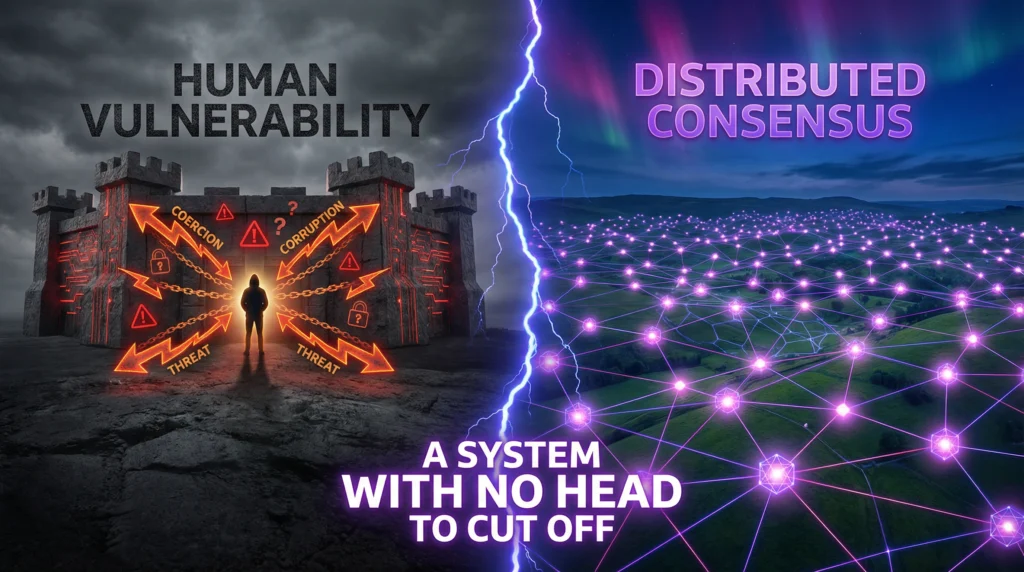
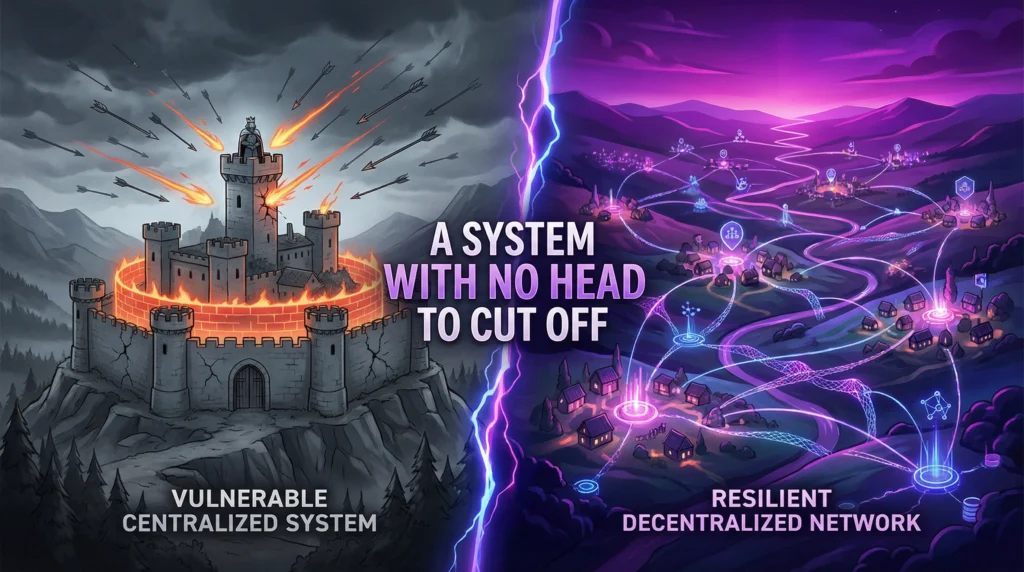
To build a truly sovereign digital Europe, we must do more than just change our security philosophy. We must fundamentally change the architecture of our digital world. We must move from centralized systems to decentralized ones. We must build a system with no head to cut off.

The Centralization Trap

For the past thirty years, the internet has evolved towards centralization. Our data, our identities, and our digital lives are concentrated in the hands of a few massive corporations and government agencies. We have built a digital world that mirrors the structure of a medieval kingdom: a central castle (the data center) protected by high walls (the firewalls), where a single king (the system administrator) holds absolute power.

As we discussed in the first post, this model is a security nightmare. It creates a single, irresistible target for our adversaries. But the danger is even more profound. A centralized system is not just vulnerable to attack; it is vulnerable to control. A government can compel a company to hand over user data. A malicious insider can alter records. A single bug in the central system can bring the entire network to its knees. This is not sovereignty. It is dependence on a fragile, powerful, and ultimately untrustworthy core.

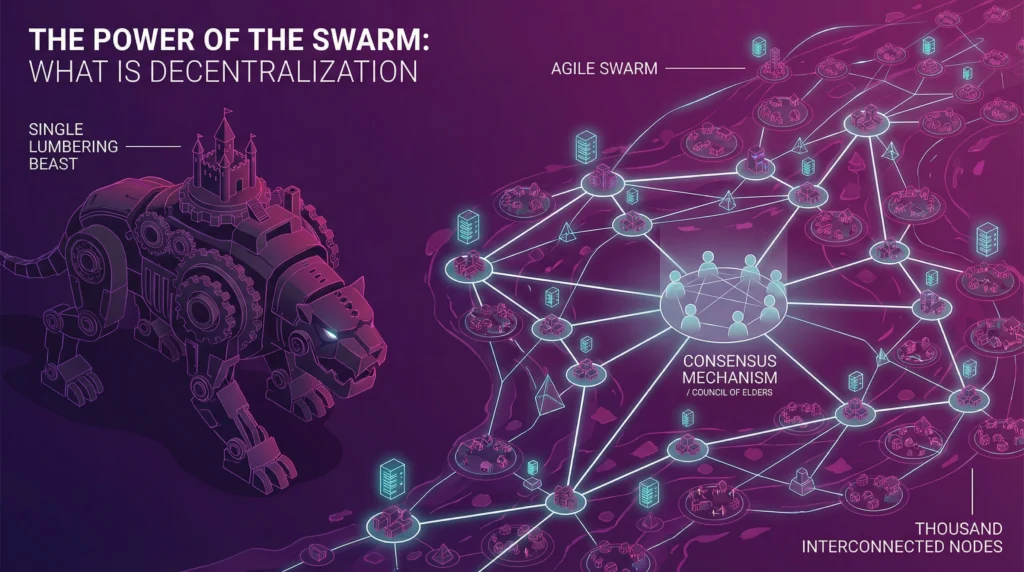
The Power of the Swarm: What is Decentralization?

Decentralization means breaking up this central point of control and distributing it across a network of peers. Instead of a single castle, imagine a thousand interconnected villages. Instead of a single king, imagine a council of elders who must reach a consensus. This is the difference between a single, lumbering beast and a resilient, adaptable swarm.

In a decentralized system, there is no single entity in charge. Data is not stored in one place; it is replicated and synchronized across many different nodes in the network. Decisions are not made by a single administrator; they are made through a consensus mechanism, where a majority of participants must agree on the state of the system. This architecture has profound implications for security and sovereignty.

Resilience by Design
A decentralized system is inherently resilient — since it does not have a centrally point of “all control“.

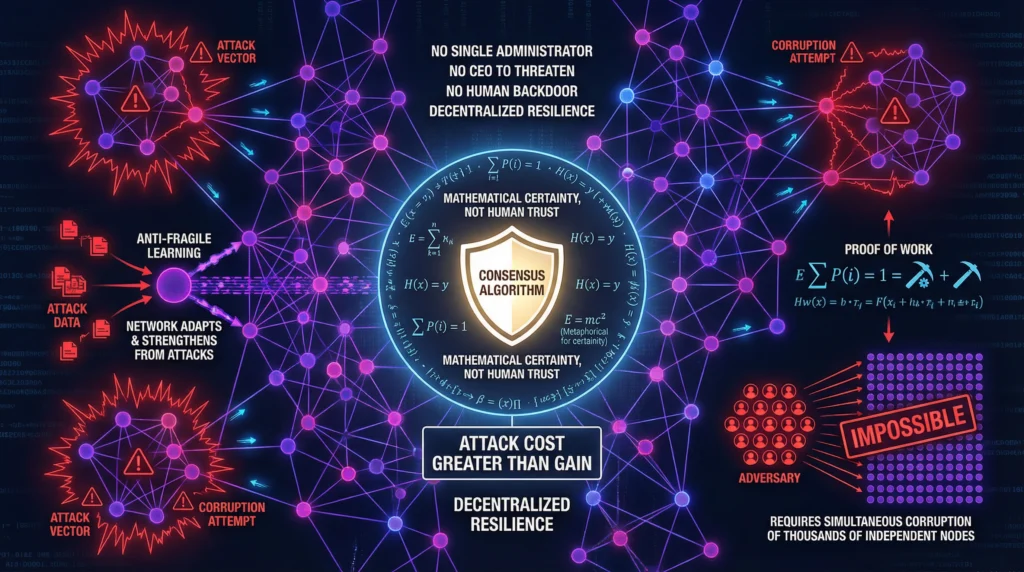
First, it has no single point of failure. If a dozen nodes in the network are attacked, flooded, or simply go offline, the network as a whole continues to function seamlessly. The system is anti-fragile; it can withstand and even learn from attacks on its individual components.

Second, it presents a terrible target for an adversary. Why would a state-level attacker spend millions of euros to compromise a single node in a network of thousands, when doing so grants them no control over the system and their malicious changes would be instantly rejected by the rest of the network? Decentralization diffuses the threat by making a successful attack economically and logistically infeasible.

Finally, it is resistant to corruption and coercion. In a decentralized system, there is no single administrator to bribe, no CEO to threaten, and no politician to pressure. To manipulate the system, you would need to corrupt a majority of the thousands of independent participants simultaneously—a near-impossible task. Trust is not placed in a person or an institution; it is placed in the mathematical certainty of the consensus algorithm.

The Unbreakable Record

This is made possible by the invention of distributed ledger technology (DLT), most famously represented by blockchain. A distributed ledger is a shared, immutable record of transactions that is maintained by a network of computers, not a central authority. Every transaction is cryptographically signed and linked to the previous one, creating a chain of verifiable truth that, once written, cannot be altered without being detected.

This technology allows us to have a shared source of truth without having to trust a central intermediary. It is the architectural backbone of a system where trust is distributed, and power is decentralized.

In our journey towards digital sovereignty, decentralization is not just a technical preference; it is a political necessity. It is the only way to build a digital infrastructure that is truly resilient, censorship-resistant, and free from the control of any single entity, whether it be a foreign power, a tech giant, or even our own government.

But a decentralized software layer is only as secure as the foundation it is built on. In our next post, we will travel to the very bottom of the stack and explore why true sovereignty must begin with the silicon itself: Hardware Security.

The Sovereignty Series (Part 2 of 5): Never Trust, Always Verify

Sovereignty Series 13th Dec 2025 Martin-Peter Lambert
The Sovereignty Series (Part 2 of 5): Never Trust, Always Verify

The Sovereignty Series (Part 2 of 5): Never Trust, Always Verify

In our last post, we made a stark declaration: all digital systems will eventually be compromised. The traditional “fortress” model of security is broken because it fails to account for the inevitability of human error, corruption, and deception. If we cannot keep attackers out, how can we possibly build a secure and sovereign digital Europe?

The answer lies in a radical new philosophy, one that is perfectly suited for a world of constant threat. It’s called Zero Trust, and its central mantra is as simple as it is powerful: Never trust, always verify – and it has been proven over decades now.

What is Zero Trust?

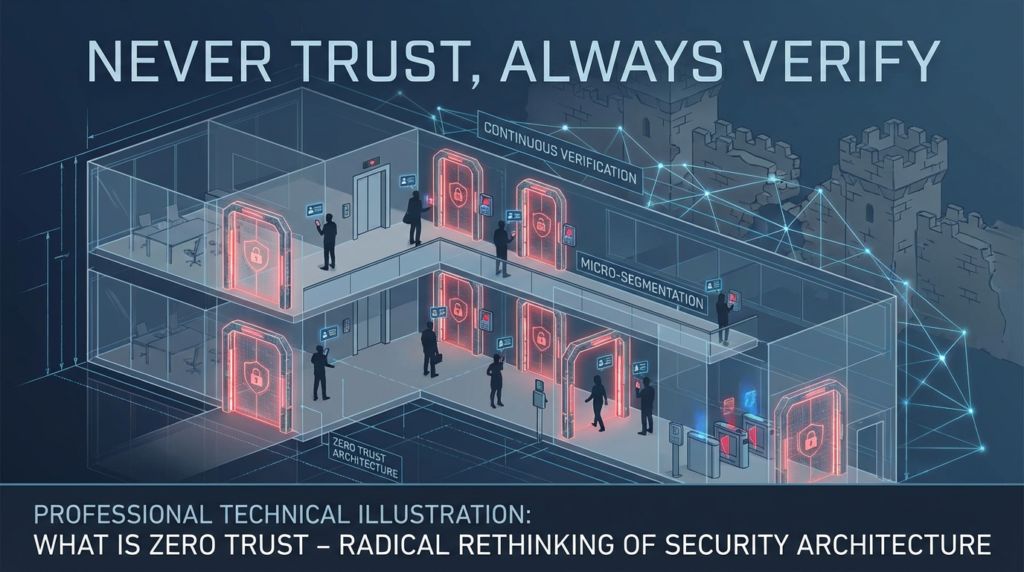
Zero Trust is not a product or a piece of software; it is a complete rethinking of how we approach security. It begins with a single, foundational assumption: the network is already hostile. There is no “inside” and “outside.” There is no “trusted zone.” Every user, every device, and every connection is treated as a potential threat until proven otherwise.

Imagine a world where your office building didn’t have a front door with a single security guard. Instead, to enter any room—even the break room—you had to prove your identity and your authorization to be there, every single time. That is the essence of Zero Trust. It eliminates the very idea of a trusted internal network. An attacker who steals a password or breaches the firewall doesn’t get a free pass to roam the system; they are still an untrusted entity who must prove their right to access every single file or application, one request at a time.

This continuous, relentless verification is the heart of the Zero Trust model. Trust is not a one-time event; it is a dynamic state that must be constantly re-earned. This makes the system incredibly resilient. A compromised device or a stolen credential has a very limited blast radius, because it does not grant the attacker automatic access to anything else.

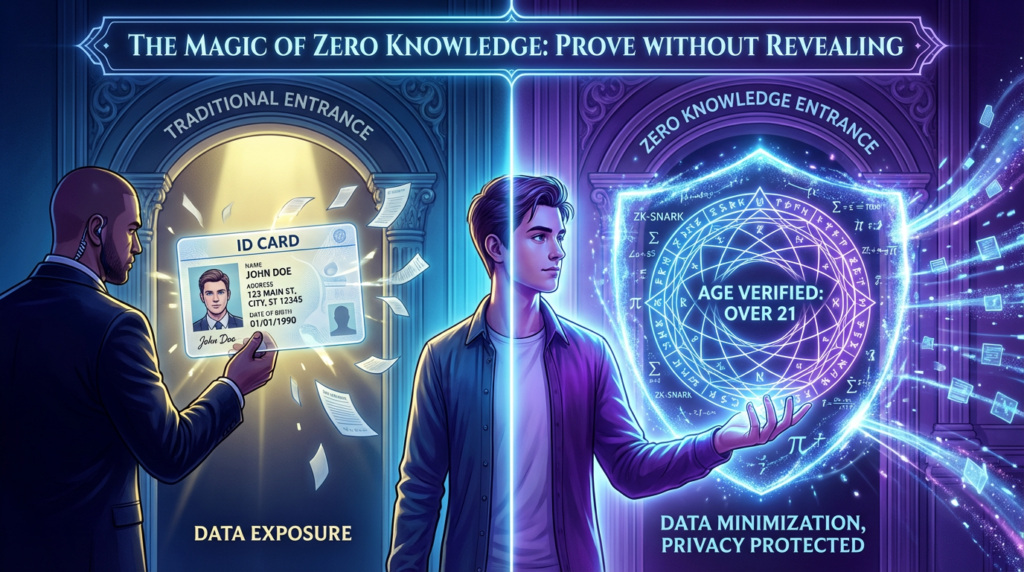
The Magic of Zero Knowledge: Proving Without Revealing

But Zero Trust on its own is not enough. If every verification requires you to present your sensitive personal data—your driver’s license, your passport, your date of birth—then we have simply moved the problem. We have replaced a single, high-value central database with thousands of smaller, but still sensitive, data transactions. This is where a revolutionary cryptographic technique comes into play: Zero-Knowledge Proofs (ZKPs).

ZKPs are a form of cryptographic magic. They allow you to prove that you know or possess a piece of information without revealing the information itself.

Think about it like this: you want to prove to a bouncer that you are over 21. In the old world, you would show them your driver’s license, which reveals not just your age, but your name, address, and a host of other personal details. In a world with ZKPs, you could simply provide a cryptographic proof that verifiably confirms the statement “I am over 21” is true, without revealing your actual date of birth or any other information. The bouncer learns only the single fact they need to know, and nothing more.

This is a game-changer for privacy and security. It allows us to build systems where verification is constant, but the exposure of personal data is minimal. We can prove our identity, our qualifications, and our authorizations without handing over the raw data to a hundred different services. It is the ultimate expression of “data minimization,” a core principle of Europe’s own GDPR.

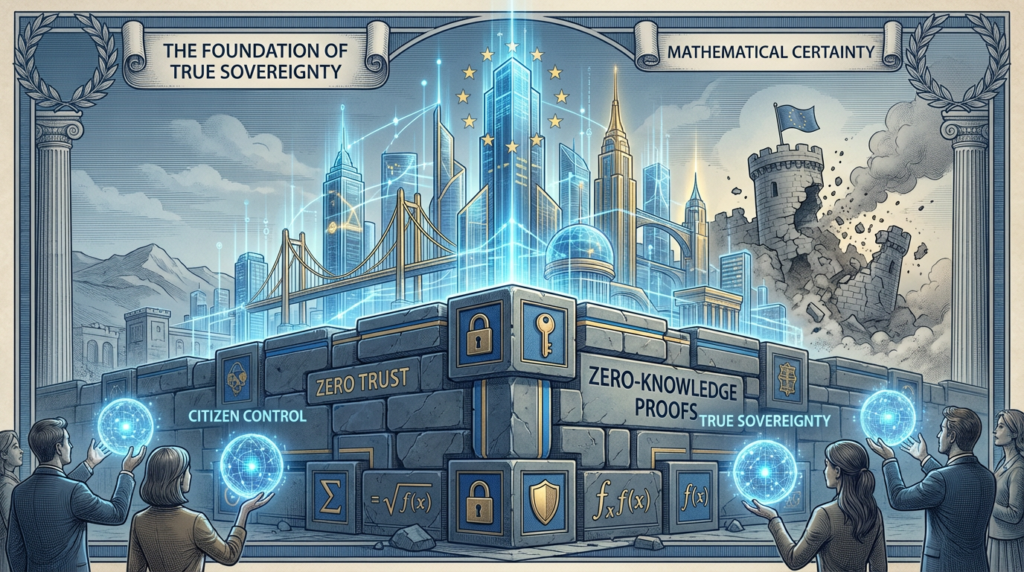
The Foundation of True Sovereignty

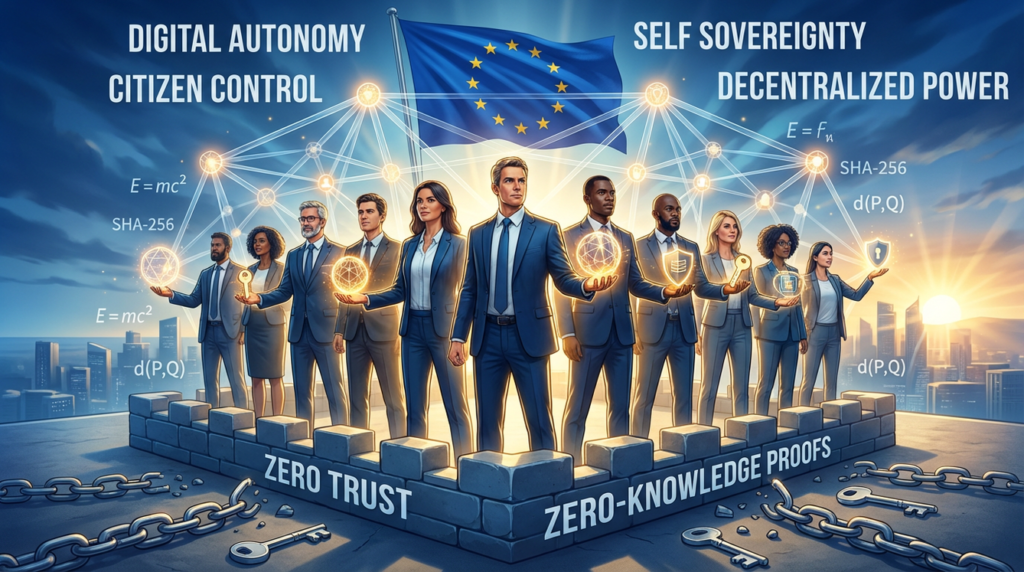
Together, Zero Trust and Zero-Knowledge Proofs form the bedrock of a truly sovereign digital infrastructure. They create a system that is secure not because it is impenetrable, but because it is inherently resilient. It is a system that does not rely on the flawed assumption of human trustworthiness, but on the mathematical certainty of cryptography.

By building on these principles, Europe can create a digital ecosystem that is both secure and respectful of privacy. It can build a system where citizens control their own data and where trust is not a commodity to be bought or sold, but a verifiable fact.

But this is only part of the story. A Zero Trust architecture cannot exist in a vacuum. It must be built on a foundation that is equally resilient. In our next post, we will explore the critical role of Decentralization in building a system with no single point of failure.

#ZeroTrustArchitecture #NeverTrustAlwaysVerify #NeverTrust #AlwaysVerify #ZeroTrustSecurity #ZeroKnowledgeProofs #ContinuousVerification #DigitalSovereignty #CryptographicVerification #DataMinimization #PrivacyPreserving #ZeroTrustImplementation #ResilientSecurity #TrustedNetwork #ContinuousAuthentication #ZeroTrustFramework #IdentityVerification

Previous:
The Sovereignty Series (Part 1 of 5): The Myth of the Impenetrable Fortress

Next:
The Sovereignty Series (Part 3 of 5): A System With No Single Point of Failure

The Sovereignty Series (Part 1 of 5): The Myth of the Impenetrable Fortress

Sovereignty Series 11th Dec 2025 Martin-Peter Lambert
The Sovereignty Series (Part 1 of 5): The Myth of the Impenetrable Fortress

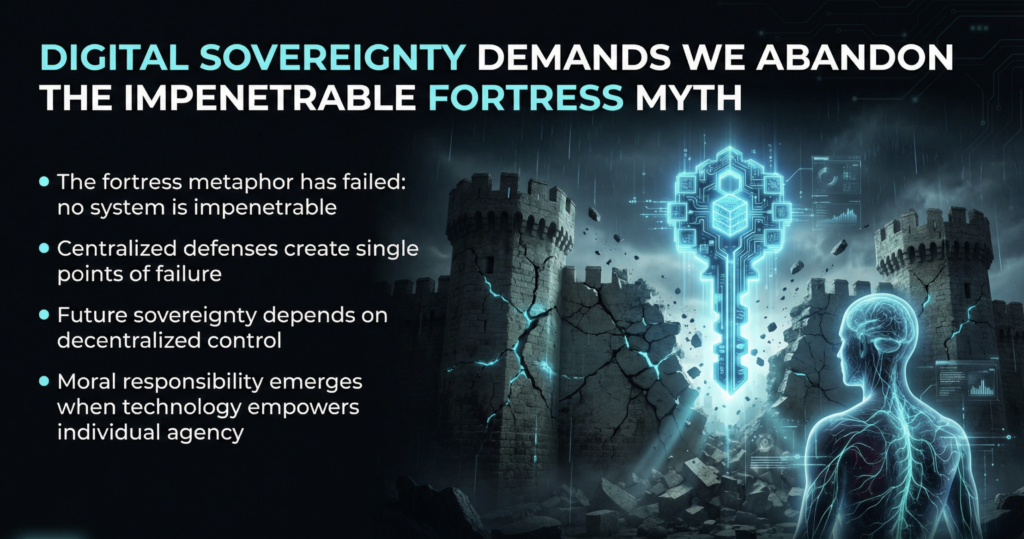
The introduction of The Sovereignty Series part 1 delves into the concept of cybersecurity long viewed as a fortress. For decades, we’ve been told a simple story about cybersecurity: it’s like building a fortress. To stay safe, we must build higher walls, deeper moats, and stronger gates than our adversaries. We invest in firewalls, intrusion detection systems, and complex passwords—all in an effort to keep the bad guys out. This model, known as perimeter security, has dominated our thinking for a generation. And for a generation, it has been failing. In The Sovereignty Series part 1, we begin to question these outdated models.

In the quest for true digital sovereignty, for an independent Europe that controls its own digital destiny, our first and most critical step is to abandon this flawed metaphor. We must accept a fundamental, uncomfortable truth. All systems will be compromised. As explained in The Sovereignty Series part 1, it is not a matter of if, but when.

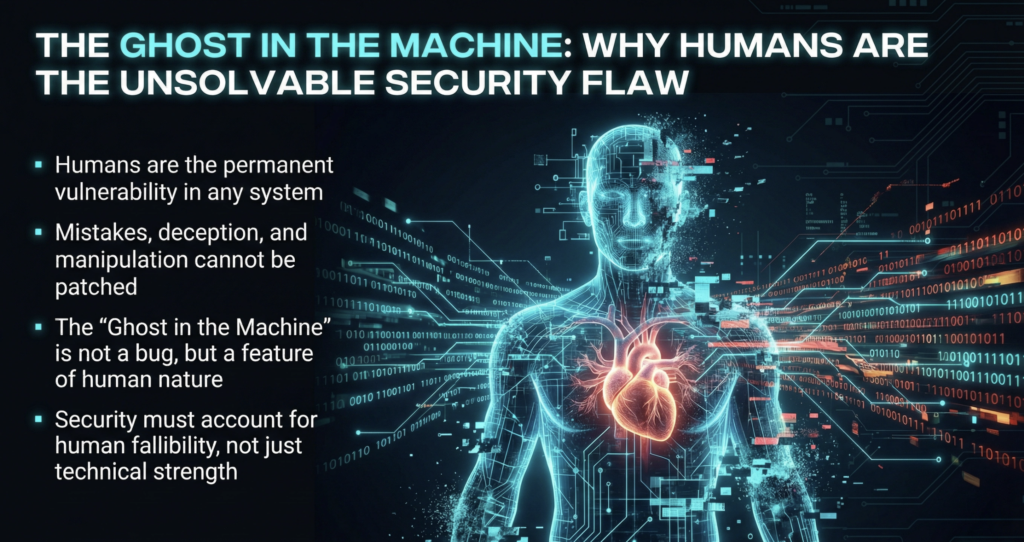
The Human Element: The Ghost in the Machine

The greatest vulnerability in any digital fortress is not in the code or the cryptography; it is in the people who build, maintain, and use it. The human element is a permanent, unsolvable security flaw. Why?

First, humans make mistakes. A simple misconfiguration, a bug in a line of code, or a forgotten security patch—these are the unlocked backdoors through which attackers waltz. The Sovereignty Series part 1 highlights how, in a complex system, the number of potential mistakes is nearly infinite.

Second, humans are susceptible to love and fear. In a centralized system, a handful of administrators hold the keys to the kingdom. These individuals become high-value targets for bribery, extortion, or blackmail. The Families of those even more so! A foreign power doesn’t need to crack a complex algorithm. They can simply buy the password from a worried parent getting a call from his wife. This makes the entire system fragile, resting on the assumption of unwavering human integrity. An assumption that history has repeatedly proven false. He who ever holds the key to the caste, will be a prime target for forces unbound by moral.

Finally, humans are vulnerable to deception. Phishing attacks, which trick users into revealing their credentials, remain one of the most effective infiltration methods. This is because they target human psychology, not technical defenses. No firewall can patch human curiosity or fear. The Series part 1 on sovereignty intensively highlights this aspect.

Finally, a little nudge, a little help here or there, might have a very big effect. Once the state would have central control and a real intractability for low transaction sums, the contradictions in a central system are absolute. A lot of untraceable little transactions will make a theft untraceable.

A central point of being able to trace everything will make the system worse. Since you only have to corrupt one person. Just by knowing who has what where, you can always visit them in the night. And have him gladly pay for the life of his loved ones — a little bit of special motivation granted. But those individuals are good and ruthless in ways of making you happily pay, as explained in The Sovereignty Series part 1.

The Centralization Problem: All Our Eggs in One Broken Basket

Our current digital infrastructure is overwhelmingly centralized. Our data, our identities, and our communications are stored in massive, centralized databases. These are controlled by a few large corporations or government agencies. This architectural choice creates two critical vulnerabilities.

First, it creates a single point of failure. When all your critical data is in one place, that place becomes a target of immense value. The Sovereignty Series part 1 also discusses that a successful breach at the center means a complete, catastrophic failure for the entire system. The attacker doesn’t need to defeat a thousand different defenses. They only need to find one way into the one place that matters.

Second, it makes these systems an irresistible target. For state-sponsored hackers, criminal organizations, and industrial spies, a centralized database of citizen information, financial records, or intellectual property is the ultimate prize. The potential reward is so great that it justifies an almost unlimited investment in time and resources to breach it.

A New Philosophy: Assume Breach

If the fortress model is broken, if the human element is an unsolvable vulnerability, and if centralization creates irresistible targets, then we must conclude that the goal of preventing a breach is futile. In The Series focused on sovereignty, part 1 reveals that the most sophisticated defenses will eventually be bypassed. The most loyal administrator can be compromised. The most secure perimeter will, one day, be crossed.

This realization is not a cause for despair, but for a radical shift in thinking. If we cannot stop attackers from getting in, we must design systems that are secure even when they are compromised. We must build a world where an attacker who has breached the perimeter finds they have gained nothing of value and can do no harm. Stay tuned for further insights in The Sovereignty Series part 1, where this topic is further explored.

This is the foundational principle of a truly sovereign digital future. It requires us to throw out the old blueprints and start fresh. In our next post, we will explore the revolutionary security philosophy that makes this possible: Zero Trust.

Starting with the the goal in mind!

Sovereignty Series 11th Dec 2025 Martin-Peter Lambert
Starting with the the goal in mind!

Starting with the goal in mind, we must consider the framework for a sovereign digital Europe!

The Sovereignty Series (Bonus Chapter): The Verifiability Conundrum

We have built a framework for Europe’s digital sovereignty based on a powerful idea: mutual protection through verification. By embracing the Fallibility Principle—that no one is infallible—we have designed a system of Zero Trust Governance that protects the public from the abuse of power, and simultaneously protects those in power from false accusations, coercion, and risk. This is achieved by replacing trust with cryptographic proof in our digital sovereignty framework.

But this elegant solution creates a profound and complex challenge: the Verifiability Conundrum. A system that can verify everything can also see everything. How do we build a system that delivers radical accountability without becoming a tool of radical surveillance? How do we protect everyone, powerful and powerless alike, without making everyone transparent?

The Double-Edged Sword of Immutability

The core of our proposed system is an immutable, distributed ledger—a permanent, unchangeable record of official actions. This ledger framework allows the sovereign digital Europe initiative to protect a public official from false accusations; they can point to the ledger as a definitive, verifiable alibi. It is also the mechanism that convicts a corrupt official; the ledger provides an undeniable trail of their misconduct.

But this double-edged sword cuts both ways. If every official action is recorded, what about the actions of ordinary citizens? Does a request for a public service, a visit to a government website, or an application for a permit also become a permanent, immutable record? If so, we have not eliminated the potential for a surveillance state; we have perfected it. We have created a system that is technically incorruptible but potentially socially oppressive.

This is the heart of the conundrum. We need verifiability to protect against the fallibility of the powerful, but universal verifiability threatens the privacy and freedom of the powerless.

Resolving the Conundrum: Asymmetric Verifiability and Zero-Knowledge Proofs

The solution is not to abandon verifiability, but to apply it asymmetrically. We must build a system where the actions of the powerful are transparent, while the identities and data of the powerless are protected. This is not a contradiction; it is a design choice, enabled by modern cryptography.

  1. Asymmetric Verifiability: We must distinguish between public acts and private lives within our sovereign digital Europe framework. The actions of an elected official or public servant, when performed in their official capacity, are public acts. They should be transparent and recorded on an immutable ledger for all to see. This is the price of power and the foundation of accountability. The actions of a private citizen, however, are private; they should not be recorded on a public ledger.
  2. Zero-Knowledge Proofs (ZKPs): This is the cryptographic tool that makes Asymmetric Verifiability possible. As we discussed, ZKPs allow an individual to prove a fact is true without revealing the underlying data. A citizen can prove they are eligible for a government service (e.g., they are a resident, they are over 65, they meet an income requirement) without revealing their address, their exact age, or their salary. The government system can verify the eligibility without ever seeing or storing the personal data. The citizen’s interaction is verifiable, but their privacy is preserved within Europe’s digital sovereignty framework.

A System of Rights, Not a System of Surveillance

This model allows us to build a system that protects rights, not just data.

  • The Right to Accountability: The public has a right to a verifiable record of the actions of its servants. Asymmetric Verifiability delivers this within the sovereign digital Europe framework.
  • The Right to Privacy: Citizens have a right to interact with their government without having their lives turned into an open book. Zero-Knowledge Proofs deliver this.

This resolves the conundrum. We can have a system that is both radically transparent in its exercise of power and radically private in its treatment of citizens. The ledger records that a verified, eligible citizen received a service, but it does not record who that citizen was. The ledger records that a public official authorized a payment, and it records their name for all to see.

The New Social Contract

This is more than a technical architecture; it is a new social contract. It is a system that acknowledges the Fallibility Principle and designs for it. It protects leaders from the impossible burden of being perfect, and it protects the public from the inevitable consequences of that imperfection.

It is a system where a leader’s best defense is the truth, and where the public’s best defense is a system that makes that truth undeniable. It is a difficult, complex path, but it is the only one that leads to a framework for a sovereign digital Europe that is both secure and free.

#DigitalSovereignty #EU #Privacy #Accountability #ZeroKnowledge #Cryptography #FutureOfEurope #DigitalIdentity