Meta Description: Sovereign Cloud Germany: What does digital sovereignty mean for public authorities? Data residency, key management, and BSI C5 compliance.
What Does Digital Sovereignty Mean?
Digital sovereignty is the ability to control one’s own IT infrastructure and data with self-determination. For the public sector, this is not a luxury but a necessity. It is about controlling citizen data, independence from individual providers, and compliance with German and European legal norms (GDPR, Schrems II).
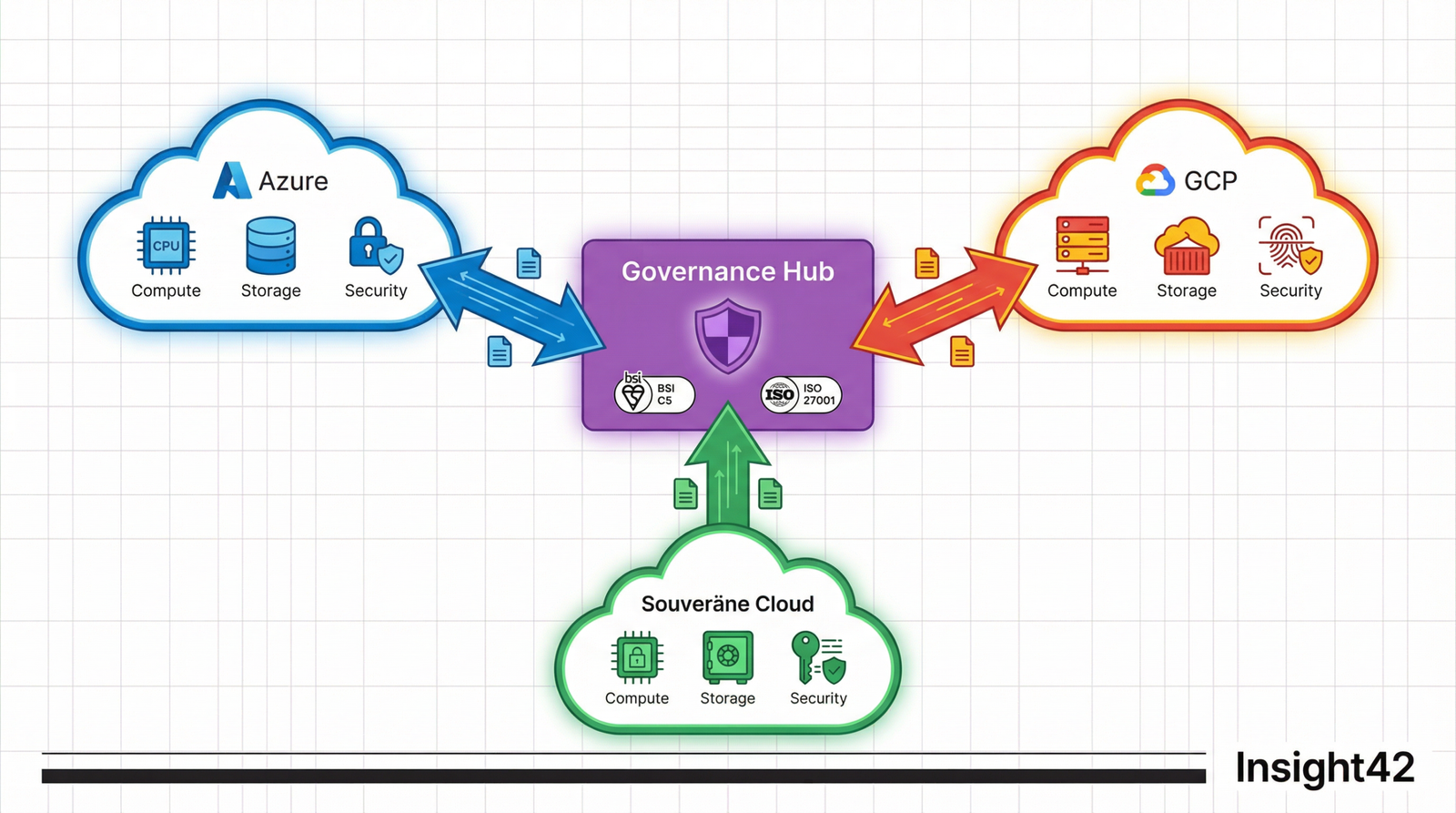
A sovereign cloud in Germany provides the technical and organizational framework to ensure this control. It combines the innovative power of global hyperscalers (like Azure and GCP) with the strict requirements of German and European law.
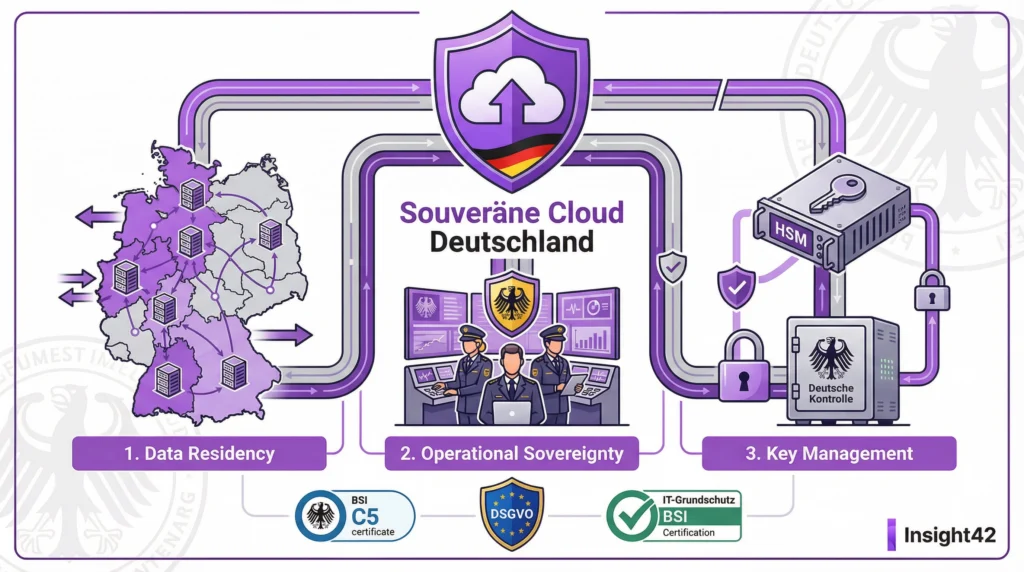
The Three Pillars of Digital Sovereignty
1. Data Residency
What it is: The guarantee that data and metadata are stored and processed exclusively within a defined geographical area (e.g., Germany).
Why it matters: Prevents access by foreign authorities based on laws like the US CLOUD Act. Ensures compliance with GDPR.
Implementation: Use of cloud regions in Germany (e.g., Frankfurt, Berlin). Contractual assurances from the provider.
2. Control & Transparency
What it is: The ability to seamlessly control and log access to data and systems, including access by the cloud provider itself.
Why it matters: Creates trust. Enables proof of compliance (BSI C5, GDPR).
Implementation: Strict access controls (Zero Trust, MFA), comprehensive logging, use of external control bodies (e.g., data trustees).
3. Key Management
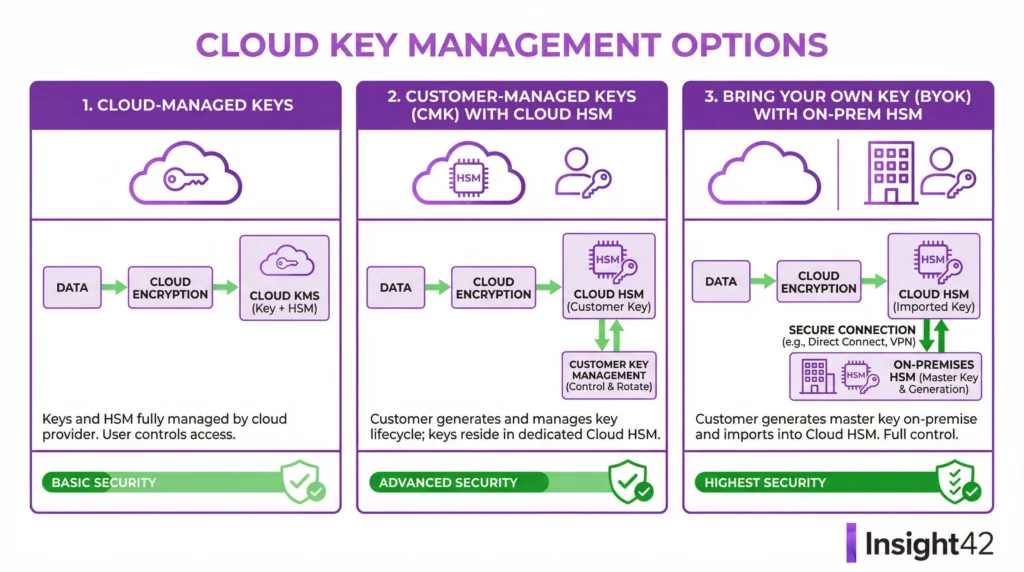
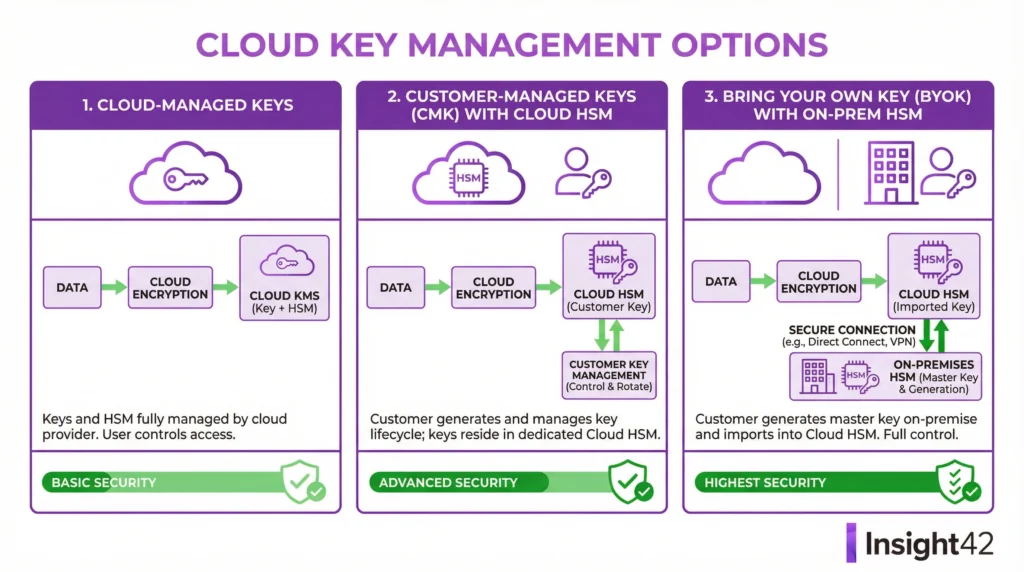
What it is: Control over the cryptographic keys used to encrypt data. Whoever holds the key, controls the data.
Why it matters: It is the ultimate lever for data sovereignty. Even if a provider could access the encrypted data, they cannot read it without the key.
Implementation: Bring Your Own Key (BYOK) or Hold Your Own Key (HYOK), where the keys remain within your own infrastructure.
Quick Checklist: Digital Sovereignty
Pillar
Key Question
Implemented?
Data Residency
Is all data guaranteed to be in Germany/EU?
☐
Control
Do we have full control over all access?
☐
Transparency
Is all access logged completely?
☐
Key Management
Do we control the cryptographic keys?
☐
Compliance
Are the requirements of GDPR, BSI C5, etc., met?
☐
To-Do List for a Sovereign Cloud Strategy
Immediately: Classify the protection needs of the data.
Week 1: Define the requirements for digital sovereignty.
Week 2: Evaluate the market for sovereign cloud offerings (e.g., Azure, GCP, T-Systems Sovereign Cloud).
Month 1: Establish a strategy for data residency and key management.
Month 2: Adapt the BSI-compliant cloud security concept accordingly.
Month 3: Start a pilot project in a sovereign cloud environment.
Sovereign Offerings from Hyperscalers
The major providers have recognized the need and offer special solutions:
Microsoft Cloud for Sovereignty: Offers data residency, enhanced controls, and transparency. Partners like T-Systems provide additional data trustee models.
Google Cloud Sovereign Solutions: Provides similar guarantees for data location and control, often in partnership with local providers.
These offerings are an important step but require careful examination. Cloud consulting for public authorities helps to validate the providers’ promises and find the right solution for your needs.
The Role of BSI C5 and IT Baseline Protection
Digital sovereignty and compliance go hand in hand. Being BSI C5 compliant is a basic requirement for a sovereign cloud. The controls in the C5 catalog cover many aspects of sovereignty, especially in the areas of transparency and operational security.
IT Baseline Protection consulting helps to integrate the BSI’s requirements into the cloud architecture. An ISO 27001 certification based on IT Baseline Protection demonstrates the effectiveness of the implemented measures.
Insight42: Your Guide to Digital Sovereignty
The path to a sovereign cloud is complex. We navigate you safely through the technological, legal, and organizational challenges. We know the offerings, the pitfalls, and the success factors.
We help you develop a strategy tailored to your specific protection needs—from data residency to external key management. Secure, BSI C5 compliant, and future-proof.
Take control. Contact us.
Figure: The Three Pillars of Digital Sovereignty in the Cloud
Blog Post 2: Cloud Key Management – BYOK vs. HYOK in Azure and GCP
Meta Description: Cloud Key Management: The ultimate lever for data sovereignty. A comparison of BYOK (Bring Your Own Key) and HYOK (Hold Your Own Key) in Azure and GCP.
Whoever Holds the Key, Holds the Power
Encryption is the foundation of cloud security. But who controls the keys? By default, the cloud provider does. This is convenient, but often not sufficient for sensitive government data. Because whoever controls the key can decrypt the data. This includes the provider itself and potentially foreign authorities.
The solution: Take control of your keys yourself. The two most important models for this are Bring Your Own Key (BYOK) and Hold Your Own Key (HYOK).
Bring Your Own Key (BYOK)
The Principle: You create your keys in your own environment (e.g., with an on-premises Hardware Security Module – HSM) and securely import them into the cloud provider’s key management system (e.g., Azure Key Vault, GCP Cloud KMS).
Advantages:
Full control over the creation and lifecycle of the key.
The key can be revoked (deleted) at any time, rendering the data unusable.
Relatively simple integration with most cloud services.
Disadvantages:
The key is physically located in the provider’s cloud. Access by the provider, though unlikely, is not 100% technically impossible.
Hold Your Own Key (HYOK) / External Key Management
The Principle: The key never leaves your own controlled environment. The cloud services send the data to be encrypted or decrypted to your external key manager. The key itself is never transferred.
Advantages:
Maximum control and sovereignty. The key is physically and logically separate from the cloud.
Access by the cloud provider or third parties is technically impossible.
Disadvantages:
Higher complexity and potentially higher latency.
Requires a highly available own key management infrastructure.
External key management is not an isolated topic. It must be integrated into the overall BSI-compliant cloud security concept. It is a central measure for meeting the requirements of BSI C5, IT Baseline Protection, and GDPR.
The processes surrounding key management must be clearly defined and documented. Who can create keys? Who approves their use? What happens in an emergency? IT Baseline Protection consulting helps to design these processes robustly.
Insight42: Experts in Cloud Key Management
We help you regain control over your keys and thus your data. We analyze your needs, compare the solutions, and implement the model that is right for you.
Whether it’s BYOK with Azure Key Vault or HYOK with external HSMs – we have the expertise to technically implement your sovereign cloud strategy. Secure, compliant, and manageable.
Lock your data securely. Talk to us.
Figure: Comparison of Key Management Models BYOK and HYOK
Data Protection Impact Assessment (DPIA) for the Cloud
Resilience, SECURITY 23rd Feb 2026Sutirtha
A Guide for Public Authorities
Meta Description: A guide to Data Protection Impact Assessments (DPIAs) for cloud projects in the public sector. GDPR-compliant, secure, and practical.
Why a DPIA is Mandatory for Cloud Projects
The cloud offers enormous opportunities, but it also poses risks to data protection. The General Data Protection Regulation (GDPR) therefore requires a Data Protection Impact Assessment (DPIA) when there is a high risk to the rights and freedoms of natural persons. For the public sector, which works with sensitive citizen data, this is almost always the case for cloud projects.
A DPIA is not an obstacle; it is a tool for risk minimization. It forces a systematic engagement with data protection and creates legal certainty for your cloud project. A missing DPIA can lead to significant fines and the halting of the project.
When Exactly is a DPIA Required?
Article 35 of the GDPR is clear. A DPIA is required, in particular, for:
Large-scale processing of special categories of data (e.g., health data).
Systematic and extensive evaluation of personal aspects (profiling).
Large-scale monitoring of publicly accessible areas.
The German Data Protection Conference (DSK) has published a positive list of processing activities for which a DPIA is generally required. The use of cloud services for specialized procedures with large amounts of data often falls into this category.
The 4 Steps of a Data Protection Impact Assessment
A DPIA follows a structured process. It is not a one-time document but a living process.
Step 1: Systematic Description
What? What data is being processed?
Why? What is the purpose of the processing?
Who? Who are the parties involved (controller, processor)?
How? What technologies and processes are being used?
Step 2: Assessment of Necessity and Proportionality
Is the processing truly necessary for the purpose? Are there milder, more data-minimizing alternatives? The legal basis must be clear.
Step 3: Risk Assessment
What are the risks to the data subjects (citizens)? (e.g., unauthorized access, data loss, discrimination). The likelihood of occurrence and the severity of the potential harm are assessed.
Step 4: Remedial Measures
What technical and organizational measures (TOMs) will be taken to minimize the risks? This includes encryption, access controls, and contractual arrangements with the cloud provider.
Quick Checklist: DPIA for the Cloud
Step
Key Question
Done?
1. Description
Is the processing completely described?
☐
2. Necessity
Is the legal basis clear and the processing proportionate?
☐
3. Risk Assessment
Are the risks to data subjects identified and assessed?
☐
4. Measures
Are effective remedial measures defined?
☐
5. Documentation
Is the entire DPIA comprehensibly documented?
☐
6. Consultation
Must the Data Protection Officer or the supervisory authority be consulted?
☐
To-Do List for the DPIA
Immediately: Clarify whether a DPIA is mandatory for the cloud project.
Week 1: Appoint a responsible team for the DPIA.
Week 2: Involve the Data Protection Officer at an early stage.
Month 1: Begin the systematic description of the processing.
Month 2: Conduct the risk assessment.
Month 3: Define remedial measures with the cloud service provider and the IT security team.
Ongoing: Update the DPIA whenever the system changes.
The Challenge: Third-Country Transfers
Since the Schrems II ruling, data transfers to the US and other third countries have become complex. Cloud providers like Microsoft (Azure) and Google (GCP) are US companies. A DPIA must explicitly assess this risk.
Remedial measures for this include:
Standard Contractual Clauses (SCCs): The standard mechanism, but often not sufficient on its own.
Additional TOMs: Strong encryption (ideally with your own keys – BYOK/HYOK), pseudonymization, anonymization.
Sovereign Cloud Options: Use of data centers in Germany/EU and contractual assurances (e.g., sovereign cloud Germany).
Insight42: Your Partner for the Cloud DPIA
A DPIA for cloud services requires legal, technical, and procedural knowledge. We connect these worlds. Our Data Protection Impact Assessment consulting is practice-oriented and tailored to the public sector.
We help you identify risks, define effective measures, and design your cloud projects to be legally compliant, in line with BSI C5 and IT Baseline Protection.
Make your data protection future-proof. Contact us.
Figure: The 4-Step Process of a Data Protection Impact Assessment for the Cloud
Blog Post 2: GDPR-Compliant Cloud Usage – TOMs in Azure and GCP
Meta Description: Implementation of Technical and Organizational Measures (TOMs) according to GDPR in Azure and GCP. Practical examples for public authorities.
From Requirement to Technology
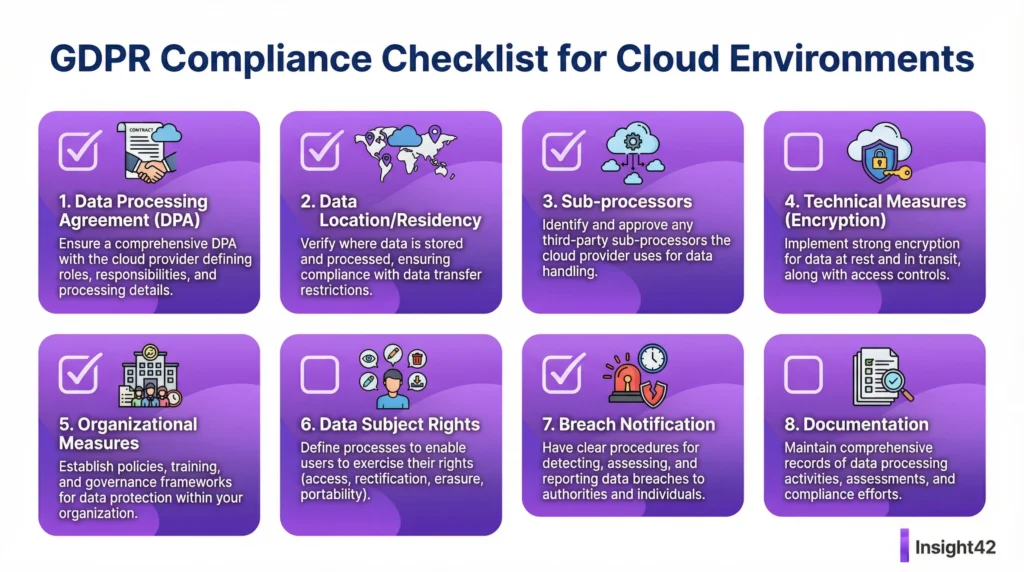
Article 32 of the GDPR calls for “appropriate technical and organizational measures” (TOMs) to ensure a level of security appropriate to the risk. But what does this mean in practice in the cloud? How do you translate legal requirements into technical configurations in Azure or GCP?
This article shows how to practically implement the abstract requirements of the GDPR using the native tools of the major cloud platforms. The cloud provider only supplies the tools; the authority, as the controller, is responsible for their correct use.
Mapping GDPR Requirements to Cloud Services
1. Pseudonymization and Encryption (Art. 32(1)(a))
Goal: Make data unreadable to unauthorized persons.
Azure:
Encryption at Rest: Transparent Data Encryption (TDE) for databases, Storage Service Encryption for storage accounts.
Encryption in Transit: Enforce TLS 1.2+ for all connections.
Key Management: Azure Key Vault for secure storage and management of keys (Bring Your Own Key – BYOK possible).
GCP:
Encryption at Rest: Enabled by default for all services.
Encryption in Transit: Default for all connections.
Key Management: Cloud Key Management Service (Cloud KMS), also with a BYOK option.
2. Confidentiality and Integrity (Art. 32(1)(b))
Goal: Ensure that only authorized persons can access data and that it cannot be altered unnoticed.
Azure:
Access Control: Entra ID with Conditional Access and MFA, Privileged Identity Management (PIM) for admin rights.
Network Security: Network Security Groups (NSGs) and Azure Firewall for segmentation.
GCP:
Access Control: Cloud IAM with Conditions, Identity-Aware Proxy (IAP) for Zero Trust access.
Network Security: VPC Firewall Rules and Cloud Armor.
3. Availability and Resilience (Art. 32(1)(b))
Goal: Ensure that systems function even in the event of disruptions or attacks.
Azure:
High Availability: Use of Availability Zones and Availability Sets.
Scalability: Virtual Machine Scale Sets, App Service Plans.
GCP:
High Availability: Distribution of instances across multiple zones.
Scalability: Managed Instance Groups (MIGs).
4. Recoverability (Art. 32(1)(c))
Goal: Be able to quickly restore data and systems after an incident.
Azure: Azure Backup for backing up VMs, databases, and file shares. Azure Site Recovery for disaster recovery.
GCP: Backup and DR Service, Snapshots for Persistent Disks.
5. Regular Testing and Evaluation (Art. 32(1)(d))
Goal: Continuously verify the effectiveness of the TOMs.
Azure: Microsoft Defender for Cloud for monitoring security configuration and detecting threats. Azure Policy for enforcing compliance rules.
GCP: Security Command Center for centralized vulnerability and compliance management.
Quick Checklist: Important TOMs in the Cloud
TOM Category
Measure
Implemented?
Encryption
Data-at-Rest & Data-in-Transit fully active
☐
Access
MFA for all administrative and privileged accounts
☐
Network
Strict segmentation and firewall rules
☐
Backup
Regular, tested backups of all critical systems
☐
Monitoring
Continuous monitoring of security configuration
☐
Patching
Timely application of security updates
☐
TOMs as Part of the Security Concept
The defined TOMs are a central component of the security concept according to BSI C5 or IT Baseline Protection. They demonstrate how information security objectives are technically implemented. Good documentation of the TOMs is therefore essential not only for GDPR but also for audits according to BSI C5 or ISO 27001.
Cloud consulting for public authorities helps to select and implement the right TOMs for your specific requirements. It is not about doing everything that is technically possible, but what is appropriate for the risk.
Insight42: We Make Your Cloud GDPR-Compliant
We translate the GDPR into the language of the cloud. We configure Azure and GCP to meet the requirements for technical and organizational measures—securely, documented, and auditable.
Our Managed Cloud Operations include the continuous monitoring and optimization of your TOMs. This ensures that your data protection level remains high even as threats and technologies change.
Implement data protection technically. Talk to us.
Figure: Technical and Organizational Measures (TOMs) according to GDPR in the Cloud
data protection impact assessment cloud, gdpr cloud, technical and organisational measures, toms gdpr, public sector cloud migration, bsi c5 compliant, it baseline protection consulting, sovereign cloud germany, azure data protection, gcp data protection, schrems ii, third country transfer, cloud consulting for authorities, bsi cloud security concept, data security, data protection compliant, data processing agreement, dpa cloud
“))oxiaomi.file(action = “write”, brief = “Translate the seventh blog post file into English”, path = “/home/ubuntu/insight42_blogs/final_docs/en/07_gdpr_dsfa_dpia.md”, text = “# Topic 7: GDPR + DPIA for cloud workloads
Blog Post 1: Data Protection Impact Assessment (DPIA) for the Cloud – A Guide for Public Authorities
Meta Description: A guide to Data Protection Impact Assessments (DPIAs) for cloud projects in the public sector. GDPR-compliant, secure, and practical.
Why a DPIA is Mandatory for Cloud Projects
The cloud offers enormous opportunities, but it also poses risks to data protection. The General Data Protection Regulation (GDPR) therefore requires a Data Protection Impact Assessment (DPIA) when there is a high risk to the rights and freedoms of natural persons. For the public sector, which works with sensitive citizen data, this is almost always the case for cloud projects.
A DPIA is not an obstacle; it is a tool for risk minimization. It forces a systematic engagement with data protection and creates legal certainty for your cloud project. A missing DPIA can lead to significant fines and the halting of the project.
When Exactly is a DPIA Required?
Article 35 of the GDPR is clear. A DPIA is required, in particular, for:
Large-scale processing of special categories of data (e.g., health data).
Systematic and extensive evaluation of personal aspects (profiling).
Large-scale monitoring of publicly accessible areas.
The German Data Protection Conference (DSK) has published a positive list of processing activities for which a DPIA is generally required. The use of cloud services for specialized procedures with large amounts of data often falls into this category.
The 4 Steps of a Data Protection Impact Assessment
A DPIA follows a structured process. It is not a one-time document but a living process.
Step 1: Systematic Description
What? What data is being processed?
Why? What is the purpose of the processing?
Who? Who are the parties involved (controller, processor)?
How? What technologies and processes are being used?
Step 2: Assessment of Necessity and Proportionality
Is the processing truly necessary for the purpose? Are there milder, more data-minimizing alternatives? The legal basis must be clear.
Step 3: Risk Assessment
What are the risks to the data subjects (citizens)? (e.g., unauthorized access, data loss, discrimination). The likelihood of occurrence and the severity of the potential harm are assessed.
Step 4: Remedial Measures
What technical and organizational measures (TOMs) will be taken to minimize the risks? This includes encryption, access controls, and contractual arrangements with the cloud provider.
Quick Checklist: DPIA for the Cloud
Step
Key Question
Done?
1. Description
Is the processing completely described?
☐
2. Necessity
Is the legal basis clear and the processing proportionate?
☐
3. Risk Assessment
Are the risks to data subjects identified and assessed?
☐
4. Measures
Are effective remedial measures defined?
☐
5. Documentation
Is the entire DPIA comprehensibly documented?
☐
6. Consultation
Must the Data Protection Officer or the supervisory authority be consulted?
☐
To-Do List for the DPIA
Immediately: Clarify whether a DPIA is mandatory for the cloud project.
Week 1: Appoint a responsible team for the DPIA.
Week 2: Involve the Data Protection Officer at an early stage.
Month 1: Begin the systematic description of the processing.
Month 2: Conduct the risk assessment.
Month 3: Define remedial measures with the cloud service provider and the IT security team.
Ongoing: Update the DPIA whenever the system changes.
The Challenge: Third-Country Transfers
Since the Schrems II ruling, data transfers to the US and other third countries have become complex. Cloud providers like Microsoft (Azure) and Google (GCP) are US companies. A DPIA must explicitly assess this risk.
Remedial measures for this include:
Standard Contractual Clauses (SCCs): The standard mechanism, but often not sufficient on its own.
Additional TOMs: Strong encryption (ideally with your own keys – BYOK/HYOK), pseudonymization, anonymization.
Sovereign Cloud Options: Use of data centers in Germany/EU and contractual assurances (e.g., sovereign cloud Germany).
Insight42: Your Partner for the Cloud DPIA
A DPIA for cloud services requires legal, technical, and procedural knowledge. We connect these worlds. Our Data Protection Impact Assessment consulting is practice-oriented and tailored to the public sector.
We help you identify risks, define effective measures, and design your cloud projects to be legally compliant, in line with BSI C5 and IT Baseline Protection.
Make your data protection future-proof. Contact us.
Figure: The 4-Step Process of a Data Protection Impact Assessment for the Cloud
Blog Post 2: GDPR-Compliant Cloud Usage – TOMs in Azure and GCP
Meta Description: Implementation of Technical and Organizational Measures (TOMs) according to GDPR in Azure and GCP. Practical examples for public authorities.
From Requirement to Technology
Article 32 of the GDPR calls for “appropriate technical and organizational measures” (TOMs) to ensure a level of security appropriate to the risk. But what does this mean in practice in the cloud? How do you translate legal requirements into technical configurations in Azure or GCP?
This article shows how to practically implement the abstract requirements of the GDPR using the native tools of the major cloud platforms. The cloud provider only supplies the tools; the authority, as the controller, is responsible for their correct use.
Mapping GDPR Requirements to Cloud Services
1. Pseudonymization and Encryption (Art. 32(1)(a))
Goal: Make data unreadable to unauthorized persons.
Azure:
Encryption at Rest: Transparent Data Encryption (TDE) for databases, Storage Service Encryption for storage accounts.
Encryption in Transit: Enforce TLS 1.2+ for all connections.
Key Management: Azure Key Vault for secure storage and management of keys (Bring Your Own Key – BYOK possible).
GCP:
Encryption at Rest: Enabled by default for all services.
Encryption in Transit: Default for all connections.
Key Management: Cloud Key Management Service (Cloud KMS), also with a BYOK option.
2. Confidentiality and Integrity (Art. 32(1)(b))
Goal: Ensure that only authorized persons can access data and that it cannot be altered unnoticed.
Azure:
Access Control: Entra ID with Conditional Access and MFA, Privileged Identity Management (PIM) for admin rights.
Network Security: Network Security Groups (NSGs) and Azure Firewall for segmentation.
GCP:
Access Control: Cloud IAM with Conditions, Identity-Aware Proxy (IAP) for Zero Trust access.
Network Security: VPC Firewall Rules and Cloud Armor.
3. Availability and Resilience (Art. 32(1)(b))
Goal: Ensure that systems function even in the event of disruptions or attacks.
Azure:
High Availability: Use of Availability Zones and Availability Sets.
Scalability: Virtual Machine Scale Sets, App Service Plans.
GCP:
High Availability: Distribution of instances across multiple zones.
Scalability: Managed Instance Groups (MIGs).
4. Recoverability (Art. 32(1)(c))
Goal: Be able to quickly restore data and systems after an incident.
Azure: Azure Backup for backing up VMs, databases, and file shares. Azure Site Recovery for disaster recovery.
GCP: Backup and DR Service, Snapshots for Persistent Disks.
5. Regular Testing and Evaluation (Art. 32(1)(d))
Goal: Continuously verify the effectiveness of the TOMs.
Azure: Microsoft Defender for Cloud for monitoring security configuration and detecting threats. Azure Policy for enforcing compliance rules.
GCP: Security Command Center for centralized vulnerability and compliance management.
Quick Checklist: Important TOMs in the Cloud
TOM Category
Measure
Implemented?
Encryption
Data-at-Rest & Data-in-Transit fully active
☐
Access
MFA for all administrative and privileged accounts
☐
Network
Strict segmentation and firewall rules
☐
Backup
Regular, tested backups of all critical systems
☐
Monitoring
Continuous monitoring of security configuration
☐
Patching
Timely application of security updates
☐
TOMs as Part of the Security Concept
The defined TOMs are a central component of the security concept according to BSI C5 or IT Baseline Protection. They demonstrate how information security objectives are technically implemented. Good documentation of the TOMs is therefore essential not only for GDPR but also for audits according to BSI C5 or ISO 27001.
Cloud consulting for public authorities helps to select and implement the right TOMs for your specific requirements. It is not about doing everything that is technically possible, but what is appropriate for the risk.
Insight42: We Make Your Cloud GDPR-Compliant
We translate the GDPR into the language of the cloud. We configure Azure and GCP to meet the requirements for technical and organizational measures—securely, documented, and auditable.
Our Managed Cloud Operations include the continuous monitoring and optimization of your TOMs. This ensures that your data protection level remains high even as threats and technologies change.
Implement data protection technically. Talk to us.
Figure: Technical and Organizational Measures (TOMs) according to GDPR in the Cloud
Resilience, SECURITY, Sovereignty Series 20th Feb 2026Martin-Peter Lambert
A Guide for Public Authorities
Meta Description: BSI C5 Cloud certification for the public sector. Audit readiness, compliance requirements, and the BSI-compliant cloud security concept.
What is BSI C5?
BSI C5 is the German standard for cloud security, developed by the Federal Office for Information Security (BSI). It defines minimum requirements for cloud services and is often mandatory for the public sector.
Is cloud migration for the public sector possible without BSI C5? It’s risky. Tenders for cloud migration usually demand it, and the procurement process for cloud service providers verifies the certification.
The Structure of BSI C5
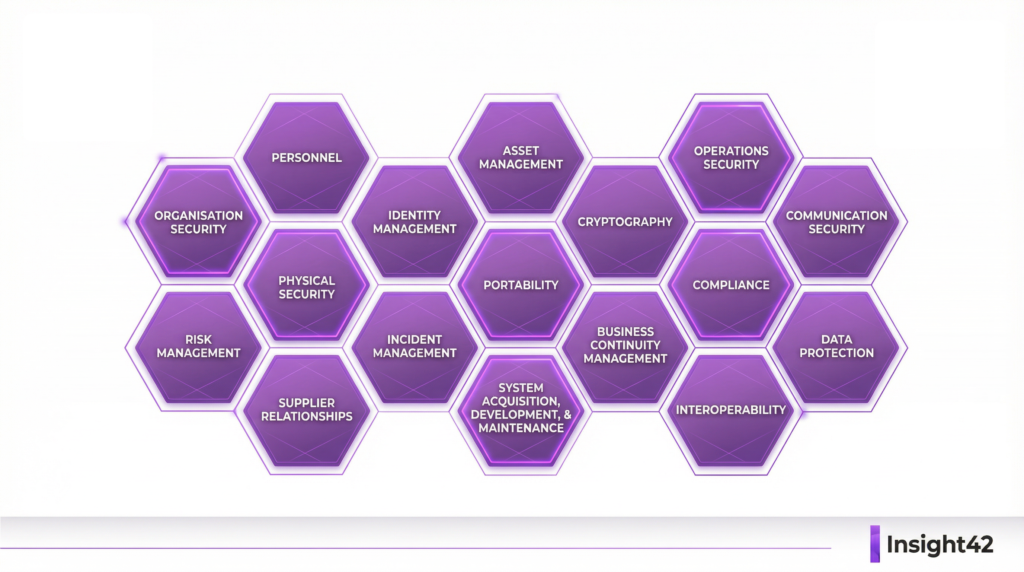
BSI C5 comprises 17 requirement domains, from organization to incident management. Each domain contains specific controls that must be demonstrated.
The 17 Domains at a Glance:
Information Security Organization, Security Policies, Human Resources, Asset Management, Physical Security, Operations Security, Identity and Access Management, Cryptography, Communication Security, Portability and Interoperability, Procurement and Development, Supplier Relationships, Security Incident Management, Compliance, Data Protection, Product Security, Interoperability.
Type 1 vs. Type 2 Attestation
BSI C5 has two attestation types, and the difference is important.
Type 1 Attestation
This assesses the appropriateness of the controls at a specific point in time. – Are the controls designed? – Are they implemented?
Type 2 Attestation
This assesses the effectiveness of the controls over a period of at least six months. – Do the controls work? – Are they being followed?
For public authorities, a Type 2 attestation is usually required. It offers more security and demonstrates continuous compliance.
Quick Checklist: BSI C5 Readiness
Domain
Checkpoint
Status
Organization
ISMS Established
☐
Policies
Security Policies Documented
☐
Personnel
Awareness Training Conducted
☐
Assets
Inventory Complete
☐
Access
IAM Implemented
☐
Cryptography
Encryption Active
☐
Logging
Logging Enabled
☐
Incident
Process Defined
☐
To-Do List for BSI C5 Certification
Month 1: Conduct a gap analysis.
Month 2: Create an action plan.
Months 3-6: Implement controls.
Month 7: Perform an internal audit.
Month 8: Conduct an external pre-audit.
Months 9-10: Undergo the Type 1 audit.
Months 11-16: Operational phase.
Month 17: Undergo the Type 2 audit.
The Path to Attestation
Becoming BSI C5 compliant is a project. It requires planning, resources, and expertise.
Step 1: Gap Analysis
Where do you stand today? Which controls are missing? IT baseline protection consulting helps with the assessment. The gap analysis shows the way forward.
Step 2: Action Planning
What measures are necessary?
In what order? With what budget?
The action plan is created and when is it due?
Step 3: Implementation
Controls are introduced
Processes are established
Documentation is created
The BSI-compliant cloud security concept is developed
Step 4: Audit
An auditor conducts the review. The controls are tested. Evidence is collected. The attestation is issued.
Cloud Providers and BSI C5
Major cloud providers like Azure, GCP, and AWS have BSI C5 attestations. But that’s not enough to claim that using them makes you compliant—quite the opposite. Because of the shared responsibility model, you still need to implement the right controls and operate them correctly. Only then can you be C5-compliant.
Azure migration and GCP migration must consider BSI C5. An Azure Landing Zone and a GCP Landing Zone should incorporate BSI C5 controls. The Cloud Adoption Framework for Azure helps with this.
Insight42 BSI C5 Services
We guide public authorities to BSI C5 compliance, from gap analysis to the audit. By provide the BSI-compliant cloud security concept from a single source and the implementation of those, we make your life easy, compliant and reliable.
Our cloud consulting services for authorities with a BSI C5 focus and cloud managed services for continuous compliance are delivered on Critical (KRITIS) level and have been withstanding audits and security challenges.
Become BSI C5 compliant. Contact us.
Figure: The Path to BSI C5 Certification
Blog Post 2: Preparing for a BSI C5 Audit – Practical Tips for the Public Sector
Meta Description: BSI C5 audit preparation for public authorities. Practical tips, documentation, and evidence collection. Create a BSI-compliant cloud security concept.
The Audit is Approaching
You have decided on BSI C5. Implementation is underway. Now comes the audit. How do you prepare? What can you expect?
BSI C5 audits are thorough. Auditors want to see evidence, not just documents, but also established practices. This article prepares you.
Documentation is Everything
No attestation without documentation. Auditors can only audit what is documented. Every control needs evidence. Every process needs a description.
What must be documented: Security policies and their approval, process descriptions with responsibilities, configuration standards and their implementation, employee training records, and logs as proof.
The Most Common Audit Findings
Preparation also means avoiding mistakes. These findings are common:
Incomplete Documentation
Controls exist but are not documented, or the documentation is outdated. Solution: Keep documentation current by automising it via IT, BI & AI. We do that all the time, ensuring reality and documentation are always in sync.
Missing Evidence
Processes are followed but not logged. Solution: Enable logging and recording.
Inconsistent Implementation
Policies exist but are not followed. Solution: Conduct regular internal audits.
Unclear Responsibilities
No one feels responsible. Solution: Create a RACI matrix.
Quick Checklist: Audit Preparation
Document
Content
Current?
ISMS Manual
Overall Security Overview
☐
Security Policies
All Policies
☐
Risk Analysis
Current Assessment
☐
Asset Register
Complete Inventory
☐
Access Matrix
Permissions Documented
☐
Incident Log
Incidents Logged
☐
Training Records
All Employees
☐
Audit Trail
Changes Traceable
☐
To-Do List for Audit Readiness
8 weeks prior: Fully review documentation.
6 weeks prior: Conduct an internal pre-audit.
4 weeks prior: Remediate findings.
2 weeks prior: Compile evidence.
1 week prior: Brief interview partners.
Audit Day: Stay calm, cooperate.
After Audit: Remediate findings promptly.
The BSI-Compliant Cloud Security Concept
The security concept is the centerpiece. It comprehensively describes your cloud security. Auditors will read it carefully.
Contents of the Security Concept:
Scope and demarcation of cloud use, risk analysis and assessment, technical and organizational measures, responsibilities and processes, and emergency and business continuity management.
IT baseline protection consulting helps with its creation. ISO 27001 based on IT-Grundschutz provides the structure. The result: an audit-proof document.
Mastering Interviews
Auditors conduct interviews. They want to understand how controls are put into practice. Preparation is of the utmost importance!
Continuous Compliance
BSI C5 is not a one-time project; it is a continuous process. After the audit is before the audit.
Cloud managed services for authorities help with this through continuous monitoring, regular reviews, and automated compliance checks.
Azure managed services and GCP operations provide support with dashboards showing compliance status and alerts for deviations.
Insight42 Audit Support
We guide you through the audit: preparation, execution, and follow-up, with experienced consultants by your side.
We create the BSI-compliant cloud security concept together. IT baseline protection consulting is our core business. BSI C5 compliance is our goal.
AI In The Public Sector, Azure CAF & Cloud Migration, Growth, Resilience, Sovereignty Series 18th Feb 2026Martin-Peter Lambert
The Path to Zero Trust
Meta Description: Entra ID Migration for Public Authorities is essential for organisations in the public sector seeking to implement SSO, MFA, and Zero Trust. BSI C5 compliant and IT-Grundschutz ready.
Identity is the New Perimeter
Firewalls alone are no longer enough. Employees work from anywhere. Cloud services are distributed. Identity has become the central security anchor. Zero Trust is the answer.
This is particularly relevant for the public sector. Sensitive data must be protected. An Entra ID migration creates the foundation. BSI C5 Cloud requirements are met.
What Zero Trust Means
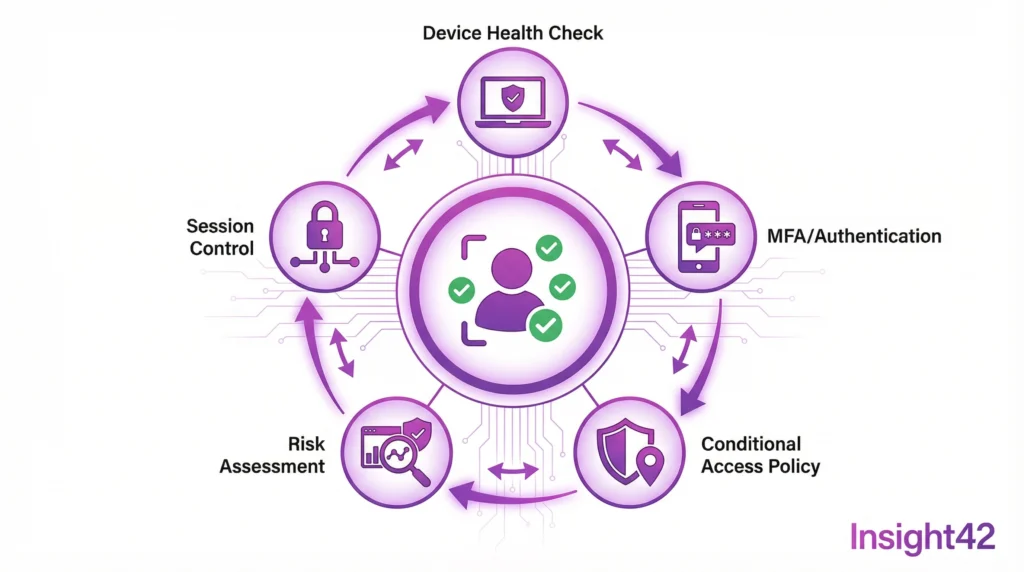
Zero Trust is a security model: never trust, always verify. Every access attempt is checked. Every identity is validated.
It sounds strict, and it is. But it works. Attacks are made more difficult. Lateral movement is prevented. The BSI-compliant cloud security concept recommends this approach.
The Pillars of Zero Trust
Verify Identity
Who is accessing the resource? Is the person who they claim to be? Multi-Factor Authentication is mandatory. Passwords alone are not enough.
Validate Device
From which device is the access coming? Is it managed? Is it compliant? Conditional Access checks these factors.
Minimize Access
The principle of least privilege applies. Only necessary rights, only for the necessary time. Just-in-Time access becomes the standard.
Monitor Activities
Every access is logged. Anomalies are detected. Automated responses are triggered.
Quick Checklist: Zero Trust Implementation
Component
Action
Priority
MFA
Enable for all users
Critical
SSO
Set up Single Sign-On
High
Conditional Access
Create baseline policies
High
PIM
Implement Privileged Identity Management
High
Device Compliance
Define device policies
Medium
App Protection
Configure application protection
Medium
Monitoring
Monitor sign-in logs
Medium
To-Do List for Entra ID Migration
Immediately: Enable MFA for administrators.
Week 1: Take inventory of identities.
Week 2: Define the SSO strategy.
Week 3: Plan Conditional Access policies.
Month 1: Migrate a pilot group.
Month 2: Roll out to all users.
Month 3: Implement PIM.
SSO Simplifies and Secures
Single Sign-On is not a luxury; it is a security feature. Fewer passwords mean less risk. Users use strong passwords because they only need one.
Entra ID enables SSO for thousands of applications, both in the cloud and on-premises. SAML, OAuth, and OpenID Connect are all supported.
SSO is essential for public sector cloud migration. Azure migration and GCP migration benefit. Users work seamlessly while security is maintained.
Implementing MFA Correctly
Multi-Factor Authentication is mandatory. BSI C5 compliance without MFA? Impossible. IT baseline protection consulting requires it, as does NIS2 compliance consulting.
But MFA must be user-friendly. Authenticator apps are standard. Biometrics where possible. Hardware tokens for high security.
Conditional Access makes MFA intelligent. Not for every login, only when there is a risk. Unknown device? MFA. Unusual location? MFA.
Protecting Privileged Identities
Administrators are prime targets. Their accounts have extensive rights. Privileged Identity Management (PIM) protects them.
The principle is Just-in-Time access. Rights are activated only when needed, for a limited time, and with approval.
The BSI-compliant cloud security concept demands these controls. KRITIS cloud security requires them. Insight42 implements them.
Insight42 Identity Services
We are experts in Entra ID migration. Zero Trust is our standard. BSI C5 compliance is our promise.
From strategy to operation, we offer cloud managed services for identity for public authorities, including Azure managed services.
Secure your identities. Contact us.
[Image: Zero Trust Architecture]
Figure: Zero Trust Identity Architecture for Public Authorities
Blog Post 2: Conditional Access and MFA – Intelligent Access Control for Public Administration
Meta Description: Conditional Access and MFA for public authorities. Intelligent, BSI C5 compliant, and IT-Grundschutz-based access control. Secure and user-friendly.
Rethinking Access Control
Old models are obsolete. Once authenticated, always trusted? Dangerous. Conditional Access changes the game. Every access is evaluated. Context is key.
This is revolutionary for the public sector. Security becomes dynamic. User-friendliness is maintained. A cloud-first administration becomes secure.
What Conditional Access Does
Conditional Access is a policy framework that evaluates access in real-time. Who? From where? With what device? To what? These questions are answered.
Based on the answers, decisions are made: allow access, block access, require MFA, or restrict the session.
Understanding the Signals
User and Group
Who is accessing? Administrators have different rules than standard users. Externals different from internals.
Location
Where is the access coming from? Known networks are more trustworthy. Unknown countries are blocked.
Device
Is the device managed? Is it compliant? Unknown devices require additional verification.
Application
Which app is being accessed? Sensitive applications need stronger protection.
Risk
Entra ID automatically assesses risk. Unusual behavior is detected. Compromised accounts are locked.
Quick Checklist: Conditional Access Policies
Policy
Goal
Action
MFA for Admins
Protect privileged accounts
Enforce MFA
Blocked Countries
Stop attacks from high-risk regions
Block access
Compliant Devices
Allow only secure devices
Require compliance
Block Legacy Auth
Prevent insecure protocols
Block
Session Timeout
Reduce risk during inactivity
Limit session
App Protection
Protect sensitive apps
Require MFA + Compliance
To-Do List for Conditional Access
Day 1: Activate report-only mode.
Week 1: Define baseline policies.
Week 2: Enforce MFA for all admins.
Week 3: Block legacy authentication.
Month 1: Introduce device compliance.
Month 2: Implement location-based policies.
Month 3: Implement risk-based policies.
Comparing MFA Methods
Not all MFA methods are equal. Some are more secure, others more user-friendly. The right choice depends on the context.
Microsoft Authenticator
Push notifications are simple. Number matching increases security. Passwordless login is possible.
FIDO2 Security Keys
Hardware-based and phishing-resistant. Ideal for high-security environments. Slightly higher cost.
SMS and Phone
Easy to implement, but less secure. Recommended only as a fallback.
Windows Hello
On-device biometrics. Very user-friendly. Requires compatible hardware.
Meeting Compliance Requirements
BSI C5 Cloud demands strong authentication. Conditional Access delivers it. IT baseline protection consulting confirms compliance.
ISO 27001 based on IT-Grundschutz requires access control. Conditional Access documents every access. Audits are passed.
NIS2 compliance consulting recommends Zero Trust. Conditional Access is a core component. It supports the Data Protection Impact Assessment for the cloud.
Integration with Other Services
Conditional Access does not stand alone. It integrates with Microsoft Defender, uses Intune for device compliance, and connects to SIEM for monitoring.
Public sector cloud migration benefits from this integration. The Azure Landing Zone includes Conditional Access. Azure managed services monitor the policies.
Insight42 Conditional Access Services
We design Conditional Access strategies tailored for public authorities. BSI C5 compliant and user-friendly.
From analysis to implementation, we provide cloud consulting for authorities with a focus on identity and cloud managed services for operations.
Control access intelligently. Talk to us.
www.insight42.de
Azure ExpressRoute for Public Authorities –
AI In The Public Sector, Resilience, Sovereignty Series 16th Feb 2026Martin-Peter Lambert
A Secure Connection to the Cloud
Meta Description: Azure ExpressRoute setup for the public sector. Secure connectivity, BSI C5 compliant, and datacenter migration to Azure with a dedicated line.
Why ExpressRoute is Essential for Public Authorities
The public internet is not an option. Sensitive government data requires dedicated connections. An Azure ExpressRoute setup provides this security through private lines, guaranteed bandwidth, and low latency.
Cloud migration for the public sector demands reliable connectivity. A datacenter migration to Azure only works with a stable connection. ExpressRoute delivers both: security and performance.
What Azure ExpressRoute Offers
ExpressRoute is a private connection that completely bypasses the internet. Data flows over dedicated lines, with carrier partners providing the infrastructure.
For the public sector, this means BSI C5 cloud requirements are met. The BSI-compliant cloud security concept can point to secure connectivity, strengthening KRITIS cloud security.
Understanding the Architecture
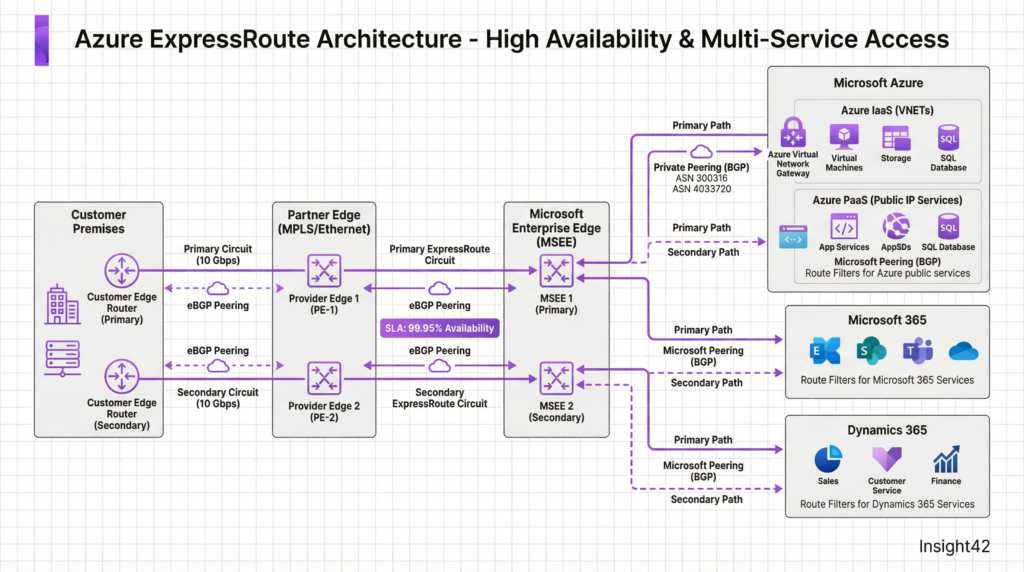
ExpressRoute Circuit
The circuit is the physical connection linking your data center to Microsoft. Various bandwidths are available, from 50 Mbps to 100 Gbps.
Peering Types
Private Peering connects to Azure VNets, while Microsoft Peering reaches Microsoft 365. Both can be used in parallel.
Redundancy
High availability requires redundancy. Two circuits at different locations ensure automatic failover in case of an outage, meeting government SLAs.
Quick Checklist: ExpressRoute Setup
Step
Task
Responsible
1
Determine Bandwidth Needs
IT Department
2
Select Carrier Partner
Procurement
3
Order Circuit
Carrier
4
Configure Azure
Cloud Team
5
Set Up Routing
Network Team
6
Implement Redundancy
Cloud Team
7
Activate Monitoring
Operations
To-Do List for Secure Connectivity
Today: Analyze current bandwidth usage.
This Week: Research carrier options.
This Month: Create the ExpressRoute design.
Quarter 1: Commission the circuit.
Quarter 2: Start migration over ExpressRoute.
Mastering Hybrid Scenarios
Not everything moves to the cloud at once. Hybrid architectures are a reality. ExpressRoute connects both worlds, allowing on-premises and Azure to work together.
A VMware to Azure migration particularly benefits, as large data volumes are transferred quickly. Replication runs in the background, and the cutover occurs without significant downtime.
Security at All Levels
ExpressRoute is secure by design, but additional measures are possible, such as encryption over the line and IPsec tunnels for extra protection.
IT baseline protection consulting recommends defense in depth. Multiple security layers, with ExpressRoute being one, are complemented by firewalls and segmentation.
Costs and Procurement
Azure ExpressRoute has two cost components: Microsoft charges for the circuit, and the carrier charges for the line. Both must be budgeted.
A cloud framework agreement can simplify procurement. A cloud migration tender should include connectivity. Cloud migration costs become transparent.
Insight42 Connectivity Services
We plan and implement ExpressRoute, from needs analysis to operation. Azure migration consulting includes connectivity.
Azure managed services monitor the connection with proactive monitoring and rapid response to issues, ensuring SLA-compliant operation.
Connect securely. Contact us.
Azure ExpressRoute Architecture
Figure: Azure ExpressRoute Architecture for Public Authorities
Blog Post 2: Multi-Cloud Connectivity – Combining ExpressRoute and Cloud Interconnect
Meta Description: Multi-cloud connectivity with Azure ExpressRoute and Google Cloud Interconnect. Secure connections for the federal multi-cloud strategy.
Multi-Cloud Needs Multi-Connectivity
The federal multi-cloud strategy is a reality. Azure and GCP are used in parallel. But how do you connect them securely? The answer: dedicated lines to both clouds.
Azure ExpressRoute for Microsoft and Google Cloud Interconnect for GCP. Both operate on similar principles and offer enterprise-grade security.
Understanding Google Cloud Interconnect
Cloud Interconnect is Google’s equivalent of ExpressRoute. Dedicated Interconnect provides physical connections, while Partner Interconnect uses carrier infrastructure.
Interconnect is crucial for GCP migration. Large data volumes must be transferred. GKE migration benefits from low latency. Google Cloud migration partners recommend dedicated connections.
The Architecture for Multi-Cloud
Central Network Hub
A hub connects everything: on-premises, Azure, and GCP. Routing is centrally controlled, and security is uniformly enforced.
ExpressRoute to the Azure Hub
Private Peering connects to Azure VNets. A hub-and-spoke topology distributes traffic. The Azure Landing Zone is the destination.
Interconnect to the GCP Hub
Use either Dedicated or Partner Interconnect. A Shared VPC receives the traffic. The GCP Landing Zone takes over.
Inter-Cloud Connection
Azure and GCP can also be connected directly through partner solutions or the central hub.
Quick Checklist: Multi-Cloud Connectivity
Cloud
Connection Type
Bandwidth
Redundancy
Azure
ExpressRoute
As needed
Dual Circuit
GCP
Dedicated Interconnect
As needed
Dual Attachment
Inter-Cloud
Partner/Hub
As needed
Active-Active
To-Do List for a Multi-Cloud Network
Week 1: Conduct a traffic analysis.
Week 2: Create a connectivity design.
Week 3: Prepare the carrier tender.
Month 1: Order ExpressRoute.
Month 2: Order Interconnect.
Month 3: Optimize routing.
Month 4: Establish monitoring.
VPN as a Backup and Entry Point
Not every authority needs dedicated lines immediately. VPN is a valid entry point. A Site-to-Site VPN connects securely at a lower cost.
Azure VPN Gateway and Cloud VPN from GCP both support IPsec and offer high availability. They are often sufficient for smaller workloads.
The transition to ExpressRoute or Interconnect can happen later when bandwidth or latency become critical. Cloud migration consulting helps with the decision.
Connectivity Compliance
Being BSI C5 compliant also means secure connections. The BSI-compliant cloud security concept must address connectivity. Encryption is mandatory, even on dedicated lines.
A Data Protection Impact Assessment (DPIA) for the cloud considers data flows. Where does data flow? Via which paths? These questions must be answered.
Optimizing Costs
Multi-cloud connectivity is not cheap, but it is necessary. FinOps approaches help with optimization. Traffic routing is analyzed, and costs are allocated.
A fixed-price for cloud migration can include connectivity. A cloud migration offer should be transparent. IT service providers for the public sector know the requirements.
Insight42 Multi-Cloud Network Services
We design multi-cloud networks, providing ExpressRoute and Interconnect from a single source for secure, performant, and cost-effective solutions.
Cloud managed services for authorities monitor the connections with proactive monitoring and rapid troubleshooting, guaranteed by SLAs.
Connect your clouds. Talk to us.
Figure: Multi-Cloud Connectivity with ExpressRoute and Interconnect
IT Baseline Protection – ISO 27001 (Based on IT Baseline Protection)
Resilience, SECURITY 15th Feb 2026Martin-Peter Lambert
ISO 27001 Based on IT Baseline Protection – The Royal Road for Public Authorities
Meta Description: ISO 27001 certification based on IT Baseline Protection (IT-Grundschutz). The proven path for the public sector. BSI-compliant, secure, and efficient.
Why IT Baseline Protection is the Standard for Public Authorities
The BSI’s IT Baseline Protection is more than a recommendation; it is the de facto standard for information security in German public administration. It offers concrete measures, field-tested building blocks, and a clear methodology, which makes it incredibly valuable.
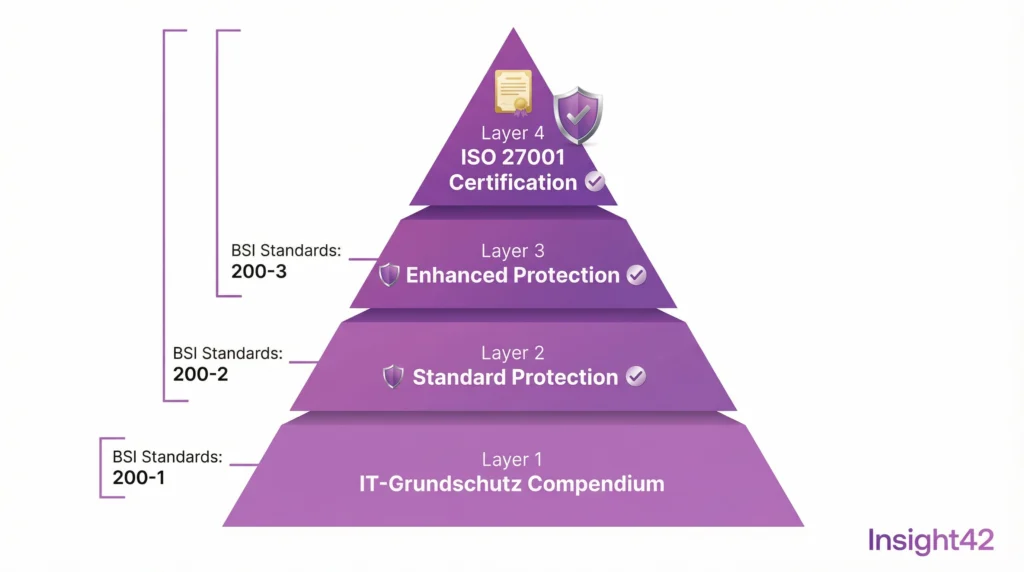
An ISO 27001 certification is internationally recognized and demonstrates a functioning Information Security Management System (ISMS). Combining these two worlds is ideal: the specific guidelines of IT Baseline Protection fulfill the abstract requirements of ISO 27001.
The Synergy of IT Baseline Protection and ISO 27001
ISO 27001 requires an ISMS but does not specify how to implement it. IT Baseline Protection provides exactly that: a detailed guide. Those who implement IT Baseline Protection have already done most of the work for an ISO 27001 certification.
The advantages of this combination:
Concrete and Field-Tested: IT Baseline Protection offers ready-made building blocks.
BSI-Recognized: The methodology is well-established within the German public sector.
Efficient: It avoids duplication of effort.
Internationally Recognized: The ISO 27001 certification builds trust.
The Path to Certification
Step 1: Structural Analysis
Which information, processes, and IT systems need protection? The structural analysis defines the scope of the ISMS.
Step 2: Protection Needs Assessment
How critical is the data? Normal, high, or very high? The protection needs assessment evaluates the requirements for confidentiality, integrity, and availability.
Step 3: Modeling According to IT Baseline Protection
The identified systems are mapped to the building blocks of the IT-Grundschutz Compendium. The result is a list of relevant requirements.
Step 4: Basic Security Check
This is a gap analysis. Which requirements are already implemented? Where are the gaps? The basic security check identifies the need for action.
Step 5: Implementation and Audit
The gaps are closed. The ISMS is put into practice. An external auditor verifies conformity and issues the ISO 27001 certificate.
Quick Checklist: ISO 27001 Based on IT Baseline Protection
Phase
Task
Status
1. Preparation
Define Scope
☐
2. Analysis
Conduct Structural Analysis
☐
3. Assessment
Determine Protection Needs
☐
4. Modeling
Map IT Baseline Protection Building Blocks
☐
5. Gap Analysis
Perform Basic Security Check
☐
6. Implementation
Execute Action Plan
☐
7. Audit
Certification Audit
☐
To-Do List for Project Managers
Immediately: Secure management commitment.
Week 1: Appoint an ISMS team.
Week 2: Commission IT Baseline Protection consulting.
Month 1: Start the structural analysis.
Month 2: Complete the protection needs assessment.
Quarter 2: Conduct the basic security check.
Quarters 3-4: Implement measures.
Next Year: Plan the certification audit.
IT Baseline Protection in the Cloud
The principles of IT Baseline Protection also apply in the cloud, but the implementation differs. Responsibility is shared. Cloud providers (Azure, GCP) deliver a secure foundation, while the authority is responsible for secure configuration and use (Shared Responsibility Model).
An ISO 27001 certification based on IT Baseline Protection for cloud workloads is possible. It requires a clear understanding of responsibilities. BSI C5 Cloud requirements are also integrated here. The BSI-compliant cloud security concept documents the implementation.
Insight42: Your Partner for IT Baseline Protection
We are experts in ISO 27001 based on IT Baseline Protection. We understand the requirements of the public sector. Our IT Baseline Protection consulting is field-tested and efficient.
We guide you from the initial analysis to successful certification and beyond, with managed services for continuous security and compliance.
Start on the secure path. Contact us.
Figure: The Synergy of IT Baseline Protection and ISO 27001
Blog Post 2: IT Baseline Protection in the Cloud – Practical Implementation in Azure and GCP
Meta Description: Practically implement IT Baseline Protection in the cloud. ISO 27001 based on IT-Grundschutz for Azure and GCP. BSI C5 compliant, secure, and for public authorities.
IT Baseline Protection Meets the Cloud
IT Baseline Protection is not limited to on-premises environments. Its principles are universal, but implementation in the cloud requires a new way of thinking. The Shared Responsibility Model is key. Who is responsible for what? This question must be answered clearly.
For the public sector, cloud migration means reinterpreting IT Baseline Protection. The building blocks do not change, but the way the requirements are met does. Automation and cloud-native tools play a central role.
The Shared Responsibility Model in Detail
Cloud Provider (e.g., Azure, GCP): Responsible for the security of the cloud. This includes the physical security of data centers, the security of the virtualization layer, and the basic infrastructure.
Customer (Authority): Responsible for security in the cloud. This includes service configuration, identity and access management, data protection, and operating system patching.
IT Baseline Protection consulting helps to define this demarcation clearly. The BSI-compliant cloud security concept documents it.
Implementing Baseline Protection Building Blocks in the Cloud
OPS.1.1.5: Logging
Azure: Azure Monitor, Log Analytics, Microsoft Sentinel
Implementation: Use hub-and-spoke or VPC peering. Enforce network segmentation. Activate DDoS protection.
Quick Checklist: IT Baseline Protection in the Cloud
Baseline Protection Building Block
Cloud Tool (Azure Example)
Implemented?
ORP.4 (IAM)
Entra ID, PIM
☐
CON.1 (Crypto)
Key Vault, TDE
☐
OPS.1.1.5 (Logging)
Log Analytics, Sentinel
☐
NET.1.1 (Network)
VNet, NSGs, Firewall
☐
SYS.1.1 (Server)
Azure Policy, Defender for Cloud
☐
DER.1 (Secure Development)
Azure DevOps Security
☐
To-Do List for Cloud Baseline Protection
Week 1: Understand and document the Shared Responsibility Model.
Week 2: Conduct a cloud-specific risk analysis.
Month 1: Create a mapping of Baseline Protection building blocks to cloud services.
Month 2: Build a landing zone with Baseline Protection configurations (Policy-as-Code).
Month 3: Centralize logging and monitoring.
Ongoing: Monitor compliance status with cloud tools (e.g., Defender for Cloud).
The Role of BSI C5
BSI C5 and IT Baseline Protection are complementary. BSI C5 is a requirements catalog specifically for cloud services. Many C5 requirements can be met directly with Baseline Protection measures. Anyone implementing IT Baseline Protection in the cloud is well on their way to BSI C5 compliance.
The BSI-compliant cloud security concept should integrate both frameworks. It demonstrates how the requirements of C5 and Baseline Protection are met through technical and organizational measures in the cloud.
Insight42: Your Partner for Cloud Security
We translate IT Baseline Protection for the cloud. We show you how to operate Azure and GCP securely and compliantly. Our IT Baseline Protection consulting is specialized for cloud scenarios.
We build secure landing zones that incorporate ISO 27001 and BSI C5 requirements from the start. With Cloud Managed Services, we ensure ongoing secure operations.
Make your cloud Baseline Protection-compliant. Talk to us.
Figure: Implementing IT Baseline Protection Principles in a Cloud Architecture
Data Isn’t the New Oil. That Lie Is Costing Europe Billions.
Azure CAF & Cloud Migration, Growth, Resilience, Sovereignty Series 12th Feb 2026Martin-Peter Lambert
Sub-headline: Oil gets burned once. Data compounds—or rots. The truth is, Data Isn’t the New Oil. That Lie Is Costing Europe Billions. The message that Data Isn’t the New Oil. That Lie Is Costing Europe Billions. is one that businesses and policy makers cannot afford to ignore. The difference is your strategy for data analytics, BI, and AI, built on a sovereign cloud architecture.
The metaphor “data is the new oil” has led to a misguided obsession with hoarding information. The truth is, its worth is determined by the quality of its curation and the incentives that govern its lifecycle. Turning raw data into profit requires a professional services partner capable of building BI, DWH automation, data analytics, or AI systems that create value from information assets.
Image: A split-panel image showing a rusty oil derrick vs. a vibrant, glowing digital tree.
We are drowning in information but starved for wisdom. This junk data is an inflation tax on your analytics, corrupting models and leading to flawed decisions. Quality, not quantity, is the true multiplier of productivity. Our professional services focus on building BI and DWH automation systems that start with a solid foundation of clean, reliable data, ensuring your AI and data analytics initiatives are built for success.
The value of data is determined by the problem it solves. This is why centralized data strategies often fail. A more effective approach is empowering users with the right tools. As your professional services partner, Insight42 helps you build the data analytics platforms that connect the right data to the right users at the right time.
If the people creating and maintaining data don’t have a clear reason to do so, the data will be poor quality. A successful data strategy aligns the incentives of data producers with data consumers. When we engage in building a BI, DWH, or AI solution, we start by defining the business value and aligning incentives to ensure project success.
To unlock the true value of data, it must be treated as a product. This means clear ownership, SLAs, and version control. Without this product-oriented mindset, your data lake becomes a swamp. Insight42’s approach to building data analytics platforms is to treat every dataset as a product, with a clear lifecycle and purpose.
The concept of property rights is the foundation of a free society. In the digital age, we must extend this to personal data, which requires robust security and a rights-first approach to technology, from your core infrastructure to your mobile end-to-end applications.
Image: A futuristic, digital factory processing raw data into valuable insights.
Personal data is a reflection of an individual’s identity. A rights-first approach to data governance is not only ethical; it’s good for business. Our services for optimizing security ensure that your data handling practices build the trust essential for long-term customer relationships.
Endless pages of legal jargon are not meaningful consent. This is a design problem. When building mobile end-to-end applications or customer-facing portals, we focus on creating intuitive interfaces that empower users to make informed decisions about their data.
The best way to protect data is to not have it. Collecting data “just in case” increases breach risk and cloud storage costs. Our cloud migration and data strategy services emphasize data minimization as a core principle for optimizing security and controlling expenses.
In a world of deepfakes, proving the provenance and lineage of data is the new standard of credibility. A verifiable audit trail is essential. For ultimate trust, we can help you explore blockchain solutions to create an immutable, transparent record of your data’s lifecycle.
Europe’s ambition for a single market for data is worthy, but it must be decentralized and business-friendly. This requires a modern approach to building their cloud and data architectures.
Image: A visual representation of a decentralized, federated data network.
A centralized approach to data sharing is a non-starter. A federated model, where data remains under the owner’s control, is the only viable path. Our expertise in building cloud architectures can help you design a federated data strategy that respects sovereignty and minimizes risk.
The digital economy must be built on a common standard of data exchange. When we undertake a cloud migration or build a new data analytics platform, we use open standards and APIs to ensure your systems are interoperable and future-proof.
If compliance costs exceed the benefits, markets fail. The frameworks governing data spaces must be business-friendly. Insight42 helps you navigate these regulations, ensuring your AI and data analytics projects remain innovative and profitable.
Is your data strategy built on a foundation of sand? At Insight42, we are the professional services partner you need to unlock the true value of your data.
Building BI, DWH, Automation, Data Analytics & AI: We transform your raw data into actionable intelligence and automated decisions.
Cloud Migration: We move your data and applications to a secure, sovereign, and cost-effective cloud environment.
Building Your Cloud: We design and implement custom cloud architectures that give you control and flexibility.
Optimizing Security, Backup, DR, and Resilience: We protect your data assets with end-to-end security and business continuity solutions.
Mobile End-to-End Applications & Blockchain: We build next-generation applications with data privacy and security at their core.
Contact us today for a consultation and let Insight42 help you build a data-driven future that is both compliant and competitive.
Sovereignty Without Freedom Is Just Bureaucracy: Build a Digital Republic of Individuals.
Resilience, Sovereignty Series 10th Feb 2026Martin-Peter Lambert
Sub-headline: Sovereignty Without Freedom Is Just Bureaucracy: Build a Digital Republic of Individuals. If “sovereignty” means more centralized control, you didn’t save Europe. True freedom requires optimizing security, decentralization, and a partner who can build resilient systems.
The quest for “digital sovereignty” is fraught with peril. If the end result is a larger bureaucracy, we have not achieved freedom. True sovereignty begins with the individual. In the digital age, this means building an infrastructure of freedom. As a professional services company, Insight42 is dedicated to optimizing security, backup, DR, and resilience to protect individual rights in the digital realm.
Image: A single, glowing, holographic figure stands within a personal, transparent energy shield.
This is the cornerstone of a free society. Our rights to privacy and property are inherent. Our professional services for optimizing security are designed to build technical safeguards that protect these rights, ensuring your systems are a fortress for your users and your business.
A truly free society requires an infrastructure of free speech: decentralized, interoperable, and censorship-resistant. This is an engineering challenge. We help clients explore and build these systems, sometimes leveraging blockchain technology to create truly immutable and censorship-resistant platforms.
If your identity is controlled by a platform, your speech is merely permissioned. A user-controlled, portable identity system is the foundation of a free digital society. When building mobile end-to-end applications, we prioritize decentralized identity solutions to give users control.
Privacy is not a luxury. Encryption is the technology that makes privacy possible. Our expertise in optimizing security includes implementing end-to-end encryption for all data, whether in transit after a cloud migration or at rest in your new data warehouse.
Competition is the freedom to choose. In the digital age, where monopolies can form rapidly, robust competition is more urgent than ever. This requires technical solutions that enable choice, a core principle of our cloud migration services.
Image: A visual representation of interoperability between digital platforms.
The only effective remedy for algorithmic censorship is choice. Our professional services focus on building systems with open standards, ensuring you are never locked into a single vendor after building your cloud.
Interoperability is the enemy of the walled garden. When building BI, DWH, automation, data analytics, or AI platforms, we prioritize interoperability to ensure your systems can communicate and share data freely and securely.
If you cannot take your data with you, you are a hostage. A true right to data portability must be simple and enforceable. Our cloud migration services are designed to ensure your data is always portable, giving you the ultimate freedom to choose the best provider.
As Europe builds its digital future, it must not trade freedom for security. The most secure systems are often the most decentralized. This is the philosophy behind our services for optimizing security, backup, DR, and resilience.
Image: A decentralized network resiliently repelling attackers.
The only viable approach to security is a decentralized one, based on Zero Trust principles. Our security audits and implementation services help you move beyond perimeter-based thinking to a modern, measurable, and decentralized security posture for your entire infrastructure, including your mobile end-to-end applications.
Transparency is the best disinfectant. Public digital systems should be designed to be auditable. For the highest level of trust and transparency, we can help you implement blockchain solutions that make your systems verifiable by design.
True sovereignty is a dynamic capability. It is the ability to build your own systems, verify their integrity, and exit relationships that no longer serve your interests. Insight42 is the professional services partner that empowers you with this capability, from initial cloud migration to ongoing optimization of security and resilience.
Are you ready to build a more free and sovereign digital future? At Insight42, we are your professional services partner for building secure, resilient, and decentralized digital systems.
Our expert services include:
Optimizing Security, Backup, DR, and Resilience: We build and manage robust, end-to-end security architectures that protect your freedom and your assets.
Blockchain: We design and implement decentralized solutions for ultimate transparency, security, and trust.
Cloud Migration: We move you to the cloud with a strategy that ensures your sovereignty and right to exit.
Building Your Cloud: We create custom cloud environments that are secure, resilient, and under your control.
Mobile End-to-End Applications: We develop secure mobile applications that respect user privacy and data ownership.
Building BI, DWH, Automation, Data Analytics & AI: We ensure your data-driven initiatives are built on a foundation of security and trust.
Contact us today for a consultation and let Insight42 help you build a digital future that is not only secure, but also free.
AI In The Public Sector, Resilience, Sovereignty Series 9th Feb 2026Martin-Peter Lambert
Cloud Migration Roadmap for the Public Sector – The Path to Digital Sovereignty
Meta Description: Learn how public authorities can develop a successful Cloud Strategy & Migration Roadmap (Multi-Cloud). Achieve BSI C5 compliance with a sovereign cloud and a federal multi-cloud strategy.
Why Public Authorities Need a Cloud Strategy Now
The digital transformation of public administration is at a turning point. A cloud-first approach is no longer an option; it is a necessity. German authorities must act, and time is of the essence.
A well-designed Cloud Migration Roadmap provides the foundation. It connects technical requirements with regulatory mandates, placing BSI C5 compliance at the core. The ultimate goal is to achieve digital sovereignty in the cloud.
Understanding the Challenge
Public institutions face unique hurdles. A Data Protection Impact Assessment (DPIA) for the cloud is mandatory. IT baseline protection consulting (IT-Grundschutz) must be involved from the start. The procurement of cloud service providers follows strict regulations.
A federal multi-cloud strategy offers flexibility. Azure migration and GCP migration can proceed in parallel. The Cloud Adoption Framework for Azure provides proven methodologies, while Google Cloud migration partners complete the ecosystem.
The 5-Phase Approach to Cloud Migration
Phase 1: Assessment and Analysis
Every successful migration begins with an inventory. What workloads exist? What are the dependencies? Cloud migration consulting provides clarity.
Phase 2: Strategy and Architecture
This is where the actual roadmap is developed. Azure Landing Zone or GCP Landing Zone? Often, the answer is both. Multi-cloud migration enables freedom of choice.
Phase 3: Compliance and Security
BSI C5 cloud requirements are defined. A BSI-compliant cloud security concept is created. ISO 27001 based on IT-Grundschutz forms the basis.
Phase 4: Migration and Implementation
A datacenter migration to Azure is performed step-by-step. A VMware to Azure migration utilizes proven tools. A fixed-price cloud migration offer provides planning security.
Phase 5: Operations and Optimization
Cloud managed services for authorities take over routine operations. Azure managed services ensure availability. Continuous improvement becomes the standard.
Quick Checklist: Cloud Migration Roadmap
Step
Action
Timeline
1
Create Workload Inventory
Week 1-2
2
Document Compliance Requirements
Week 2-3
3
Evaluate Cloud Providers
Week 3-4
4
Plan Landing Zone
Week 4-6
5
Launch Pilot Project
Week 6-8
6
Finalize Rollout Plan
Week 8-10
To-Do List for Decision-Makers
Today: Appoint an internal cloud champion.
This Week: Initiate an IT landscape assessment.
This Month: Commission cloud consulting for public authorities.
Quarter 1: Conduct a BSI C5 gap analysis.
Quarter 2: Prepare the cloud migration tender.
Why Multi-Cloud Makes Sense for Public Authorities
A sovereign cloud in Germany alone is often not enough. Specialized services require flexibility. The German Administration Cloud (Deutsche Verwaltungscloud) can be combined with Azure and GCP.
The advantages are clear: no vendor lock-in and the best solution for every use case. A cloud framework agreement enables rapid procurement.
Cloud migration costs remain predictable. Cloud migration offers can be compared. IT service providers for the public sector understand the requirements.
The Next Step
A professional Cloud Migration Roadmap is complex. It requires expertise in technology and procurement law. Azure migration partners and Google Cloud migration partners bring both.
Insight42 supports public authorities on this journey, from the initial analysis to ongoing operations. BSI C5 compliant, KRITIS cloud security included, and NIS2 compliance consulting as standard.
Ready for the first step? Contact us for a non-binding initial consultation.
Figure: The 5 Phases of Cloud Migration for the Public Sector
Blog Post 2: Multi-Cloud Strategy for the Federal Government – Flexibility Meets Compliance
Meta Description: Federal Multi-Cloud Strategy: Combine Azure and GCP. Implement a cloud-first administration with BSI C5, digital sovereignty, and a cloud framework agreement.
Multi-Cloud is the Future of Public Sector IT
Single cloud providers have their limits. A federal multi-cloud strategy overcomes them. Azure migration and GCP migration complement each other. The result: maximum flexibility with full compliance.
The public sector benefits particularly. Cloud migration for public administration becomes simpler. Specialized workloads find their optimal platform. Digital sovereignty in the cloud is maintained.
What Multi-Cloud Really Means
Multi-cloud is more than just using two providers. It is a strategy, an architecture, and an operating model. The Cloud Adoption Framework for Azure provides the methodology; a GCP Landing Zone provides the structure.
Each workload is analyzed. Where does it run best? Azure? GCP? A sovereign cloud in Germany? The answer is often: it depends.
The Building Blocks of a Multi-Cloud Architecture
Governance Layer
Centralized control is essential. An Azure Landing Zone and a GCP Landing Zone follow common principles: uniform policies, consistent monitoring, and end-to-end security.
Connectivity Layer
An Azure ExpressRoute setup connects data centers. Google Cloud Interconnect complements it. Hybrid scenarios become possible. A datacenter migration to Azure proceeds without interruption.
Security Layer
The BSI C5 cloud standard applies across the board. The BSI-compliant cloud security concept is uniform. IT baseline protection consulting considers all platforms. ISO 27001 based on IT-Grundschutz remains the standard.
Application Layer
This is where multi-cloud shows its strength. Kubernetes runs on both AKS and GKE. Containers are portable. Vendor lock-in is avoided.
Quick Checklist: Multi-Cloud Readiness
Area
Checkpoint
Status
Governance
Central Policy Engine Defined
☐
Network
Connectivity Concept Created
☐
Security
BSI C5 Mapping for All Clouds
☐
Identity
Centralized IAM Planned
☐
Costs
FinOps Process Established
☐
Operations
Multi-Cloud Monitoring Active
☐
To-Do List for Multi-Cloud Success
Immediately: Conduct a cloud strategy workshop.
Week 1: Start workload classification.
Week 2: Create a compliance matrix.
Month 1: Build landing zones in parallel.
Month 2: Migrate pilot workloads.
Month 3: Establish governance processes.
Structuring Tenders and Procurement Correctly
A cloud migration tender requires expertise. The procurement of cloud service providers follows public procurement law. A cloud framework agreement accelerates procurement.
IT service providers for the public sector know these processes. Cloud consulting for authorities begins before the tender. Cloud migration offers are designed to be comparable.
Cloud migration costs vary widely. A fixed-price for cloud migration creates certainty. Azure migration consulting and GCP migration partners work hand in hand.
Compliance as an Enabler
Being BSI C5 compliant is not an obstacle; it is a mark of quality. KRITIS cloud security becomes the standard. NIS2 compliance consulting integrates European requirements.
A Data Protection Impact Assessment (DPIA) for the cloud is mandatory. It protects citizens and the authority. The German Administration Cloud (Deutsche Verwaltungscloud) meets the highest standards.
The Insight42 Approach
We understand multi-cloud. We understand public authorities. We understand procurement law. This combination makes the difference.
From strategy to operations, we offer cloud managed services for authorities as a complete package. Azure managed services and GCP operations from a single source.
Start now. The cloud is not waiting. Neither are your citizens.
Figure: Multi-Cloud Architecture for the Public Sector
Beyond the Wall: Mastering the Digital Sovereignty Trilemma in a Fragmented World
AI In The Public Sector, Resilience, Sovereignty Series 27th Jan 2026Martin-Peter Lambert
January 27, 2026 – The digital landscape is shifting beneath our feet. While today’s headlines focus on localized outages and the fragility of global AI dependencies, a deeper, more structural challenge is emerging for European leaders. It is the Digital Sovereignty Trilemma: the “Impossible Trinity” of Sovereignty, Resilience, and Safety. In fact, this issue is central to the ongoing debate on European Safety, Sovereignty and Resilience.
For years, we’ve been told we can have it all. But as the EU pushes for strategic autonomy while its businesses crave the raw power of Silicon Valley’s innovation, the cracks are showing. This isn’t just a regulatory hurdle; it’s a management masterclass in trade-offs where European Safety, Sovereignty and Resilience are at stake.
The Anatomy of the Conundrum
To understand how to win, we must first understand why we often lose. The trilemma forces us to choose between three essential but competing pillars:
Sovereignty (The Fortress): Total control over data boundaries and legal jurisdiction. It keeps the “digital borders” secure but often isolates you from the global innovation stream.
Resilience (The Hydra): The ability to survive any failure through massive, global redundancy. This requires spreading your “digital DNA” across the globe, which inherently dilutes your control.
Safety (The Shield): Access to world-class security and encryption protocols. Currently, the most advanced shields are forged in the R&D labs of global hyperscalers, creating a dependency that threatens the Fortress.
The “Sovereignty Trap”: Why Pure Autonomy Fails
The traditional European response has been to build “digital walls”—strict data localization and local-only provider mandates. However, this often leads to the Sovereignty Trap. By locking data into a single, local “sovereign” silo, organizations actually decrease their Resilience. A localized power failure or a targeted cyberattack on a smaller, local provider can lead to total operational paralysis. In our quest for control, we inadvertently create a single point of failure. These trade-offs highlight the complexity of achieving European Safety, Sovereignty and Resilience in the digital era.
Turning the Tide: How to Successfully Deal with the Trilemma
The winners of 2026 aren’t choosing one pillar over the others; they are redefining the relationship between them. Here is how to successfully navigate the trilemma for better European Safety, Sovereignty and Resilience.
1. Shift from “Isolation” to “Strategic Interdependence”
Stop trying to build a European clone of every US service. Instead, focus on Interoperability Layers. By using open-source standards (like Gaia-X frameworks), you can “knit together” the capability of global giants with the legal protections of local providers. You don’t need to own the whole stack to control the data that flows through it.
2. Adopt “Sovereignty-by-Design” Architectures
Don’t treat sovereignty as a legal checkbox; treat it as a technical requirement. Use Confidential Computing and Bring Your Own Key (BYOK) encryption. This allows you to use the massive processing power of global clouds (Capability) while ensuring that the provider physically cannot access your data, even under a foreign subpoena (Sovereignty).
True resilience is no longer about having a backup; it’s about being “cloud-agnostic.” Distribute your critical workloads across a “Sovereign Cloud” for sensitive data and a global hyperscaler for high-performance tasks. If one fails, your orchestration layer shifts the load. This is Resilience without the Sacrifice of Control.
4. Leverage Public Procurement as Industrial Policy
The EU’s greatest strength is its collective buying power. By mandating “sovereign-compatible” standards in public contracts, we force global providers to adapt to our rules. We don’t just ask for safety; we define the terms of the shield.
The Path Forward: A Hybrid Future
The Digital Sovereignty Trilemma isn’t a problem to be “solved”—it’s a tension to be managed. The future belongs to the “Digital Architects” who can balance the need for global innovation with the mandate for local control.
We don’t need to build a wall around Europe. We need to build a smarter, more resilient bridge—one that is anchored in our values but reaches for the best the world has to offer. Ultimately, European Safety, Sovereignty and Resilience can only be achieved by embracing this hybrid approach.
How is your organization balancing the scales of the Digital Trilemma? Are you building walls or bridges? Let’s discuss in the comments.
AI In The Public Sector, Azure CAF & Cloud Migration, Resilience, Sovereignty Series 12th Jan 2026Martin-Peter Lambert
Stop Git Impersonation, Strengthen Supply Chain Security, Meet US & EU Compliance
If you build software professionally, you don’t just need secure code—you need verifiable proof of who changed it and whether it was altered before release. Code Signing & Signed Commits play a crucial role in preventing Git impersonation and meeting US/EU compliance requirements such as NIS2, GDPR, and CRA. That’s why code signing (including Git signed commits) has become a baseline control for software supply chain security, DevSecOps, and compliance.
It also directly addresses a common risk: a developer (or attacker) committing code while pretending to be someone else. With unsigned commits, names and emails can be faked. With signed commits, identity becomes cryptographically verifiable.
This matters even more if you operate in the US and Europe, where cybersecurity requirements increasingly expect strong controls—and where the EU, in particular, attaches explicit, high penalties for non-compliance (NIS2, GDPR, and the Cyber Resilience Act). (EUR-Lex)
What is “code signing” (and what customers actually mean by it)?
In industry conversations, code signing usually means a chain of trust across your entire delivery pipeline:
Signed commits (Git commit signing): proves the author/committer identity for each change
Signed tags / signed releases: proves a release point (e.g., v2.7.0) wasn’t forged
Signed build artifacts: proves your binaries, containers, and packages weren’t tampered with
Signed provenance / attestations: proves what source + CI/CD pipeline produced the artifact (a growing expectation in supply chain security programs)
The goal is simple: integrity + identity + traceability from developer laptop to production.
Why signed commits prevent “commit impersonation”
Without signing, Git identity is just text. Anyone can set an author name/email to match a colleague and push code that looks legitimate.
Signed commits add a cryptographic signature that platforms can verify. When you enforce signed commits (especially on protected branches):
fake author names don’t pass verification
only commits signed by trusted keys are accepted
auditors and incident responders get a reliable attribution trail
In other words: Git commit signing is one of the cleanest ways to prevent developers (or attackers) from committing as someone else.
Code Signing = Better Security + Cleaner Audits
Customers in regulated industries (finance, critical infrastructure, healthcare, manufacturing, government vendors) frequently search for:
“software supply chain security”
“CI/CD security controls”
“secure SDLC evidence”
“audit trail for code changes”
Code signing helps because it creates durable evidence for:
change control (who changed what)
integrity (tamper-evidence)
accountability (strong attribution)
faster incident response and forensics
That’s why code signing is often positioned as a compliance accelerator: it reduces the cost and friction of proving good practices.
US Compliance View: Why Code Signing Supports Federal and Enterprise Security Requirements
In the US, the big push is secure software development and software supply chain assurance—especially for vendors selling into government and regulated sectors.
Executive Order 14028 + software attestations
Executive Order 14028 drove major follow-on guidance around supply chain security and secure software development expectations. (NIST) OMB guidance (including updates like M-23-16) establishes timelines and expectations for collecting secure software development attestations from software producers. (The White House) Procurement artifacts like the GSA secure software development attestation reflect this direction in practice. (gsa.gov)
NIST SSDF (SP 800-218) as the common language
Many organizations align their secure SDLC programs to the NIST Secure Software Development Framework (SSDF). (csrc.nist.gov)
Where code signing fits: it’s a practical control that supports identity, integrity, and traceability—exactly the kinds of things customers and auditors ask for when validating secure development practices.
(In the US, the “penalty” is often commercial: failed vendor security reviews, procurement blockers, contract risk, and higher liability after an incident—especially if your controls can’t be evidenced.)
EU Compliance View: NIS2, GDPR, and the Cyber Resilience Act (CRA) Penalties
Europe is where penalties become very concrete—and where customers increasingly ask vendors about NIS2 compliance, GDPR security, and Cyber Resilience Act compliance.
NIS2 penalties (explicit fines)
NIS2 includes an administrative fine framework that can reach:
Essential entities: up to €10,000,000 or 2% of worldwide annual turnover (whichever is higher)
Important entities: up to €7,000,000 or 1.4% of worldwide annual turnover (whichever is higher) (EUR-Lex)
Why code signing matters for NIS2 readiness: it supports strong controls around integrity, accountability, and change management—key building blocks for cybersecurity governance in professional environments.
GDPR penalties (security failures can get expensive fast)
GDPR allows administrative fines up to €20,000,000 or 4% of global annual turnover (whichever is higher) for certain serious infringements. (GDPR)
Code signing doesn’t “solve GDPR,” but it reduces the risk of supply-chain compromise and improves your ability to demonstrate security controls and traceability after an incident.
Cyber Resilience Act (CRA) penalties + timelines
The CRA (Regulation (EU) 2024/2847) introduces horizontal cybersecurity requirements for products with digital elements. Its penalty article states that certain non-compliance can be fined up to:
€15,000,000 or 2.5% worldwide annual turnover (whichever is higher), and other tiers including
€10,000,000 or 2%, and €5,000,000 or 1% depending on the type of breach. (EUR-Lex)
Timing also matters: the CRA applies from 11 December 2027, with earlier dates for specific obligations (e.g., some reporting obligations from 11 September 2026 and some provisions from 11 June 2026). (EUR-Lex)
For vendors, this translates into a customer question you should expect to hear more often:
“How do you prove the integrity and origin of what you ship?”
Your best answer includes code signing + signed releases + signed artifacts + verifiable provenance.
Implementation Checklist: Code Signing Best Practices (Practical + Auditable)
If you want code signing that actually holds up in audits and real incidents, implement it as a system—not a developer “nice-to-have”.
1) Enforce Git signed commits
Require signed commits on protected branches (main, release/*)
Block merges if commits are not verified
Require signed tags for releases
2) Secure developer signing keys
Prefer hardware-backed keys (or secure enclaves)
Require MFA/SSO on developer accounts
Rotate keys and remove trust when people change roles or leave
3) Sign what you ship (artifact signing)
Sign containers, packages, and binaries
Verify signatures in CI/CD and at deploy time
4) Add provenance (supply chain proof)
Produce build attestations/provenance so you can prove which pipeline built which artifact from which source
FAQ (high-intent keywords customers search)
Is Git commit signing the same as code signing? Git commit signing proves identity and integrity at the source-control level. Code signing often also includes release and artifact signing for what you ship.
Does signed commits stop a compromised developer laptop? It helps with attribution and tamper-evidence, but you still need endpoint security, key protection, least privilege, reviews, and CI/CD hardening.
What’s the business value? Less impersonation risk, stronger software supply chain security, faster audits, clearer incident response, and a better compliance posture for US and EU customers.
Takeaway
If you sell software into regulated or security-sensitive markets, code signing and signed commits are no longer optional. They directly prevent commit impersonation, strengthen software supply chain security, and support compliance conversations—especially in the EU where NIS2, GDPR, and CRA penalties can be severe. (EUR-Lex)
If you want, I can also provide:
an SEO-focused FAQ expansion (10–15 more questions),
a one-page “Code Signing Policy” template,
or platform-specific enforcement steps (GitHub / GitLab / Azure DevOps / Bitbucket) written in a customer-friendly way.
AI In The Public Sector, Growth, Resilience, Sovereignty Series 3rd Jan 2026Martin-Peter Lambert
Why Abundance, Security, and Free Markets are the Only True Catalysts for Innovation
Introduction: The Paradox of Creation
In the modern economic narrative, competition is lionized as the engine of progress. We are taught that a fierce marketplace, where rivals battle for supremacy, drives innovation, lowers prices, and ultimately benefits society. However, a closer examination of the last three decades of technological advancement reveals a startling paradox: true, transformative innovation—the kind that leaps from zero to one—rarely emerges from the bloody trenches of perfect competition. This notion supports the idea that perfect competition stifles progress and creativity, leading us to question why abundance, security, and free markets are the only true catalysts for innovation, as these environments often look far more like a monopoly with long-term vision rather than a cutthroat market.
This thesis, most forcefully articulated by entrepreneur and investor Peter Thiel in his seminal work, Zero to One, argues that progress is not a product of incremental improvements in a crowded field, but of bold new creations that establish temporary monopolies [1]. This article will explore Thiel’s framework, arguing that the capacity for radical innovation is contingent upon the financial security and long-term planning horizons that only sustained profitability can provide.
We will then turn our lens to the European Union, particularly Germany, to diagnose why the continent has failed to produce world-dominating technology companies in recent decades, attributing this failure to a culture of short-termism, stifling regulation, and punitive taxation.
Finally, we will dismantle the notion that the state can act as an effective substitute for the market in allocating capital for innovation. Drawing on the work of Nobel Prize-winning economists like Friedrich Hayek and the laureates recognized for their work on creative destruction, we will demonstrate that centralized planning is, and has always been, the most inefficient allocator of resources, fundamentally at odds with the chaotic, decentralized, and often wasteful process that defines true invention.
The Thiel Doctrine: Competition is for Losers
Peter Thiel’s provocative assertion that “competition is for losers” is not an endorsement of anti-competitive practices but a fundamental critique of how we perceive value creation. He draws a sharp distinction between “0 to 1” innovation, which involves creating something entirely new, and “1 to n” innovation, which consists of copying or iterating on existing models. While globalization represents the latter, spreading existing technologies and ideas, true progress is defined by the former.
To understand this, Thiel contrasts two economic models: perfect competition and monopoly.
In a state of perfect competition, no company makes an economic profit in the long run. Firms are undifferentiated, selling at whatever price the market dictates. If there is money to be made, new firms enter, supply increases, prices fall, and the profit is competed away. In this brutal struggle for survival, companies are forced into a short-term, defensive crouch. Their focus is on marginal gains and cost-cutting, not on ambitious, long-term research and development projects that may not pay off for years, if ever [1].
The U.S. airline industry serves as a prime example. Despite creating immense value by transporting millions of passengers, the industry’s intense competition drives profits to near zero. In 2012, for instance, the average airfare was $178, yet the airlines made only 37 cents per passenger trip [1]. This leaves no room for the “waste” and “slack” necessary for bold experimentation.
In stark contrast, a company that achieves a monopoly—not through illegal means, but by creating a product or service so unique and superior that it has no close substitute—can generate sustained profits. These profits are not a sign of market failure but a reward for creating something new and valuable. Google, for example, established a monopoly in search in the early 2000s. Its resulting profitability allowed it to invest in ambitious “moonshot” projects like self-driving cars and artificial intelligence, endeavors that a company struggling for survival could never contemplate.
This environment of abundance and security is the fertile ground from which “Zero to One” innovations spring. It allows a company to think beyond immediate survival and plan for a decade or more into the future, accepting the necessity of financial waste and the high probability of failure in the pursuit of groundbreaking discoveries. This is the core of the Thiel doctrine: progress requires the security that only a monopoly, however temporary, can provide.
The European Malaise: A Continent of Incrementalism
For the past three decades, a glaring question has haunted the economic landscape: where are Europe’s Googles, Amazons, or Apples? Despite a highly educated workforce, strong industrial base, and significant government investment in R&D, the European Union, and Germany in particular, has failed to produce a single technology company that dominates its global market. The continent’s tech scene is characterized by a plethora of “hidden champions”—highly successful, niche-focused SMEs—but it lacks the breakout, world-shaping giants that have defined the digital age. This is not an accident of history but a direct consequence of a political and economic culture that is fundamentally hostile to the principles of “Zero to One” innovation.
The Triple Constraint: Regulation, Taxation, and Short-Termism
The European innovation deficit can be attributed to a trifecta of self-imposed constraints:
A Culture of Precautionary Regulation: The EU’s regulatory philosophy is governed by the “precautionary principle,” which prioritizes risk avoidance over seizing opportunities. This manifests in sprawling, complex regulations like the General Data Protection Regulation (GDPR) and the AI Act. While well-intentioned, these frameworks impose immense compliance burdens, especially on startups and smaller firms. A 2021 study found that GDPR led to a measurable decline in venture capital investment and reduced firm profitability and innovation output, as resources were diverted from R&D to legal and compliance departments [2]. The AI Act, with its risk-based categories and strict mandates, creates further bureaucratic hurdles that stifle the rapid, iterative experimentation necessary for AI development. This risk-averse environment encourages incremental improvements within established paradigms rather than the disruptive breakthroughs that challenge them.
Punitive Taxation and the Demand for Premature Profitability: European tax policies, particularly in countries like Germany where the average corporate tax burden is around 30%, create a significant disadvantage for innovation-focused companies [3]. High taxes on corporate profits and wealth disincentivize the long-term, high-risk investments that drive transformative innovation. Furthermore, the European venture capital ecosystem is less developed and more risk-averse than its U.S. counterpart. Startups often rely on bank lending, which demands a clear and rapid path to profitability. This pressure to become profitable quickly is antithetical to the “wasteful” and often decade-long process of developing truly novel technologies. As a result, many of Europe’s most promising startups, such as UiPath and Dataiku, have relocated to the U.S. to access larger markets, deeper capital pools, and a more favorable regulatory environment [2].
A Fragmented Market: Despite the ideal of a single market, the EU remains a patchwork of 27 different national laws and regulatory interpretations. This fragmentation prevents European companies from achieving the scale necessary to compete with their American and Chinese rivals. A startup in one member state may face entirely different compliance requirements in another, creating significant barriers to expansion. This stands in stark contrast to the unified markets of the U.S. and China, where companies can scale rapidly to achieve national and then global dominance.
This combination of overregulation, high taxation, and market fragmentation creates an environment where it is nearly impossible for companies to achieve the sustained profitability and security necessary for “Zero to One” innovation. The European model, in essence, enforces a state of perfect competition, trapping its companies in a cycle of incrementalism and ensuring that the next generation of technological giants will be born elsewhere.
The State as Innovator: A Proven Failure
Faced with this innovation deficit, some policymakers in Europe and elsewhere have been tempted by the siren song of industrial planning.
The argument is that the state, with its vast resources and ability to direct investment, can strategically guide innovation and pick winners. This is a dangerous and historically discredited idea. The 2025 Nobel Prize in Economics, awarded to Philippe Aghion, Peter Howitt, and Joel Mokyr for their work on innovation-led growth, serves as a powerful reminder that prosperity comes not from stability and central planning, but from the chaotic and unpredictable process of “creative destruction” [4].
The Knowledge Problem and the Price System
Nobel laureate Friedrich Hayek, in his seminal work, dismantled the socialist belief that a central authority could ever effectively direct an economy. He argued that the knowledge required for rational economic planning is not concentrated in a single mind or committee but is dispersed among millions of individuals, each with their own unique understanding of their particular circumstances. The market, through the price system, acts as a vast, decentralized information-processing mechanism, coordinating the actions of these individuals without any central direction [5].
As Hayek wrote, “The economic problem of society is thus not merely a problem of how to allocate ‘given’ resources—if ‘given’ is taken to mean given to a single mind which could solve the problem set by these ‘data.’ It is rather a problem of how to secure the best use of resources known to any of the members of society, for ends whose relative importance only these individuals know” [5].
State-led innovation initiatives inevitably fail because they are blind to this dispersed knowledge. A government committee, no matter how well-informed, cannot possibly possess the information necessary to make the millions of interconnected decisions required to bring a new technology to market. The historical record is littered with the failures of central planning, from the economic collapse of the Soviet Union to the stagnation of countless state-owned enterprises.
Creative Destruction: The Engine of Progress
The work of the 2025 Nobel laureates reinforces Hayek’s critique. Joel Mokyr’s historical analysis of the Industrial Revolution reveals that it was not the product of government programs but of a cultural shift towards open inquiry, merit-based debate, and the free exchange of ideas. The political fragmentation of Europe, which allowed innovators to flee repressive regimes, was a key factor in this process [4].
Aghion and Howitt’s model of “growth through creative destruction” shows that a dynamic economy depends on a constant process of experimentation, entry, and replacement. New, innovative firms challenge and displace established ones, driving progress. This process is inherently messy and unpredictable. It cannot be “engineered” or “guided” by a central planner. Attempts to protect incumbents or strategically direct innovation only serve to entrench mediocrity and stifle the very dynamism that drives growth.
Policies like Europe’s employment protection laws, which make it difficult and expensive to restructure or downsize a failing venture, work directly against this process. A dynamic economy requires that entrepreneurs be free to enter the market, fail, and try again without asking for the state’s permission or being cushioned from the consequences of failure.
The Market at Work: Three Stories of Innovation and Regulation
To make the abstract principles of market dynamics and regulatory friction concrete, consider three powerful stories of technologies that share common roots but followed radically different cost trajectories. These case studies vividly illustrate how free, competitive markets drive costs down and quality up, while regulated, third-party-payer systems often achieve the opposite.
Story 1: LASIK—A Clear View of the Free Market
LASIK eye surgery is a modern medical miracle, yet it operates almost entirely outside the conventional health insurance system. As an elective procedure, it is a cash-pay service where consumers act as true customers, shopping for the best value. The results are a textbook example of free-market success. In the late 1990s, the procedure cost around $2,000 per eye in today’s dollars. A quarter-century later, the price has not only failed to rise with medical inflation but has actually fallen in real terms, with the average cost remaining around $1,500-$2,500 per eye [6].
More importantly, the quality has soared. Today’s all-laser, topography-guided custom LASIK is orders of magnitude safer, more precise, and more effective than the original microkeratome blade-based procedures. This combination of falling prices and rising quality is what we expect from every other technology sector, from televisions to smartphones. It happens in LASIK for one simple reason: providers compete directly for customers who are spending their own money. There are no insurance middlemen, no complex billing codes, and no government price controls to distort the market. The result is relentless innovation and price discipline.
Story 2: The Genome Revolution—Faster Than Moore’s Law
The most stunning example of technology-driven cost reduction in human history is not in computing, but in genomics. When the Human Genome Project was completed in 2003, the cost to sequence a single human genome was nearly $100 million. By 2008, with the advent of next-generation sequencing, that cost had fallen to around $10 million. Then, something incredible happened. The cost began to plummet at a rate that far outpaced Moore’s Law, the famous benchmark for progress in computing. By 2014, the coveted “$1,000 genome” was a reality. Today, a human genome can be sequenced for as little as $200 [7].
This 99.9998% cost reduction occurred in a field driven by fierce technological competition between companies like Illumina, Pacific Biosciences, and Oxford Nanopore. It was a race to innovate, fueled by research and consumer demand, largely unencumbered by the regulatory thicket of the traditional medical device market. While the interpretation of genomic data for clinical diagnosis is regulated, the underlying technology of sequencing itself has been free to follow the logic of the market, delivering exponential gains at an ever-lower cost.
Story 3: The Insulin Tragedy—A Century of Regulatory Failure
In stark contrast to LASIK and genomics stands the story of insulin, a life-saving drug discovered over a century ago. The basic technology for producing insulin is well-established and inexpensive; a vial costs between $3 and $10 to manufacture. Yet, in the heavily regulated U.S. healthcare market, the price has become a national scandal. The list price of Humalog, a common insulin analog, skyrocketed from $21 a vial in 1996 to over $332 in 2019—a more than 1,500% increase [8].
How is this possible? The answer lies in a web of regulatory capture and market distortion. The U.S. patent system allows for “evergreening,” where minor tweaks to delivery devices or formulations extend monopolies. The FDA’s classification of insulin as a “biologic” has historically made it nearly impossible for cheaper generics to enter the market. Most critically, a shadowy ecosystem of Pharmacy Benefit Managers (PBMs) negotiates secret rebates with manufacturers, creating perverse incentives to favor high-list-price drugs. The FTC even sued several PBMs in 2024 for artificially inflating insulin prices [9]. In this system, the consumer is not the customer; the PBM is. The result is a market where a century-old, life-saving technology has become a luxury good, a tragic testament to the failure of a market that is anything but free.
These three stories—of sight, of self-knowledge, and of survival—tell a single, coherent tale. Where markets are free, transparent, and competitive, innovation flourishes and costs fall. Where they are burdened by regulation, obscured by middlemen, and captured by entrenched interests, the consumer pays the price, both literally and figuratively.
Conclusion: Embracing the Monopoly of Progress
The evidence is clear we have a conundrum: true, transformative innovation is not a product of competition alone but in its’ results – not in ensuring same suboptimal outcome by regulated process. It requires an environment of abundance and security where companies can afford to think long-term, embrace risk, and invest in the “wasteful” process of discovery. Peter Thiel’s framework, far from being a defense of predatory monopolies, is a call to recognize the conditions necessary for human progress.
The failure of the EU and Germany to produce world-leading technology companies is a direct result of their hostility to these conditions. A culture of precautionary regulation, punitive taxation, and short-term profitability has created a continent of incrementalism (keep it the same – if not, we cannot deal with setbacks), where the fear of failure outweighs the ambition to create something new. The temptation to solve this problem through state-led industrial planning is a dangerous illusion that ignores the fundamental lessons of economic history.
If we are to unlock the next wave of human progress, we must abandon the comforting but false narrative of perfect competition and embrace the messy, unpredictable, and often monopolistic reality of innovation. This means creating an ecosystem that rewards bold bets and tolerates failure. It means light regulation, competitive taxation, and a culture that celebrates the entrepreneur, not the bureaucrat. The path to a better future is not paved with the good intentions of central planners but with the creative destruction of the free market. It is a path that leads, paradoxically, through the monopoly of progress.
In essence – we need the right balance. The EU has the most potential to maximize output by a minimal input! The US has to catch up on food safety and non capitalistic and predatory capitalism. We all can learn something from each other – including not mentioned global super powers!
Secure Your Multi-Cloud Infrastructure with absecure
Why this matters (and what it costs if you don’t)
Multi-cloud is awesome… right up until it isn’t.
One minute you’re enjoying flexibility across AWS, Azure, and GCP. The next minute you’re juggling different IAM models, different logging systems, different defaults, different dashboards, and a growing fear that somewhere there’s a “public bucket” waiting to ruin your week.
And here’s the part nobody wants to hear (but everybody needs to): cloud security is a shared responsibility. Your cloud provider secures the underlying infrastructure, but you’re responsible for securely configuring identities, access, data, and services.
So let’s talk about why this matters — in plain language — and how absecure helps you fix it without turning your team into full-time spreadsheet archaeologists.
Why this matters: multi-cloud multiplies risk (quietly)
Multi-cloud doesn’t just add more places to run workloads. It adds more places to:
misconfigure access
forget a setting
miss a log pipeline
keep secrets around too long
fall out of compliance without noticing
And most teams are already running multi-cloud whether they planned to or not. A 2025 recap of Flexera’s State of the Cloud survey reports organizations use 2.4 public cloud providers on average. SoftwareOne
More clouds = more moving parts = more ways to accidentally ship risk.
What it costs if you don’t fix it (the “ouch” section)
This is the part that makes CFOs stop scrolling.
1) Breaches are expensive (even when nobody “meant to”)
IBM’s Cost of a Data Breach Report 2025 reports a global average breach cost of $4.44M. bakerdonelson.com
That’s not “security budget” money. That’s “we didn’t plan for this” money.
2) Secrets stay exposed for months
Verizon’s 2025 DBIR reports the median time to remediate leaked secrets discovered in a GitHub repository was 94 days. Verizon
That’s three months of “hope nobody finds it.”
3) Public cloud storage exposure is still a real thing
An IT Pro write-up referencing Tenable’s 2025 research reports 9% of publicly accessible cloud storage contains sensitive data, and 97% of that is classified as restricted/confidential. IT Pro
So yes — “just one misconfiguration” can be the whole story.
4) The hidden cost: your team’s time and momentum
Even without a breach, the daily tax is brutal:
alert fatigue
manual reviews
chasing evidence for audits
Slack firefighting instead of shipping product
Security becomes the speed bump… and everyone resents it.
Enter absecure: the complete security team (not just a tool)
absecure is built to make multi-cloud security feel less like herding cats and more like running a clean system.
Think of absecure as:
visibility (what you have, where it is, what’s risky)
prioritization (what matters most right now)
remediation workflows (fixes with approvals + rollback + audit trail)
compliance automation (evidence without panic)
In other words: less “we have 700 findings” … more “here are the 12 fixes that cut the most risk this week.”
What you get (in customer language)
1) One view across all your clouds
A unified console for AWS/Azure/GCP (+ OCI / Alibaba Cloud if you use them).
CIS Benchmarks are a common baseline for cloud hardening and are widely referenced in security programs. absecure helps you track posture, map controls, and generate audit-ready reports.
How it works (simple version)
1) Connect your cloud accounts (read-only first)
This keeps onboarding safe and frictionless while you build confidence.
2) Scan continuously (so you catch drift)
Because cloud changes constantly — and drift is where “secure yesterday” becomes “exposed today.”
3) Fix fast (with approvals + rollback)
Turn findings into outcomes:
one-click fixes for common misconfigurations
approval workflows for higher-risk changes
audit logs so you can prove what happened (and when)
How to set it up (practical steps you can follow today)
Here’s a clean “day 1 → day 7” plan that works in real teams.
Day 1: Get the foundations right
Turn on centralized audit logs early. These are your “black box flight recorder” during incidents and audits.
AI In The Public Sector, Resilience, Sovereignty Series 24th Dec 2025Martin-Peter Lambert
Unleashing Innovation in the Age of Integrated Platforms – and Rediscovery of Free Discovery!
In the global arena of technological dominance, the United States soars as the Eagle, Russia stands as the formidable Bear, and China commands as the mythical Dragon. The European Union, with its rich history of innovation and immense economic power, is the Bull—a symbol of strength and potential, yet currently tethered by its own well-intentioned constraints. This post explores how the EU can unleash its inherent creativity and forge a new path to digital sovereignty, not by abandoning its principles, but by embracing a new model of innovation inspired by the very giants it seeks to rival.
The Palantir Paradigm: Integration as the New Frontier
At the heart of the modern software landscape lies a powerful paradigm, exemplified by companies like Palantir. Their genius is not in reinventing the wheel, but in masterfully integrating existing, high-quality open-source components into a single, seamless platform. Technologies like Apache Spark, Kubernetes, and various open-source databases are the building blocks, but the true value—and the competitive advantage—lies in the proprietary integration layer that connects them.
This integrated approach creates a powerful synergy, transforming a collection of disparate tools into a cohesive, intelligent system. It’s a model that delivers immense value to users, who are shielded from the underlying complexity and can focus on solving their business problems. This is the new frontier of software innovation: not just creating new components, but artfully combining existing ones to create something far greater than the sum of its parts.
In contrast, the European tech landscape, while boasting a wealth of world-class open-source projects and brilliant developers, remains fragmented. It’s a collection of individual gems that have yet to be set into a crown.
The European Paradox: Drowning in Regulation, Starving for Innovation
The legendary management consultant Peter Drucker famously stated, “Business has only two functions — marketing and innovation.” He argued that these two functions produce results, while all other activities are simply costs. This profound insight cuts to the heart of the European paradox. The EU’s commitment to data privacy and ethical technology is laudable, but its current regulatory approach has created a system where it excels at managing costs (regulation) rather than producing results (innovation).
Regulations like the GDPR and the AI Act, while designed to protect citizens, have inadvertently erected barriers to innovation, particularly for the small and medium-sized enterprises (SMEs) that are the lifeblood of the European economy. When a continent is more focused on perfecting regulation than fostering innovation, it finds itself in an untenable position: it can only market products that it does not have.
This “one-size-fits-all” regulatory framework creates a natural imbalance. Large, non-EU tech giants have the vast resources and legal teams to navigate the complex compliance landscape, effectively turning regulation into a competitive moat. Meanwhile, European startups and SMEs are forced to divert precious resources from innovation to compliance, stifling their growth and ability to compete on a global scale.
This is the European paradox: a continent rich in talent and technology, yet constrained by a system that favors established giants over homegrown innovators. The result is a landscape where the EU excels at creating rules but struggles to create world-beating products. To get back to innovation, Europe must shift its focus from simply regulating to actively enabling the creation of new technologies.
Unleashing the Bull: A New Path for European Tech Sovereignty
To break free from this paradox, the EU must forge a new path—one that balances its regulatory ideals with the pragmatic need for innovation. The solution lies in the creation of secure innovation zones, or regulatory sandboxes. These are controlled environments where startups and developers can experiment, build, and iterate rapidly, free from the immediate weight of full regulatory compliance.
This approach is not about abandoning regulation, but about applying it at the right stage of the innovation lifecycle. It’s about prioritizing potential benefits and viability first, allowing new ideas to flourish before subjecting them to the full force of regulatory scrutiny. By creating these safe harbors for innovation, the EU can empower its brightest minds to build the integrated platforms of the future, turning its fragmented open-source landscape into a cohesive, competitive advantage.
The Vision: A Sovereign and Innovative Europe
Imagine a future where the European Bull is unleashed. A future where a vibrant ecosystem of homegrown tech companies thrives, building on the continent’s rich open-source heritage to create innovative, integrated platforms. A future where the EU is not just a regulator, but a leading force in the global technology landscape.
This vision is within reach. The EU has the talent, the technology, and the values to build a digital future that is both innovative and humane. By embracing a new model of innovation—one that fosters experimentation, prioritizes integration, and applies regulation with wisdom and foresight—the European Bull can take its rightful place as a global leader in the digital age.
The Wake – Up! It’s happening again – What to do when your CDN Fails
Surprise: The Day Cloudflare Stopped
It happened twice in two weeks. On December 5th and again in late November 2025, Mi Cloudflare — one of the world’s largest content delivery networks—experienced critical outages that briefly took portions of the internet offline. For millions of users, websites displayed error pages. For business owners, those minutes felt like hours. In situations like these, it’s crucial to know what to do when your CDN fails. For engineering teams, it sparked an urgent question: Are we really protected if our CDN is our only shield?
The answer is uncomfortable: most companies are not.
Figure 1: Traditional CDN architecture—single point of failure
If you operate a business whose entire web stack depends on a single CDN, this post is for you. We will walk through why single-CDN architectures are brittle at scale, and introduce two proven approaches to eliminate the risk: CDN bypass mechanisms and multi-CDN failover. By the end, you will understand how to design systems that keep serving your users even when a major vendor goes dark.
The Problem: Single Point of Failure at Global Scale
How a Single CDN Becomes Your Weakest Link
Most companies adopt a CDN for good reasons: faster content delivery, DDoS protection, global edge caching, and WAF (Web Application Firewall) services. The architecture looks simple and clean:
User → CDN → Origin Server
The CDN becomes the front door to everything. DNS resolves to the CDN’s IP addresses. The CDN caches static assets, forwards API traffic, and enforces security policies. The origin sits behind, protected from direct access.
This design works beautifully—until the CDN has a problem.
What Happened During the Outages
In both the November and December 2025 Cloudflare incidents, a configuration error or internal incident at Cloudflare’s control plane caused cascading failures across their global network. For affected customers, the symptoms were clear:
All traffic to Cloudflare-fronted services returned 5xx errors
DNS queries continued to resolve, but reached an unreachable service
Origin servers remained healthy and online, but were invisible to end users because all paths led through the CDN
Workarounds required manual intervention—logging into the CDN dashboard (if reachable), changing DNS, or calling support during an outage
The irony is sharp: the infrastructure designed to provide high availability became the source of unavailability.
Figure 2: Multi-CDN failover strategy—removes single point of failure
The Business Impact
For a SaaS company with $100k monthly revenue, even 15 minutes of CDN-induced downtime can mean:
Potential SLA breaches and compensation obligations
Reputational damage in competitive markets
For fintech, healthcare, and e-commerce, the costs are exponentially higher. And yet, many teams assume “the CDN vendor will not fail” because they have redundancy internally.
They do. But you depend on them all the same.
Solution 1: CDN Bypass—The Emergency Exit
Why Bypass Matters
A CDN bypass is not about abandoning your primary CDN during normal operations. Instead, it is a controlled, secure pathway to your origin server that activates only when the CDN itself becomes the problem.
Think of it like a fire exit: you do not walk through it every day, but it saves lives when the main entrance is blocked.
How CDN Bypass Works
The architecture operates in layers:
Layer 1: Health Monitoring Continuous health checks on your primary CDN—latency, error rate, reachability, and geographic coverage. If thresholds are breached (e.g., 5% of regions report 5xx errors or p95 latency > 2 seconds), an alert is triggered and bypass logic is engaged.
Layer 2: Dual Routing You maintain two DNS records:
Primary: Points to your CDN (used under normal conditions)
Secondary / Bypass: Points to your origin or a hardened entry point (activated only on CDN failure)
Switching between them is automated—no manual DNS editing during an incident.
Layer 3: Origin Hardening Direct access to your origin is dangerous if uncontrolled. You must protect it with:
IP Allow-lists: Only accept requests from your bypass management service or approved monitoring endpoints
VPN / Private Connectivity: Route bypass traffic through a secure tunnel (e.g., AWS PrivateLink, Azure Private Link)
WAF and Rate Limiting: Apply the same security policies you had at the CDN to the direct path
Header Validation: Ensure only traffic from your bypass orchestration layer is accepted
Layer 4: Gradual Traffic Shift Once bypass is active, traffic does not all migrate at once. Instead:
Begin with 5-10% of traffic on the direct path
Monitor for errors and latency
Ramp up to 100% over 5-10 minutes
If issues arise, revert to CDN automatically
Figure 3: Origin server protection during bypass mode
The Bypass Playbook
A well-designed bypass system includes:
Automated Detection: Monitor CDN health continuously; do not wait for customer complaints
Runbook Automation: Execute failover logic without human intervention—speed is critical
Graceful Degradation: Bypass mode may not include all CDN features (like edge caching). Accept lower performance to avoid complete outage
Recovery and Rollback: Once the CDN recovers, automatically shift traffic back after a safety window
Incident Logging: Record what happened, when, and why for post-incident review
Who Should Use Bypass?
Bypass is ideal for:
E-commerce platforms, SaaS applications, and marketplaces where every minute of downtime is quantifiable revenue loss
Services with strict SLAs or compliance requirements (fintech, healthcare)
Teams with engineering capacity to operate a secondary resilience layer
Businesses that can tolerate reduced performance (no edge caching, longer latency) for short periods to stay online
It is not a replacement for a good CDN, but a safety net when your primary CDN fails.
Solution 2: Multi-CDN with Intelligent Failover
Moving Beyond Single-Vendor Lock-In
While CDN bypass solves the immediate problem, a more comprehensive approach is to distribute load across multiple CDN providers. This removes the single point of failure entirely and offers additional benefits: better performance, cost negotiation, and the ability to choose the best CDN for each use case.
Multi-CDN Architecture
In a multi-CDN setup, traffic is shared between two or more independent CDN providers:
Secondary CDN: Another global provider with complementary strengths — handles 30-40% of traffic
Routing Layer: DNS-based or HTTP-based intelligent routing that steers traffic based on real-time metrics
Figure 4: Network resilience with multi-CDN anomaly detection
How Intelligent Routing Works
Instead of static 50/50 load balancing, smart routing adjusts in real time:
Real-Time Metrics:
Latency: Route users to the CDN with lower p95 latency in their region
Error Rate: If one CDN returns 5xx errors >1%, shift traffic away automatically
Cache Hit Ratio: Some CDNs cache better for your content type; route accordingly
Regional Availability: If a CDN loses an entire region, route around it
Routing Methods:
DNS-Level (GeoDNS): Return different CDN A records based on user geography and health checks. Simplest but less granular
HTTP-Level (Application Layer): A small proxy or load balancer sits before both CDNs, making per-request decisions. More powerful but adds latency
Dedicated Multi-CDN Platforms: Third-party services (IO River, Cedexis, Intelligent CDN) manage routing and billing across multiple CDNs as a managed service
Practical Setup Example
DNS Query: cdn.example.com ↓ Resolver checks health of both CDNs ↓ CDN-A: Latency 50ms, Error Rate 0.1%, Status OK CDN-B: Latency 120ms, Error Rate 0.2%, Status OK ↓ Decision: Route to CDN-A ↓ User downloads content from CDN-A at 50ms
If CDN-A later spikes to 2% error rate:
Next query routes to CDN-B instead Existing connections may drain gracefully Traffic rebalances to healthy provider
Cache Warm-up and Cold Starts
One challenge with multi-CDN is that both CDNs must be warmed with your content. If you only route 30% of traffic to CDN-B, it will have more cache misses and higher latency to origin during the failover period.
Solutions:
Dual Caching: Proactively push your most critical assets to both CDNs daily
Warm Traffic: Send a small amount of traffic (10-20%) to the secondary CDN constantly to keep cache warm
Keep-Alive Connections: Maintain a baseline of requests to the secondary CDN even if not actively used
Unified Security and Configuration
For multi-CDN to work without surprising users, security policies must be consistent across both providers:
SSL/TLS Certificates: Same domain, same cert on both CDNs
WAF Rules: Mirror your DDoS and WAF policies between providers. A bypass to CDN-B should not have weaker protection
Cache Headers and Directives: Both CDNs should honor the same TTL and cache rules
Custom Headers and Transformations: If you inject headers or modify responses, do it consistently
Figure 5: Failover system in cloud—automatic traffic rerouting
Who Should Use Multi-CDN?
Multi-CDN is ideal for:
Large enterprises serving global traffic where downtime has severe financial impact
Companies with high volumes that can negotiate favorable rates with multiple providers
Organizations that want to avoid vendor lock-in and maintain negotiating leverage
Businesses with diverse content types (streaming, APIs, static, dynamic) that benefit from specialized CDNs
Multi-CDN is more complex than single-CDN, but also more resilient and often cost-effective at scale.
Comparison: Single CDN, Bypass, and Multi-CDN
Aspect
Single CDN Only
CDN + Bypass
Multi-CDN
Availability During CDN Outage
High downtime risk
Critical paths online
Auto-rerouted
Setup Complexity
Low
Medium
High
Operational Overhead
Low
Medium
Medium-High
Cost
$$
$$$
$$$-$$$$
Performance (Normal State)
High
High
High (optimized)
Performance (Bypass/Failover)
N/A
Reduced (no edge cache)
Maintained
Security Consistency
Vendor-managed
Manual hardening needed
Must be unified
Time to Restore Service
Minutes to hours
Seconds (automatic)
Milliseconds (automatic)
Vendor Lock-In Risk
High
Medium
Low
Table 1: Table 1: Comparison of CDN resilience strategies
Designing for Your Organization
Assessment Questions
Before choosing bypass, multi-CDN, or both, ask yourself:
What is the cost of 1 hour of downtime? If it exceeds $10k, invest in resilience now.
Do we have geographic concentration risk? If most users are in one region where one CDN has weak coverage, diversify.
What is our incident response capability? Bypass requires automated systems; multi-CDN requires sophisticated routing. Do we have the team?
Is vendor lock-in a concern? If yes, multi-CDN reduces risk.
What is our compliance posture? Some industries require redundancy by regulation. Build it in from the start.
Phased Implementation Roadmap
Phase 1 (Weeks 1-4): Foundation
Audit current CDN configuration and dependencies
Identify critical user journeys (auth, checkout, APIs)
Design origin hardening and bypass playbooks
Set up continuous health monitoring
Phase 2 (Weeks 5-8): Bypass Ready
Implement health checks and alerting
Build DNS failover automation
Harden origin server access controls
Test bypass in staging; verify automatic recovery
Phase 3 (Weeks 9-12): Multi-CDN (Optional)
Onboard secondary CDN provider
Replicate security and cache configuration
Deploy intelligent routing layer
Gradual traffic shift and optimization
Each phase is low-risk if executed in staging first.
The Role of Managed Services
Building and operating these resilience layers yourself is possible but demanding. It requires:
Deep DNS and networking expertise
Continuous monitoring and alerting systems
Incident response runbooks and automation
Compliance and audit trails
24/7 on-call coverage for failover management
This is where specialized vendors and managed services add value. Services like Insight 42 help engineering teams:
Design resilient CDN architectures tailored to your traffic patterns and risk tolerance
Implement automated bypass and multi-CDN routing without reinventing the wheel
Operate these systems with 24/7 monitoring, alerting, and runbook execution
Optimize performance and cost by continuously tuning routing policies and cache behavior
Certify compliance and SLA adherence through detailed incident logging and remediation
A managed CDN resilience service typically pays for itself within one incident cycle by preventing revenue loss and reducing engineering overhead.
Next Steps: Start Your Assessment
The Cloudflare outages of November and December 2025 are not anomalies—they are signals that single-CDN dependency is a business risk, not a technical oversight.
You can take action today:
Run a scenario test: Imagine your primary CDN goes offline right now. Could your engineering team route traffic to an alternate path in under 5 minutes? If not, you have a gap.
Calculate your downtime cost: Quantify what one hour of unavailability means to your business in lost revenue, SLA penalties, and reputational damage.
Engage a resilience partner: Schedule a consultation to walk through bypass and multi-CDN options tailored to your infrastructure and risk profile.
We offer a free CDN Resilience Assessment where we review your current architecture, simulate a CDN failure, quantify business impact, and outline a concrete 12-week roadmap to eliminate single points of failure.
No vendor lock-in. No long contracts. Just pragmatic engineering that keeps your services online.
To provide the best experiences, we use technologies like cookies to store and/or access device information. Consenting to these technologies will allow us to process data such as browsing behavior or unique IDs on this site. Not consenting or withdrawing consent, may adversely affect certain features and functions.
Functional
Always active
The technical storage or access is strictly necessary for the legitimate purpose of enabling the use of a specific service explicitly requested by the subscriber or user, or for the sole purpose of carrying out the transmission of a communication over an electronic communications network.
Preferences
The technical storage or access is necessary for the legitimate purpose of storing preferences that are not requested by the subscriber or user.
Statistics
The technical storage or access that is used exclusively for statistical purposes.The technical storage or access that is used exclusively for anonymous statistical purposes. Without a subpoena, voluntary compliance on the part of your Internet Service Provider, or additional records from a third party, information stored or retrieved for this purpose alone cannot usually be used to identify you.
Marketing
The technical storage or access is required to create user profiles to send advertising, or to track the user on a website or across several websites for similar marketing purposes.