Microsoft Fabric: The Definitive Guide for 2026

AI In The Public Sector, Microsoft Fabric:, Sovereignty Series 16th Jan 2026 Martin-Peter Lambert

A complete walkthrough of architecture, governance, security, and best practices for building a unified data platform.

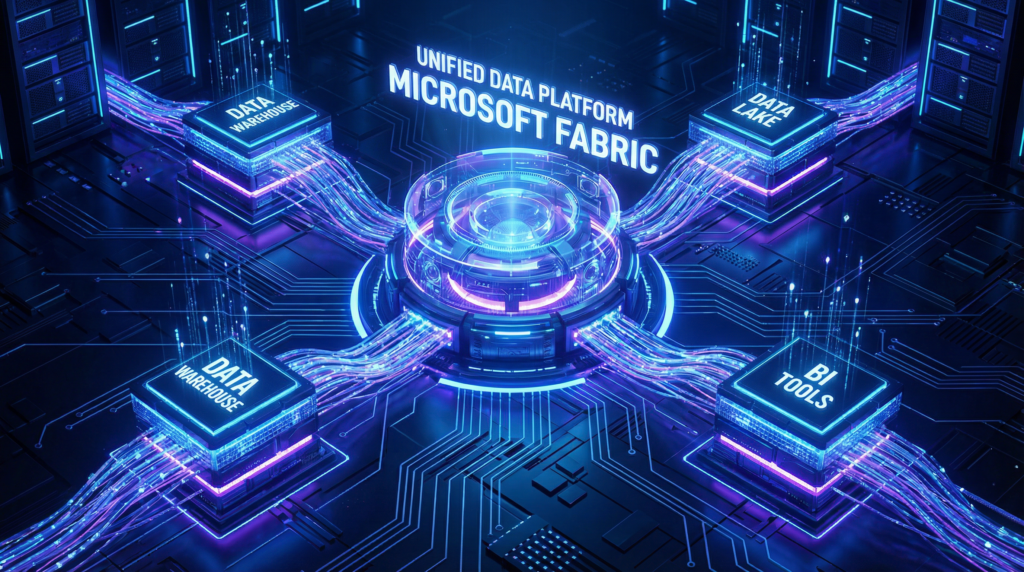
A unified data platform concept for Microsoft Fabric.

Meta title (SEO): Microsoft Fabric Definitive Guide (2026): OneLake, Security, Governance, Architecture & Best Practices

Meta description: The most practical, end-to-end guide to Microsoft Fabric for business and technical leaders. Learn how to unify data engineering, warehousing, real-time analytics, data science, and BI on OneLake.

Primary keywords: Microsoft Fabric, OneLake, Lakehouse, Data Warehouse, Real-Time Intelligence, Power BI, Microsoft Purview, Fabric security, Fabric capacity, data platform architecture, data sprawl, medallion architecture

Key Takeaways

  • Microsoft Fabric is a unified analytics platform that aims to solve the problem of data platform sprawl by integrating various data services into a single SaaS offering.
  • OneLake is the centerpiece of Fabric, acting as a single, logical data lake for the entire organization, similar to OneDrive for data.
  • Fabric offers different “experiences” for various roles, such as data engineering, data science, and business intelligence, all built on a shared foundation.
  • The platform uses a capacity-based pricing model, which allows for scalable and predictable costs.
  • Security and governance are built-in, with features like Microsoft Purview integration, fine-grained access controls, and private links.
  • A well-defined rollout plan is crucial for a successful Fabric adoption, starting with a discovery phase, followed by a pilot, and then a full production rollout.

Who is this guide for?

This guide is for business and technical leaders who are evaluating or implementing Microsoft Fabric. It provides a comprehensive overview of the platform, from its core concepts to a practical rollout plan. Whether you are a CIO, a data architect, or a BI manager, this guide will help you understand how to leverage Fabric to build a modern, scalable, and secure data platform.

Why Microsoft Fabric exists (in plain language)

Most organizations don’t have a “data problem”—they have a data platform sprawl problem:

  • Multiple tools for ingestion, transformation, and reporting
  • Duplicate data copies across lakes/warehouses/marts
  • Inconsistent security rules between engines
  • A governance gap (lineage, classification, ownership)
  • Cost surprises when teams scale

Microsoft Fabric was designed to reduce that sprawl by delivering an end-to-end analytics platform as a SaaS service: ingestion → transformation → storage → real-time → science → BI, all integrated.

If your goal is a platform that business teams can trust and technical teams can scale, Fabric is fundamentally about unification: common storage, integrated experiences, shared governance, and a capacity model you can manage centrally.

What is Microsoft Fabric? (the one-paragraph definition)

Microsoft Fabric is an analytics platform that supports end-to-end data workflows—data ingestion, transformation, real-time processing, analytics, and reporting—through integrated experiences such as Data Engineering, Data Factory, Data Science, Real-Time Intelligence, Data Warehouse, Databases, and Power BI, operating over a shared compute and storage model with OneLake as the centralized data lake.

The Fabric mental model: the 6 building blocks that matter

1) OneLake = the “OneDrive for data”

OneLake is Fabric’s single logical data lake. Fabric stores items like lakehouses and warehouses in OneLake, similar to how Office stores files in OneDrive. Under the hood, OneLake is built on ADLS Gen2 concepts and supports many file types.

OneLake acts as a single, logical data lake for the entire organization.

Why this matters: OneLake is the anchor that makes “one platform” real—shared storage, consistent access patterns, fewer duplicate copies.

2) Experiences (workloads) = role-based tools on the same foundation

Fabric exposes different “experiences” depending on what you’re doing—engineering, integration, warehousing, real-time, BI—without making you stitch together separate products.

3) Items = the concrete things teams build

In Fabric, you build “items” inside workspaces (think: lakehouse, warehouse, pipelines, notebooks, eventstreams, dashboards, semantic models). OneLake stores the data behind these items.

4) Capacity = the knob you scale (and govern)

Fabric uses a capacity-based model (F SKUs). You can scale up/down dynamically and even pause capacity (pay-as-you-go model).

5) Governance = make it discoverable, trusted, compliant

Fabric includes governance and compliance capabilities to manage and protect your data estate, improve discoverability, and meet regulatory requirements.

6) Security = consistent controls across engines

Fabric has a layered permission model (workspace roles, item permissions, compute permissions, and data-plane controls like OneLake security).

Choosing the right storage: Lakehouse vs Warehouse vs “other”

This is where many Fabric projects either become elegant—or messy.

A visual comparison of the flexible Lakehouse and the structured Data Warehouse.

Lakehouse (best when you want flexibility + Spark + open lake patterns)

Use a Lakehouse when:

  • You’re doing heavy data engineering and transformations
  • You want medallion patterns (bronze/silver/gold)
  • You’ll mix structured + semi-structured data
  • You want Spark-native developer workflows

Warehouse (best when you want SQL-first analytics and managed warehousing)

Fabric Data Warehouse is positioned as a “lake warehouse” with two warehousing items (warehouse item + SQL analytics endpoint) and includes replication to OneLake files for external access.

Real-Time Intelligence (best for streaming events, telemetry, “data in motion”)

Real-Time Intelligence is an end-to-end solution for event-driven scenarios—handling ingestion, transformation, storage, analytics, visualization, and real-time actions.

Eventstreams can ingest and route events without code and can expose Kafka endpoints for Kafka protocol connectivity.

Discovery: how to decide if Fabric is the right platform (business + technical)

Step 1 — Identify 3–5 “lighthouse” use cases

Pick use cases that prove the platform across the lifecycle:

  • Executive BI: certified metrics + governed semantic model
  • Operational analytics: near-real-time dashboards + alerts
  • Data engineering: ingestion + transformations + orchestration
  • Governance: lineage + sensitivity labeling + access controls

Step 2 — Score your current pain (and expected value)

Use a simple scoring matrix:

  • Time-to-insight (days → hours?)
  • Data trust (single source of truth?)
  • Security consistency (one model vs many?)
  • Cost predictability (capacity governance?)
  • Reuse (shared datasets and pipelines?)

Step 3 — Confirm your constraints early (these change architecture)

  • Data residency and tenant requirements
  • Identity model (Entra ID groups, RBAC approach)
  • Network posture (public internet vs private links)
  • Licensing & consumption model (broad internal distribution?)

The reference architecture: a unified Fabric platform that scales

Here’s a proven blueprint that works for most organizations.

A 5-layer reference architecture for a unified data platform in Microsoft Fabric.

Layer 1 — Landing + ingestion

Goal: bring data in reliably, with minimal coupling.

  • Use Data Factory style ingestion/orchestration (pipelines, connectors, scheduling)
  • Land raw data into OneLake (often “Bronze”)
  • Keep ingestion contracts explicit (schemas, SLAs, source owners)

Layer 2 — Transformation (medallion pattern)

Goal: create reusable, tested datasets.

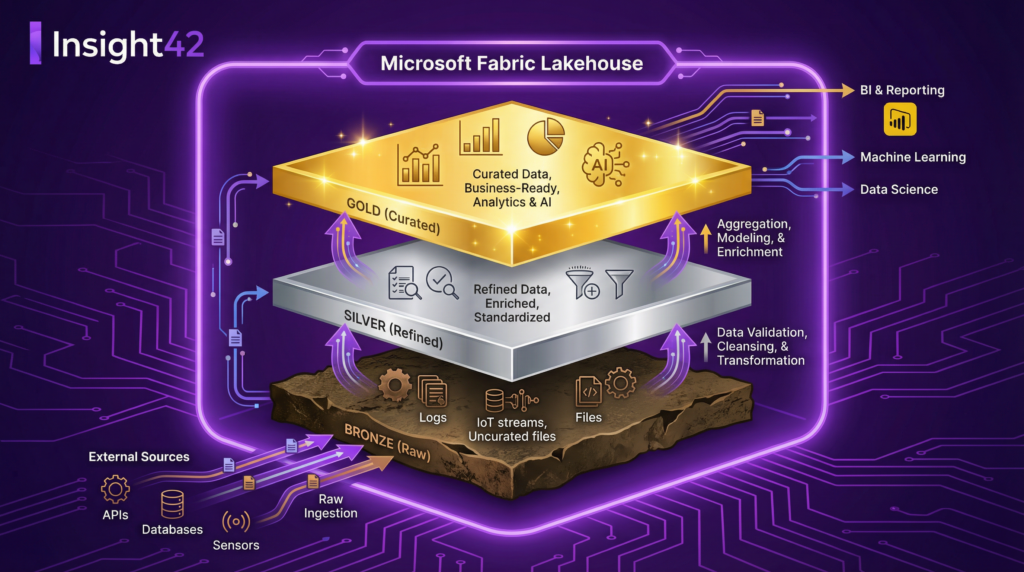
The Medallion Architecture (Bronze, Silver, Gold) for data transformation.

  • Bronze: raw, append-only, immutable where possible
  • Silver: cleaned, conformed, deduplicated
  • Gold: curated, analytics-ready, business-friendly

Layer 3 — Serving & semantics

Goal: standardize definitions so the business stops arguing about numbers.

Gold tables feed:

  • Warehouse / SQL endpoints for SQL-first analytics
  • Power BI semantic models for governed metrics and reports (within Fabric’s unified environment)

Layer 4 — Real-time lane (optional but powerful)

Goal: detect and act on events quickly (minutes/seconds).

  • Ingest with Eventstreams
  • Store/query using Real-Time Intelligence components
  • Trigger actions with Activator (no/low-code event detection and triggers)

Layer 5 — Governance & security plane (always on)

Goal: everything is discoverable, classifiable, and controlled.

  • Microsoft Purview integration for governance
  • Fabric governance and compliance capabilities (lineage, protection, discoverability)

Security: how to build “secure by default” without slowing teams down

Understand the Fabric permission layers

Fabric uses multiple permission types (workspace roles, item permissions, compute permissions, and OneLake security) that work together.

A layered security permission model in Microsoft Fabric.

Practical rule:

  • Workspace roles govern “who can do what” in a workspace
  • Item permissions refine access per artifact
  • OneLake security governs data-plane access consistently

OneLake Security (fine-grained, data-plane controls)

OneLake security enables granular, role-based security on data stored in OneLake and is designed to be enforced consistently across Fabric compute engines (not per engine). It is currently in preview.

Network controls: private connectivity + outbound restrictions

If your organization needs tighter network posture:

  • Fabric supports Private Links at tenant and workspace levels, routing traffic through Microsoft’s private backbone.
  • You can enable workspace outbound access protection to block outbound connections by default, then allow only approved external connections (managed private endpoints or rules).

Governance & compliance capabilities

Fabric provides governance/compliance features to manage, protect, monitor, and improve discoverability of sensitive information.

A “good default” governance model:

  • Standard workspace taxonomy (by domain/product, not by team names)
  • Defined data owners + stewards
  • Certified datasets + endorsed metrics
  • Mandatory sensitivity labels for curated/gold assets (where applicable)

Capacity & licensing: the essentials (what leaders actually need to know)

Fabric uses capacity SKUs and also has important Power BI licensing implications.

Key official points from Microsoft’s pricing documentation:

  • Fabric capacity can be scaled up/down and paused (pay-as-you-go approach).
  • Power BI Pro licensing requirements extend to Fabric capacity for publishing/consuming Power BI content; however, with F64 (Premium P1 equivalent) or larger, report consumers may not require Pro licenses (per Microsoft’s licensing guidance).

How to translate this into planning decisions:

  • If your strategy includes broad internal distribution of BI content, licensing and capacity sizing should be evaluated together—not separately.
  • Treat capacity as shared infrastructure: define which workloads get priority, and put guardrails around dev/test/prod usage.

AI & Copilot in Fabric: what it is (and how to adopt responsibly)

Copilot in Fabric introduces generative AI experiences to help transform/analyze data and create insights, visualizations, and reports; availability varies by experience and feature state (some are preview).

Adoption best practices:

  • Enable it deliberately (not “turn it on everywhere”)
  • Create usage guidelines (data privacy, human review, approved datasets)
  • Start with low-risk scenarios (documentation, SQL drafts, exploration)

OneLake shortcuts: unify without copying (and why this changes migrations)

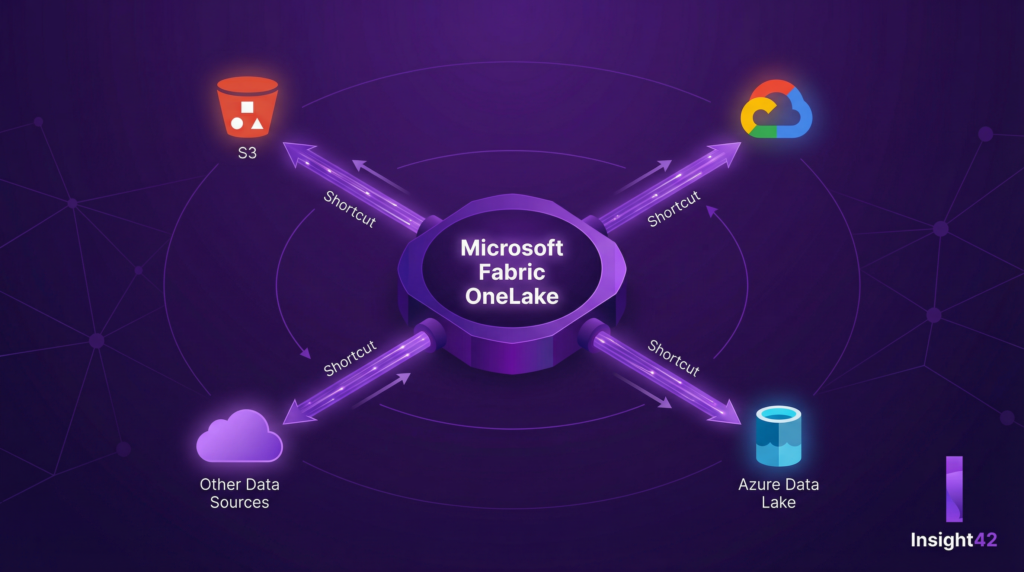
Shortcuts let you “virtualize” data across domains/clouds/accounts by making OneLake a single virtual data lake; Fabric engines can connect through a unified namespace, and OneLake manages permissions/credentials so you don’t have to configure each workload separately.

  • You can reduce duplicate staging copies
  • You can incrementally migrate legacy lakes/warehouses
  • You can allow teams to keep data where it is (temporarily) while centralizing governance

A practical end-to-end rollout plan (discovery → pilot → production)

Phase 1 — 2–4 weeks: Discovery & platform blueprint

Deliverables:

  • Target architecture (lakehouse/warehouse/real-time lanes)
  • Workspace strategy and naming standards
  • Security model (groups, roles, data access patterns)
  • Governance model (ownership, certification, lineage expectations)
  • Initial capacity sizing hypothesis

Phase 2 — 4–8 weeks: Pilot (“thin slice” end-to-end)

Pick one lighthouse use case and implement the full lifecycle:

  • Ingest → bronze → silver → gold
  • One governed semantic model and 2–3 business reports
  • Data quality checks + monitoring
  • Role-based access + audit-ready governance story

Success criteria (be explicit):

  • Reduced manual steps
  • Clear lineage and ownership
  • Faster cycle time for new datasets
  • A repeatable pattern others can copy

Phase 3 — 8–16 weeks: Production foundation

  • Separate dev/test/prod workspaces (or clear release flows)
  • CI/CD and deployment patterns (whatever your org standard is)
  • Cost controls: capacity scheduling, workload prioritization, usage monitoring
  • Network posture: Private Links and outbound rules if required

Phase 4 — Scale: domain rollout + self-service enablement

  • Create “golden paths” (templates for pipelines, lakehouses, semantic models)
  • Training by persona: analysts (Power BI + governance), engineers (lakehouse patterns, orchestration), ops/admins (security, capacity, monitoring)
  • Establish a data product operating model (ownership, SLAs, versioning)

Common pitfalls (and how to avoid them)

1. Treating Fabric like “just a BI tool”

Fabric is a full analytics platform; plan governance, engineering standards, and an operating model from day one.

2. Not deciding Lakehouse vs Warehouse intentionally

Use Microsoft’s decision guidance and align by workload/persona.

3. Inconsistent security between workspaces and data

Define a single permission strategy and understand how Fabric’s permission layers interact.

4. Underestimating network requirements

If your org is private-network-first, plan Private Links and outbound restrictions early.

5. Capacity without FinOps

Capacity is shared—without guardrails, “noisy neighbor” problems appear fast. Establish policies, monitoring, and environment separation.

The “done right” Fabric checklist (copy/paste)

Strategy

☐ 3–5 lighthouse use cases with measurable outcomes

☐ Target architecture and workload mapping

☐ Capacity model + distribution/licensing plan

Platform foundation

☐ Workspace taxonomy and naming standards

☐ Dev/test/prod separation

☐ CI/CD or release process defined

Data architecture

☐ Bronze/Silver/Gold pattern defined

☐ Lakehouse vs Warehouse decisions documented

☐ Real-time lane (if needed) using Eventstreams/RTI

Security & governance

☐ Permission model documented (roles, items, compute, OneLake)

☐ OneLake security strategy (where applicable)

☐ Purview governance integration approach

☐ Network posture (Private Links / outbound rules) if required

Conclusion

Microsoft Fabric represents a significant shift in the data platform landscape. By unifying the entire analytics lifecycle, from data ingestion to business intelligence, Fabric has the potential to eliminate data sprawl, simplify governance, and empower organizations to make better, faster decisions. However, a successful Fabric adoption requires careful planning, a clear understanding of its core concepts, and a phased rollout approach. By following the best practices outlined in this guide, you can unlock the full potential of Microsoft Fabric and build a data platform that is both powerful and future-proof.

Call to Action

Ready to start your Microsoft Fabric journey? Contact us today for a free consultation and learn how we can help you design and implement a successful Fabric solution.

References

[1] What is Microsoft Fabric – Microsoft Fabric | Microsoft Learn: https://learn.microsoft.com/en-us/fabric/fundamentals/microsoft-fabric-overview

[2] OneLake, the OneDrive for data – Microsoft Fabric: https://learn.microsoft.com/en-us/fabric/onelake/onelake-overview

[3] Microsoft Fabric – Pricing | Microsoft Azure: https://azure.microsoft.com/en-us/pricing/details/microsoft-fabric/

[4] Governance and compliance in Microsoft Fabric: https://learn.microsoft.com/en-us/fabric/governance/governance-compliance-overview

[5] Permission model – Microsoft Fabric | Microsoft Learn: https://learn.microsoft.com/en-us/fabric/security/permission-model

[6] Microsoft Fabric decision guide: Choose between Warehouse and Lakehouse: https://learn.microsoft.com/en-us/fabric/fundamentals/decision-guide-lakehouse-warehouse

[7] What Is Fabric Data Warehouse? – Microsoft Fabric: https://learn.microsoft.com/en-us/fabric/data-warehouse/data-warehousing

[8] Real-Time Intelligence documentation in Microsoft Fabric: https://learn.microsoft.com/en-us/fabric/real-time-intelligence/

[9] Microsoft Fabric Eventstreams Overview: https://learn.microsoft.com/en-us/fabric/real-time-intelligence/event-streams/overview

[10] What is Fabric Activator? – Microsoft Fabric: https://learn.microsoft.com/en-us/fabric/real-time-intelligence/data-activator/activator-introduction

[11] Use Microsoft Purview to govern Microsoft Fabric: https://learn.microsoft.com/en-us/fabric/governance/microsoft-purview-fabric

[12] OneLake security overview – Microsoft Fabric: https://learn.microsoft.com/en-us/fabric/onelake/security/get-started-security

[13] About private Links for secure access to Fabric: https://learn.microsoft.com/en-us/fabric/security/security-private-links-overview

[14] Enable workspace outbound access protection: https://learn.microsoft.com/en-us/fabric/security/workspace-outbound-access-protection-set-up

[15] Overview of Copilot in Fabric – Microsoft Fabric: https://learn.microsoft.com/en-us/fabric/fundamentals/copilot-fabric-overview

[16] Unify data sources with OneLake shortcuts: https://learn.microsoft.com/en-us/fabric/onelake/onelake-shortcuts

MicrosoftFabric #OneLake #PowerBI #DataPlatform #DataAnalytics #AnalyticsPlatform #Lakehouse #DataWarehouse #DataEngineering #DataIntegration #DataFactory #DataPipelines #ETL #ELT #RealTimeIntelligence #RealTimeAnalytics #Eventstreams #StreamingAnalytics #DataGovernance #MicrosoftPurview #DataLineage #DataSecurity #RBAC #EntraID #Compliance #FinOps #CapacityPlanning #DataQuality #CloudAnalytics #DataModernization
Microsoft Fabric: A Deep Dive into the Future of Cloud Data Platforms

Microsoft Fabric: 2nd Jan 2026 Martin-Peter Lambert
Microsoft Fabric: A Deep Dive into the Future of Cloud Data Platforms

Microsoft Fabric – Comprehensive

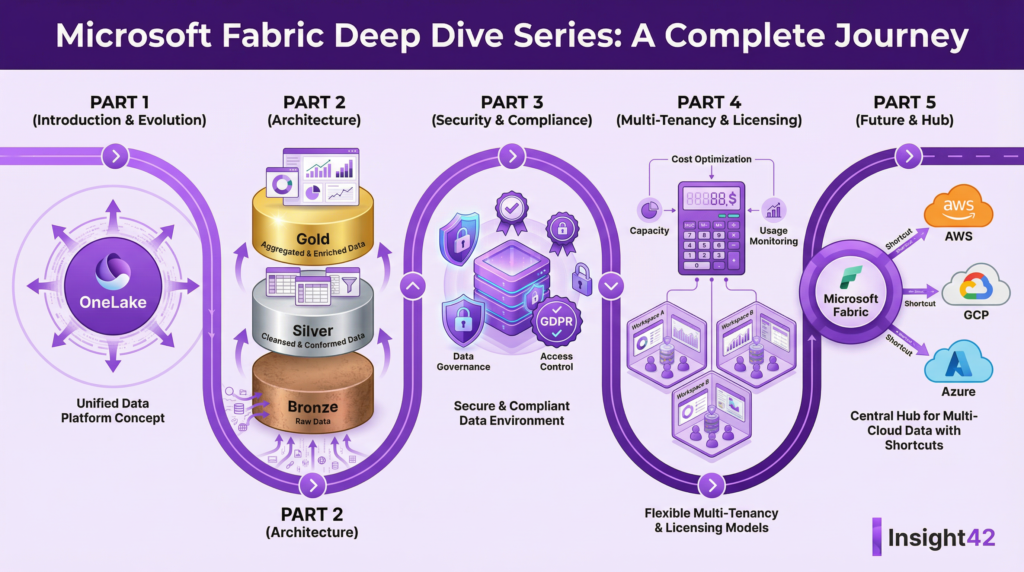
Discover Microsoft Fabric – Comprehensive insights in our 5-Part Technical Series by insight 42

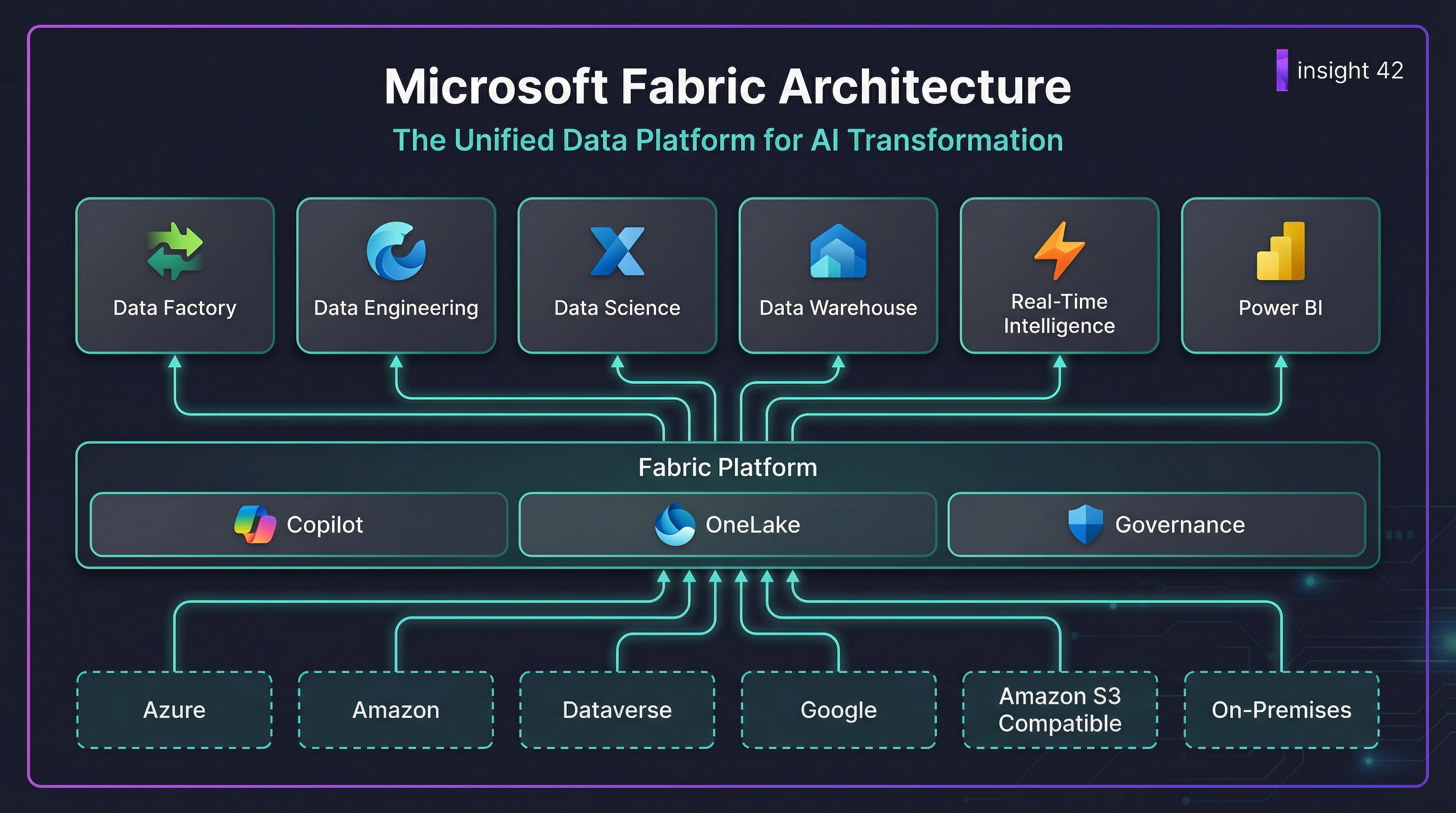
Microsoft Fabric Architecture

Series Overview

This comprehensive blog series provides an in-depth, critical analysis of Microsoft Fabric—the latest and most ambitious attempt to unify the modern data estate. From its evolutionary roots to its future trajectory, we explore the architecture, promises, shortcomings, and practical realities of adopting Fabric in enterprise environments.

Whether you’re a data architect evaluating Fabric for your organization, an ISV building multi-tenant solutions, or a data professional seeking to understand the future of cloud data platforms, this series provides the insights you need.

Quick Navigation

PartTitleFocus Areas
Part 1Introduction to Fabric and the Evolution of Cloud Data PlatformsHistory, evolution, Fabric overview, core principles
Part 2Data Lakes and DWH Architecture in the Fabric EraMedallion architecture, lakehouse patterns, OneLake
Part 3Security, Compliance, and Network Separation ChallengesSecurity layers, compliance, network isolation, GDPR
Part 4Multi-Tenant Architecture, Licensing, and Practical SolutionsWorkspace patterns, F SKU licensing, cost optimization
Part 5Future Trajectory, Shortcuts to Hyperscalers, and the Hub VisionCross-cloud integration, roadmap, universal hub concept

Key Diagrams

This series includes 10 professionally designed architectural diagrams that illustrate key concepts:

Platform Architecture

Microsoft Fabric Architecture – Complete platform overview with workloads, Fabric Platform, and cloud sourcesPart 1
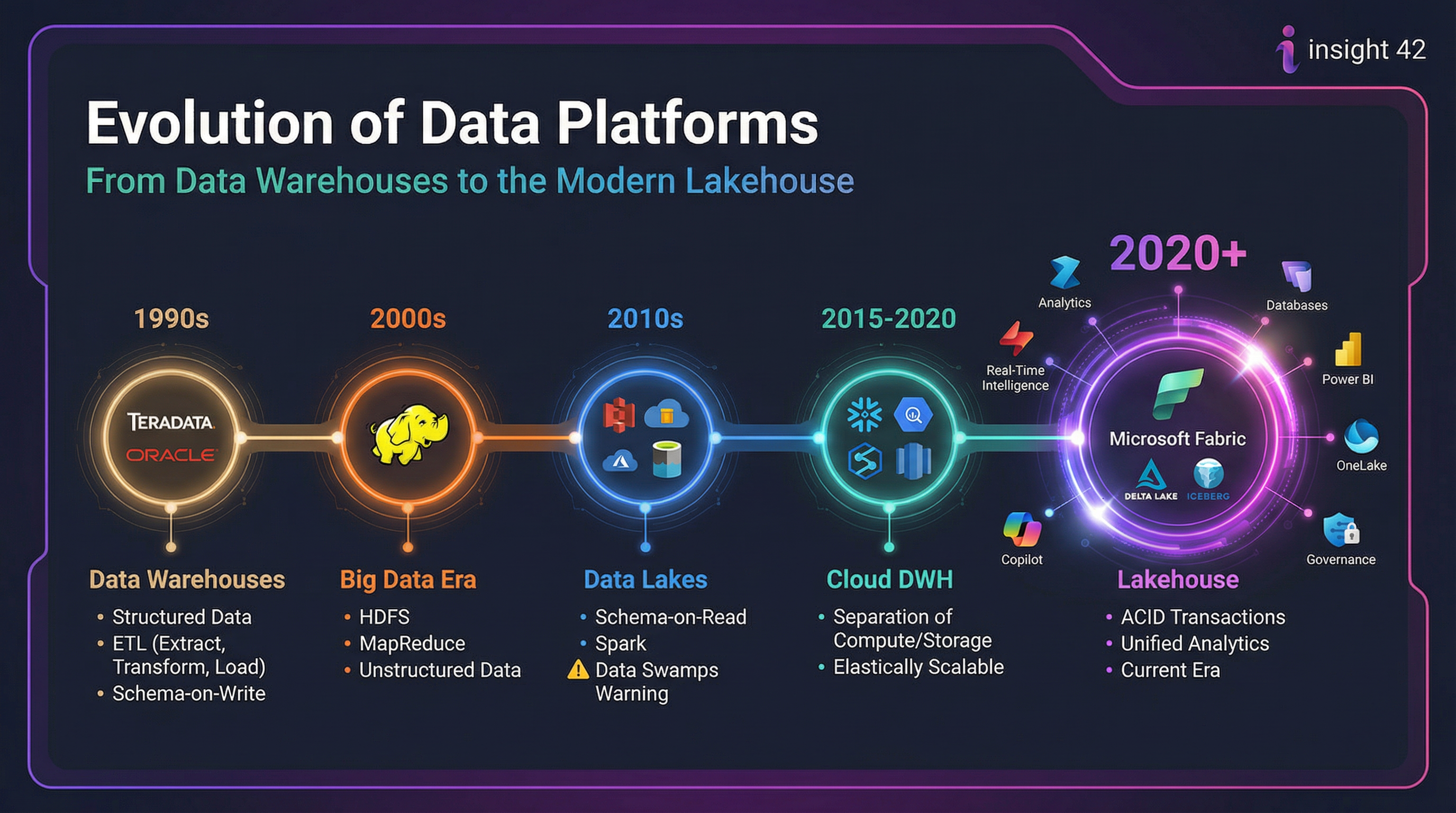
Evolution of Data Platforms – Timeline from 1990s DWH to 2020+ LakehousePart 1

Data Architecture

DiagramDescriptionUsed In
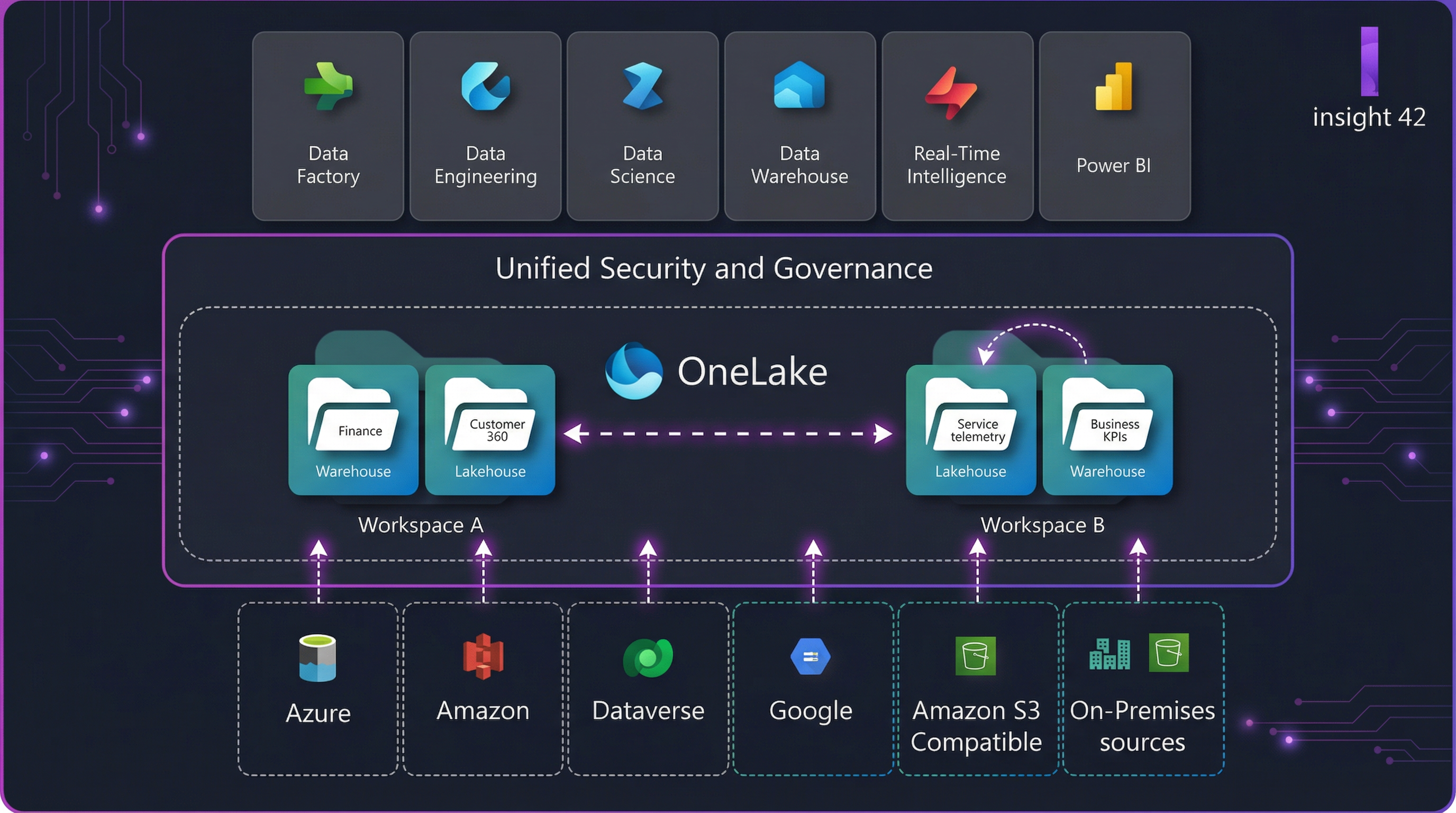
OneLake & Workspaces – Unified Security & Governance with workspace isolationPart 2
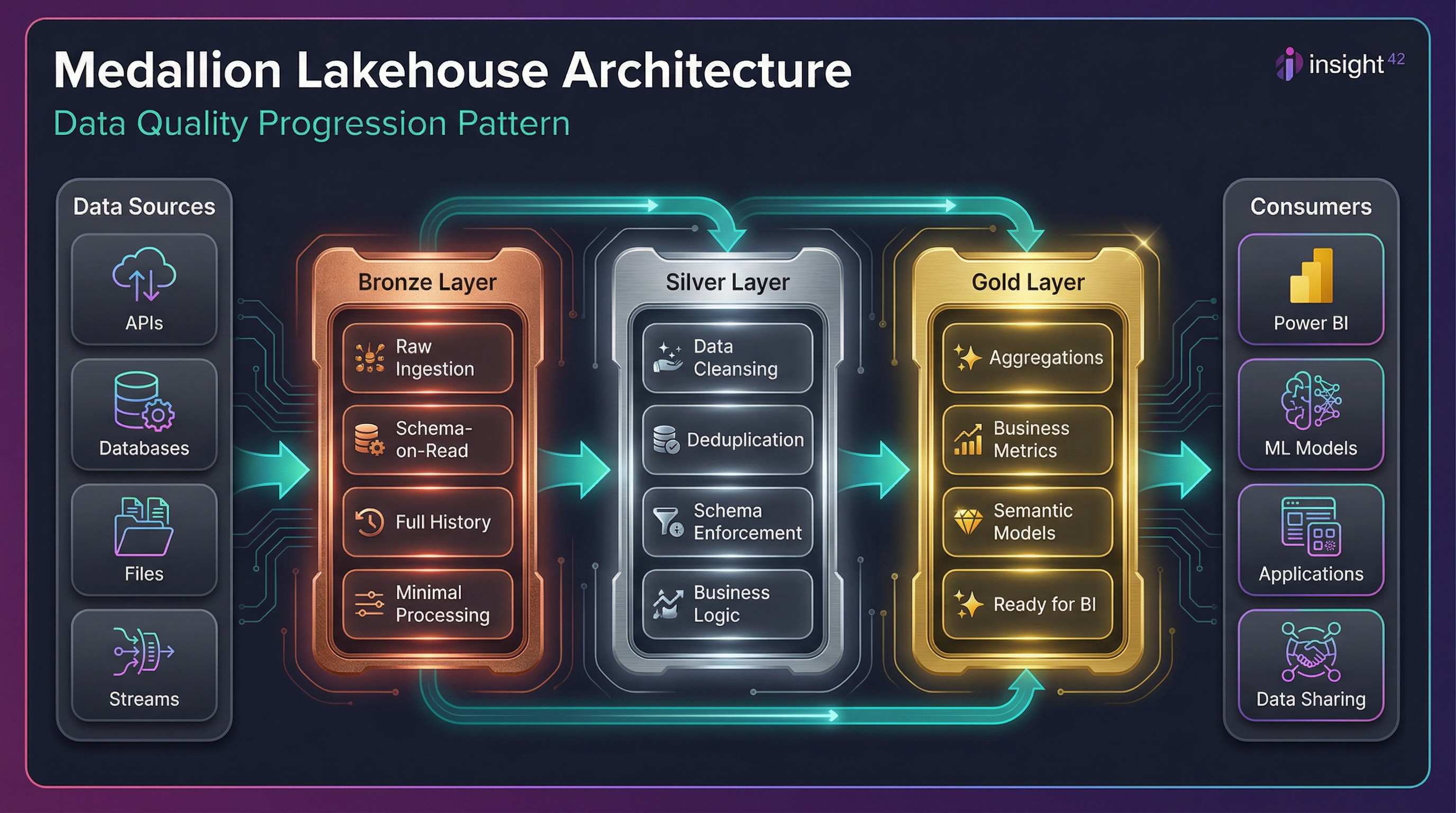
Medallion Architecture – Bronze/Silver/Gold data quality progressionPart 2

Security & Compliance

DiagramDescriptionUsed In
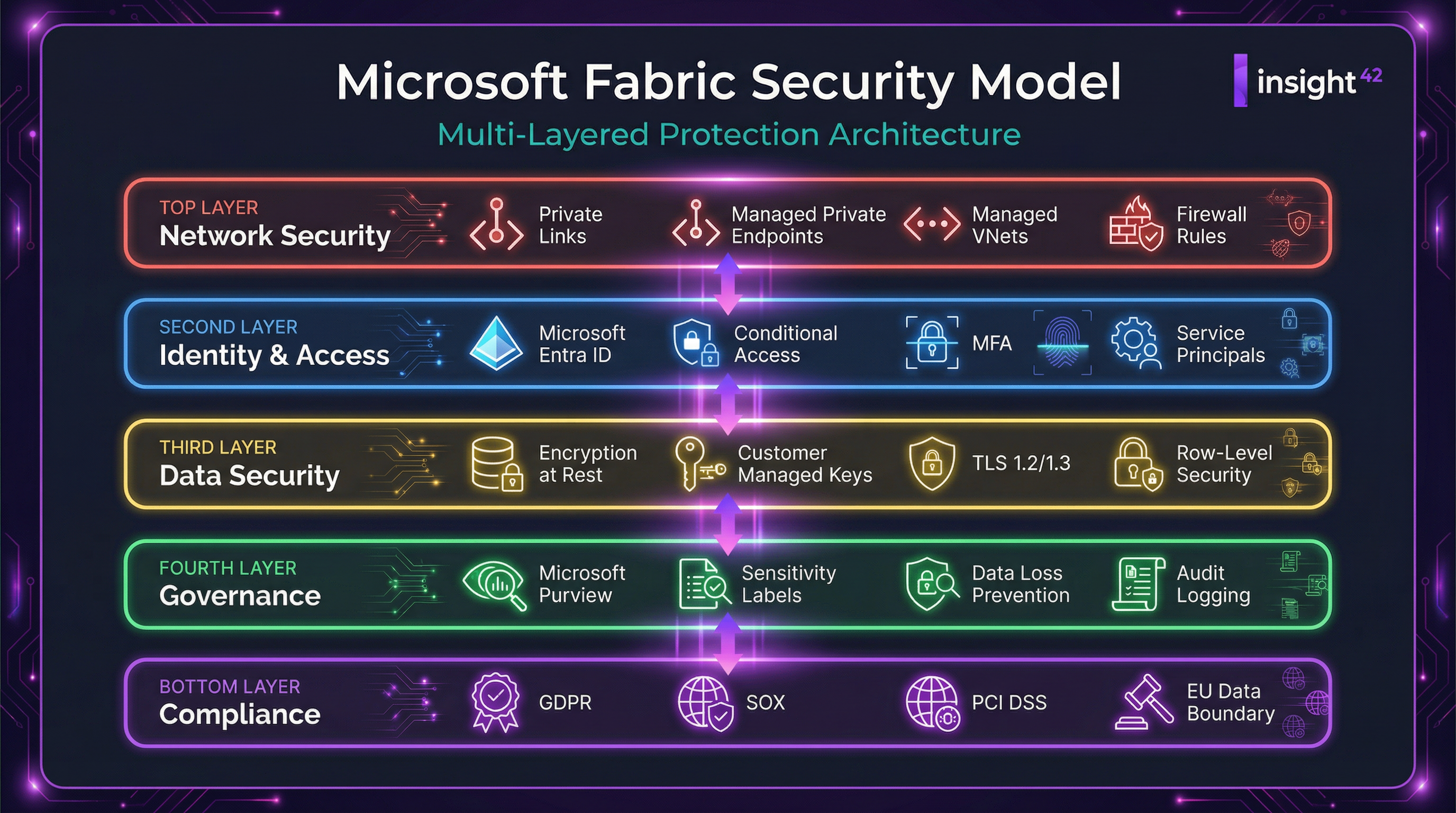
Security Layers Model – 5-layer protection architecturePart 3
Network Separation Challenges – SaaS vs IaaS/PaaS comparisonPart 3

Multi-Tenancy & Licensing

DiagramDescriptionUsed In
Multi-Tenant Architecture – Workspace-per-tenant isolation patternPart 4
Licensing Model – F SKUs, user-based options, Azure integrationPart 4

Future Vision

DiagramDescriptionUsed In
Cross-Cloud Shortcuts – Zero-copy multi-cloud data accessPart 5
Universal Data Hub Vision – Future roadmap and hub conceptPart 5

Key Takeaways

What Fabric Gets Right

  • Unified Experience: Single platform for all data and analytics workloads
  • OneLake: Central data lake eliminating silos and reducing data movement
  • Open Formats: Delta and Parquet ensure no vendor lock-in
  • Cross-Cloud Shortcuts: Revolutionary zero-copy multi-cloud integration

What Needs Improvement

  • Network Isolation: SaaS model limits enterprise-grade network control
  • Multi-Tenancy: Licensing and cost management complexity
  • Compliance: Proving isolation in shared infrastructure environments
  • Maturity: Some features still evolving and not production-ready

Who Should Consider Fabric

  • Organizations already invested in the Microsoft ecosystem
  • Teams seeking to simplify their data platform architecture
  • ISVs building multi-tenant analytics solutions
  • Enterprises ready to embrace a SaaS-first approach

Who Should Wait

  • Organizations with strict network isolation requirements
  • Highly regulated industries requiring physical data separation
  • Teams not ready for the SaaS trade-offs
  • Organizations requiring mature, battle-tested features
#MicrosoftFabric #UnifiedDataPlatform #CloudDataPlatforms #DataLakehouse #FabricDeepDive #DataArchitecture #OneLake #DataPlatform #DataEngineering #BusinessIntelligence #SaaSData #DataSilos #FabricImplementation #CloudDataStrategy #DataAnalytics

A Deep Dive into Azures’ Future of Cloud Data Platforms

Microsoft Fabric: 1st Jan 2026 Martin-Peter Lambert
A Deep Dive into Azures’ Future of Cloud Data Platforms

Microsoft Fabric: (Part 5 of 5)

An insight 42 Technical Deep Dive Series

The Horizon: Fabric’s Future Trajectory and the Universal Data Hub

Over the past four parts of this series, we have taken a deep and critical journey through the world of Microsoft Fabric. We’ve explored its evolutionary roots, dissected its architecture, confronted its security and compliance challenges, and navigated the pragmatic realities of multi-tenancy and licensing. Now, in our final installment, we turn our gaze to the horizon and explore the future of Fabric. What is Microsoft’s long-term vision for this ambitious platform, and what does it mean for the future of data and analytics?

This post will examine the future trajectory of Microsoft Fabric, with a particular focus on its most innovative and forward-looking feature: shortcuts. We will explore how shortcuts are enabling a new era of cross-cloud data integration and positioning Fabric to become the central hub for the entire modern data estate.

Shortcuts: The Gateway to a Multi-Cloud World

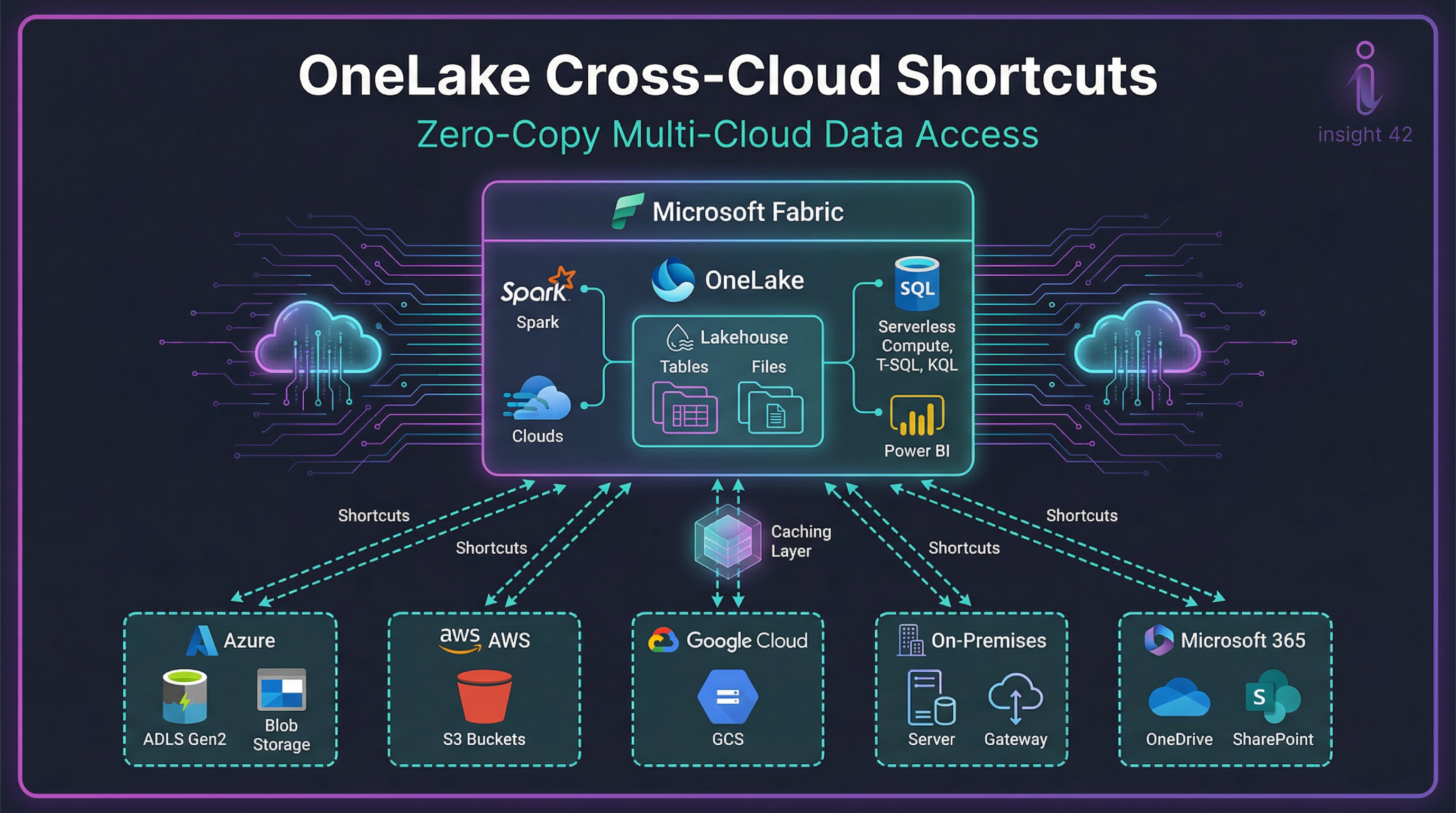
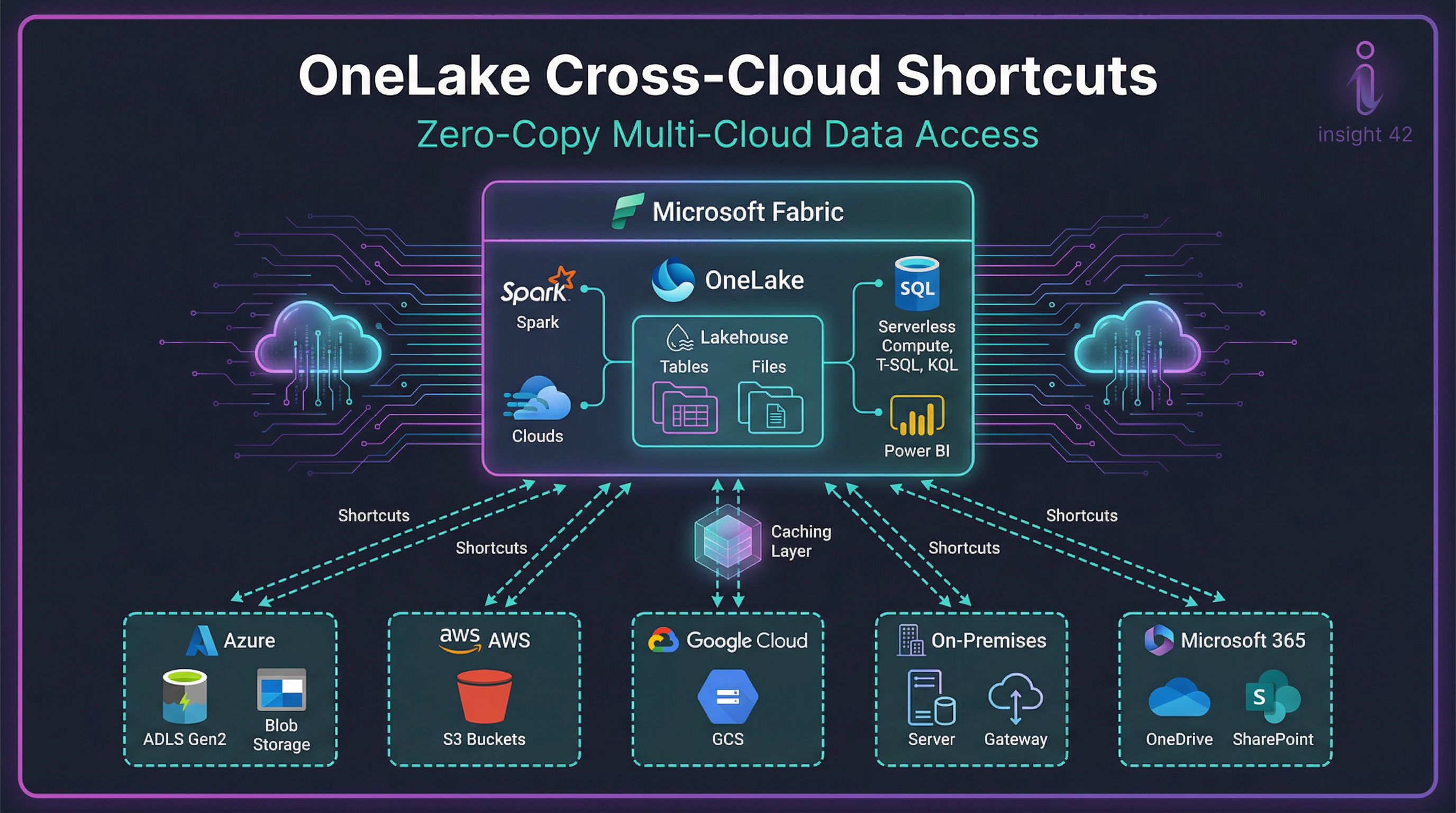
Perhaps the most groundbreaking feature in Microsoft Fabric is the concept of shortcuts. A shortcut is a symbolic link that allows you to access data in external storage locations—including other clouds like Amazon S3 and Google Cloud Storage—as if it were stored locally in OneLake. This simple but powerful idea has profound implications for the future of data architecture.

Cross-Cloud Shortcuts in Fabric

Figure 1: The cross-cloud shortcut architecture in Microsoft Fabric, enabling zero-copy data access across hyperscalers through a caching layer.

The Power of Zero-Copy Integration

For years, multi-cloud data integration has been a complex and expensive endeavor, requiring organizations to build and maintain fragile ETL pipelines to copy and move data between clouds. Shortcuts eliminate this complexity by enabling zero-copy integration. Instead of moving data, you simply create a shortcut to it, and Fabric’s query engines can access it directly in its original location [1].

This approach offers several key benefits:

BenefitDescription
Reduced CostsEliminates the need to copy and store data in multiple locations, significantly reducing storage and egress costs.
Improved Data FreshnessAccess data directly at its source, always working with the most up-to-date information.
Simplified ArchitectureEliminates complex ETL pipelines, simplifying the data landscape and reducing maintenance overhead.
Unified AccessQuery data from multiple clouds using familiar tools like Spark, SQL, and Power BI.

Supported Shortcut Sources

Fabric shortcuts support a growing list of external data sources:

SourceTypeKey Features
Azure Data Lake Storage Gen2Microsoft CloudNative integration, optimal performance
Azure Blob StorageMicrosoft CloudLegacy storage support
Amazon S3AWSCross-cloud integration
Google Cloud StorageGCPCross-cloud integration
DataverseMicrosoft 365Business application data
On-PremisesGatewayHybrid cloud scenarios
OneDrive/SharePointMicrosoft 365Collaboration data

A Truly Multi-Cloud Data Platform

With shortcuts, Microsoft Fabric is not just a Microsoft-centric data platform; it is a truly multi-cloud data platform. It allows you to unify your entire data estate, regardless of where it resides, under a single, logical data lake. This is a major step towards breaking down the data silos that have plagued organizations for years and creating a single pane of glass for all data and analytics.

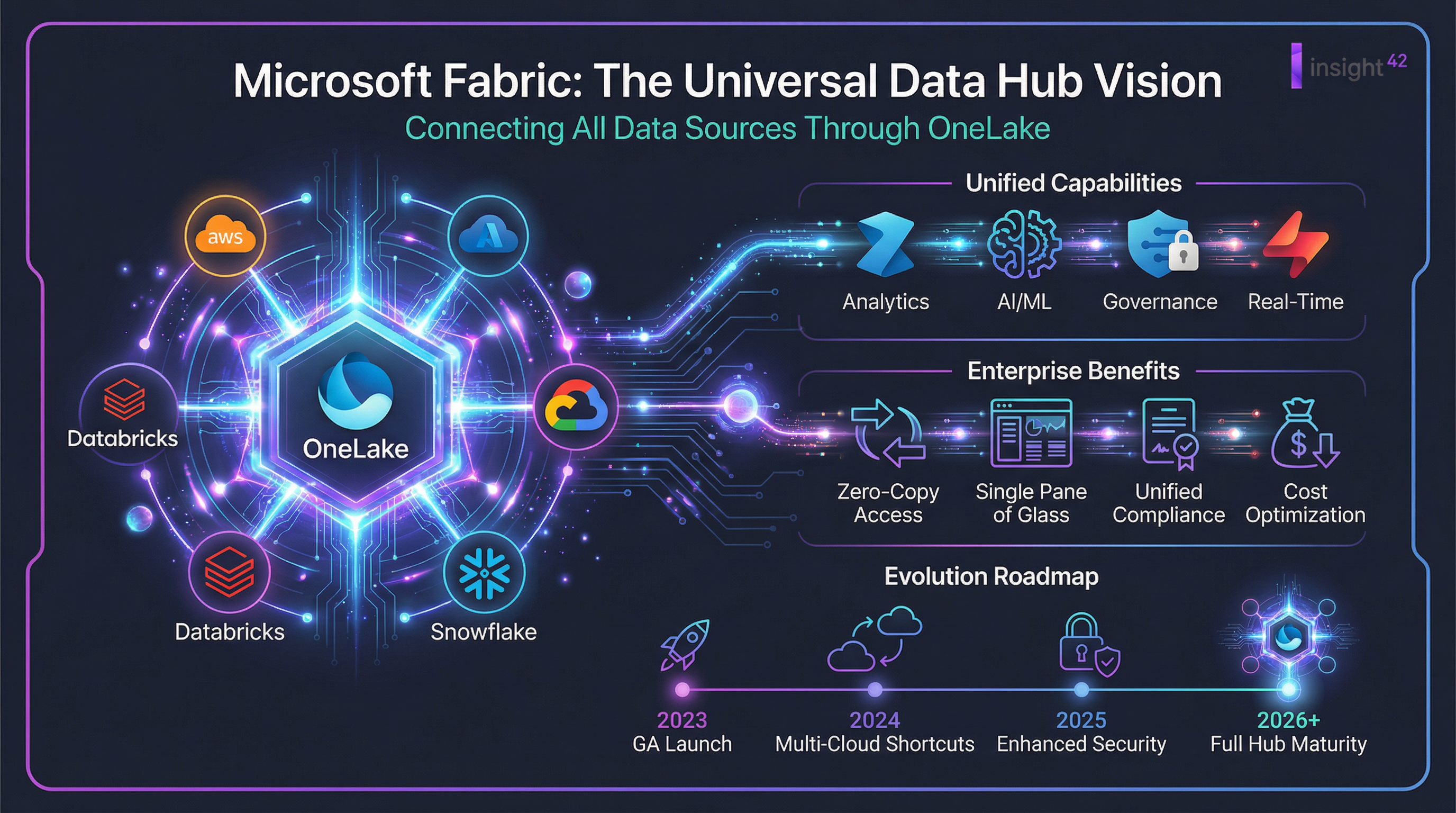
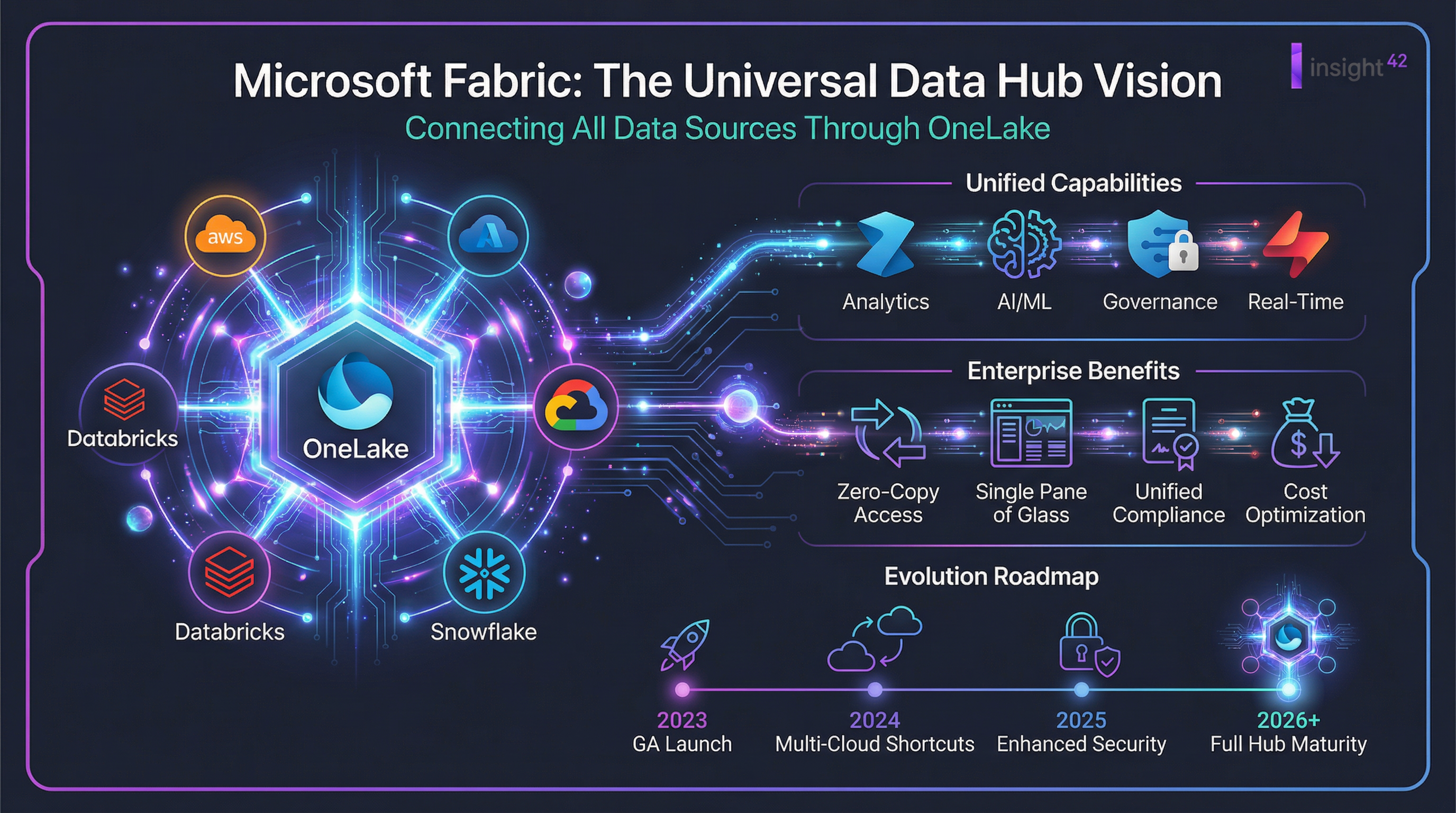
The Hub Vision: Fabric as the Universal Data Hub

The long-term vision for Microsoft Fabric is to become the central hub for the modern data estate—a single, unified platform that can connect to any data source, power any analytics workload, and serve any user. This “hub and spoke” model, with OneLake at the center and shortcuts as the spokes, has the potential to fundamentally reshape the way we think about data architecture.

The Future Vision of Fabric

Figure 2: The future vision of Microsoft Fabric as a universal data hub, connecting to all major hyperscalers and data sources with a clear evolution roadmap.

Unified Capabilities

The hub vision brings together several critical capabilities under one roof:

CapabilityDescription
AnalyticsUnified analytics across all data sources with Spark, SQL, and KQL
AI/MLIntegrated machine learning with Azure ML and Copilot
GovernanceCentralized governance through Microsoft Purview
Real-TimeStream processing and real-time intelligence

Enterprise Benefits

For organizations that embrace the hub model, the benefits are substantial:

BenefitImpact
Zero-Copy AccessEliminate data duplication and reduce storage costs
Single Pane of GlassUnified view of all data assets across clouds
Unified ComplianceConsistent governance and security policies
Cost OptimizationReduced data movement and simplified architecture

The Road to the Hub

While the vision is compelling, the road to becoming a true universal data hub is still a long one. Microsoft is rapidly adding new features and capabilities to Fabric, but there are still several key areas that need to be addressed:

AreaCurrent StateFuture Need
Security & GovernanceMaturing, some gapsEnterprise-grade isolation and compliance
Multi-TenancyWorkspace-based, limitedSimplified licensing, better cost management
Cross-Cloud IntegrationShortcuts availableQuery federation, unified governance
PerformanceGood for most workloadsOptimized caching, predictable latency

Evolution Roadmap

Based on Microsoft’s announcements and the trajectory of the platform, we can anticipate the following evolution:

YearMilestoneExpected Capabilities
2023GA LaunchCore platform, OneLake, basic shortcuts
2024Multi-Cloud ShortcutsS3, GCS integration, enhanced caching
2025Enhanced SecurityImproved network isolation, CMK everywhere
2026+Full Hub MaturityCross-cloud federation, unified governance

Conclusion: A Paradigm Shift in the Making

Microsoft Fabric is more than just a new product; it is a paradigm shift in the way we think about data and analytics. It represents a bold and ambitious attempt to solve some of the most complex and long-standing challenges in the data industry. While the platform is still in its early days and has its share of shortcomings, its core principles—a unified experience, a central data lake, and open data formats—are sound.

Key Insight: The journey to a truly unified data platform is far from over, but Microsoft Fabric has laid a strong foundation. Its innovative shortcut feature has opened the door to a new era of multi-cloud data integration, and its long-term vision of becoming a universal data hub has the potential to reshape the industry for years to come.

As data professionals, it is our responsibility to understand the implications of this shift and to be prepared to adapt to the new world that Fabric is creating. The future of data is unified, it is multi-cloud, and it is happening now.

Series Summary

Throughout this 5-part series, we have explored:

PartTopicKey Takeaway
Part 1Introduction & EvolutionFabric represents the next step in the data platform evolution
Part 2Architecture & MedallionThe lakehouse and medallion architecture are the new standard
Part 3Security & ComplianceSaaS trade-offs require careful consideration for enterprise adoption
Part 4Multi-Tenancy & LicensingPractical workarounds are needed for complex scenarios
Part 5Future & Hub VisionShortcuts and the hub model are the future of data architecture

Thank you for joining us on this deep dive into Microsoft Fabric. We hope this series has provided you with the insights you need to navigate this exciting and rapidly evolving landscape.

References

[1] Unify data sources with OneLake shortcuts – Microsoft Fabric

← Previous: Part 4: Multi-Tenant Architecture and Licensing | Return to Series Index

#FabricShortcuts #MultiCloudData #UniversalDataHub #ZeroCopyIntegration #OneLake #CrossCloudAccess #FabricS3 #FabricGCS #DataFederation #UnifiedDataHub #CloudDataIntegration #FabricFuture #DataArchitecture #HubAndSpoke #MultiCloudPlatform

A Deep Dive into Azures’ Future of Cloud Data Platforms

Microsoft Fabric: 31st Dec 2025 Martin-Peter Lambert
A Deep Dive into Azures’ Future of Cloud Data Platforms

Microsoft Fabric: (Part 4 of 5)

An insight 42 Technical Deep Dive Series

The Pragmatist’s Guide: Multi-Tenancy, Licensing, and Practical Solutions

In the previous part of our series, we confronted the significant security, compliance, and network separation challenges inherent in Microsoft Fabric’s SaaS architecture. While the vision of a unified data platform is compelling, the practical realities of enterprise adoption require navigating a complex landscape of trade-offs. For many organizations, especially Independent Software Vendors (ISVs) and large enterprises with diverse business units, multi-tenancy is not just a feature—it’s a fundamental requirement.

This post shifts from the theoretical to the practical. We will provide a deep dive into the world of multi-tenant architectures in Microsoft Fabric, dissect the often-confusing licensing model, and offer concrete, actionable solutions and workarounds for the challenges we’ve identified. This is the pragmatist’s guide to making Fabric work in the real world.

Architecting for Multi-Tenancy: Patterns and Best Practices

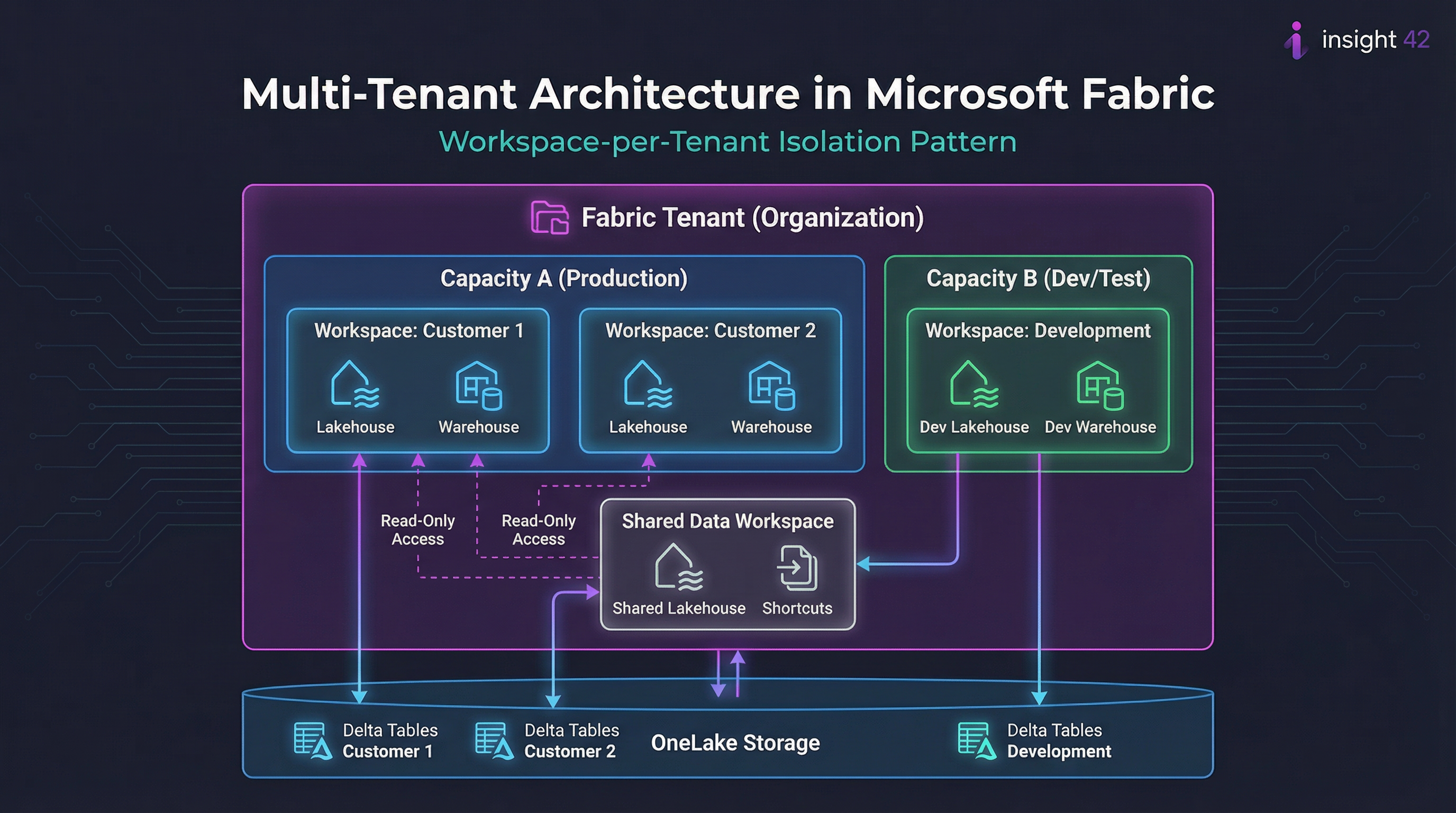
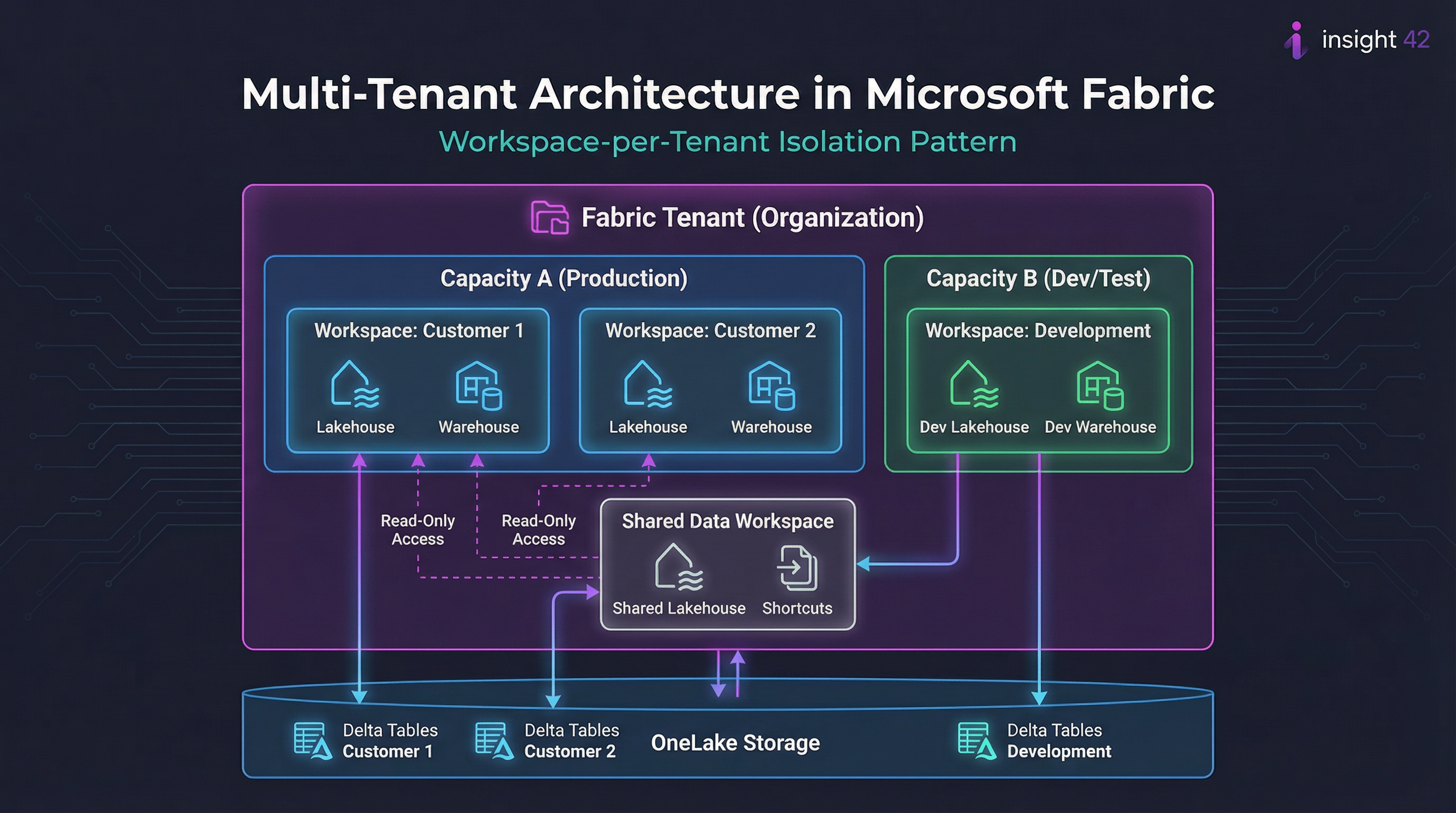
Achieving tenant isolation is one of the most critical aspects of a multi-tenant architecture. In Fabric, the primary mechanism for achieving this is through workspaces. The recommended approach is to use a workspace-per-tenant model, which provides a strong logical boundary for data and access control [1].

Multi-Tenant Architecture in Fabric

Figure 1: A workspace-per-tenant architecture in Microsoft Fabric, showing isolation within shared capacities and OneLake storage.

The Workspace-per-Tenant Model

This model offers several key advantages that make it the preferred approach for most multi-tenant scenarios:

BenefitDescription
SecuritySimplifies security management by isolating permissions at the workspace level. Each tenant’s data remains within their designated workspace.
ManageabilityAllows for easy onboarding, offboarding, and archiving of tenants without impacting others. Workspace lifecycle can be automated.
MonitoringEnables clear monitoring of resource usage and costs on a per-tenant basis through workspace-level metrics.
SLA ManagementProvides the flexibility to assign different capacities to different tenants, allowing for varied SLAs and performance tiers.
Data SharingShared Data Workspaces with shortcuts enable controlled, read-only data sharing between tenants when needed.

However, this model is not a silver bullet. While it provides logical isolation, the underlying compute and storage resources may still be shared, which may not be sufficient for all compliance scenarios. This leads to a critical decision point: a single Fabric tenant with multiple workspaces, or multiple Fabric tenants?

Single Tenant vs. Multiple Tenants: A Critical Decision

The choice between these approaches has significant implications for cost, complexity, and compliance:

ApproachProsCons
Single Fabric TenantLower licensing costs, easier data sharing between tenants, centralized administration, unified governance.Weaker isolation, shared fate (a platform issue can affect all tenants), complex compliance story.
Multiple Fabric TenantsComplete data and identity isolation, separate compliance boundaries, independent administration, no shared fate.Higher licensing costs, complex data sharing, increased management overhead, multiple Entra ID directories.

For most ISVs and enterprises, the single-tenant, multi-workspace approach provides the best balance of cost, manageability, and isolation. However, for organizations with the strictest security and compliance requirements, the multi-tenant approach may be the only viable option, despite its higher cost and complexity.

Decoding the Fabric Licensing Model

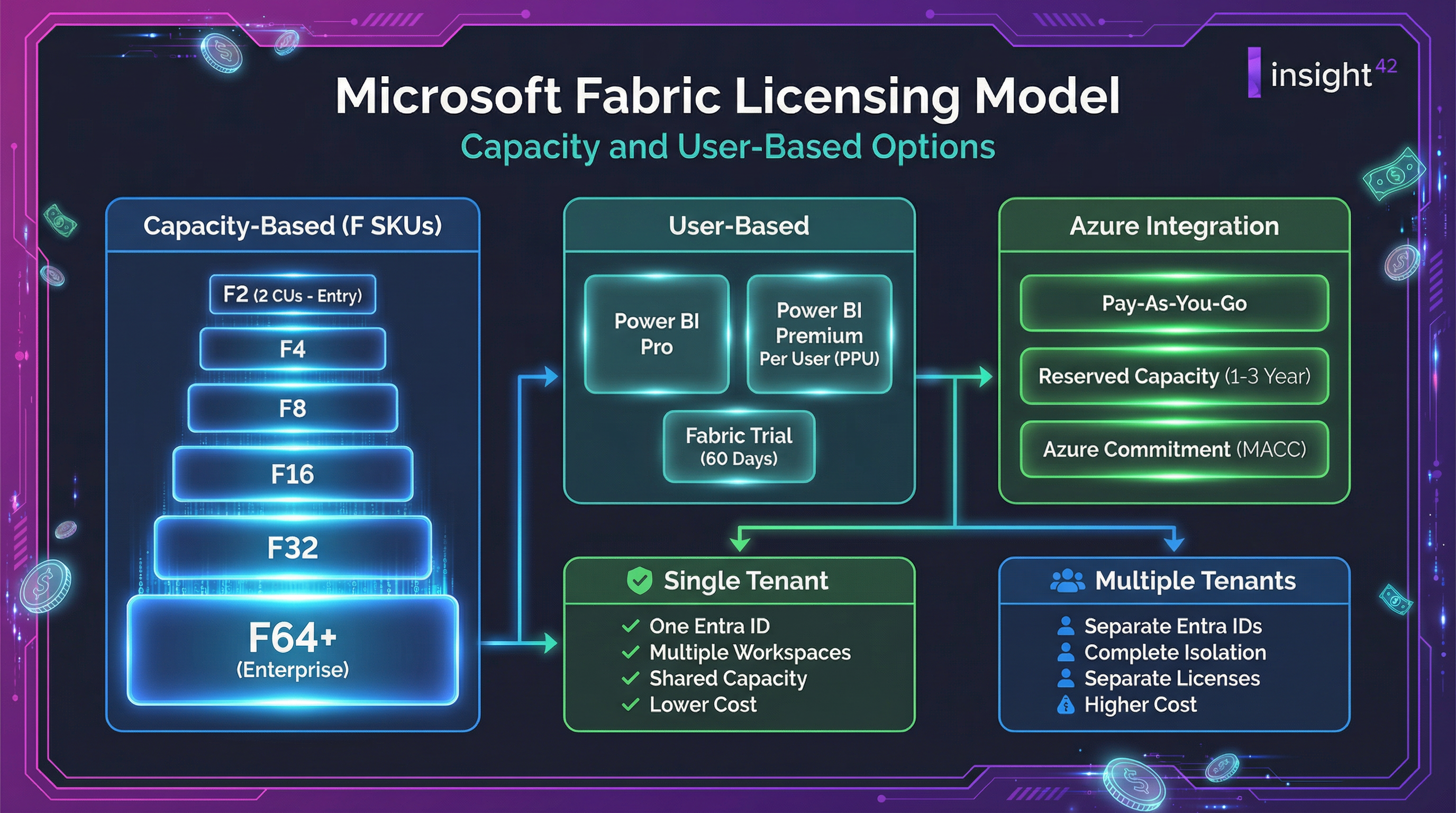
Microsoft Fabric’s licensing model is a significant departure from traditional Azure services and can be a source of confusion. It is a hybrid model that combines capacity-based licensing for the core platform with per-user licensing for certain features, primarily Power BI.

Fabric Licensing Model

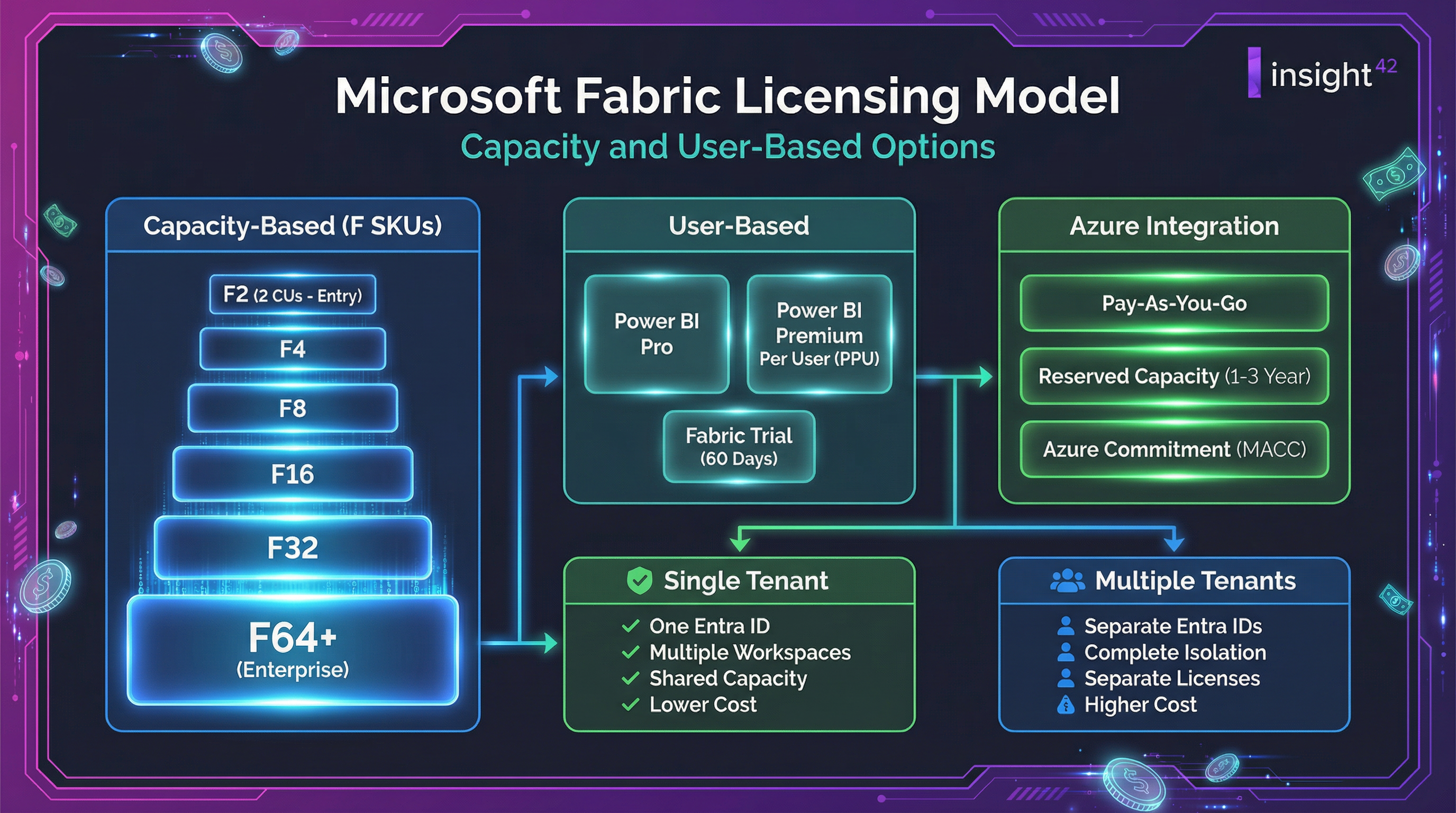
Figure 2: The Microsoft Fabric licensing model, showing capacity-based F SKUs, user-based options, and Azure integration paths.

Capacity-Based Licensing (F SKUs)

The core of Fabric’s licensing is the capacity unit (CU), a measure of compute power. You purchase Fabric capacity in the form of F SKUs, ranging from F2 (2 CUs) to F2048 (2048 CUs). This capacity is shared across all Fabric workloads and can be purchased on a pay-as-you-go basis or as a reserved instance for cost savings [2].

SKUCapacity UnitsTypical Use CaseApproximate Monthly Cost
F22 CUsDevelopment, small workloadsEntry level
F44 CUsSmall teams, POCsLow
F88 CUsDepartmental analyticsMedium
F1616 CUsBusiness unit analyticsMedium-High
F3232 CUsEnterprise workloadsHigh
F64+64+ CUsLarge-scale enterpriseEnterprise

User-Based Licensing

In addition to capacity, certain features require per-user licenses:

License TypeWhat It Enables
Power BI ProSharing and collaboration on Power BI content
Power BI Premium Per User (PPU)Premium features without capacity purchase
Fabric Trial60-day trial with limited capacity

The Multi-Tenant Licensing Challenge

This capacity-based model introduces a significant challenge for multi-tenant architectures: how do you allocate and charge back costs to individual tenants? While Fabric provides monitoring tools to track CU usage, there is no built-in mechanism for enforcing limits on a per-workspace basis. This can lead to a “noisy neighbor” problem, where one tenant consumes a disproportionate amount of resources, impacting the performance of others.

Practical Solutions and Workarounds

Given the limitations of the platform, organizations must adopt a combination of technical and administrative workarounds to manage multi-tenancy effectively:

1. Tiered Service Offerings

Create different service tiers and assign tenants to different capacities based on their tier. This provides a level of performance isolation and a basis for chargeback.

TierCapacityFeaturesSLA
BronzeShared F8Basic analytics, standard support99.5%
SilverShared F32Advanced analytics, priority support99.9%
GoldDedicated F64Full features, dedicated resources99.95%

2. Monitoring and Governance

Implement a robust monitoring and governance process to track CU usage per workspace and identify noisy neighbors. This may require building custom dashboards and alerting mechanisms on top of the Fabric monitoring APIs.

3. Automation

Use the Fabric REST APIs to automate the creation and management of workspaces, permissions, and other resources. This can help to reduce the administrative overhead of managing a large number of tenants.

4. Strategic Use of Multiple Tenants

For tenants with the most stringent security and compliance requirements, consider using a separate Fabric tenant. While this increases cost and complexity, it may be the only way to meet their needs.

Decision Framework

Use this framework to determine the right approach for each tenant:

RequirementSingle TenantMultiple Tenants
Cost sensitivity✅ Preferred⚠️ Higher cost
Data sharing needs✅ Easy⚠️ Complex
Compliance requirements⚠️ May be insufficient✅ Full isolation
Administrative simplicity✅ Centralized⚠️ Distributed
Performance isolation⚠️ Logical only✅ Physical

The Verdict: A Platform of Compromises

Microsoft Fabric is a platform of compromises. It offers a simplified, all-in-one experience at the cost of the granular control and isolation that many enterprises are used to. While the workspace-per-tenant model provides a viable path for multi-tenancy, it is not without its challenges, particularly when it comes to licensing and cost management.

Key Insight: Successfully implementing a multi-tenant solution on Fabric requires a deep understanding of its architecture, a pragmatic approach to its limitations, and a willingness to build custom solutions and workarounds to fill the gaps.

It is not a turnkey solution, but for those willing to invest the time and effort, it can be a powerful platform for building the next generation of data and analytics applications.

In the final part of our series, we will look to the future. We will explore Fabric’s long-term trajectory, its innovative “shortcut” feature for connecting to other hyperscalers, and its ultimate vision of becoming the central hub for the entire data estate.

References

[1] Microsoft Fabric – Multi-Tenant Architecture
[2] Microsoft Fabric licenses

← Previous: Part 3: Security, Compliance, and Network Separation | Next: Part 5: Future Trajectory and the Hub Vision

#FabricMultiTenancy #FabricLicensing #CostManagement #FabricCostControl #WorkspacePerTenant #FabricFSU #LicensingOptimization #MultiTenantArchitecture #FabricCapacity #EnterpriseFabric #FabricWorkarounds #DataPlatformCost #CloudCostManagement #FabricImplementation #DataAnalytics

A Deep Dive into Azures’ Future of Cloud Data Platforms

Microsoft Fabric: 30th Dec 2025 Martin-Peter Lambert
A Deep Dive into Azures’ Future of Cloud Data Platforms

Microsoft Fabric: (Part 3 of 5)

An insight 42 Technical Deep Dive Series

The Elephant in the Room: Security, Compliance, and Network Separation

In the first two parts of this series, we explored the ambitious vision of Microsoft Fabric and its potential to unify the modern data estate. However, as with any powerful new technology, the devil is in the details. For enterprise organizations, particularly those in highly regulated industries, the most critical details are security, compliance, and the ability to isolate and control network traffic. While Fabric offers a compelling vision of a simplified, all-in-one data platform, its SaaS (Software-as-a-Service) nature introduces a new set of challenges that must be carefully considered.

This post will take a critical look at the security and compliance landscape of Microsoft Fabric. We will dissect its multi-layered security model, examine the challenges of achieving true network separation in a multi-tenant SaaS environment, and discuss the practical realities of meeting stringent compliance requirements like GDPR in 2025 and beyond.

Fabric’s Multi-Layered Security Model

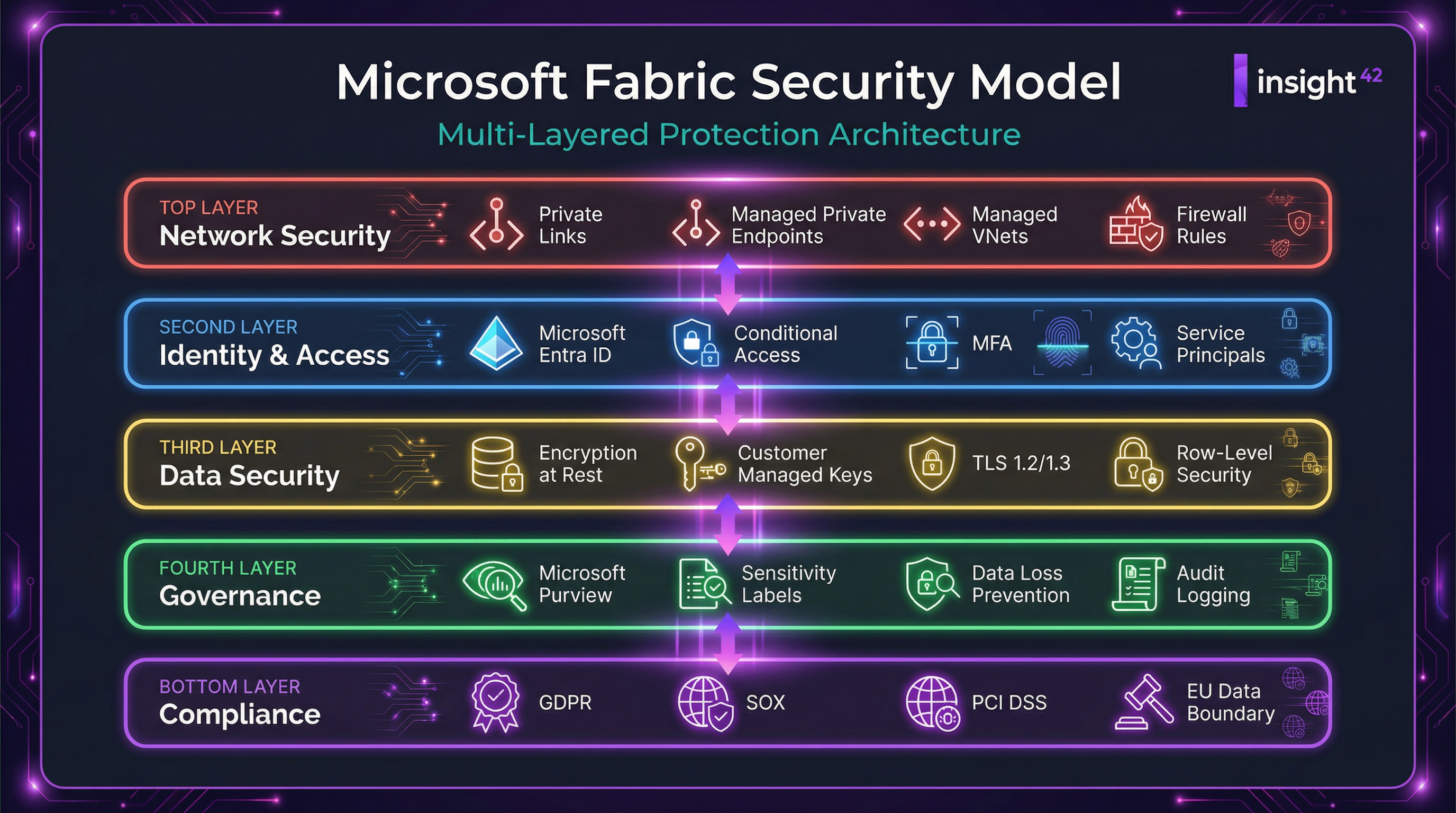
Microsoft has built a comprehensive, multi-layered security model for Fabric, leveraging the mature security capabilities of the Azure platform. This model can be broken down into several distinct layers, each providing a different level of protection.

Fabric Security Layers

Figure 1: The multi-layered security model of Microsoft Fabric, from network security to compliance.

A Layer-by-Layer Breakdown

The security model consists of five interconnected layers, each addressing a specific aspect of data protection:

LayerKey FeaturesDescription
Network SecurityPrivate Links, Managed Private Endpoints, Managed VNets, Firewall RulesProvides options for securing network traffic to and from the Fabric service, but with significant limitations compared to traditional IaaS/PaaS.
Identity & AccessMicrosoft Entra ID, Conditional Access, MFA, Service PrincipalsLeverages the robust identity and access management capabilities of Entra ID to control who can access the platform and what they can do.
Data SecurityEncryption at Rest (MS-managed & CMK), TLS 1.2/1.3, Row-Level SecurityProtects data both in transit and at rest, with options for customer-managed encryption keys for enhanced control.
GovernanceMicrosoft Purview, Sensitivity Labels, Data Loss Prevention (DLP), Audit LoggingIntegrates with Microsoft Purview to provide a unified governance and compliance solution across the entire data estate.
ComplianceGDPR, SOX, PCI DSS, EU Data BoundaryDesigned to meet a wide range of industry and regional compliance requirements, including the EU Data Boundary for data residency.

While this layered approach provides a strong security posture on paper, the reality of implementing and managing it in a complex enterprise environment can be challenging, especially when it comes to network separation.

The Challenge of Network Separation in a SaaS World

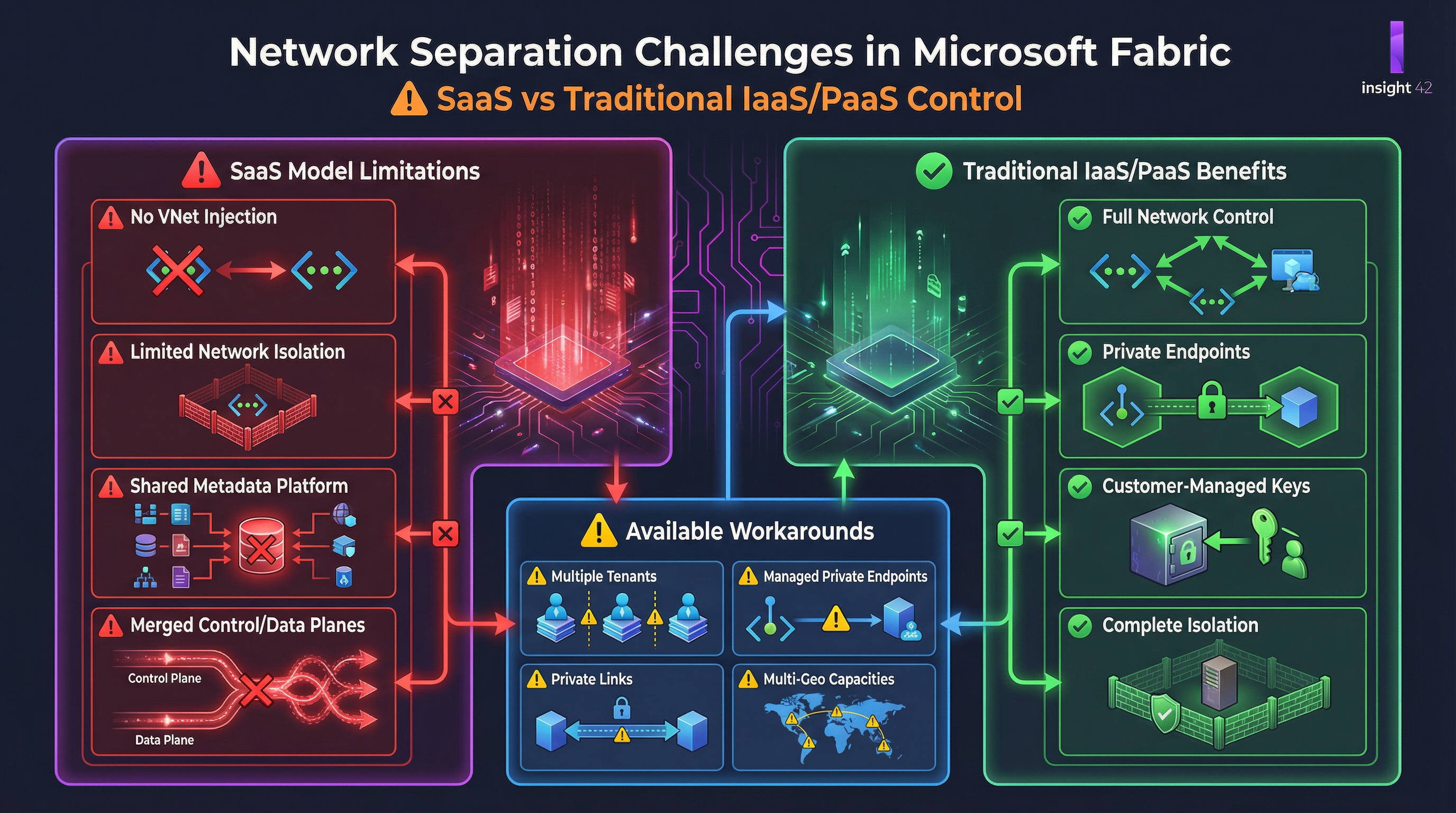
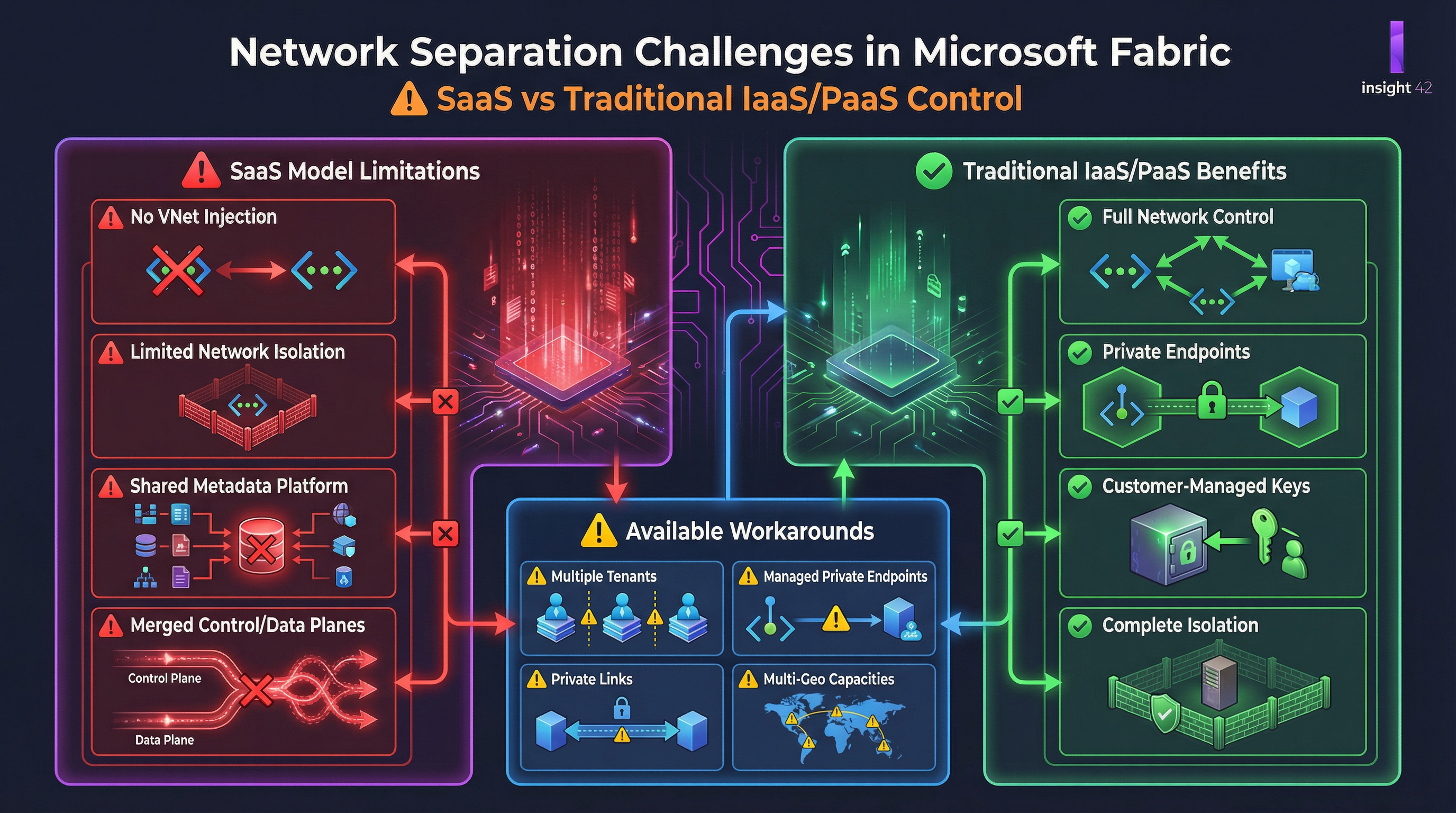
One of the biggest challenges with Microsoft Fabric is the inherent trade-off between the simplicity of a SaaS offering and the control of a traditional IaaS (Infrastructure-as-a-Service) or PaaS (Platform-as-a-Service) solution. In a traditional cloud environment, organizations have full control over their virtual network (VNet), allowing them to implement strict network isolation, custom routing, and fine-grained firewall rules. In Fabric, however, the control plane, storage layer, and compute layer are all managed by Microsoft in a multi-tenant environment, creating what many in the community have called an “amalgamated” and challenging architecture [1].

Network Separation Challenges

Figure 2: The network separation challenges in Microsoft Fabric compared to a traditional IaaS/PaaS approach, showing available workarounds.

Key Network Separation Shortcomings

The SaaS model introduces several limitations that enterprise architects must understand:

LimitationImpactRisk Level
No VNet InjectionCannot inject Fabric into your own virtual network. Loss of control over inbound/outbound traffic with NSGs and firewalls.High
Limited Network IsolationLogical isolation between tenants exists, but underlying infrastructure is shared. Concern for strict data sovereignty requirements.Medium-High
Shared Metadata PlatformMetadata platform storing permissions/authorization is shared. Logical isolation only, no physical isolation.Medium
Merged Control/Data PlanesControl and data planes amalgamated in SaaS model. Difficult to implement traditional separated architecture security.High

Workarounds and Their Limitations

To address these shortcomings, Microsoft has introduced several features, but each comes with its own set of limitations:

WorkaroundWhat It DoesLimitation
Managed Private EndpointsSecurely connect to data sources from within FabricOnly works for outbound traffic; no inbound protection
Private LinksPrivate, dedicated connection to the Fabric serviceConfigured at tenant level; complex to manage
Multi-Geo CapacitiesControl data residency of compute and storageTenant metadata remains in home region
Multiple TenantsComplete isolation through separate Entra ID tenantsRequires separate licenses; management overhead

Navigating the Compliance Maze in 2025

For organizations operating in the EU, the compliance landscape is becoming increasingly complex. Regulations like the General Data Protection Regulation (GDPR) and the upcoming AI Act place strict requirements on how data is stored, processed, and governed. While Microsoft has made significant investments in ensuring that Fabric is compliant with these regulations, including making it an EU Data Boundary service [2], the architectural challenges we’ve discussed can make it difficult to prove compliance to auditors.

The Multi-Tenant Conundrum

The multi-tenant nature of Fabric, combined with the lack of full network control, can create a compliance nightmare. How do you prove to an auditor that your data is truly isolated when it resides on a shared infrastructure? How do you manage encryption keys and access policies in a way that meets the stringent requirements of GDPR?

One potential workaround is to use multiple tenants, creating a separate Entra ID tenant for each business unit or data domain that requires strict isolation. However, this approach introduces its own set of challenges:

ChallengeDescription
Licensing ComplexityEach tenant requires its own set of licenses, which can significantly increase costs.
Management OverheadManaging multiple tenants, each with its own set of users, permissions, and configurations, can be a major administrative burden.
Data Sharing ChallengesSharing data between tenants can be complex, requiring the use of guest accounts and other workarounds.
Identity FederationUsers may need multiple identities or complex B2B guest configurations.

Compliance Checklist for 2025

For organizations planning to adopt Fabric in a regulated environment, consider the following:

RequirementFabric CapabilityGap/Consideration
Data ResidencyEU Data Boundary, Multi-GeoMetadata may still reside outside preferred region
Encryption at RestMicrosoft-managed keys, CMK optionCMK requires additional configuration and management
Access AuditMicrosoft Purview, Audit LoggingEnsure logs meet retention requirements
Data ClassificationSensitivity Labels, DLPRequires Microsoft 365 E5 or equivalent
Network IsolationPrivate Links, Managed EndpointsNot equivalent to VNet injection

The Road Ahead: A Balancing Act

Microsoft Fabric is a powerful and ambitious platform that has the potential to revolutionize the world of data and analytics. However, its SaaS nature introduces a new set of security and compliance challenges that cannot be ignored. For organizations that require the highest levels of security, control, and isolation, the current state of Fabric may not be sufficient.

Key Insight: The trade-off between SaaS simplicity and enterprise control is real. Organizations must carefully evaluate whether Fabric’s current security capabilities meet their specific compliance requirements, or whether workarounds like multi-tenant architectures are necessary.

In the next part of this series, we will delve deeper into the practical solutions and workarounds for these challenges. We will explore multi-tenant architecture patterns in more detail, provide a comprehensive guide to Fabric’s licensing model, and offer practical advice on how to navigate the complex trade-offs between simplicity and control.

References

[1] Fabric shortcomings : r/MicrosoftFabric
[2] What is the EU Data Boundary? – Microsoft Privacy

← Previous: Part 2: Data Lakes and DWH Architecture | Next: Part 4: Multi-Tenant Architecture and Licensing
#FabricSecurity #NetworkIsolation #SaaSSecurity #FabricCompliance #GDPR #MultiTenant #PrivateLinks #DataResidency #EUDataBoundary #FabricGovernance #CMKEncryption #EnterpriseSecurity #AzureFabric #CloudSecurity #DataProtection

A Deep Dive into Azures’ Future of Cloud Data Platforms

Microsoft Fabric: 29th Dec 2025 Martin-Peter Lambert
A Deep Dive into Azures’ Future of Cloud Data Platforms

Microsoft Fabric: (Part 2 of 5)

An insight 42 Technical Deep Dive SeriesThis is A Deep Dive into Azures’ Future of Cloud Data Platforms Part 2.

Rethinking Data Architecture in the Fabric Era

In the first part of this series, we explored the evolution of data platforms and introduced Microsoft Fabric as the next step in this journey. Now, we will delve deeper into the architectural implications of Fabric, examining how its unified approach and central OneLake storage layer are forcing a fundamental rethink of how we design and build data lakes and data warehouses. The traditional lines between these two concepts are blurring, and a new, more integrated architectural pattern is emerging.

This post will analyze the shift from separate data lakes and warehouses to a unified lakehouse architecture within Fabric. We will also provide a detailed look at the medallion architecture, a popular design pattern for organizing data in a lakehouse, and how it can be effectively implemented in a Fabric environment.

The Convergence of Data Lakes and Data Warehouses

For years, data lakes and data warehouses have been treated as separate, albeit complementary, components of a modern data platform. Data lakes were used for storing raw, unstructured data and for exploratory analysis and data science, while data warehouses were used for structured, curated data for business intelligence and reporting. This separation, however, created significant challenges:

  • Data Duplication: Data had to be copied and moved between the data lake and the data warehouse, leading to increased storage costs and data consistency issues.
  • Complex ETL Pipelines: Fragile and complex ETL (Extract, Transform, Load) pipelines were required to move and transform data, increasing development and maintenance overhead.
  • Data Silos: The separation of data and tools created silos, making it difficult for different teams to collaborate and share data effectively.

Microsoft Fabric aims to solve these challenges by unifying the data lake and the data warehouse into a single, integrated experience. At the heart of this convergence is OneLake, which acts as a single source of truth for all data, and the lakehouse as the primary architectural pattern.

OneLake and Workspaces: The Foundation

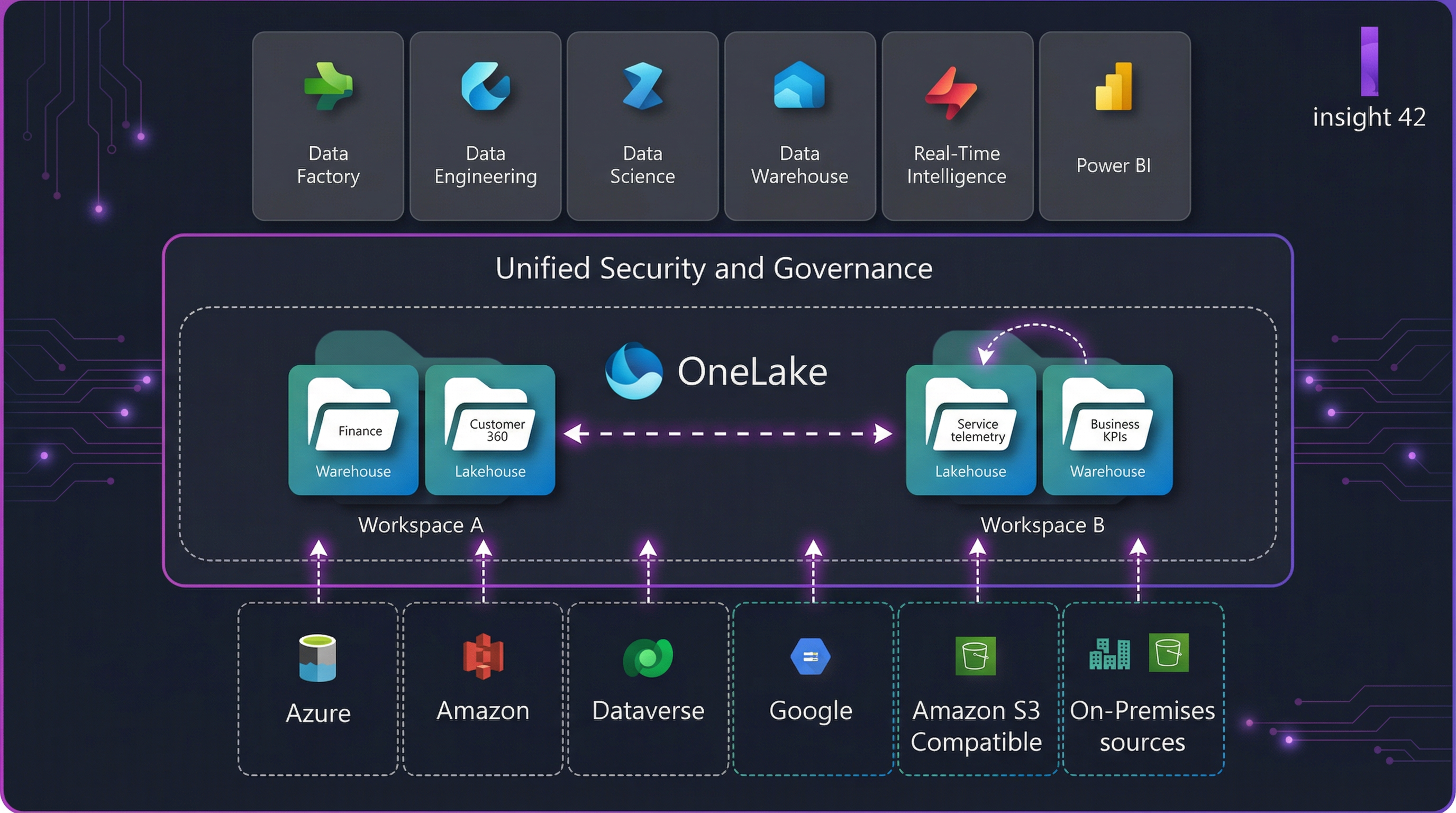
Before diving into the medallion architecture, it’s essential to understand how OneLake organizes data through workspaces. OneLake provides a single, unified storage layer where all Fabric items—lakehouses, warehouses, and other artifacts—store their data.

OneLake and Workspaces

Figure 1: OneLake workspace architecture showing unified security, governance, and multi-cloud data access through shortcuts.

The Lakehouse: A New Architectural Centerpiece

A lakehouse in Fabric is not just a data lake with a SQL layer on top; it is a first-class citizen that combines the best features of both data lakes and data warehouses. It provides:

FeatureDescription
Direct-to-data accessAll Fabric workloads, including Power BI, can directly access data in the lakehouse without having to import or copy it.
Open data formatsData is stored in the open-source Delta format, ensuring that you are not locked into a proprietary ecosystem.
ACID transactionsThe Delta format provides ACID (Atomicity, Consistency, Isolation, Durability) guarantees, ensuring data reliability and consistency.
Unified governanceAll data in the lakehouse is governed by the same security and compliance policies, managed centrally through Microsoft Purview.

Implementing the Medallion Architecture in Fabric

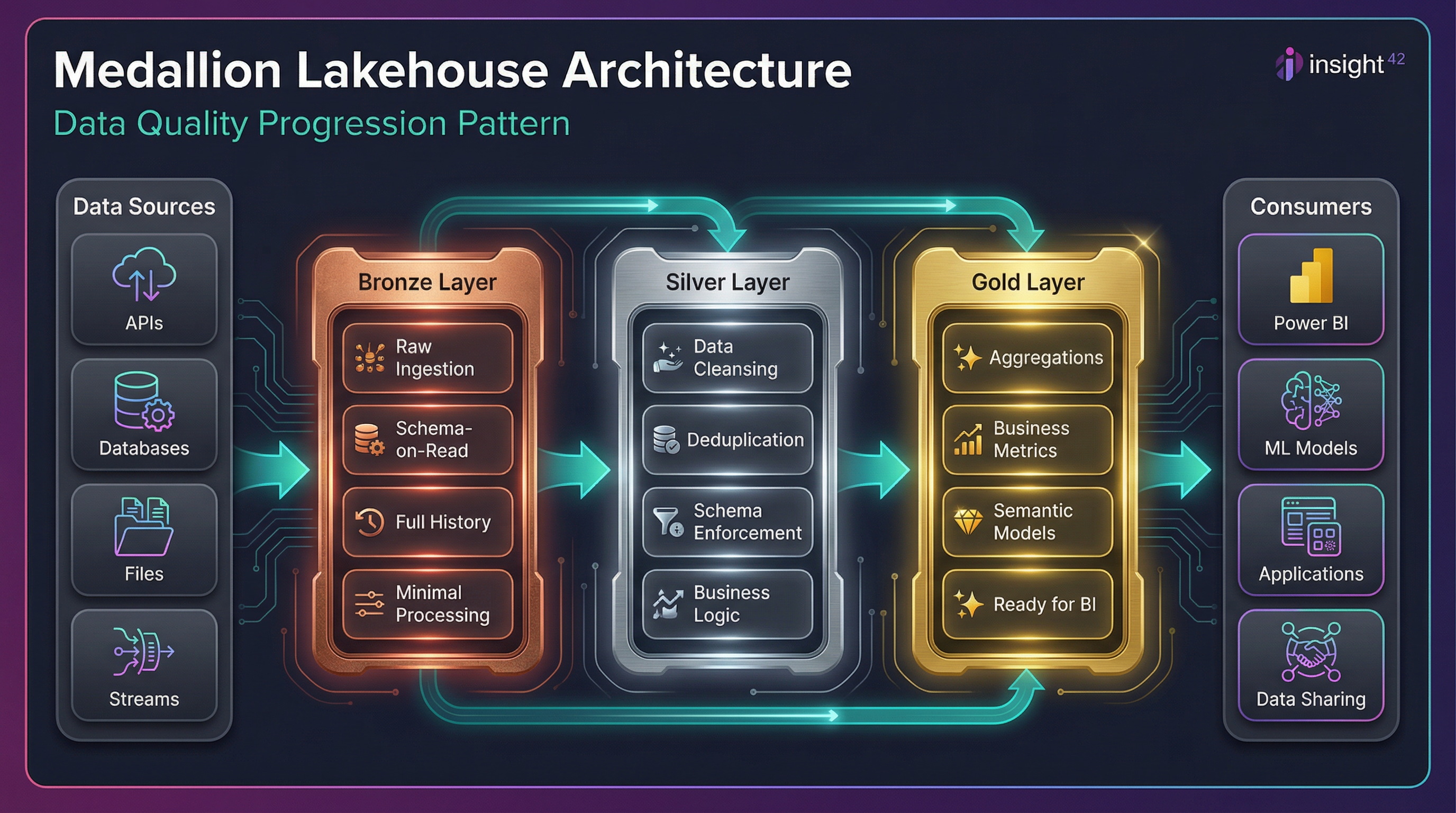
The medallion architecture is a data design pattern that has become increasingly popular for organizing data in a lakehouse. It logically organizes data into three distinct layers—Bronze, Silver, and Gold—with the goal of incrementally and progressively improving the quality and structure of the data as it moves through the layers [1].

Medallion Architecture

Figure 2: The medallion architecture, showing the progression of data from raw (Bronze) to cleansed (Silver) to business-ready (Gold).

Let’s explore how each of these layers can be effectively implemented within a Microsoft Fabric environment.

Bronze Layer: The Raw Data

The Bronze layer is where you land all your raw data from various source systems. The goal of this layer is to capture the data in its original, unaltered state, providing a historical archive and a source for reprocessing if needed. Key characteristics of the Bronze layer include:

CharacteristicDescription
Schema-on-readData is ingested and stored in its native format without any schema enforcement.
Append-onlyData is typically appended to existing tables to maintain a full historical record.
Minimal processingOnly minimal transformations, such as data type casting, are performed in this layer.
Full historyComplete audit trail of all ingested data for compliance and reprocessing.

In Fabric, the Bronze layer can be implemented using a dedicated lakehouse for raw data ingestion. Data can be brought into this lakehouse using Data Factory pipelines, Spark notebooks, or shortcuts to external data sources.

Silver Layer: The Cleansed and Conformed Data

The Silver layer is where the raw data from the Bronze layer is cleansed, transformed, and enriched. The goal of this layer is to provide a clean, consistent, and conformed view of the data that can be used by various downstream applications and analytics workloads. Key characteristics of the Silver layer include:

CharacteristicDescription
Data cleansingHandling missing values, standardizing formats, and correcting data quality issues.
DeduplicationRemoving duplicate records to ensure data accuracy.
Schema enforcementApplying a well-defined schema to the data.
Business logicApplying business rules and transformations to enrich the data.

In Fabric, the Silver layer is typically implemented as a separate lakehouse or as a set of curated tables within the same lakehouse as the Bronze layer. Spark notebooks and Dataflow Gen2 are the primary tools for performing the transformations required to move data from Bronze to Silver.

Gold Layer: The Business-Ready Data

The Gold layer is the final, highly curated layer of the medallion architecture. It contains aggregated, business-level data that is optimized for reporting and analytics. The goal of this layer is to provide a single source of truth for key business metrics and dimensions. Key characteristics of the Gold layer include:

CharacteristicDescription
AggregationsData is aggregated to various levels of granularity to support different reporting needs.
Business metricsKey performance indicators (KPIs) and other business metrics are calculated and stored.
Semantic modelsData is organized into star schemas or other dimensional models for self-service BI.
Ready for BIThe data is optimized for consumption by BI tools like Power BI.

In Fabric, the Gold layer can be implemented as a Fabric Data Warehouse or as a set of highly curated tables in a lakehouse. The choice between a warehouse and a lakehouse depends on the specific requirements of the use case. Warehouses provide a more traditional SQL-based experience, while lakehouses offer more flexibility and direct integration with other Fabric workloads.

Implementation Summary

LayerPurposeFabric ImplementationKey Tools
BronzeRaw data ingestionDedicated lakehouseData Factory, Spark, Shortcuts
SilverCleansed and conformed dataCurated lakehouse tablesSpark, Dataflow Gen2
GoldBusiness-ready dataData Warehouse or curated lakehouseSQL, Spark, Power BI

The Future of Data Architecture is Unified

Microsoft Fabric represents a significant step forward in the evolution of data platforms. By unifying the data lake and the data warehouse into a single, integrated experience, Fabric has the potential to simplify the data landscape, break down data silos, and accelerate time to value. The medallion architecture provides a proven design pattern for organizing data in this new, unified world.

However, as we will see in the next part of this series, the reality of implementing these new architectures is not without its challenges. In Part 3, we will take a critical look at the security, compliance, and network separation challenges that organizations face when adopting Microsoft Fabric, and explore the practical solutions and workarounds that are available today.

References

[1] What is the medallion lakehouse architecture? – Azure Databricks

← Previous: Part 1: Introduction to Fabric | Next: Part 3: Security, Compliance, and Network Separation

#MicrosoftFabric #MedallionArchitecture #DataLakehouse #OneLake #DataArchitecture #DataEngineering #BronzeSilverGold #UnifiedDataPlatform #DeltaLake #DataGovernance #CloudData #FabricImplementation #DataModeling #ETLSimplification #DataWarehouseModernization

A Deep Dive into Azures’ Future of Cloud Data Platforms

Microsoft Fabric: 27th Dec 2025 Martin-Peter Lambert
A Deep Dive into Azures’ Future of Cloud Data Platforms

Microsoft Fabric: (Part 1 of 5)

An insight 42 Technical Deep Dive Series presents A Deep Dive into Azure’s Future of Cloud Data Platforms.

The Unending Quest for a Unified Data Platform

In the world of data, the only constant is change. For decades, organizations have been on a quest to find the perfect data architecture—a single, unified platform. It should handle everything from traditional business intelligence to the most demanding AI workloads. This journey has taken us from rigid, on-premises data warehouses to the flexible, but often chaotic, world of cloud data lakes. Each step in this evolution has solved old problems while introducing new ones. It leaves many to wonder if a truly unified platform was even possible.

This 5-part blog series will provide a deep and critical analysis of Microsoft Fabric, the latest and most ambitious attempt to solve this long-standing challenge. We will explore its architecture, its promises, its shortcomings, and its potential to reshape the future of data and analytics. In this first post, we will set the stage by examining the evolution of data platforms. Additionally, we will introduce the core concepts behind Microsoft Fabric.

A Brief History of Data Platforms: From Warehouses to Lakehouses

To understand the significance of Microsoft Fabric, we must first understand the history that led to its creation. The evolution of data platforms can be broadly categorized into distinct eras. Each era has its own set of technologies and architectural patterns.

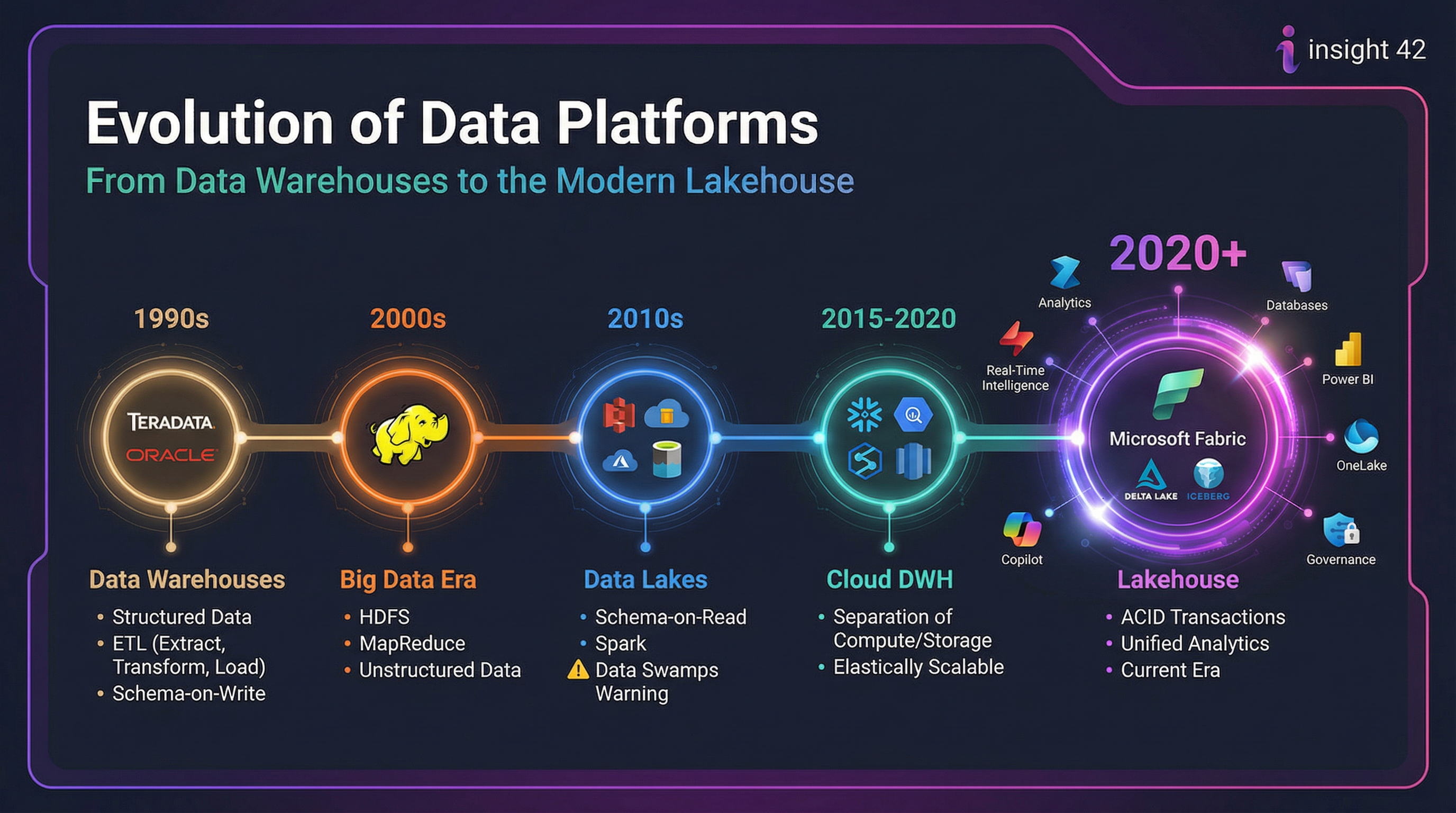
Evolution of Data Platforms

Figure 1: The evolution of data platforms, from traditional data warehouses to the modern lakehouse architecture.

The Era of the Data Warehouse

In the 1990s, the data warehouse emerged as the dominant architecture for business intelligence and reporting [1]. These systems, pioneered by companies like Teradata and Oracle, were designed to store and analyze large volumes of structured data. The core principle was schema-on-write, where data was cleaned, transformed, and loaded into a predefined schema before it could be queried. This approach provided excellent performance and data quality but was inflexible and expensive. This was especially true when dealing with the explosion of unstructured and semi-structured data from the web.

The Rise of the Data Lake

The 2010s saw the rise of the data lake, a new architectural pattern designed to handle massive volumes and variety of data. Modern applications generated this data. Built on cloud storage services like Amazon S3 and Azure Data Lake Storage (ADLS), data lakes embraced a schema-on-read approach. This allowed raw data to be stored in its native format and processed on demand [2]. This provided immense flexibility but often led to “data swamps.” These are poorly managed data lakes with little to no governance. They make it difficult to find, trust, and use the data within them.

The Lakehouse: The Best of Both Worlds?

In recent years, the lakehouse architecture has emerged as a hybrid approach. It aims to combine the best of both worlds. It takes the performance and data management capabilities of the data warehouse with the flexibility and low-cost storage of the data lake [3]. Technologies like Delta Lake and Apache Iceberg bring ACID transactions and schema enforcement. Other data warehousing features are added to the data lake. This makes it possible to build reliable and performant analytics platforms on open data formats.

Introducing Microsoft Fabric: The Next Step in the Evolution

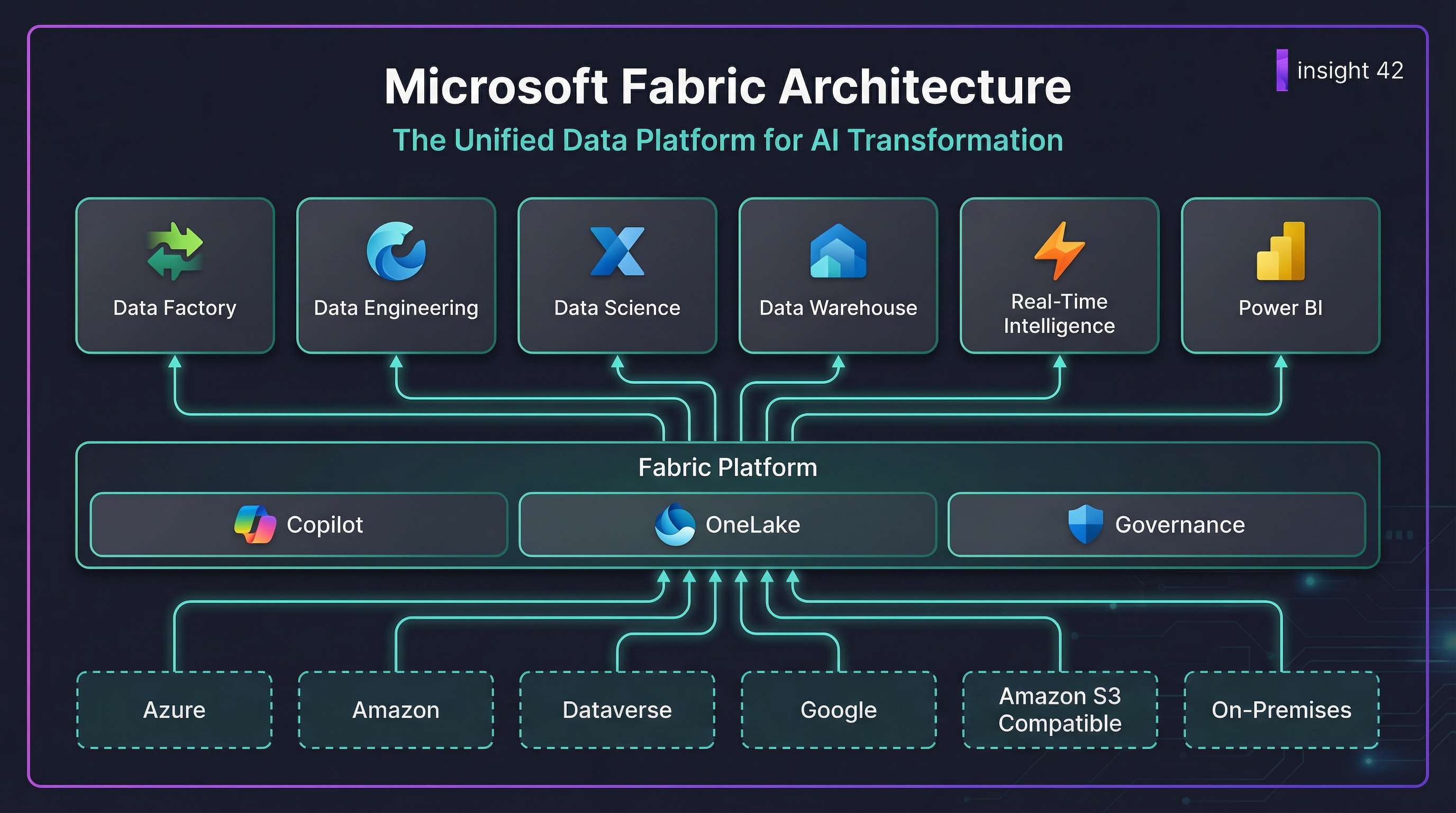
Microsoft Fabric represents the next logical step. In this evolutionary journey, it is not just another data platform. It is a complete, end-to-end analytics solution delivered as a software-as-a-service (SaaS) offering. Fabric integrates a suite of familiar and new tools into a single, unified experience. These tools include Data Factory, Synapse Analytics, and Power BI. All are built around a central data lake called OneLake [4].

Microsoft Fabric Architecture

Figure 2: The high-level architecture of Microsoft Fabric, showing the unified experiences, platform layer, and OneLake storage.

The Core Principles of Fabric

Microsoft Fabric is built on several key principles that differentiate it from previous generations of data platforms:

PrincipleDescription
Unified ExperienceFabric provides a single, integrated environment for all data and analytics workloads. It supports data engineering, data science, business intelligence, and real-time analytics.
OneLakeAt the heart of Fabric is OneLake, a single, unified data lake for the entire organization. All Fabric workloads and experiences are natively integrated with OneLake, eliminating data silos. This reduces data movement.
Open Data FormatsOneLake is built on top of Azure Data Lake Storage Gen2. It uses open data formats like Delta and Parquet, ensuring that you are not locked into a proprietary format.
SaaS FoundationFabric is a fully managed SaaS offering. This means that Microsoft handles infrastructure, maintenance, and updates, allowing you to focus on delivering data value.

The Promise of Fabric

The vision behind Microsoft Fabric is to create a single, cohesive platform serving all the data and analytics needs of an organization. By unifying the various tools and services that were previously separate, Fabric aims to:

  • Simplify the data landscape: Reduce the complexity of building and managing modern data platforms.
  • Break down data silos: Provide a single source of truth for all data in the organization.
  • Empower all users: Enable everyone from data engineers to business analysts to collaborate and innovate on a single platform.
  • Accelerate time to value: Reduce the time and effort required to build and deploy new data and analytics solutions.

What’s Next in This Series

While the vision for Microsoft Fabric is compelling, the reality of implementing and using it in a complex enterprise environment is far from simple. In the upcoming posts in this series, we will take a critical look at various aspects of Fabric. This includes:

PartTitleFocus
Part 2Data Lakes and DWH Architecture in the Fabric EraMedallion architecture, lakehouse patterns, data modeling
Part 3Security, Compliance, and Network Separation ChallengesSecurity layers, compliance, network isolation limitations
Part 4Multi-Tenant Architecture, Licensing, and Practical SolutionsWorkspace patterns, F SKU licensing, cost optimization
Part 5Future Trajectory, Shortcuts to Hyperscalers, and the Hub VisionCross-cloud integration, future roadmap, universal hub concept

Join us as we continue this deep dive into Microsoft Fabric. We will separate the hype from the reality. Our goal is to provide you with the insights needed to navigate the future of cloud data platforms.

References

This article is part of the Microsoft Fabric Deep Dive series by insight 42. Continue to Part 2: Data Lakes and DWH Architecture

#MicrosoftFabric #UnifiedDataPlatform #CloudDataPlatforms #DataLakehouse #FabricDeepDive #DataArchitecture #OneLake #DataPlatform #DataEngineering #BusinessIntelligence #SaaSData #DataSilos #FabricImplementation #CloudDataStrategy #DataAnalytics