AI In The Public Sector, Azure CAF & Cloud Migration, Growth, Resilience, Sovereignty Series 18th Feb 2026Martin-Peter Lambert
The Path to Zero Trust
Meta Description: Entra ID Migration for Public Authorities is essential for organisations in the public sector seeking to implement SSO, MFA, and Zero Trust. BSI C5 compliant and IT-Grundschutz ready.
Identity is the New Perimeter
Firewalls alone are no longer enough. Employees work from anywhere. Cloud services are distributed. Identity has become the central security anchor. Zero Trust is the answer.
This is particularly relevant for the public sector. Sensitive data must be protected. An Entra ID migration creates the foundation. BSI C5 Cloud requirements are met.
What Zero Trust Means
Zero Trust is a security model: never trust, always verify. Every access attempt is checked. Every identity is validated.
It sounds strict, and it is. But it works. Attacks are made more difficult. Lateral movement is prevented. The BSI-compliant cloud security concept recommends this approach.
The Pillars of Zero Trust
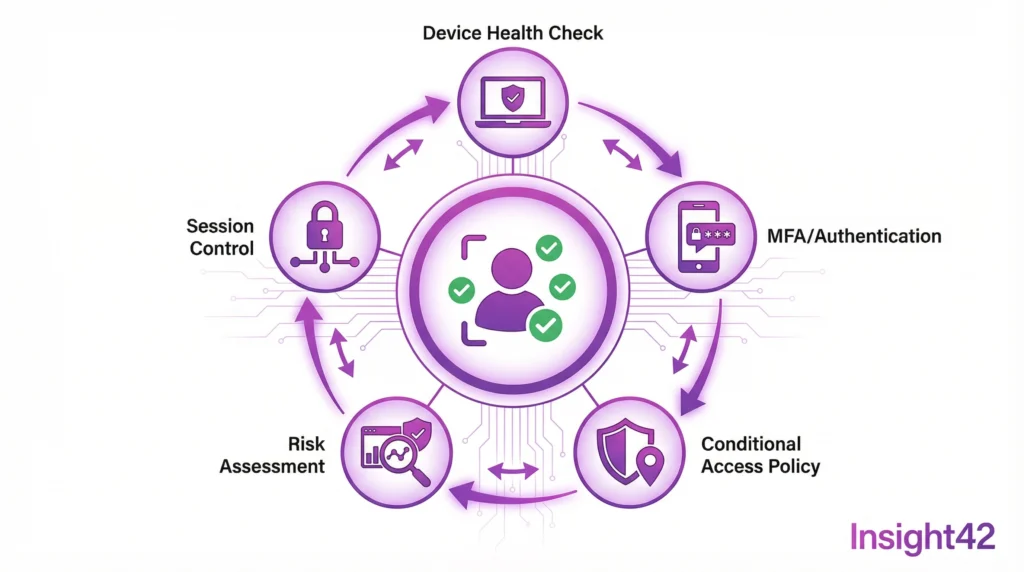
Verify Identity
Who is accessing the resource? Is the person who they claim to be? Multi-Factor Authentication is mandatory. Passwords alone are not enough.
Validate Device
From which device is the access coming? Is it managed? Is it compliant? Conditional Access checks these factors.
Minimize Access
The principle of least privilege applies. Only necessary rights, only for the necessary time. Just-in-Time access becomes the standard.
Monitor Activities
Every access is logged. Anomalies are detected. Automated responses are triggered.
Quick Checklist: Zero Trust Implementation
Component
Action
Priority
MFA
Enable for all users
Critical
SSO
Set up Single Sign-On
High
Conditional Access
Create baseline policies
High
PIM
Implement Privileged Identity Management
High
Device Compliance
Define device policies
Medium
App Protection
Configure application protection
Medium
Monitoring
Monitor sign-in logs
Medium
To-Do List for Entra ID Migration
Immediately: Enable MFA for administrators.
Week 1: Take inventory of identities.
Week 2: Define the SSO strategy.
Week 3: Plan Conditional Access policies.
Month 1: Migrate a pilot group.
Month 2: Roll out to all users.
Month 3: Implement PIM.
SSO Simplifies and Secures
Single Sign-On is not a luxury; it is a security feature. Fewer passwords mean less risk. Users use strong passwords because they only need one.
Entra ID enables SSO for thousands of applications, both in the cloud and on-premises. SAML, OAuth, and OpenID Connect are all supported.
SSO is essential for public sector cloud migration. Azure migration and GCP migration benefit. Users work seamlessly while security is maintained.
Implementing MFA Correctly
Multi-Factor Authentication is mandatory. BSI C5 compliance without MFA? Impossible. IT baseline protection consulting requires it, as does NIS2 compliance consulting.
But MFA must be user-friendly. Authenticator apps are standard. Biometrics where possible. Hardware tokens for high security.
Conditional Access makes MFA intelligent. Not for every login, only when there is a risk. Unknown device? MFA. Unusual location? MFA.
Protecting Privileged Identities
Administrators are prime targets. Their accounts have extensive rights. Privileged Identity Management (PIM) protects them.
The principle is Just-in-Time access. Rights are activated only when needed, for a limited time, and with approval.
The BSI-compliant cloud security concept demands these controls. KRITIS cloud security requires them. Insight42 implements them.
Insight42 Identity Services
We are experts in Entra ID migration. Zero Trust is our standard. BSI C5 compliance is our promise.
From strategy to operation, we offer cloud managed services for identity for public authorities, including Azure managed services.
Secure your identities. Contact us.
[Image: Zero Trust Architecture]
Figure: Zero Trust Identity Architecture for Public Authorities
Blog Post 2: Conditional Access and MFA – Intelligent Access Control for Public Administration
Meta Description: Conditional Access and MFA for public authorities. Intelligent, BSI C5 compliant, and IT-Grundschutz-based access control. Secure and user-friendly.
Rethinking Access Control
Old models are obsolete. Once authenticated, always trusted? Dangerous. Conditional Access changes the game. Every access is evaluated. Context is key.
This is revolutionary for the public sector. Security becomes dynamic. User-friendliness is maintained. A cloud-first administration becomes secure.
What Conditional Access Does
Conditional Access is a policy framework that evaluates access in real-time. Who? From where? With what device? To what? These questions are answered.
Based on the answers, decisions are made: allow access, block access, require MFA, or restrict the session.
Understanding the Signals
User and Group
Who is accessing? Administrators have different rules than standard users. Externals different from internals.
Location
Where is the access coming from? Known networks are more trustworthy. Unknown countries are blocked.
Device
Is the device managed? Is it compliant? Unknown devices require additional verification.
Application
Which app is being accessed? Sensitive applications need stronger protection.
Risk
Entra ID automatically assesses risk. Unusual behavior is detected. Compromised accounts are locked.
Quick Checklist: Conditional Access Policies
Policy
Goal
Action
MFA for Admins
Protect privileged accounts
Enforce MFA
Blocked Countries
Stop attacks from high-risk regions
Block access
Compliant Devices
Allow only secure devices
Require compliance
Block Legacy Auth
Prevent insecure protocols
Block
Session Timeout
Reduce risk during inactivity
Limit session
App Protection
Protect sensitive apps
Require MFA + Compliance
To-Do List for Conditional Access
Day 1: Activate report-only mode.
Week 1: Define baseline policies.
Week 2: Enforce MFA for all admins.
Week 3: Block legacy authentication.
Month 1: Introduce device compliance.
Month 2: Implement location-based policies.
Month 3: Implement risk-based policies.
Comparing MFA Methods
Not all MFA methods are equal. Some are more secure, others more user-friendly. The right choice depends on the context.
Microsoft Authenticator
Push notifications are simple. Number matching increases security. Passwordless login is possible.
FIDO2 Security Keys
Hardware-based and phishing-resistant. Ideal for high-security environments. Slightly higher cost.
SMS and Phone
Easy to implement, but less secure. Recommended only as a fallback.
Windows Hello
On-device biometrics. Very user-friendly. Requires compatible hardware.
Meeting Compliance Requirements
BSI C5 Cloud demands strong authentication. Conditional Access delivers it. IT baseline protection consulting confirms compliance.
ISO 27001 based on IT-Grundschutz requires access control. Conditional Access documents every access. Audits are passed.
NIS2 compliance consulting recommends Zero Trust. Conditional Access is a core component. It supports the Data Protection Impact Assessment for the cloud.
Integration with Other Services
Conditional Access does not stand alone. It integrates with Microsoft Defender, uses Intune for device compliance, and connects to SIEM for monitoring.
Public sector cloud migration benefits from this integration. The Azure Landing Zone includes Conditional Access. Azure managed services monitor the policies.
Insight42 Conditional Access Services
We design Conditional Access strategies tailored for public authorities. BSI C5 compliant and user-friendly.
From analysis to implementation, we provide cloud consulting for authorities with a focus on identity and cloud managed services for operations.
Control access intelligently. Talk to us.
www.insight42.de
Data Isn’t the New Oil. That Lie Is Costing Europe Billions.
Azure CAF & Cloud Migration, Growth, Resilience, Sovereignty Series 12th Feb 2026Martin-Peter Lambert
Sub-headline: Oil gets burned once. Data compounds—or rots. The truth is, Data Isn’t the New Oil. That Lie Is Costing Europe Billions. The message that Data Isn’t the New Oil. That Lie Is Costing Europe Billions. is one that businesses and policy makers cannot afford to ignore. The difference is your strategy for data analytics, BI, and AI, built on a sovereign cloud architecture.
The metaphor “data is the new oil” has led to a misguided obsession with hoarding information. The truth is, its worth is determined by the quality of its curation and the incentives that govern its lifecycle. Turning raw data into profit requires a professional services partner capable of building BI, DWH automation, data analytics, or AI systems that create value from information assets.
Image: A split-panel image showing a rusty oil derrick vs. a vibrant, glowing digital tree.
We are drowning in information but starved for wisdom. This junk data is an inflation tax on your analytics, corrupting models and leading to flawed decisions. Quality, not quantity, is the true multiplier of productivity. Our professional services focus on building BI and DWH automation systems that start with a solid foundation of clean, reliable data, ensuring your AI and data analytics initiatives are built for success.
The value of data is determined by the problem it solves. This is why centralized data strategies often fail. A more effective approach is empowering users with the right tools. As your professional services partner, Insight42 helps you build the data analytics platforms that connect the right data to the right users at the right time.
If the people creating and maintaining data don’t have a clear reason to do so, the data will be poor quality. A successful data strategy aligns the incentives of data producers with data consumers. When we engage in building a BI, DWH, or AI solution, we start by defining the business value and aligning incentives to ensure project success.
To unlock the true value of data, it must be treated as a product. This means clear ownership, SLAs, and version control. Without this product-oriented mindset, your data lake becomes a swamp. Insight42’s approach to building data analytics platforms is to treat every dataset as a product, with a clear lifecycle and purpose.
The concept of property rights is the foundation of a free society. In the digital age, we must extend this to personal data, which requires robust security and a rights-first approach to technology, from your core infrastructure to your mobile end-to-end applications.
Image: A futuristic, digital factory processing raw data into valuable insights.
Personal data is a reflection of an individual’s identity. A rights-first approach to data governance is not only ethical; it’s good for business. Our services for optimizing security ensure that your data handling practices build the trust essential for long-term customer relationships.
Endless pages of legal jargon are not meaningful consent. This is a design problem. When building mobile end-to-end applications or customer-facing portals, we focus on creating intuitive interfaces that empower users to make informed decisions about their data.
The best way to protect data is to not have it. Collecting data “just in case” increases breach risk and cloud storage costs. Our cloud migration and data strategy services emphasize data minimization as a core principle for optimizing security and controlling expenses.
In a world of deepfakes, proving the provenance and lineage of data is the new standard of credibility. A verifiable audit trail is essential. For ultimate trust, we can help you explore blockchain solutions to create an immutable, transparent record of your data’s lifecycle.
Europe’s ambition for a single market for data is worthy, but it must be decentralized and business-friendly. This requires a modern approach to building their cloud and data architectures.
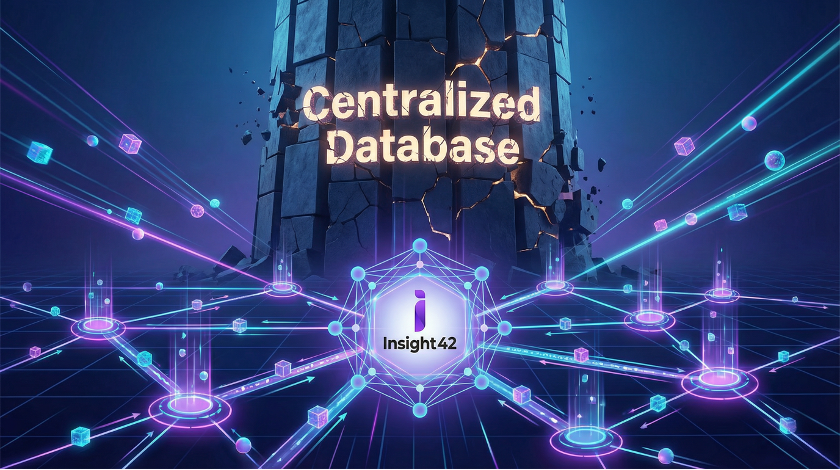
Image: A visual representation of a decentralized, federated data network.
A centralized approach to data sharing is a non-starter. A federated model, where data remains under the owner’s control, is the only viable path. Our expertise in building cloud architectures can help you design a federated data strategy that respects sovereignty and minimizes risk.
The digital economy must be built on a common standard of data exchange. When we undertake a cloud migration or build a new data analytics platform, we use open standards and APIs to ensure your systems are interoperable and future-proof.
If compliance costs exceed the benefits, markets fail. The frameworks governing data spaces must be business-friendly. Insight42 helps you navigate these regulations, ensuring your AI and data analytics projects remain innovative and profitable.
Is your data strategy built on a foundation of sand? At Insight42, we are the professional services partner you need to unlock the true value of your data.
Building BI, DWH, Automation, Data Analytics & AI: We transform your raw data into actionable intelligence and automated decisions.
Cloud Migration: We move your data and applications to a secure, sovereign, and cost-effective cloud environment.
Building Your Cloud: We design and implement custom cloud architectures that give you control and flexibility.
Optimizing Security, Backup, DR, and Resilience: We protect your data assets with end-to-end security and business continuity solutions.
Mobile End-to-End Applications & Blockchain: We build next-generation applications with data privacy and security at their core.
Contact us today for a consultation and let Insight42 help you build a data-driven future that is both compliant and competitive.
AI In The Public Sector, Growth, Resilience, Sovereignty Series 3rd Jan 2026Martin-Peter Lambert
Why Abundance, Security, and Free Markets are the Only True Catalysts for Innovation
Introduction: The Paradox of Creation
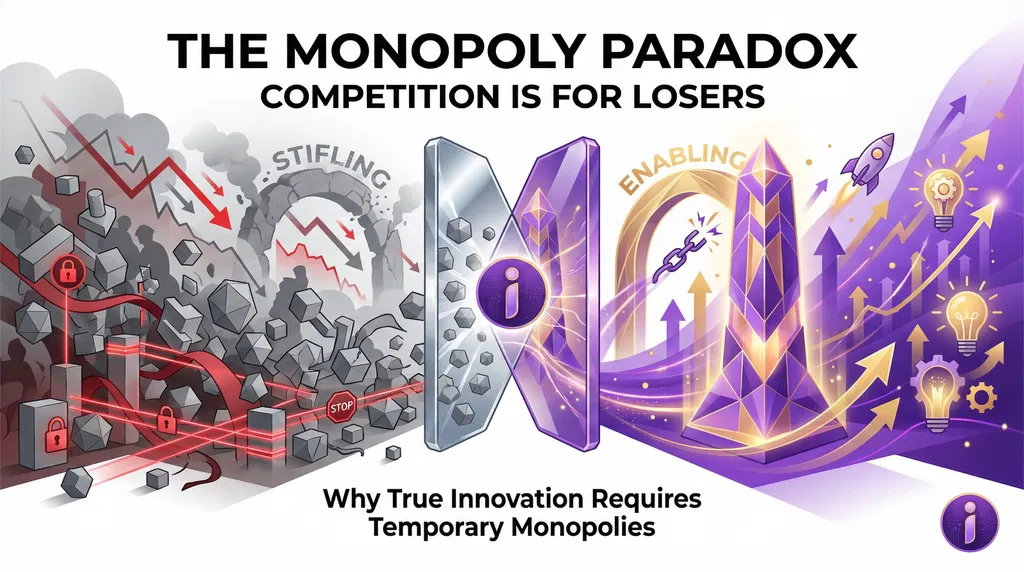
In the modern economic narrative, competition is lionized as the engine of progress. We are taught that a fierce marketplace, where rivals battle for supremacy, drives innovation, lowers prices, and ultimately benefits society. However, a closer examination of the last three decades of technological advancement reveals a startling paradox: true, transformative innovation—the kind that leaps from zero to one—rarely emerges from the bloody trenches of perfect competition. This notion supports the idea that perfect competition stifles progress and creativity, leading us to question why abundance, security, and free markets are the only true catalysts for innovation, as these environments often look far more like a monopoly with long-term vision rather than a cutthroat market.
This thesis, most forcefully articulated by entrepreneur and investor Peter Thiel in his seminal work, Zero to One, argues that progress is not a product of incremental improvements in a crowded field, but of bold new creations that establish temporary monopolies [1]. This article will explore Thiel’s framework, arguing that the capacity for radical innovation is contingent upon the financial security and long-term planning horizons that only sustained profitability can provide.
We will then turn our lens to the European Union, particularly Germany, to diagnose why the continent has failed to produce world-dominating technology companies in recent decades, attributing this failure to a culture of short-termism, stifling regulation, and punitive taxation.
Finally, we will dismantle the notion that the state can act as an effective substitute for the market in allocating capital for innovation. Drawing on the work of Nobel Prize-winning economists like Friedrich Hayek and the laureates recognized for their work on creative destruction, we will demonstrate that centralized planning is, and has always been, the most inefficient allocator of resources, fundamentally at odds with the chaotic, decentralized, and often wasteful process that defines true invention.
The Thiel Doctrine: Competition is for Losers
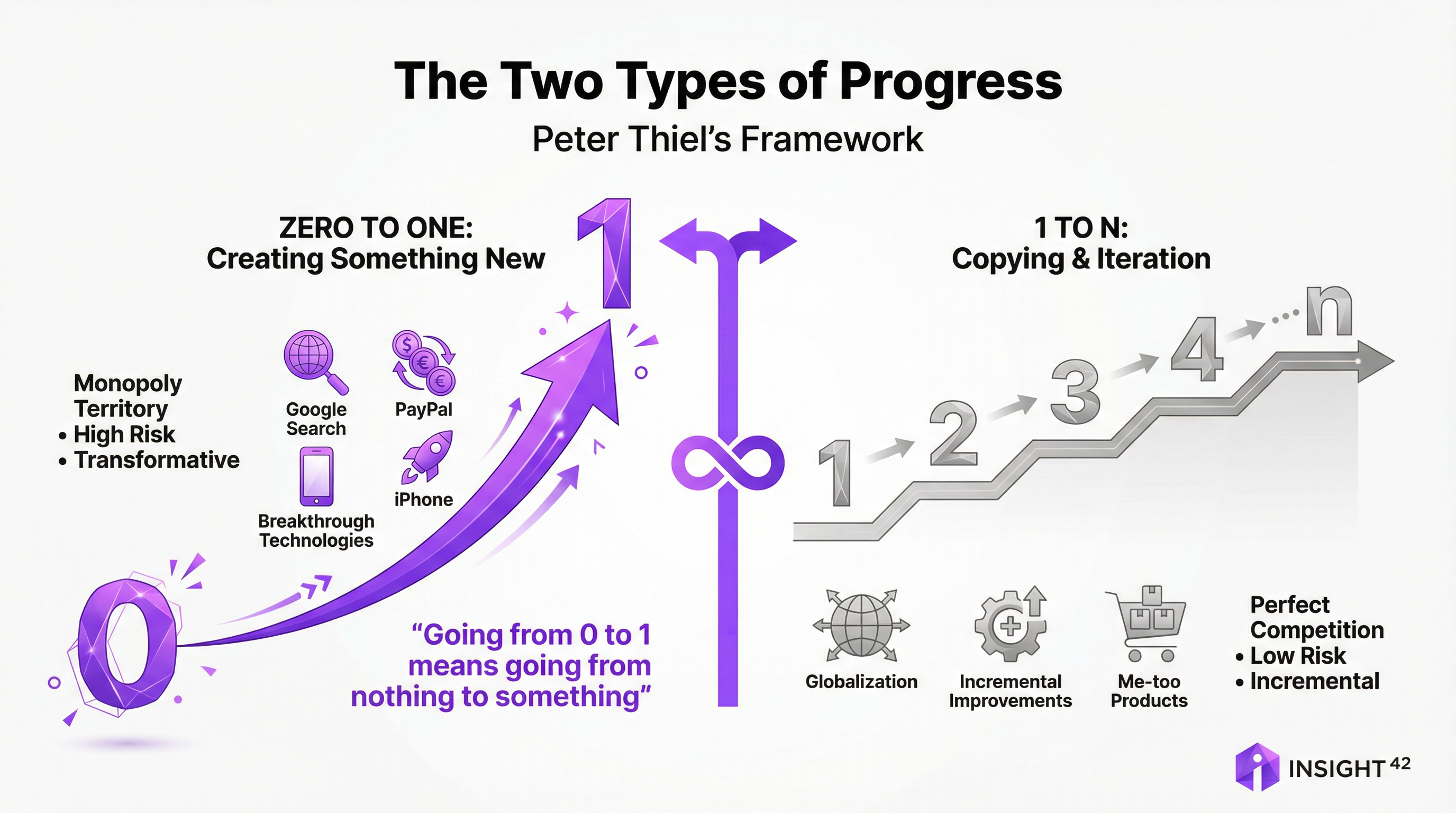
Peter Thiel’s provocative assertion that “competition is for losers” is not an endorsement of anti-competitive practices but a fundamental critique of how we perceive value creation. He draws a sharp distinction between “0 to 1” innovation, which involves creating something entirely new, and “1 to n” innovation, which consists of copying or iterating on existing models. While globalization represents the latter, spreading existing technologies and ideas, true progress is defined by the former.
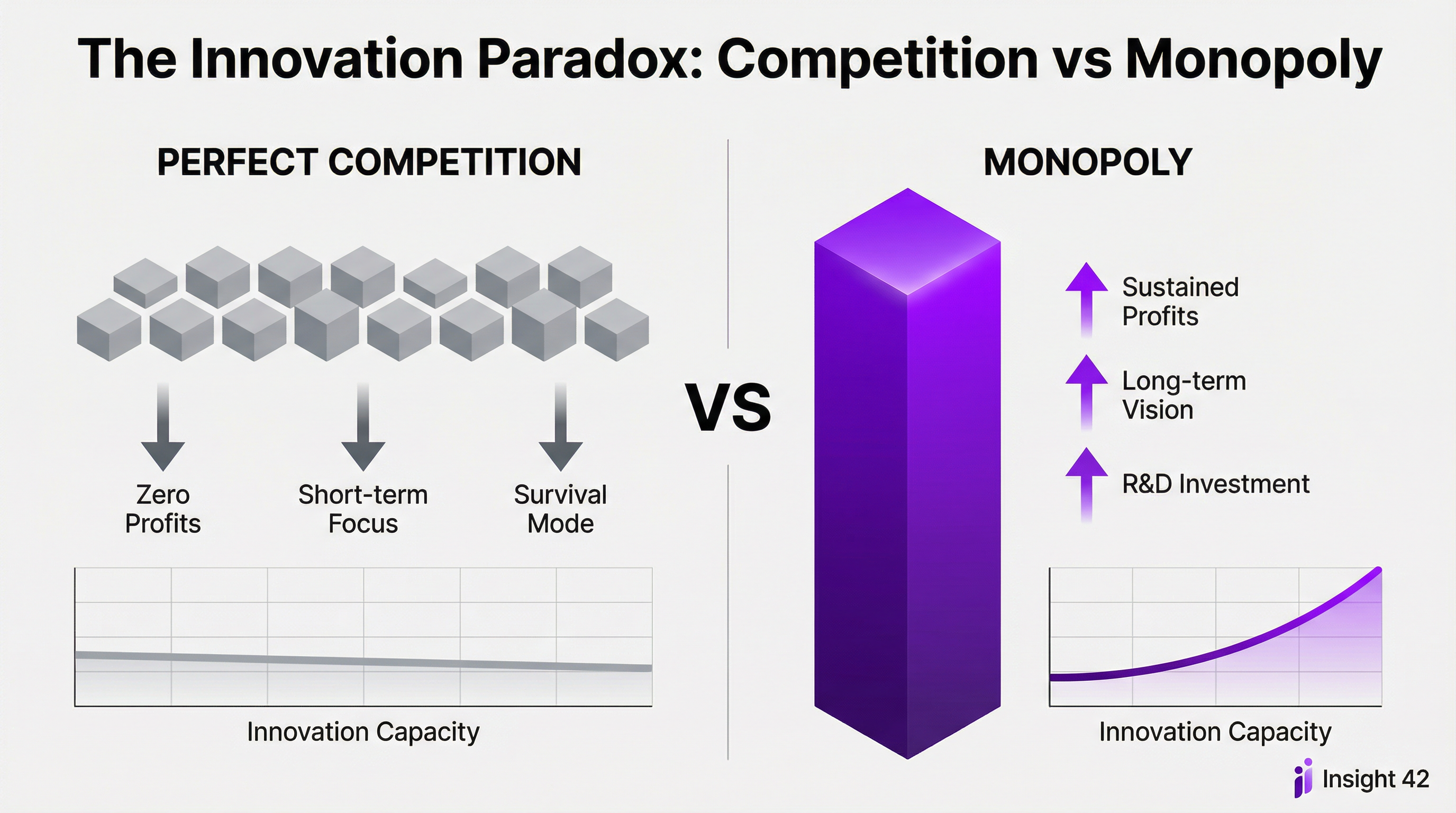
To understand this, Thiel contrasts two economic models: perfect competition and monopoly.
In a state of perfect competition, no company makes an economic profit in the long run. Firms are undifferentiated, selling at whatever price the market dictates. If there is money to be made, new firms enter, supply increases, prices fall, and the profit is competed away. In this brutal struggle for survival, companies are forced into a short-term, defensive crouch. Their focus is on marginal gains and cost-cutting, not on ambitious, long-term research and development projects that may not pay off for years, if ever [1].
The U.S. airline industry serves as a prime example. Despite creating immense value by transporting millions of passengers, the industry’s intense competition drives profits to near zero. In 2012, for instance, the average airfare was $178, yet the airlines made only 37 cents per passenger trip [1]. This leaves no room for the “waste” and “slack” necessary for bold experimentation.
In stark contrast, a company that achieves a monopoly—not through illegal means, but by creating a product or service so unique and superior that it has no close substitute—can generate sustained profits. These profits are not a sign of market failure but a reward for creating something new and valuable. Google, for example, established a monopoly in search in the early 2000s. Its resulting profitability allowed it to invest in ambitious “moonshot” projects like self-driving cars and artificial intelligence, endeavors that a company struggling for survival could never contemplate.
This environment of abundance and security is the fertile ground from which “Zero to One” innovations spring. It allows a company to think beyond immediate survival and plan for a decade or more into the future, accepting the necessity of financial waste and the high probability of failure in the pursuit of groundbreaking discoveries. This is the core of the Thiel doctrine: progress requires the security that only a monopoly, however temporary, can provide.
The European Malaise: A Continent of Incrementalism
For the past three decades, a glaring question has haunted the economic landscape: where are Europe’s Googles, Amazons, or Apples? Despite a highly educated workforce, strong industrial base, and significant government investment in R&D, the European Union, and Germany in particular, has failed to produce a single technology company that dominates its global market. The continent’s tech scene is characterized by a plethora of “hidden champions”—highly successful, niche-focused SMEs—but it lacks the breakout, world-shaping giants that have defined the digital age. This is not an accident of history but a direct consequence of a political and economic culture that is fundamentally hostile to the principles of “Zero to One” innovation.
The Triple Constraint: Regulation, Taxation, and Short-Termism
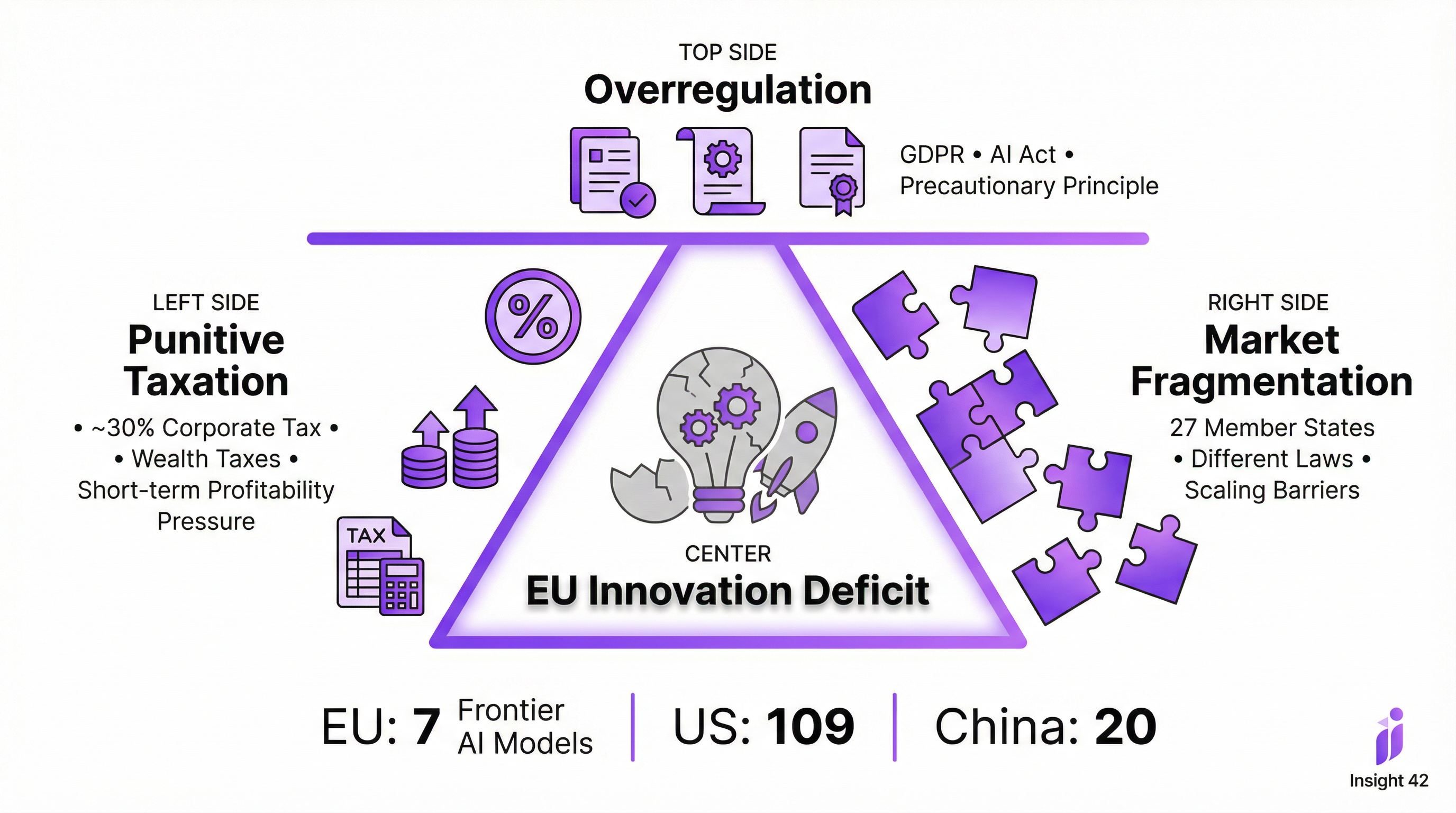
The European innovation deficit can be attributed to a trifecta of self-imposed constraints:
A Culture of Precautionary Regulation: The EU’s regulatory philosophy is governed by the “precautionary principle,” which prioritizes risk avoidance over seizing opportunities. This manifests in sprawling, complex regulations like the General Data Protection Regulation (GDPR) and the AI Act. While well-intentioned, these frameworks impose immense compliance burdens, especially on startups and smaller firms. A 2021 study found that GDPR led to a measurable decline in venture capital investment and reduced firm profitability and innovation output, as resources were diverted from R&D to legal and compliance departments [2]. The AI Act, with its risk-based categories and strict mandates, creates further bureaucratic hurdles that stifle the rapid, iterative experimentation necessary for AI development. This risk-averse environment encourages incremental improvements within established paradigms rather than the disruptive breakthroughs that challenge them.
Punitive Taxation and the Demand for Premature Profitability: European tax policies, particularly in countries like Germany where the average corporate tax burden is around 30%, create a significant disadvantage for innovation-focused companies [3]. High taxes on corporate profits and wealth disincentivize the long-term, high-risk investments that drive transformative innovation. Furthermore, the European venture capital ecosystem is less developed and more risk-averse than its U.S. counterpart. Startups often rely on bank lending, which demands a clear and rapid path to profitability. This pressure to become profitable quickly is antithetical to the “wasteful” and often decade-long process of developing truly novel technologies. As a result, many of Europe’s most promising startups, such as UiPath and Dataiku, have relocated to the U.S. to access larger markets, deeper capital pools, and a more favorable regulatory environment [2].
A Fragmented Market: Despite the ideal of a single market, the EU remains a patchwork of 27 different national laws and regulatory interpretations. This fragmentation prevents European companies from achieving the scale necessary to compete with their American and Chinese rivals. A startup in one member state may face entirely different compliance requirements in another, creating significant barriers to expansion. This stands in stark contrast to the unified markets of the U.S. and China, where companies can scale rapidly to achieve national and then global dominance.
This combination of overregulation, high taxation, and market fragmentation creates an environment where it is nearly impossible for companies to achieve the sustained profitability and security necessary for “Zero to One” innovation. The European model, in essence, enforces a state of perfect competition, trapping its companies in a cycle of incrementalism and ensuring that the next generation of technological giants will be born elsewhere.
The State as Innovator: A Proven Failure
Faced with this innovation deficit, some policymakers in Europe and elsewhere have been tempted by the siren song of industrial planning.
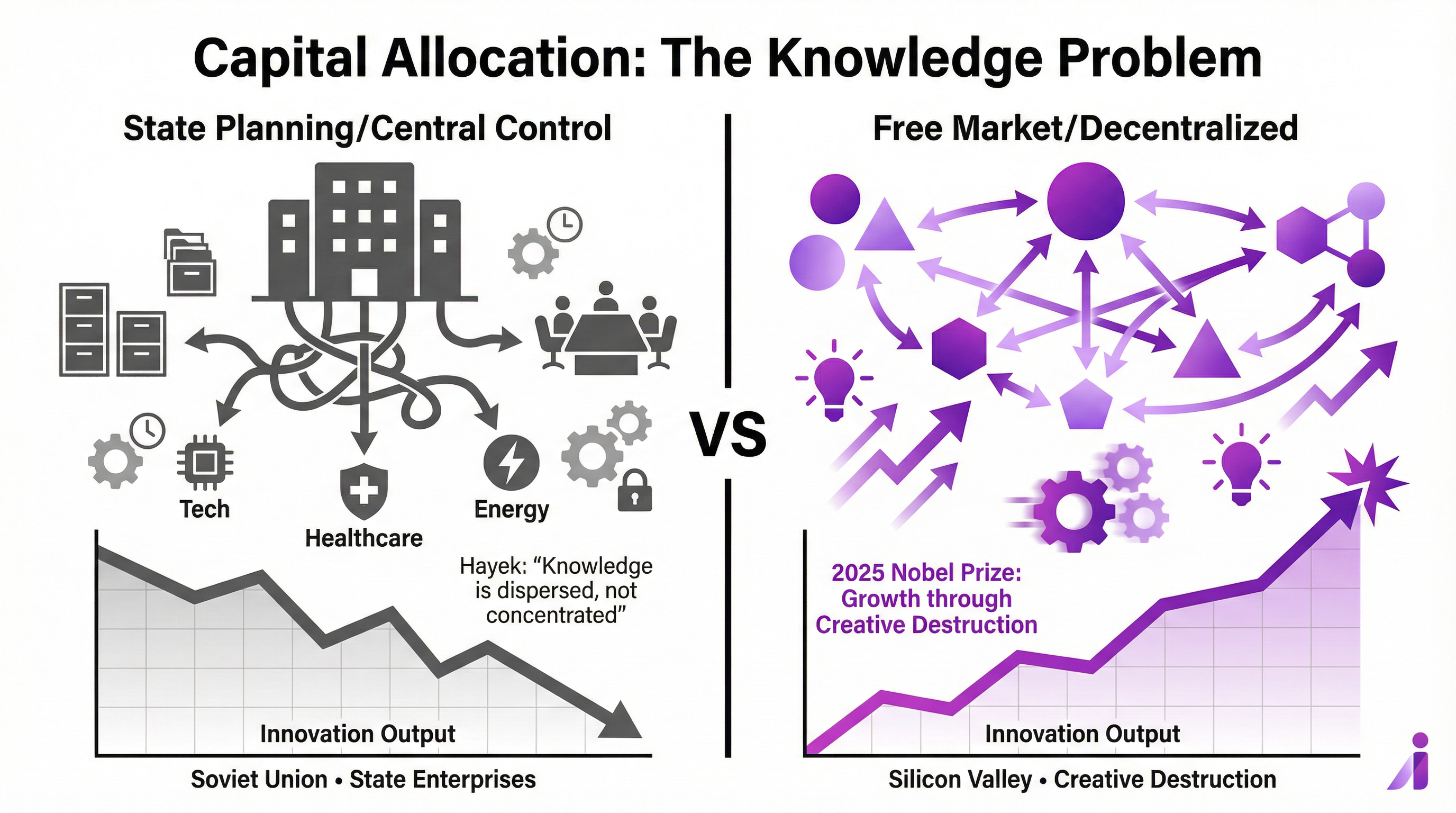
The argument is that the state, with its vast resources and ability to direct investment, can strategically guide innovation and pick winners. This is a dangerous and historically discredited idea. The 2025 Nobel Prize in Economics, awarded to Philippe Aghion, Peter Howitt, and Joel Mokyr for their work on innovation-led growth, serves as a powerful reminder that prosperity comes not from stability and central planning, but from the chaotic and unpredictable process of “creative destruction” [4].
The Knowledge Problem and the Price System
Nobel laureate Friedrich Hayek, in his seminal work, dismantled the socialist belief that a central authority could ever effectively direct an economy. He argued that the knowledge required for rational economic planning is not concentrated in a single mind or committee but is dispersed among millions of individuals, each with their own unique understanding of their particular circumstances. The market, through the price system, acts as a vast, decentralized information-processing mechanism, coordinating the actions of these individuals without any central direction [5].
As Hayek wrote, “The economic problem of society is thus not merely a problem of how to allocate ‘given’ resources—if ‘given’ is taken to mean given to a single mind which could solve the problem set by these ‘data.’ It is rather a problem of how to secure the best use of resources known to any of the members of society, for ends whose relative importance only these individuals know” [5].
State-led innovation initiatives inevitably fail because they are blind to this dispersed knowledge. A government committee, no matter how well-informed, cannot possibly possess the information necessary to make the millions of interconnected decisions required to bring a new technology to market. The historical record is littered with the failures of central planning, from the economic collapse of the Soviet Union to the stagnation of countless state-owned enterprises.
Creative Destruction: The Engine of Progress
The work of the 2025 Nobel laureates reinforces Hayek’s critique. Joel Mokyr’s historical analysis of the Industrial Revolution reveals that it was not the product of government programs but of a cultural shift towards open inquiry, merit-based debate, and the free exchange of ideas. The political fragmentation of Europe, which allowed innovators to flee repressive regimes, was a key factor in this process [4].
Aghion and Howitt’s model of “growth through creative destruction” shows that a dynamic economy depends on a constant process of experimentation, entry, and replacement. New, innovative firms challenge and displace established ones, driving progress. This process is inherently messy and unpredictable. It cannot be “engineered” or “guided” by a central planner. Attempts to protect incumbents or strategically direct innovation only serve to entrench mediocrity and stifle the very dynamism that drives growth.
Policies like Europe’s employment protection laws, which make it difficult and expensive to restructure or downsize a failing venture, work directly against this process. A dynamic economy requires that entrepreneurs be free to enter the market, fail, and try again without asking for the state’s permission or being cushioned from the consequences of failure.
The Market at Work: Three Stories of Innovation and Regulation
To make the abstract principles of market dynamics and regulatory friction concrete, consider three powerful stories of technologies that share common roots but followed radically different cost trajectories. These case studies vividly illustrate how free, competitive markets drive costs down and quality up, while regulated, third-party-payer systems often achieve the opposite.
Story 1: LASIK—A Clear View of the Free Market
LASIK eye surgery is a modern medical miracle, yet it operates almost entirely outside the conventional health insurance system. As an elective procedure, it is a cash-pay service where consumers act as true customers, shopping for the best value. The results are a textbook example of free-market success. In the late 1990s, the procedure cost around $2,000 per eye in today’s dollars. A quarter-century later, the price has not only failed to rise with medical inflation but has actually fallen in real terms, with the average cost remaining around $1,500-$2,500 per eye [6].
More importantly, the quality has soared. Today’s all-laser, topography-guided custom LASIK is orders of magnitude safer, more precise, and more effective than the original microkeratome blade-based procedures. This combination of falling prices and rising quality is what we expect from every other technology sector, from televisions to smartphones. It happens in LASIK for one simple reason: providers compete directly for customers who are spending their own money. There are no insurance middlemen, no complex billing codes, and no government price controls to distort the market. The result is relentless innovation and price discipline.
Story 2: The Genome Revolution—Faster Than Moore’s Law
The most stunning example of technology-driven cost reduction in human history is not in computing, but in genomics. When the Human Genome Project was completed in 2003, the cost to sequence a single human genome was nearly $100 million. By 2008, with the advent of next-generation sequencing, that cost had fallen to around $10 million. Then, something incredible happened. The cost began to plummet at a rate that far outpaced Moore’s Law, the famous benchmark for progress in computing. By 2014, the coveted “$1,000 genome” was a reality. Today, a human genome can be sequenced for as little as $200 [7].
This 99.9998% cost reduction occurred in a field driven by fierce technological competition between companies like Illumina, Pacific Biosciences, and Oxford Nanopore. It was a race to innovate, fueled by research and consumer demand, largely unencumbered by the regulatory thicket of the traditional medical device market. While the interpretation of genomic data for clinical diagnosis is regulated, the underlying technology of sequencing itself has been free to follow the logic of the market, delivering exponential gains at an ever-lower cost.
Story 3: The Insulin Tragedy—A Century of Regulatory Failure
In stark contrast to LASIK and genomics stands the story of insulin, a life-saving drug discovered over a century ago. The basic technology for producing insulin is well-established and inexpensive; a vial costs between $3 and $10 to manufacture. Yet, in the heavily regulated U.S. healthcare market, the price has become a national scandal. The list price of Humalog, a common insulin analog, skyrocketed from $21 a vial in 1996 to over $332 in 2019—a more than 1,500% increase [8].
How is this possible? The answer lies in a web of regulatory capture and market distortion. The U.S. patent system allows for “evergreening,” where minor tweaks to delivery devices or formulations extend monopolies. The FDA’s classification of insulin as a “biologic” has historically made it nearly impossible for cheaper generics to enter the market. Most critically, a shadowy ecosystem of Pharmacy Benefit Managers (PBMs) negotiates secret rebates with manufacturers, creating perverse incentives to favor high-list-price drugs. The FTC even sued several PBMs in 2024 for artificially inflating insulin prices [9]. In this system, the consumer is not the customer; the PBM is. The result is a market where a century-old, life-saving technology has become a luxury good, a tragic testament to the failure of a market that is anything but free.
These three stories—of sight, of self-knowledge, and of survival—tell a single, coherent tale. Where markets are free, transparent, and competitive, innovation flourishes and costs fall. Where they are burdened by regulation, obscured by middlemen, and captured by entrenched interests, the consumer pays the price, both literally and figuratively.
Conclusion: Embracing the Monopoly of Progress
The evidence is clear we have a conundrum: true, transformative innovation is not a product of competition alone but in its’ results – not in ensuring same suboptimal outcome by regulated process. It requires an environment of abundance and security where companies can afford to think long-term, embrace risk, and invest in the “wasteful” process of discovery. Peter Thiel’s framework, far from being a defense of predatory monopolies, is a call to recognize the conditions necessary for human progress.
The failure of the EU and Germany to produce world-leading technology companies is a direct result of their hostility to these conditions. A culture of precautionary regulation, punitive taxation, and short-term profitability has created a continent of incrementalism (keep it the same – if not, we cannot deal with setbacks), where the fear of failure outweighs the ambition to create something new. The temptation to solve this problem through state-led industrial planning is a dangerous illusion that ignores the fundamental lessons of economic history.
If we are to unlock the next wave of human progress, we must abandon the comforting but false narrative of perfect competition and embrace the messy, unpredictable, and often monopolistic reality of innovation. This means creating an ecosystem that rewards bold bets and tolerates failure. It means light regulation, competitive taxation, and a culture that celebrates the entrepreneur, not the bureaucrat. The path to a better future is not paved with the good intentions of central planners but with the creative destruction of the free market. It is a path that leads, paradoxically, through the monopoly of progress.
In essence – we need the right balance. The EU has the most potential to maximize output by a minimal input! The US has to catch up on food safety and non capitalistic and predatory capitalism. We all can learn something from each other – including not mentioned global super powers!
Drive Business Growth with Cloud Datalake and AI Solutions
Growth 27th Oct 2025Martin-Peter Lambert
Drive Business Growth with Cloud Datalake and AI Solutions
In today’s digital age, businesses are constantly seeking innovative solutions to drive growth and stay ahead of the competition. One such solution that has been gaining traction in recent years is Cloud Datalake and AI technologies. These technologies not only offer cost-effective storage solutions. They also provide valuable insights to help businesses make informed decisions and drive business growth.
Insight 42, a leading software consultancy firm specializing in Cloud Adoption, Cloud Governance services, Datalake, and AI solutions, is at the forefront of helping businesses harness the power of these technologies. With over a decade of experience in the industry, the firm has established itself as a trusted partner. Clients looking to leverage the benefits of cloud computing and artificial intelligence turn to them.
Cloud Datalake solutions offered by Insight 42 provide businesses with a centralized repository for storing and analyzing large volumes of data. By consolidating data from various sources into a single location, businesses can gain a comprehensive view of their operations and customer interactions. This, in turn, enables them to identify trends. They can make predictions and optimize business processes for improved efficiency and profitability. In addition to Datalake solutions, Insight 42 also offers AI services that can further enhance business operations. Artificial intelligence algorithms can analyze data patterns. They also automate repetitive tasks, personalize customer experiences, and even predict future outcomes. By incorporating AI into their operations, businesses can unlock new opportunities for growth and innovation.
With a focus on cloud adoption and governance, Insight 42 ensures that businesses can seamlessly transition to the cloud. They maintain compliance with industry regulations and best practices. This not only streamlines the adoption process. It also enhances data security and scalability for future growth. In conclusion, Cloud Datalake and AI solutions have the potential to drive significant business growth by enabling data-driven decision-making and fostering innovation. By partnering with a reputable firm like Insight 42, businesses can unlock the full potential of these technologies and stay ahead in today’s competitive market landscape.
To provide the best experiences, we use technologies like cookies to store and/or access device information. Consenting to these technologies will allow us to process data such as browsing behavior or unique IDs on this site. Not consenting or withdrawing consent, may adversely affect certain features and functions.
Functional
Always active
The technical storage or access is strictly necessary for the legitimate purpose of enabling the use of a specific service explicitly requested by the subscriber or user, or for the sole purpose of carrying out the transmission of a communication over an electronic communications network.
Preferences
The technical storage or access is necessary for the legitimate purpose of storing preferences that are not requested by the subscriber or user.
Statistics
The technical storage or access that is used exclusively for statistical purposes.The technical storage or access that is used exclusively for anonymous statistical purposes. Without a subpoena, voluntary compliance on the part of your Internet Service Provider, or additional records from a third party, information stored or retrieved for this purpose alone cannot usually be used to identify you.
Marketing
The technical storage or access is required to create user profiles to send advertising, or to track the user on a website or across several websites for similar marketing purposes.