
This article is part of our curated Growth Hub — five pillars on sovereignty, AI, cloud economics, data and security. Visit the Growth Hub.
Most European companies still file digital sovereignty under “compliance cost”. That framing is quietly costing them revenue. In regulated markets — public sector, healthcare, finance, critical infrastructure — the vendor who can prove control over data, keys and jurisdiction is increasingly the vendor who wins the deal. Sovereignty has become a commercial qualifier, not a legal footnote.
This article makes the business case: how control of data and encryption keys compounds into regulatory readiness, faster procurement and access to markets your competitors cannot enter — and what to build first.
Key takeaways
- Sovereignty requirements (GDPR, BSI C5, NIS2, EU data residency) now appear directly in tenders and vendor security reviews — they decide shortlists before price is discussed.
- The growth mechanism is a chain: control of data → control of keys → regulatory readiness → faster procurement → access to regulated markets → revenue.
- Customer-held keys (BYOK/HYOK) and EU data residency are the two controls buyers ask about first — and the two hardest to retrofit.
- Sovereignty done as architecture costs a fraction of sovereignty done as remediation after a lost deal or audit finding.
From cost center to market access
Ask any sales team selling into German public sector or regulated industries what stalls their deals: the security questionnaire, the data-residency clause, the “where are your keys held and who can access them?” question. Every unanswered control is friction — weeks of back-and-forth, escalations to legal, sometimes a silent disqualification nobody tells you about.
Now invert it. A company that can answer with evidence — data residency pinned to EU regions, customer-managed keys, a BSI C5 attestation or a mapped NIS2 control set — moves through the same review in days. In procurement, speed is share: the compliant vendor is short-listed while competitors are still drafting answers.
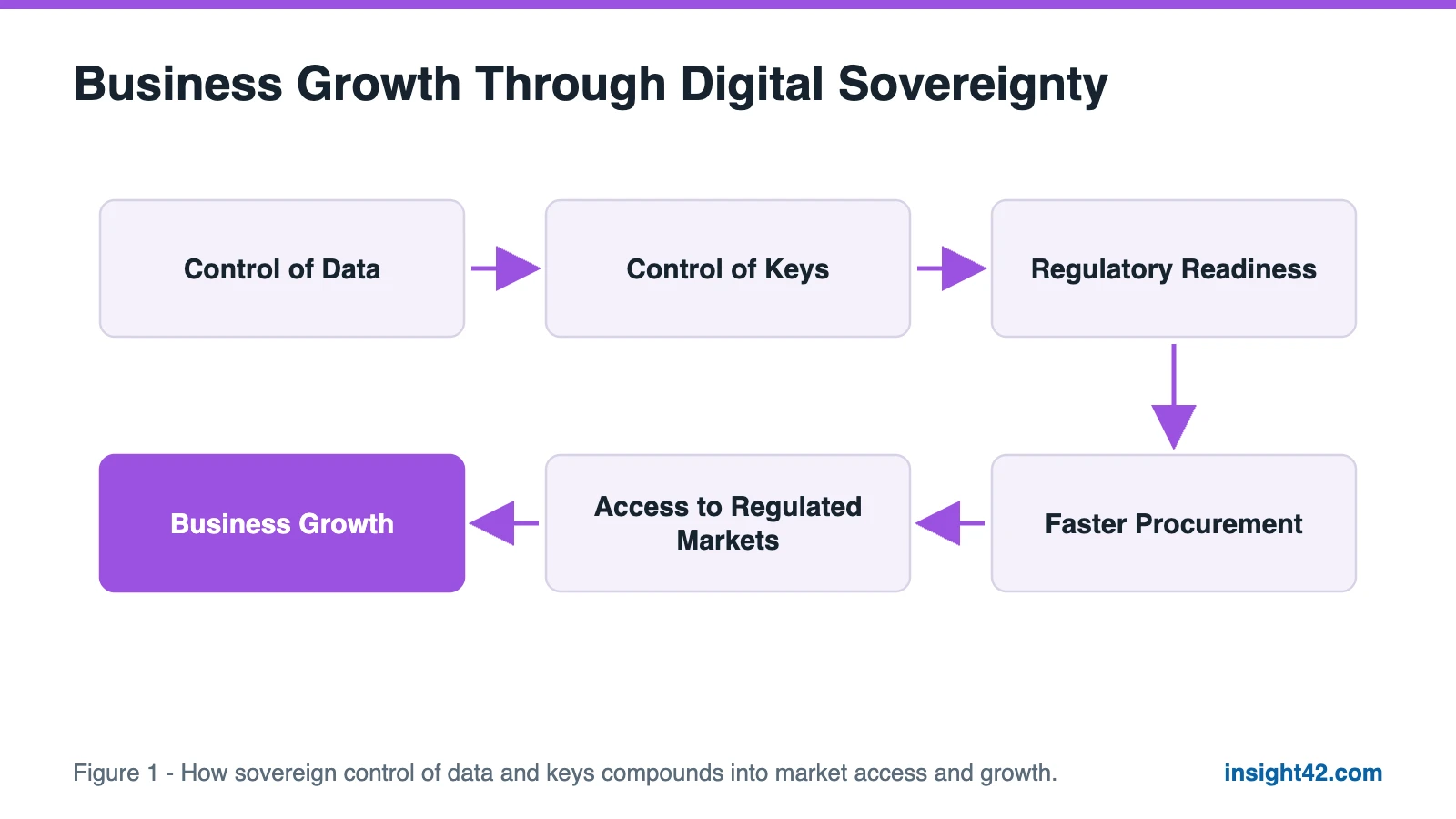
The chain, link by link
1. Control of data
Know where every regulated dataset lives, which jurisdiction governs it, and who can access it — including your cloud provider’s support and sub-processors. Practically this means EU regions with contractual residency guarantees, a data classification that engineering actually uses, and architecture that keeps regulated workloads inside defined boundaries. Our work on cloud and IT security almost always starts here, because every later control inherits from this one.
2. Control of keys
Whoever holds the keys holds the veto. Bring-your-own-key (BYOK) and hold-your-own-key (HYOK) architectures decide whether your provider can be compelled to hand over readable data — which is exactly what sophisticated buyers now test for. The trade-offs between BYOK and HYOK are real (operational overhead, blast radius, disaster recovery), and we have written a practical comparison in our guide to cloud key management. What matters commercially: “we hold our keys in an EU HSM” is a sentence that ends security-review threads.
3. Regulatory readiness
Controls only create value when they are provable. Readiness means mapped control frameworks (BSI C5, ISO 27001, NIS2), evidence that regenerates itself instead of being assembled in a panic, and documentation a buyer’s auditor can consume. If a C5 attestation is on your roadmap, start with our field notes on preparing for a BSI C5 audit.
4. Faster procurement → 5. Market access → 6. Growth
The last three links are where finance starts paying attention. Faster security reviews shorten sales cycles measurably. Passing regulated tenders adds entire customer segments — public administration, KRITIS operators, insurers — that were previously unreachable. And because few competitors invest early, sovereignty compounds: each won reference makes the next regulated deal easier. For public-sector strategy specifically, see our analysis of multi-cloud strategy for the federal administration and our guide to sovereign cloud in Germany.
Where to start: a 90-day sovereignty baseline
- Weeks 1–2 — Map the exposure. Inventory regulated data, current regions, key custody, and every sub-processor in the chain.
- Weeks 3–4 — Classify the deals. Which live and target customers impose sovereignty requirements? What did the last three lost security reviews actually ask?
- Weeks 5–8 — Fix the two veto controls. EU residency for regulated workloads and a key-management architecture (BYOK at minimum, HYOK where the market demands it).
- Weeks 9–12 — Make it provable. Map controls to BSI C5 / NIS2, generate evidence automatically, and produce the two-page “sovereignty answer pack” your sales team sends into every review.
Make sovereignty your unfair advantage
Insight42 designs and implements sovereign cloud architectures for enterprises and public-sector organizations — data residency, key management, BSI C5 and NIS2 readiness, and the evidence that turns controls into won deals. Request a sovereignty assessment and we will map your fastest path from compliance cost to market access.
Related reading
- Sovereign Cloud Germany: Digital Sovereignty for the Public Sector
- Preparing for a BSI C5 Audit: Practical Tips
- Cloud Key Management: BYOK vs. HYOK in Azure and GCP
More insights like this in our Growth, Innovation & Digital Strategy hub.