
Every board wants AI agents on the roadmap. Very few can say what an agent is worth. The result is a familiar pattern: impressive demos, unclear economics, and pilots that never graduate — not because the technology failed, but because nobody defined the number it had to beat.
This is the ROI framework we use for agentic AI in European enterprises: seven factors, one honest equation, and the two costs almost everyone forgets — human review and errors.
Key takeaways
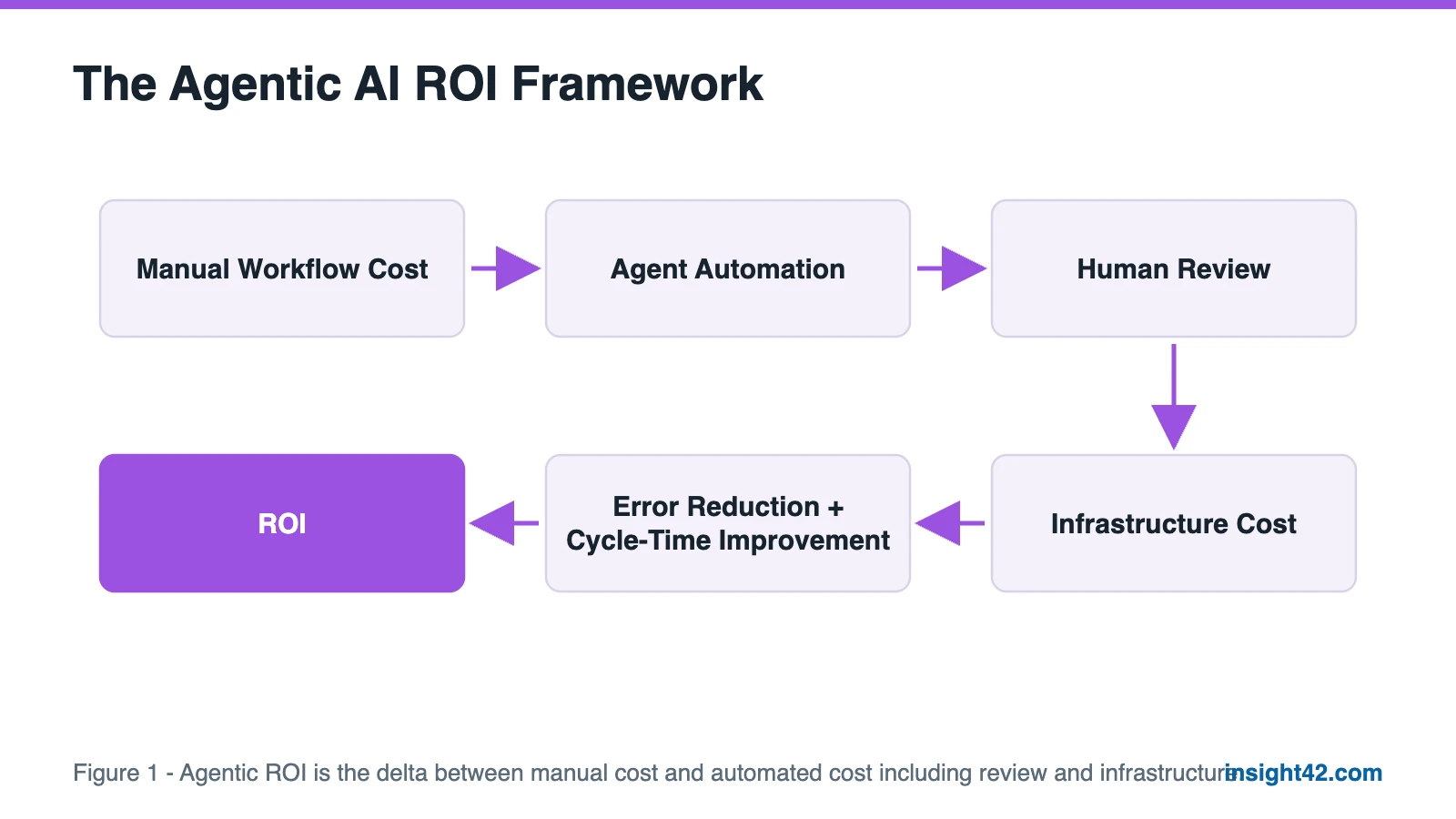
- Agentic ROI = (manual workflow cost − automated workflow cost) + error-reduction value + cycle-time value. Anything less specific is a demo, not a business case.
- Automated workflow cost includes agent infrastructure and human review — the control step that makes agents deployable in regulated environments.
- Error reduction and cycle time are usually worth more than labor savings, and they are measurable.
- Pick workflows that are frequent, rule-rich, costly to get wrong — and measure a two-week manual baseline before automating anything.
The framework
Start with the manual workflow cost
Take one concrete workflow — invoice triage, supplier onboarding, first-line ticket resolution, tender-document analysis. Measure it for two weeks: volume, minutes per case, fully loaded hourly cost, error rate, and end-to-end cycle time. This baseline is the single most valuable artifact in the whole program; without it, ROI is astrology.
Price the automated workflow honestly
Three cost lines, not one. Agent automation: development, integration, prompts and policies, maintenance. Human review: the deliberate control step — a person approving edge cases and sampled outputs. In GDPR- and works-council-shaped organizations this step is what makes agents approvable; our piece on shipping AI your compliance team can approve covers why it belongs in the design, not the objections list. Infrastructure: model and API usage, hosting, observability, evaluation runs.
Then add the two values everyone forgets
Error reduction: what does one wrong payment, one mis-routed case, one compliance slip cost — and how many fewer will there be? Agents with review loops routinely beat tired humans on consistency; that delta is money. Cycle-time improvement: a quote answered in one hour instead of three days changes win rates; a citizen request resolved same-day changes service KPIs. Attach a value per hour saved in the process, however conservative.
A worked miniature
Document-heavy approval workflow, 1,800 cases per month, 22 minutes each, €55/h loaded → manual cost ≈ €36k/month. Agentic redesign: 80% fully handled, 20% to human review at 6 minutes; agent run-cost €4k/month; review cost ≈ €6k/month; error rate falls from 2.5% to 0.6% at €250 average error cost (≈ €8.5k/month recovered); cycle time from 2.1 days to 3 hours. Net: ≈ €30k+/month against a build cost you can amortize inside a year. Your numbers will differ — the discipline is the point.
Workflow selection checklist
- High frequency (hundreds+ of cases per month)
- Clear rules and reference documents — agents excel where policy exists
- Meaningful cost of errors (money, compliance, reputation)
- Measurable baseline available or capturable in two weeks
- A named human owner for the review loop
- Data allowed for processing under GDPR — verified, not assumed
Ship agents with a number attached
Insight42 designs and builds production agentic systems — workflow selection, ROI baseline, guardrails, human-review loops and EU-compliant operations. See our Agentic AI solutions or request an Agentic AI ROI assessment for one candidate workflow.
Related reading
- Enterprise AI in Europe: Why Most Projects Stall
- AI Won’t Replace People. Bad Incentives Will.
- Data Platforms & Analytics — the substrate agents run on
More insights like this in our Growth, Innovation & Digital Strategy hub.