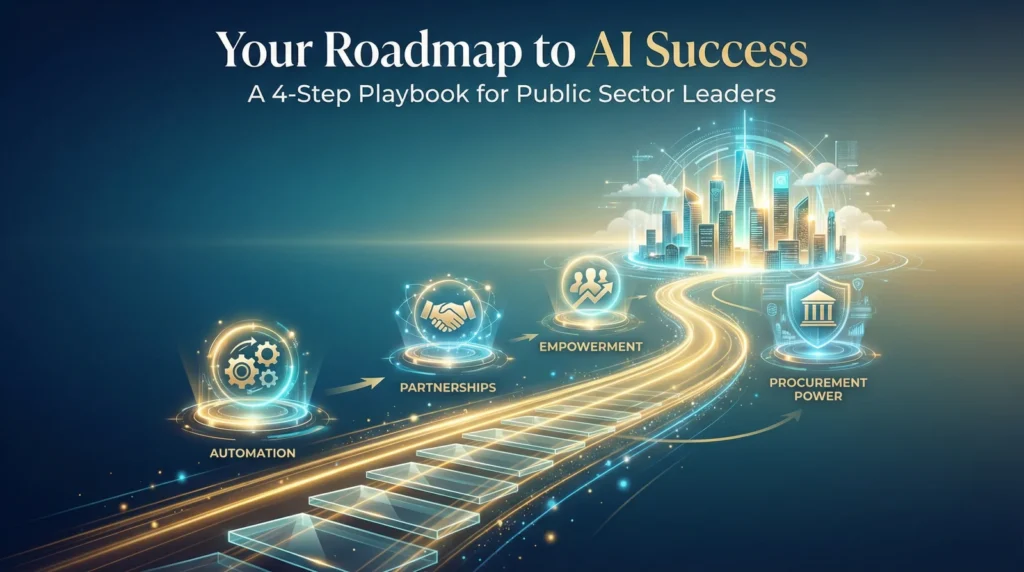
A 3-part series on AI procurement for government digital transformation. Part 3 of 3 — see Part 1: The Revolution Will Be Sovereign and Part 2: Agile vs. Goliath.
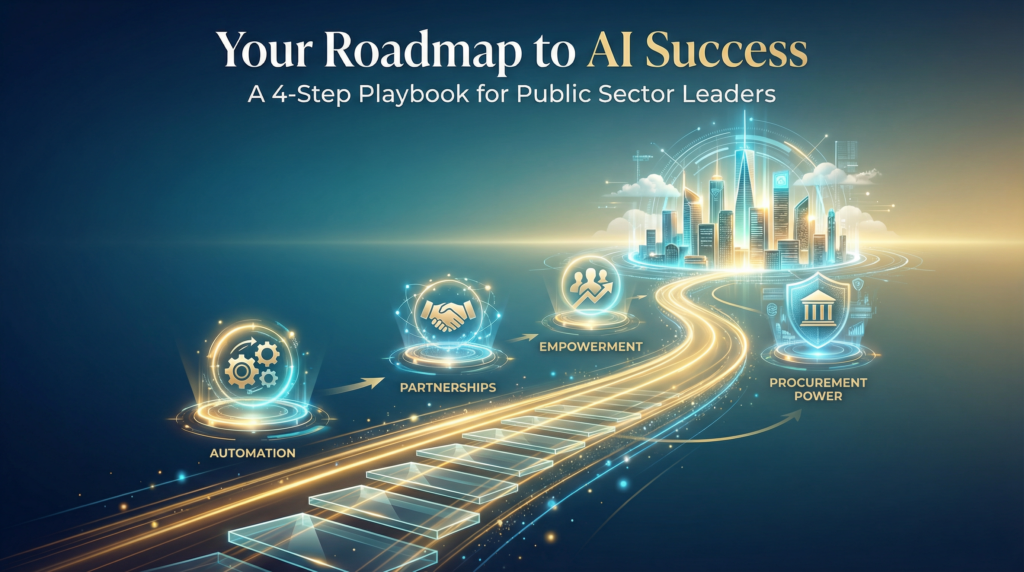
Welcome to the final instalment of our AI procurement guide for the public sector. In Part 1, we established the critical importance of sovereign AI. In Part 2, we presented the data showing why agile, smaller vendors consistently outperform large tech intermediaries in public sector AI implementation.
Now, let’s translate these insights into a practical, actionable playbook. How do you, a public sector leader, avoid the 95% failure rate and build a government AI strategy that is fast, secure, and truly serves your citizens? This is your step-by-step guide.
The Four-Step Playbook for Sovereign AI Procurement
This isn’t about boiling the ocean or launching a massive, multi-year overhaul. It’s about making smart, strategic moves that build momentum and deliver measurable value. The SAP paper put it perfectly: start with the “low-hanging fruit” [1].
Step 1: Target Back-Office Bottlenecks for High-ROI Automation
Forget the flashy, headline-grabbing AI chatbot for now. The MIT report was unequivocal: the biggest and fastest ROI comes from public sector automation in the back office [2]. Begin by identifying your most tedious, repetitive, and resource-intensive internal processes.
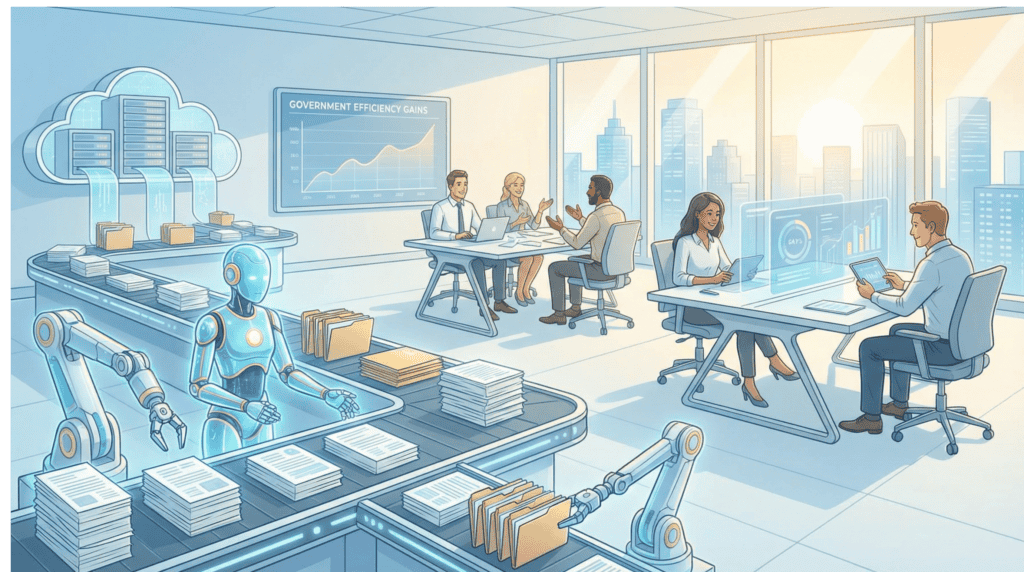
Prime candidates include:
- Data entry and migration
- Document processing and classification
- Internal helpdesk and IT support tickets
- Invoice processing and financial reconciliation
- Scheduling and resource allocation
These projects are the ideal starting point for your government AI adoption journey because they are low-risk, high-impact, and the gains are easy to measure. You’re not just saving money; you’re freeing up your talented public servants to focus on the high-value, citizen-facing work they were hired to do. This approach builds confidence, demonstrates the practical power of AI to internal sceptics, and creates the momentum needed for more ambitious projects — exactly the logic behind our Agentic AI Readiness-Workshop.
Step 2: Buy, Don’t Build: A Core Tenet of Agile AI Procurement
The data is conclusive. Organisations that purchase specialised AI tools from expert vendors see a 67% success rate, while those that attempt to build everything in-house fail two-thirds of the time [2]. The impulse to build a proprietary system is strong in government, but it’s a trap. You will burn through your budget and political capital reinventing the wheel.
Instead, embrace agile AI procurement by partnering with the Davids. Find the domestic, specialised companies that have already built proven solutions for your specific pain points. Your AI vendor selection criteria should prioritise:
| What to Look For | Why It Matters for Public Sector AI Procurement |
|---|---|
| Open-weight models | Prevents vendor lock-in; allows for customisation and inspection. |
| Interoperability | Integrates with your existing systems; avoids creating new data silos. |
| Local data residency | Ensures compliance with GDPR and national data protection laws. |
| Transparent pricing | Avoids hidden fees and escalating costs as you scale. |
| Proven track record | Demand case studies and references within the public sector. |
This is your best defence against AI vendor lock-in. As the McKinsey report on European AI sovereignty argues, the goal is to create a “single market for AI” built on open standards and partnerships, not isolated fortresses [3].
Step 3: Empower Your Frontline Managers to Drive Adoption
A common mistake in large organisations is centralising all AI expertise in a remote “innovation lab” that is disconnected from day-to-day operational realities. This creates a chasm between the people building AI solutions and the people who actually need them.
A successful government AI strategy takes the opposite approach: it empowers frontline managers to drive adoption from the ground up [2].
Your department heads and team leads know where the real problems are. Give them the budget and authority to find and implement AI tools that solve their teams’ specific challenges. This decentralised approach fosters a culture of innovation and ensures that AI is adopted in a way that is practical, relevant, and immediately useful.
Step 4: Use Your Procurement Power to Anchor the Sovereign AI Ecosystem
Here’s a secret weapon that public sector leaders often overlook: you are a massive market maker.
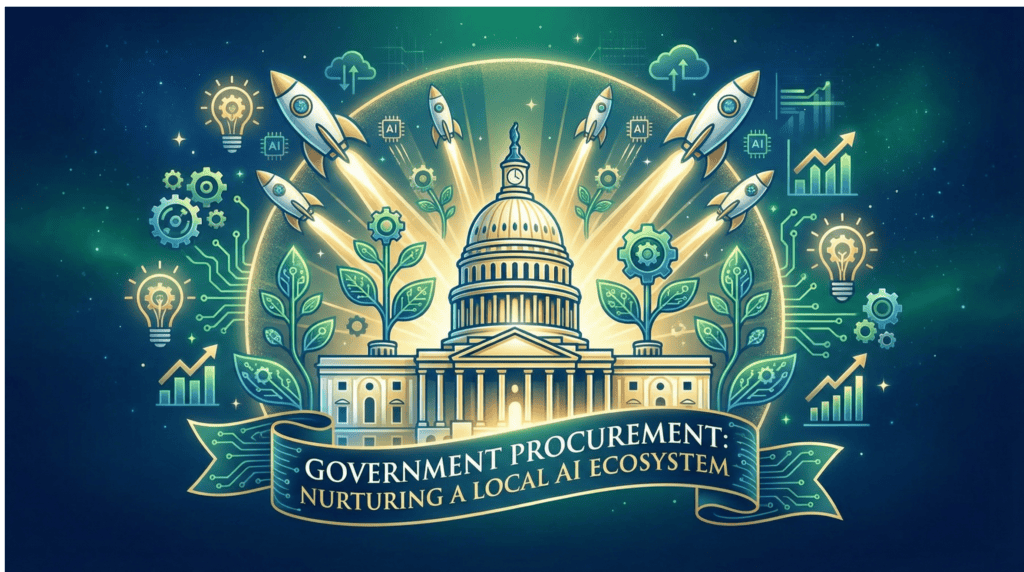
Government procurement is one of the largest sources of demand in any economy. When you choose to buy a product or service, you’re not just solving your own problem; you’re sending a powerful signal to the market. You’re telling innovators, “This is what we need. Build more of this.”
McKinsey suggests that European governments could earmark at least 10% of their digital transformation budgets for sovereign AI solutions [3]. This creates the stable, anchor demand that allows smaller, domestic AI companies to scale and compete with global giants.
By consciously choosing to partner with local innovators, you are not just solving your own problems; you are building a robust, sovereign AI ecosystem in your own backyard.
The Future of Government is Agile
The digital transformation of government is not primarily a technical challenge; it’s a strategic one. It’s about resisting the siren song of the big intermediaries and making a conscious choice to be agile, independent, and sovereign.
By focusing on practical problems, partnering with specialised innovators, empowering your people, and using your procurement power strategically, you can build an AI-powered public sector that is more efficient, more responsive, and more resilient.
Summary: The Insight42 AI Procurement Checklist
| Step | Action | Key Metric |
|---|---|---|
| 1 | Target back-office bottlenecks for automation | Hours saved per week |
| 2 | Buy specialised tools from agile, sovereign partners | 67% success rate vs. 22% for internal builds |
| 3 | Empower frontline managers to drive adoption | Number of use cases identified by teams |
| 4 | Use procurement power to support local AI ecosystem | % of AI budget spent on sovereign solutions |
Thank you for reading this series. If you’re ready to take the next step in your public sector AI procurement journey, Insight42 is here to help — see our Agentic AI consulting, sovereign cloud consulting for the infrastructure side, or contact us.
References
- Public Sector Network & SAP. “AI in the Public Sector.” 2025.
- Estrada, Sheryl. “MIT report: 95% of generative AI pilots at companies are failing.” Fortune, August 18, 2025.
- McKinsey & Company. “Accelerating Europe’s AI adoption: The role of sovereign AI capabilities.” December 19, 2025.