
A 3-part series on AI procurement for government digital transformation. Part 1 of 3 — continue with Part 2: Agile vs. Goliath and Part 3: The Procurement Playbook.
Welcome to the new era of digital transformation in government. If you are a public sector leader, you are likely navigating the complex landscape of AI in the public sector. The pressure is immense: citizens demand better digital services, budgets are perpetually tight, and every technology vendor is promoting a new “generative AI” solution as the ultimate answer.
Two challenges define the moment. First: “Your AI is quietly old, not specialised and already out of date.” Second: it is no longer if you should pursue government AI adoption, but how — while bureaucracy is optimised to make you produce paperwork before you have done any of the meaningful tests you desperately need.
This guide argues that the AI revolution in government will not be a flashy, televised event. It will be a quiet, strategic shift towards a powerful new concept: sovereign AI.
The Sovereignty Imperative: Your Data, Your Rules in Public Sector AI

Across Europe, the groundbreaking EU AI Act has established a new global standard for AI governance. This is more than just regulation; it is a declaration of digital independence [1]. This legislation is accelerating a fundamental shift towards sovereign AI—the capability for a nation, region, or organisation to develop, deploy, and control its own AI systems. This ensures that critical government data, AI models, and the future of public services are not outsourced to the highest bidder in another hemisphere [2].
Why is this the cornerstone of any effective government AI strategy? When you are responsible for sensitive citizen data—from healthcare records to tax information—you cannot simply transfer it to a hyperscaler whose business model is opaque and whose priorities may not align with the public good. A recent McKinsey report highlights that 44% of technology leaders are delaying public cloud adoption due to data security concerns [3]. Another 31% state that data residency requirements prevent them from using public cloud services altogether. These leaders understand that true sovereignty is non-negotiable.
This is not about digital isolationism. It is about securing optionality and control. It is about ensuring the AI systems shaping your public services are aligned with your values, your laws, and your citizens’ best interests—not the quarterly earnings report of a foreign tech giant. The potential prize is enormous: McKinsey estimates that a successful sovereign AI strategy could unlock up to €480 billion in value annually by 2030 for Europe alone [3].
The Siren Song of Big Tech: Avoiding AI Vendor Lock-in
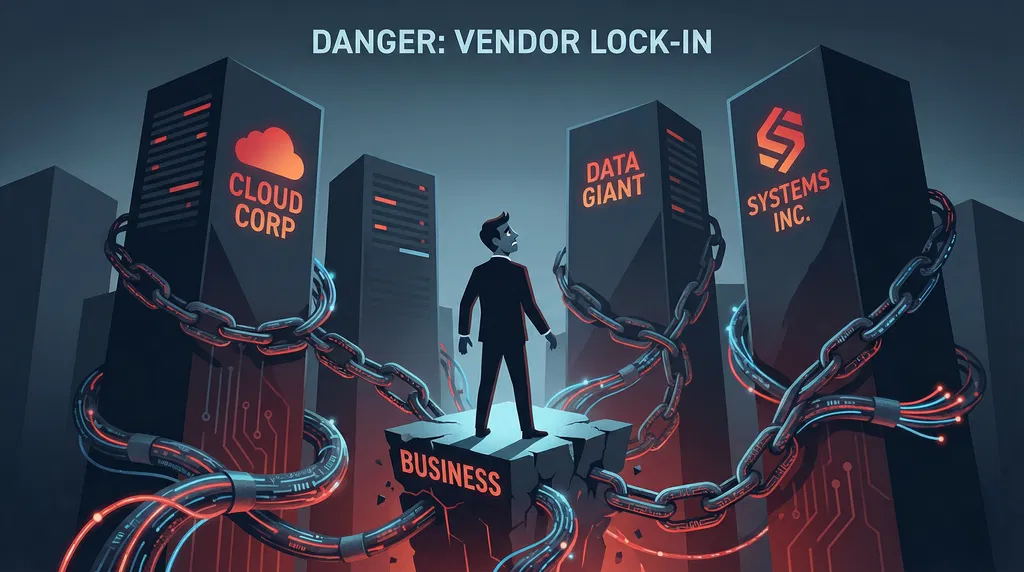
The major technology players are, of course, eager to assist in your public sector digital transformation. They arrive with compelling presentations, promising to solve every challenge with their one-size-fits-all AI platforms. They offer the comfort of a familiar brand and the promise of an easy button for your AI journey. It is a tempting offer.
It is also a trap.
The publication that inspired this series, a joint paper by SAP and the Public Sector Network, explicitly warns about the critical risk of AI vendor lock-in [4]. This is the digital equivalent of quicksand. Once you are in, every attempt to escape only pulls you deeper. Your data is ingested into proprietary formats, your workflows become dependent on their specific tools, and your ability to innovate is shackled to their product roadmap and pricing structure.
“When choosing products and services, public sector organizations should also be aware of the risk of vendor lock-in, especially in a rapidly evolving market in which LLMs are being commoditized. We’re already seeing some finely-tuned models outperform more sophisticated, general-purpose models in particular domains and tasks.”
AI in the Public Sector, SAP / Public Sector Network [4]
This quote reveals a crucial trend: specialised, nimble models are already outperforming the giants. The market is shifting, and the large intermediaries are struggling to adapt. Once locked in, you are no longer a partner; you are a hostage. The very intermediaries promising to accelerate your AI transition become the biggest bottleneck, caught in their own sprawling processes and self-interest.
The Central Question for Your AI Procurement Strategy
This leads to an uncomfortable but essential question for every public procurement officer: if the big players are the undisputed leaders in AI, why are their own enterprise AI projects failing at a rate of 95%? (We dissect this statistic in Part 2.)
And if small businesses are achieving government AI adoption faster and more effectively, what does that signal about where true innovation lies?
The answer is clear: the future of AI in the public sector belongs to the small, the agile, and the sovereign — decentralisation will make you antifragile.
In the next post, we explore why the Davids are beating the Goliaths—and what that means for your public sector AI procurement strategy.
Continue reading: Part 2: Agile vs. Goliath in Government AI — A Procurement Guide
References
- European Commission. “European approach to artificial intelligence.” digital-strategy.ec.europa.eu
- Accenture. “Europe Seeking Greater AI Sovereignty, Accenture Report Finds.” November 3, 2025. newsroom.accenture.com
- McKinsey & Company. “Accelerating Europe’s AI adoption: The role of sovereign AI capabilities.” December 19, 2025. mckinsey.com
- Public Sector Network & SAP. “AI in the Public Sector.” 2025.
Insight42 provides expert guidance for public sector organisations navigating the AI transition — fast, secure and sovereign. See our Agentic AI consulting or Agentic AI Solutions.