
A Procurement Guide
A 3-Part Blog Series on AI Procurement for Government Digital Transformation
By Insight 42 UG | www.insight42.com
Meta Description: 95% of enterprise AI projects fail. Learn why agile, smaller AI vendors outperform big tech in government procurement and public sector AI implementation. A guide for public sector leaders.
Focus Keywords: Government AI Procurement, Public Sector AI Implementation, Agile AI Procurement, AI Vendor Selection Government
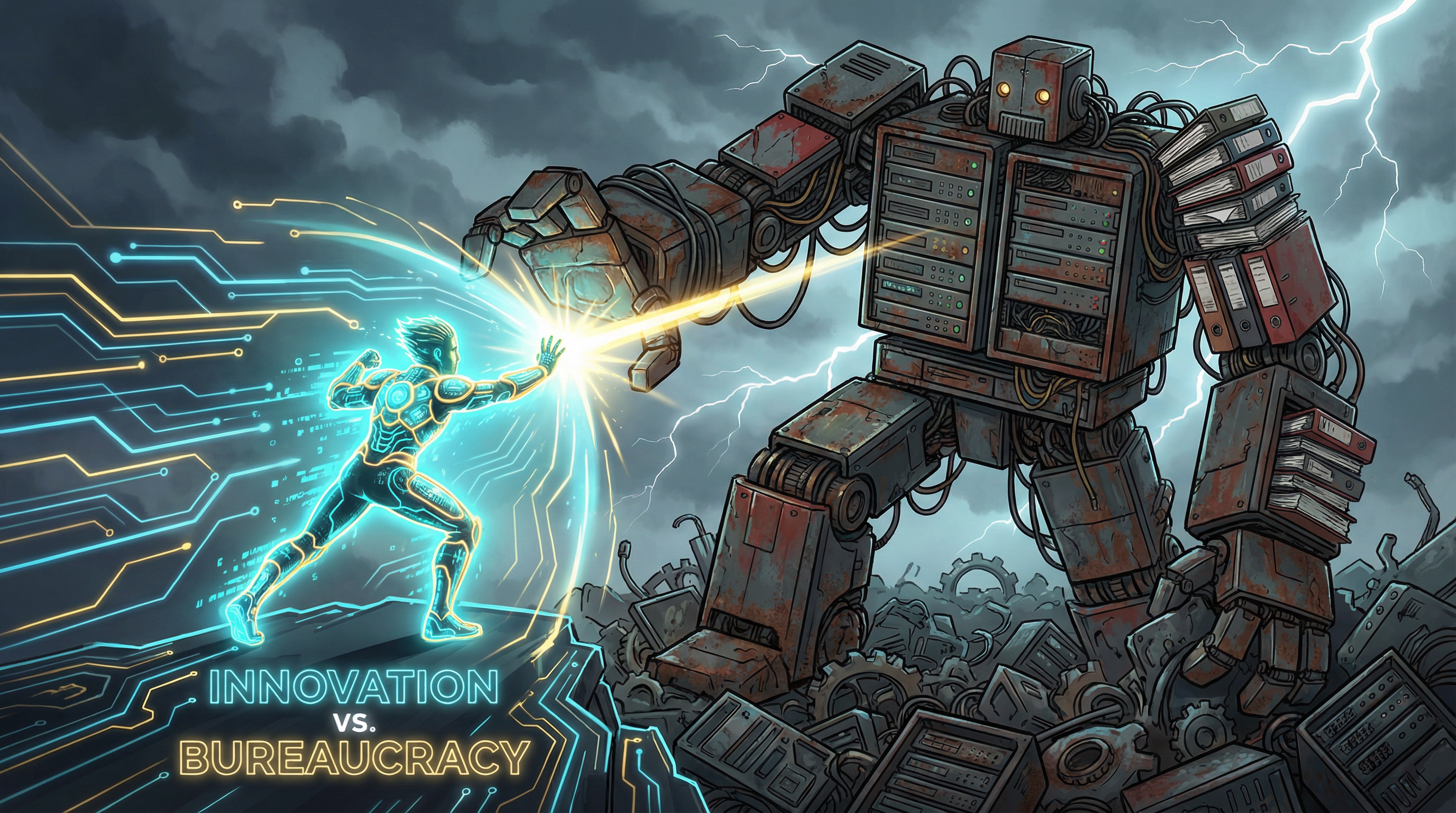
The battle for the future of government AI isn’t about budget; it’s about bureaucracy vs. innovation.
In Part 1 of our guide, we established a new imperative for AI in the public sector: the future is sovereign. We highlighted the risks of AI vendor lock-in and the need for a government AI strategy that prioritizes data control and independence.
Now, let’s examine the data that should change how every public procurement officer approaches government AI procurement. We will explore why the lumbering Goliaths of the tech world, despite their vast resources, are being consistently outmaneuvered by the nimble Davids of the innovation ecosystem.
The 95% Failure Rate: A Tale of Two AI Implementation Strategies
Here is a statistic that should be central to every public sector AI implementation plan: a recent MIT report found that a jaw-dropping 95% of enterprise generative AI pilots fail to deliver any return on investment [1].
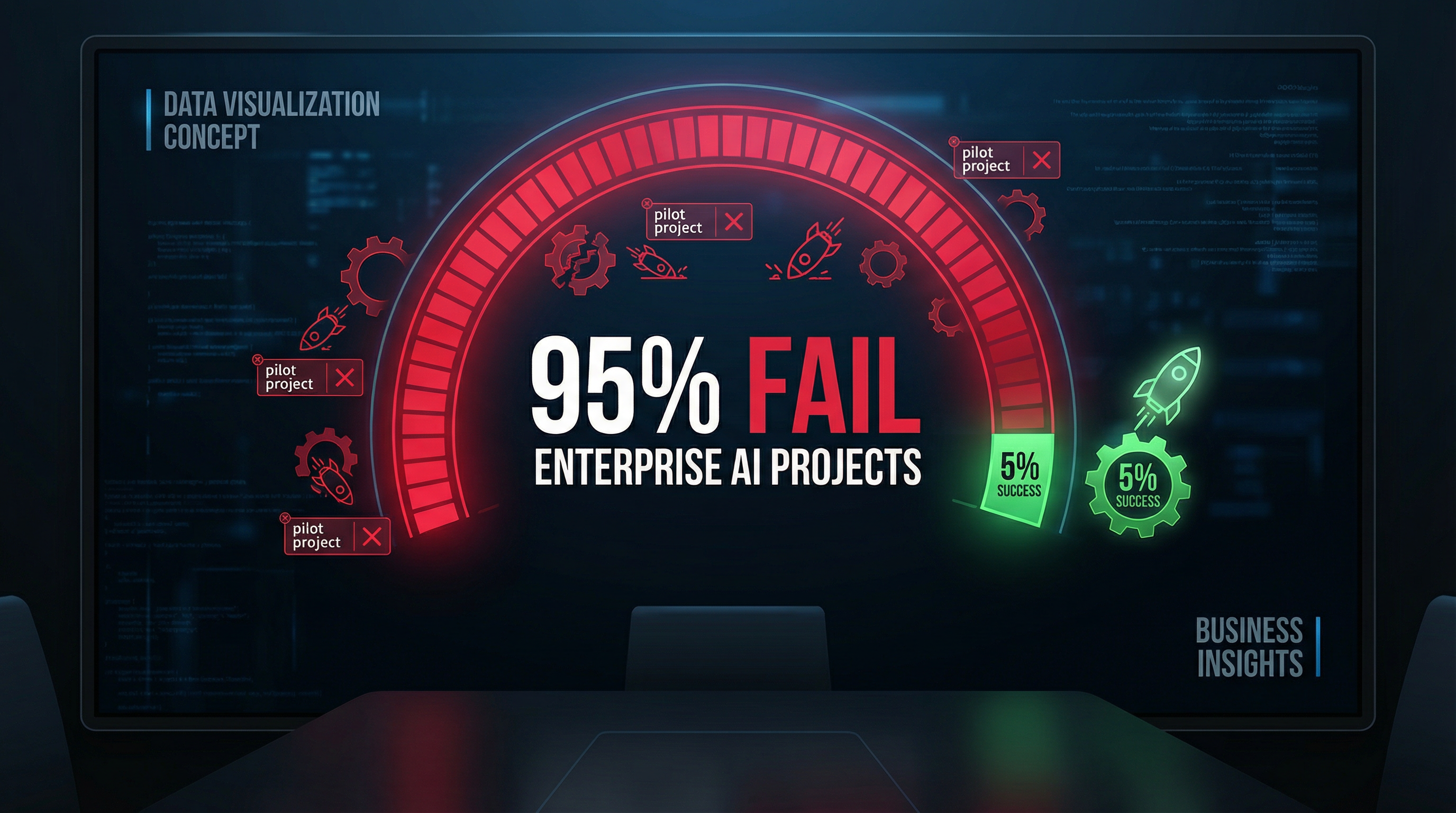
Data from MIT shows a staggering 95% failure rate for enterprise AI pilots, a clear warning for public sector procurement.
Let that sink in.
Nineteen out of every twenty large-scale AI projects are stuck in “pilot purgatory,” consuming millions in public funds with no measurable impact. The MIT report, based on extensive research including 150 leadership interviews and 300 public AI deployment analyses, identifies the root cause not as a failure of technology, but as a failure of strategy. Large organizations are attempting to build complex, monolithic tools from scratch, getting bogged down in internal bureaucracy, and misallocating resources on cosmetic front-end projects instead of focusing on high-ROI public sector automation in the back office.
As the lead author of the MIT report noted:
“Almost everywhere we went, enterprises were trying to build their own tool… but the data showed purchased solutions delivered more reliable results.”
– Aditya Challapally, MIT NANDA Initiative [1]
Now, contrast this with the small business sector. A recent survey featured in the Los Angeles Times found that an incredible 92% of small businesses have already integrated AI into their operations—a massive leap from just 20% in 2023 [2]. They are, according to the report, “operationalizing it faster and more pragmatically than many large enterprises.”
The Tale of the Tape: A Clear Choice for AI Vendor Selection
This head-to-head comparison provides a clear framework for AI vendor selection in government:
| Metric | Large Enterprises (The Goliaths) | Small & Medium Businesses (The Davids) |
|---|---|---|
| AI Pilot Success Rate | 5% deliver ROI [1] | 92% have integrated AI [2] |
| Primary Approach | Build complex, internal tools | Buy specialized, proven solutions |
| Key Obstacle | Internal bureaucracy, flawed integration | Limited resources (overcome by agility) |
| Typical Outcome | “Pilot Purgatory” | Rapid, pragmatic operationalization |
| Success with Purchased Tools | 67% [1] | High (default approach) |
| Success with Internal Builds | ~22% [1] | N/A |
This data reveals a clear pattern. The Goliaths are trapped by their own scale. Their size, once a strength, has become a liability. They are intermediaries caught in their own interests, while the Davids are on the front lines, directly connected to the source of innovation and laser-focused on solving real-world problems. This makes a compelling case for agile AI procurement.
The Agility Advantage: From Concept to Nationwide Deployment in Three Weeks

Agile partners can deliver solutions in weeks, while large enterprises can be stuck in bureaucratic red tape for years.
Need proof that agility trumps scale in public sector AI implementation? Look no further than the case study in the original SAP document that inspired this series.
When the pandemic hit Germany, the city of Hamburg needed to distribute aid to struggling artists—fast. Did they enter a multi-year procurement cycle with a tech behemoth? No. They partnered with an agile team and launched a fully functional aid-application platform in just three weeks—and then rolled it out across all 16 German states [3].
Three weeks. That is the agility advantage in action.
Small, domestic partners who understand the local regulatory landscape can move at the speed of need. They are not bogged down by layers of management or a product roadmap set years in advance by a committee on another continent. They are built to be responsive, to iterate quickly, and to deliver value—not just billable hours.
The European Renaissance and Open-Source AI
This trend is accelerating across Europe. While US giants focus on closed, proprietary models that lead to AI vendor lock-in, France’s Mistral AI has become a European champion by releasing powerful, open-weight models that offer developers greater control and transparency [4]. In June 2025, Mistral launched Europe’s first AI reasoning model, proving that you don’t need to be a trillion-dollar company to lead in AI innovation [5].
This highlights the core advantages of partnering with smaller, specialized vendors:
- Direct Connection to the Source: Small innovators are the source of the technology, not just resellers.
- Domestic Agility: They understand local regulations like GDPR and the EU AI Act, and can move quickly.
- Aligned Incentives: Their success depends on delivering real value to you, not on maximizing contract size.
The Clear Choice for Your Next Procurement Cycle
The choice for public sector leaders is clear. Do you bet on the Goliath, with their 95% failure rate and lock-in contracts? Or do you embrace agile AI procurement and partner with the Davids—the sovereign, innovative companies that are actually getting the job done?
In our final post, we will provide a practical playbook for making that transition: how to choose the right partners, where to focus your efforts, and how to build a fast, secure, and sovereign AI future for your organization.
Coming Up Next:
Part 3: The Public Sector AI Procurement Playbook: Fast, Secure, Sovereign
Previous:
Part 1 – Public Sector AI: A Guide to Sovereign AI in the Public Sector
References
[1] Estrada, Sheryl. “MIT report: 95% of generative AI pilots at companies are failing.” Fortune, August 18, 2025.
[2] Williams, Paul. “AI for Small Business: 92% Adoption Rate Drives Growth.” Los Angeles Times, December 14, 2025.
[3] Public Sector Network & SAP. “AI in the Public Sector.” 2025.
[4] Open Source Initiative. “Open Source and the future of European AI sovereignty.” June 18, 2025.
[5] Reuters. “France’s Mistral launches Europe’s first AI reasoning model.” June 10, 2025.
Insight 42 UG provides expert guidance for public sector organizations navigating the AI transition. Our focus is on fast, secure, and sovereign AI solutions. Learn more at www.insight42.com
#AI2025 #GovTech2025 #DigitalSovereignty #AIforGood #FutureOfGovernment #SmartGovernment #AIleadership #PublicInnovation #TechPolicy #AIgovernance #AIadoption #SmallBusinessAI #EnterpriseAI #OpenSourceAI #EuropeanAI #MistralAI #AIinnovation #DigitalTransformation #AIvendor #TechProcurement