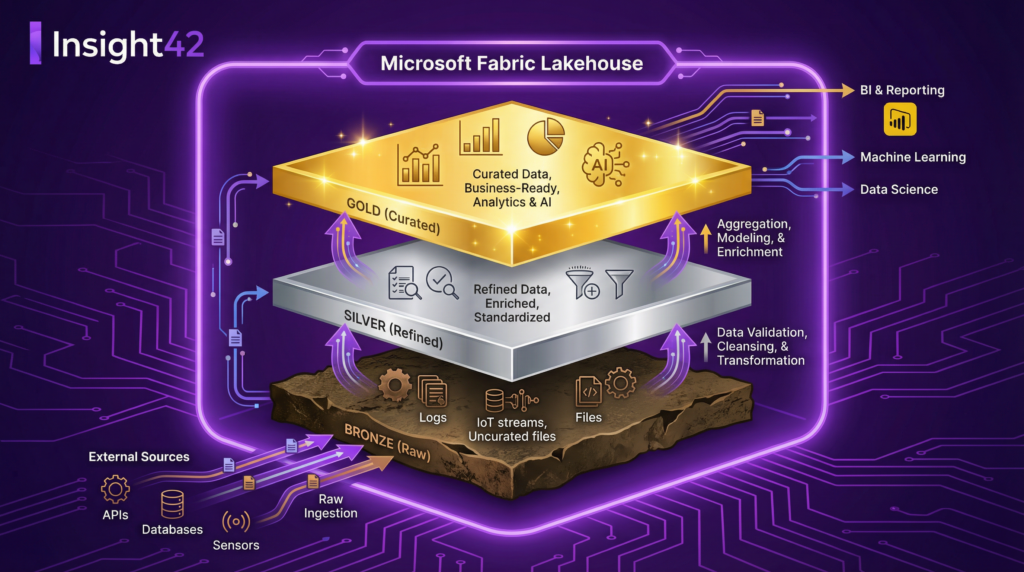
Microsoft Fabric: (Part 2 of 5)
An insight 42 Technical Deep Dive SeriesThis is A Deep Dive into Azures’ Future of Cloud Data Platforms Part 2.
Rethinking Data Architecture in the Fabric Era
In the first part of this series, we explored the evolution of data platforms and introduced Microsoft Fabric as the next step in this journey. Now, we will delve deeper into the architectural implications of Fabric, examining how its unified approach and central OneLake storage layer are forcing a fundamental rethink of how we design and build data lakes and data warehouses. The traditional lines between these two concepts are blurring, and a new, more integrated architectural pattern is emerging.
This post will analyze the shift from separate data lakes and warehouses to a unified lakehouse architecture within Fabric. We will also provide a detailed look at the medallion architecture, a popular design pattern for organizing data in a lakehouse, and how it can be effectively implemented in a Fabric environment.
The Convergence of Data Lakes and Data Warehouses
For years, data lakes and data warehouses have been treated as separate, albeit complementary, components of a modern data platform. Data lakes were used for storing raw, unstructured data and for exploratory analysis and data science, while data warehouses were used for structured, curated data for business intelligence and reporting. This separation, however, created significant challenges:
- Data Duplication: Data had to be copied and moved between the data lake and the data warehouse, leading to increased storage costs and data consistency issues.
- Complex ETL Pipelines: Fragile and complex ETL (Extract, Transform, Load) pipelines were required to move and transform data, increasing development and maintenance overhead.
- Data Silos: The separation of data and tools created silos, making it difficult for different teams to collaborate and share data effectively.
Microsoft Fabric aims to solve these challenges by unifying the data lake and the data warehouse into a single, integrated experience. At the heart of this convergence is OneLake, which acts as a single source of truth for all data, and the lakehouse as the primary architectural pattern.
OneLake and Workspaces: The Foundation
Before diving into the medallion architecture, it’s essential to understand how OneLake organizes data through workspaces. OneLake provides a single, unified storage layer where all Fabric items—lakehouses, warehouses, and other artifacts—store their data.
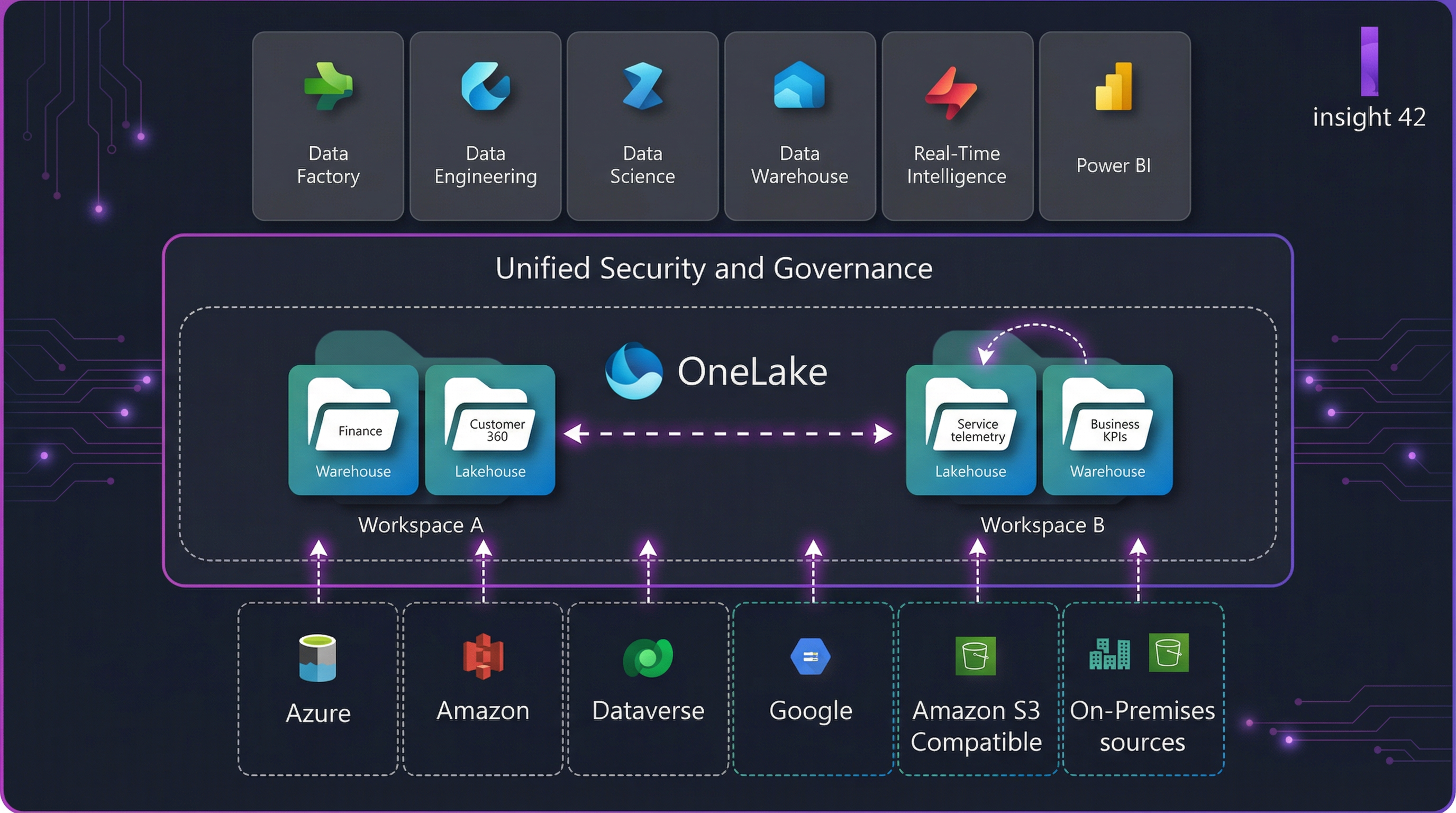
Figure 1: OneLake workspace architecture showing unified security, governance, and multi-cloud data access through shortcuts.
The Lakehouse: A New Architectural Centerpiece
A lakehouse in Fabric is not just a data lake with a SQL layer on top; it is a first-class citizen that combines the best features of both data lakes and data warehouses. It provides:
| Feature | Description |
|---|---|
| Direct-to-data access | All Fabric workloads, including Power BI, can directly access data in the lakehouse without having to import or copy it. |
| Open data formats | Data is stored in the open-source Delta format, ensuring that you are not locked into a proprietary ecosystem. |
| ACID transactions | The Delta format provides ACID (Atomicity, Consistency, Isolation, Durability) guarantees, ensuring data reliability and consistency. |
| Unified governance | All data in the lakehouse is governed by the same security and compliance policies, managed centrally through Microsoft Purview. |
Implementing the Medallion Architecture in Fabric
The medallion architecture is a data design pattern that has become increasingly popular for organizing data in a lakehouse. It logically organizes data into three distinct layers—Bronze, Silver, and Gold—with the goal of incrementally and progressively improving the quality and structure of the data as it moves through the layers [1].
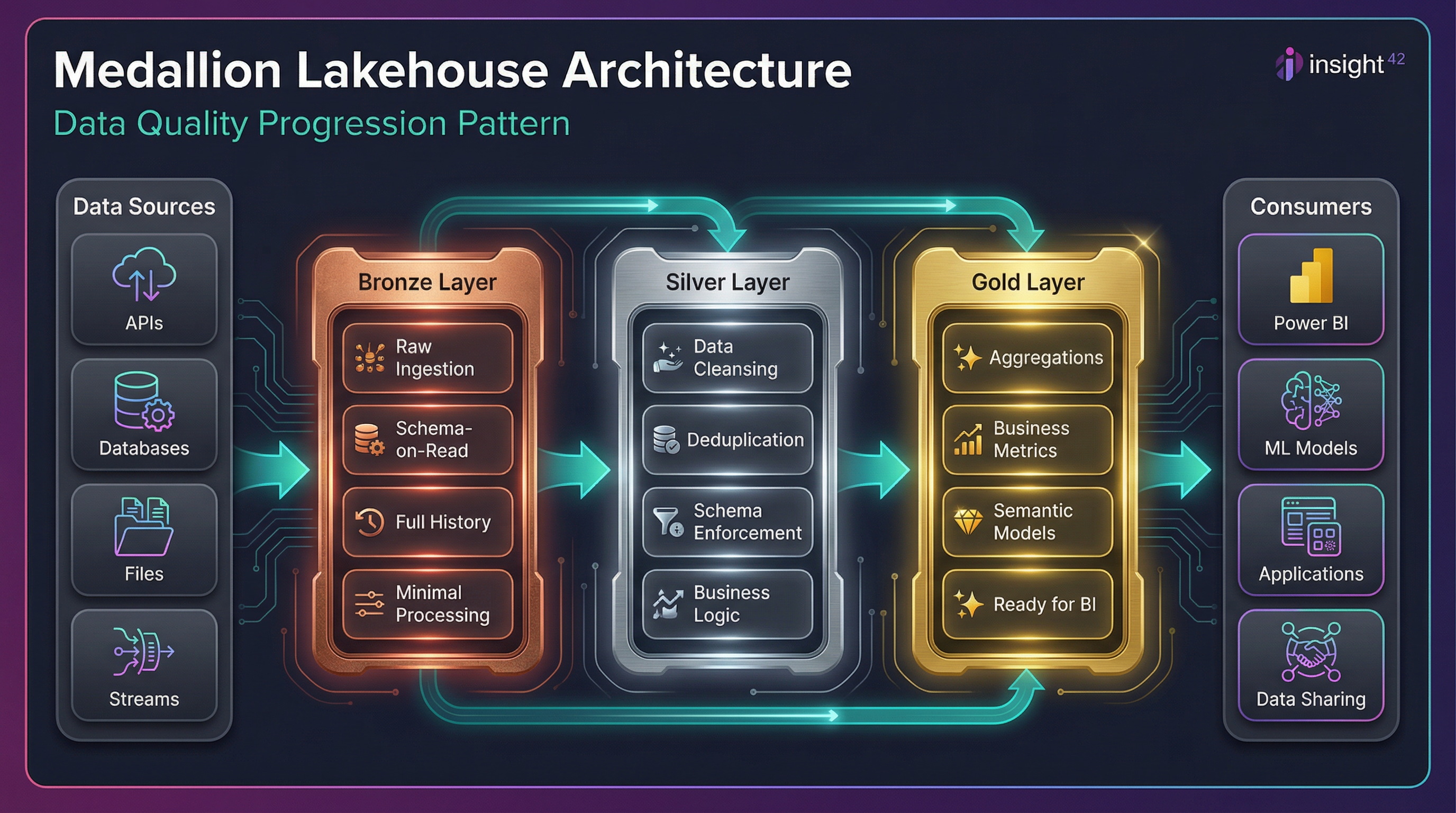
Figure 2: The medallion architecture, showing the progression of data from raw (Bronze) to cleansed (Silver) to business-ready (Gold).
Let’s explore how each of these layers can be effectively implemented within a Microsoft Fabric environment.
Bronze Layer: The Raw Data
The Bronze layer is where you land all your raw data from various source systems. The goal of this layer is to capture the data in its original, unaltered state, providing a historical archive and a source for reprocessing if needed. Key characteristics of the Bronze layer include:
| Characteristic | Description |
|---|---|
| Schema-on-read | Data is ingested and stored in its native format without any schema enforcement. |
| Append-only | Data is typically appended to existing tables to maintain a full historical record. |
| Minimal processing | Only minimal transformations, such as data type casting, are performed in this layer. |
| Full history | Complete audit trail of all ingested data for compliance and reprocessing. |
In Fabric, the Bronze layer can be implemented using a dedicated lakehouse for raw data ingestion. Data can be brought into this lakehouse using Data Factory pipelines, Spark notebooks, or shortcuts to external data sources.
Silver Layer: The Cleansed and Conformed Data
The Silver layer is where the raw data from the Bronze layer is cleansed, transformed, and enriched. The goal of this layer is to provide a clean, consistent, and conformed view of the data that can be used by various downstream applications and analytics workloads. Key characteristics of the Silver layer include:
| Characteristic | Description |
|---|---|
| Data cleansing | Handling missing values, standardizing formats, and correcting data quality issues. |
| Deduplication | Removing duplicate records to ensure data accuracy. |
| Schema enforcement | Applying a well-defined schema to the data. |
| Business logic | Applying business rules and transformations to enrich the data. |
In Fabric, the Silver layer is typically implemented as a separate lakehouse or as a set of curated tables within the same lakehouse as the Bronze layer. Spark notebooks and Dataflow Gen2 are the primary tools for performing the transformations required to move data from Bronze to Silver.
Gold Layer: The Business-Ready Data
The Gold layer is the final, highly curated layer of the medallion architecture. It contains aggregated, business-level data that is optimized for reporting and analytics. The goal of this layer is to provide a single source of truth for key business metrics and dimensions. Key characteristics of the Gold layer include:
| Characteristic | Description |
|---|---|
| Aggregations | Data is aggregated to various levels of granularity to support different reporting needs. |
| Business metrics | Key performance indicators (KPIs) and other business metrics are calculated and stored. |
| Semantic models | Data is organized into star schemas or other dimensional models for self-service BI. |
| Ready for BI | The data is optimized for consumption by BI tools like Power BI. |
In Fabric, the Gold layer can be implemented as a Fabric Data Warehouse or as a set of highly curated tables in a lakehouse. The choice between a warehouse and a lakehouse depends on the specific requirements of the use case. Warehouses provide a more traditional SQL-based experience, while lakehouses offer more flexibility and direct integration with other Fabric workloads.
Implementation Summary
| Layer | Purpose | Fabric Implementation | Key Tools |
|---|---|---|---|
| Bronze | Raw data ingestion | Dedicated lakehouse | Data Factory, Spark, Shortcuts |
| Silver | Cleansed and conformed data | Curated lakehouse tables | Spark, Dataflow Gen2 |
| Gold | Business-ready data | Data Warehouse or curated lakehouse | SQL, Spark, Power BI |
The Future of Data Architecture is Unified
Microsoft Fabric represents a significant step forward in the evolution of data platforms. By unifying the data lake and the data warehouse into a single, integrated experience, Fabric has the potential to simplify the data landscape, break down data silos, and accelerate time to value. The medallion architecture provides a proven design pattern for organizing data in this new, unified world.
However, as we will see in the next part of this series, the reality of implementing these new architectures is not without its challenges. In Part 3, we will take a critical look at the security, compliance, and network separation challenges that organizations face when adopting Microsoft Fabric, and explore the practical solutions and workarounds that are available today.
References
[1] What is the medallion lakehouse architecture? – Azure Databricks
← Previous: Part 1: Introduction to Fabric | Next: Part 3: Security, Compliance, and Network Separation
#MicrosoftFabric #MedallionArchitecture #DataLakehouse #OneLake #DataArchitecture #DataEngineering #BronzeSilverGold #UnifiedDataPlatform #DeltaLake #DataGovernance #CloudData #FabricImplementation #DataModeling #ETLSimplification #DataWarehouseModernization