January 27, 2026 – The digital landscape is shifting beneath our feet. While today’s headlines focus on localized outages and the fragility of global AI dependencies, a deeper, more structural challenge is emerging for European leaders. It is the Digital Sovereignty Trilemma: the “Impossible Trinity” of Sovereignty, Resilience, and Safety. In fact, this issue is central to the ongoing debate on European Safety, Sovereignty and Resilience.
For years, we’ve been told we can have it all. But as the EU pushes for strategic autonomy while its businesses crave the raw power of Silicon Valley’s innovation, the cracks are showing. This isn’t just a regulatory hurdle; it’s a management masterclass in trade-offs where European Safety, Sovereignty and Resilience are at stake.
The Anatomy of the Conundrum
To understand how to win, we must first understand why we often lose. The trilemma forces us to choose between three essential but competing pillars:
- Sovereignty (The Fortress): Total control over data boundaries and legal jurisdiction. It keeps the “digital borders” secure but often isolates you from the global innovation stream.
- Resilience (The Hydra): The ability to survive any failure through massive, global redundancy. This requires spreading your “digital DNA” across the globe, which inherently dilutes your control.
- Safety (The Shield): Access to world-class security and encryption protocols. Currently, the most advanced shields are forged in the R&D labs of global hyperscalers, creating a dependency that threatens the Fortress.

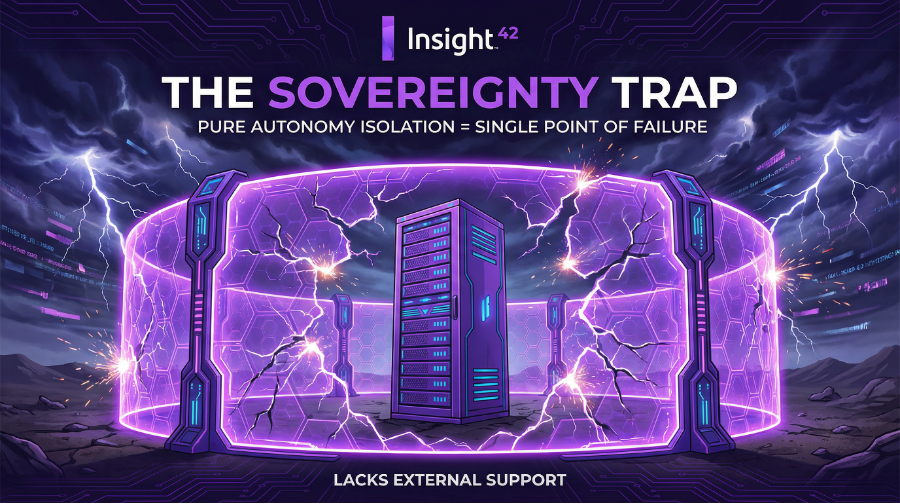
The “Sovereignty Trap”: Why Pure Autonomy Fails
The traditional European response has been to build “digital walls”—strict data localization and local-only provider mandates. However, this often leads to the Sovereignty Trap. By locking data into a single, local “sovereign” silo, organizations actually decrease their Resilience. A localized power failure or a targeted cyberattack on a smaller, local provider can lead to total operational paralysis. In our quest for control, we inadvertently create a single point of failure. These trade-offs highlight the complexity of achieving European Safety, Sovereignty and Resilience in the digital era.
Turning the Tide: How to Successfully Deal with the Trilemma
The winners of 2026 aren’t choosing one pillar over the others; they are redefining the relationship between them. Here is how to successfully navigate the trilemma for better European Safety, Sovereignty and Resilience.
1. Shift from “Isolation” to “Strategic Interdependence”
Stop trying to build a European clone of every US service. Instead, focus on Interoperability Layers. By using open-source standards (like Gaia-X frameworks), you can “knit together” the capability of global giants with the legal protections of local providers. You don’t need to own the whole stack to control the data that flows through it.
2. Adopt “Sovereignty-by-Design” Architectures
Don’t treat sovereignty as a legal checkbox; treat it as a technical requirement. Use Confidential Computing and Bring Your Own Key (BYOK) encryption. This allows you to use the massive processing power of global clouds (Capability) while ensuring that the provider physically cannot access your data, even under a foreign subpoena (Sovereignty).

3. Implement “Active-Active” Multi-Cloud Resilience
True resilience is no longer about having a backup; it’s about being “cloud-agnostic.” Distribute your critical workloads across a “Sovereign Cloud” for sensitive data and a global hyperscaler for high-performance tasks. If one fails, your orchestration layer shifts the load. This is Resilience without the Sacrifice of Control.
4. Leverage Public Procurement as Industrial Policy
The EU’s greatest strength is its collective buying power. By mandating “sovereign-compatible” standards in public contracts, we force global providers to adapt to our rules. We don’t just ask for safety; we define the terms of the shield.
The Path Forward: A Hybrid Future
The Digital Sovereignty Trilemma isn’t a problem to be “solved”—it’s a tension to be managed. The future belongs to the “Digital Architects” who can balance the need for global innovation with the mandate for local control.
We don’t need to build a wall around Europe. We need to build a smarter, more resilient bridge—one that is anchored in our values but reaches for the best the world has to offer. Ultimately, European Safety, Sovereignty and Resilience can only be achieved by embracing this hybrid approach.

How is your organization balancing the scales of the Digital Trilemma? Are you building walls or bridges? Let’s discuss in the comments.
#DigitalSovereignty #EUTech #DataPrivacy #CyberSecurity #Resilience #DigitalTransformation #CloudComputing #StrategicAutonomy #Insight42 #TechStrategy
Key Takeaways
- The Digital Sovereignty Trilemma presents a challenge balancing European Safety, Sovereignty and Resilience.
- European leaders struggle between total control, global redundancy, and access to advanced security protocols.
- To overcome the trilemma, Europeans should shift to strategic interdependence and use interoperability layers.
- Implementing Sovereignty-by-Design architectures can enhance data control while leveraging global cloud capabilities.
- The future lies in balancing global innovation with local control to achieve true European Safety, Sovereignty and Resilience.
Table of contents
Related Articels:
Unleash the European Bull