Practical guide 04 / 05
Public-sector process automation starts with a clearly defined case, not with a robot. Who checks the information? Which system holds the authoritative record? What happens when a document is incomplete? Answer these questions before selecting workflow or AI components.
The practical answer: remove the handoff, not just the paper
A form can be completed online while creating substantial manual work behind the scenes. Structured fields become a PDF, attachments move through email, and processing status lives in a separate spreadsheet. A useful automation engagement connects intake to validation, ownership and the case-management application.
For German administrative services, FIT-Connect provides standardised transmission between online services and administrative systems. [1] Whether the result is an end-to-end workflow still depends on the connected applications and business process.
Choose a suitable first workflow
Repeated document types, understandable validation rules and a clear service owner are helpful starting conditions. A workflow dominated by unresolved exceptions or shifting responsibilities should first be clarified at the process level.
The objective is not the highest automation percentage. It is less manual effort per correctly completed case. That distinction prevents a technically impressive pilot from creating new operational work elsewhere.
Why digital government processes can duplicate effort
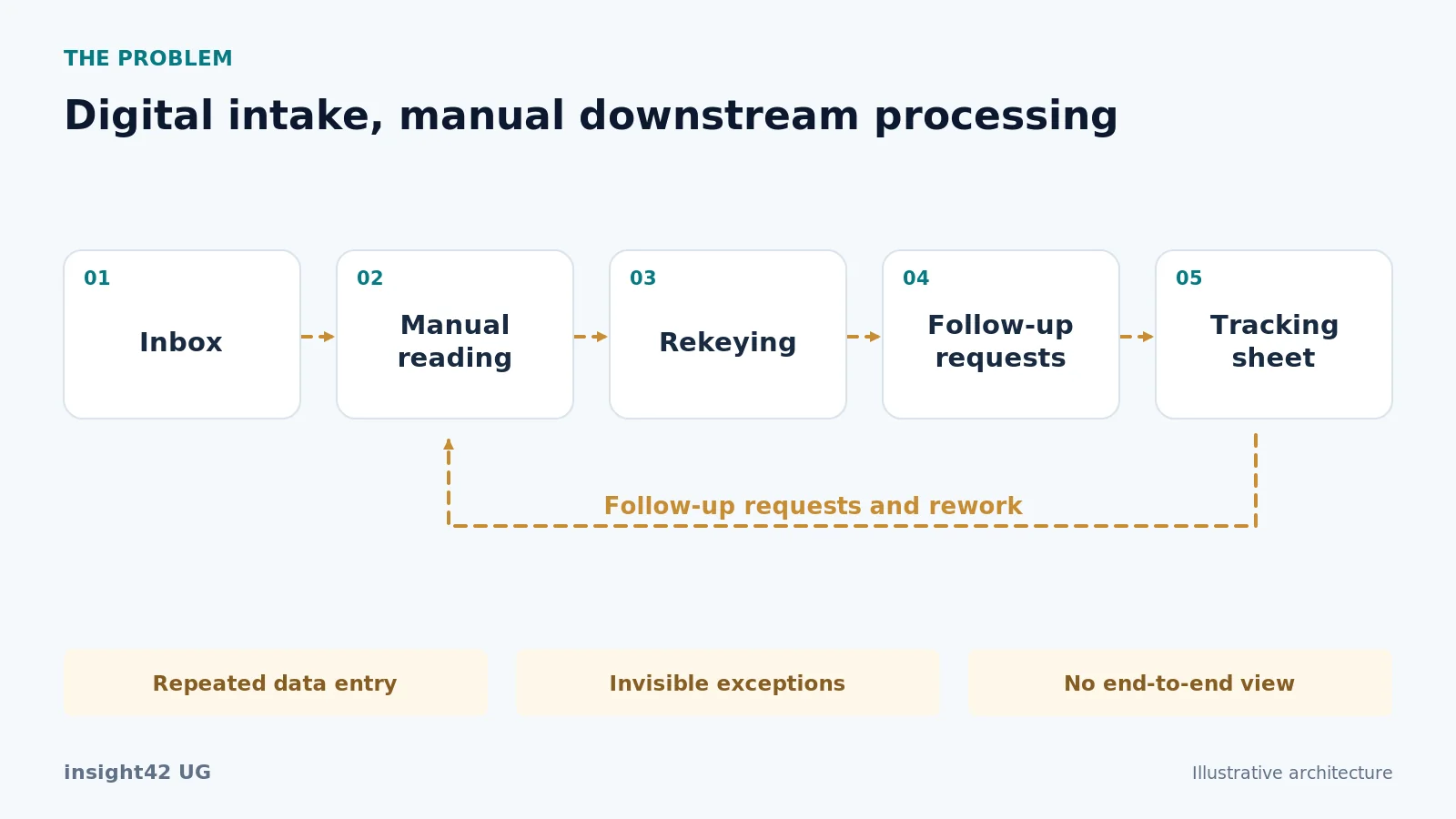
Structured information becomes unstructured again
When data already exists in a form, preserve and transmit it as structured data where possible. Turning it into a PDF and applying text recognition later is usually an avoidable detour. Document extraction is more useful where structured intake is unavailable, such as heterogeneous supporting attachments.
The normal path is automated but exceptions are not
A missing signature, conflicting date or uncertain identity match must not make a case disappear into a technical queue. An exception needs a reason, owner, deadline and visible status. Otherwise, automation creates a new digital backlog that is harder to understand than the original inbox.
A technical retry creates a duplicate business event
A request can be stored successfully even when the caller never receives the response. Retrying without a stable case identifier and controlled duplicate handling can create a second application. These failure modes must be tested before production, not left to the first support incident.
Measure the complete workflow: Sample reading, rekeying, waiting, correction and decision effort. Looking only at the time spent in one automated step can conceal additional work created elsewhere.
The solution: rules control the process; AI assists extraction
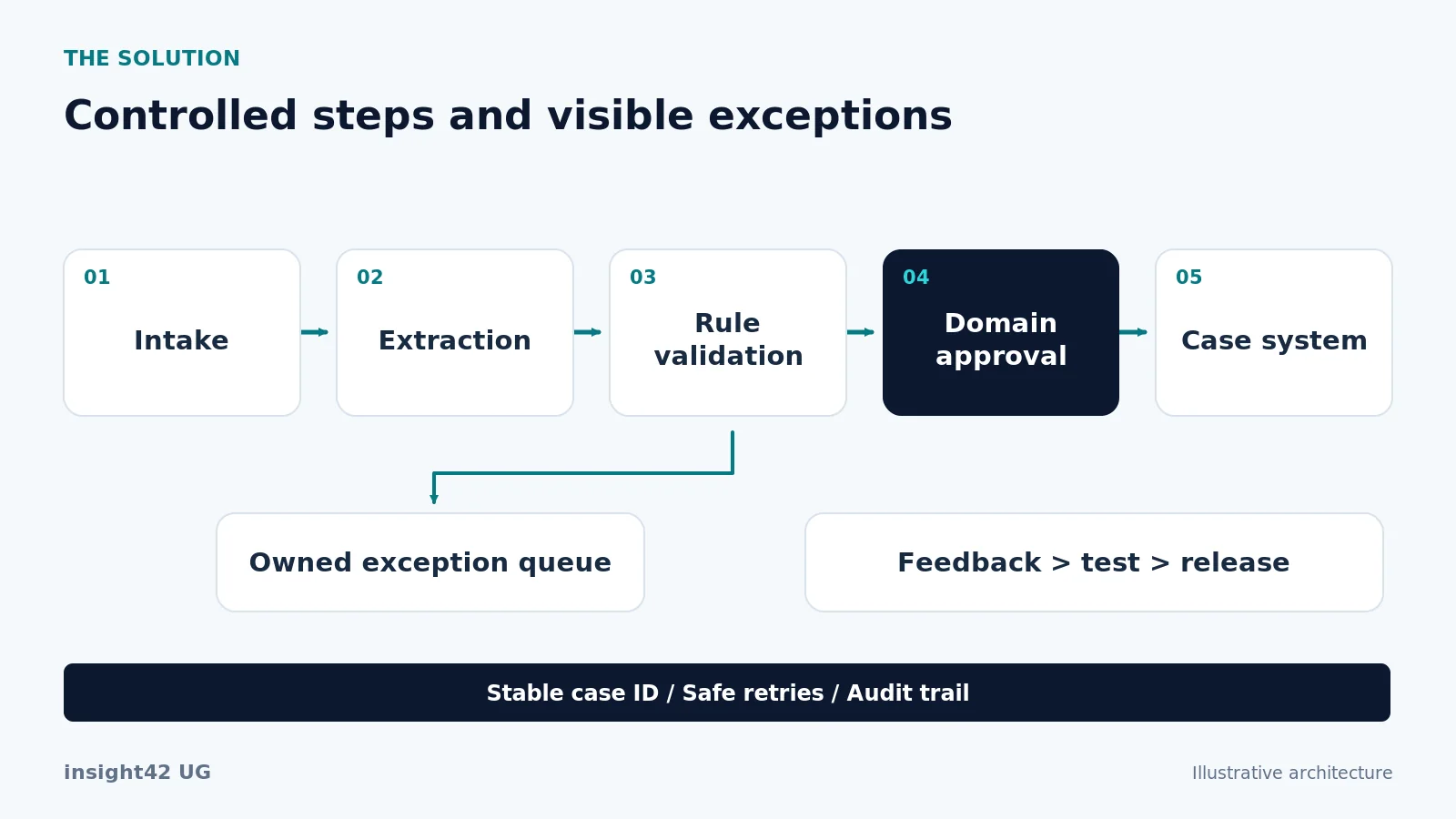
Validate the intake and preserve identity
Assign a stable case reference. Check file types, completeness and integrity. Process structured fields against an agreed schema and extract unstructured information only where needed. An absent value must remain absent rather than being replaced with a plausible model-generated guess.
Separate extraction from administrative decisions
A model can propose an amount or a document category. Explicit rules should check mandatory fields, ranges and other deterministic requirements. Uncertain or conflicting results go to domain review. Incoming documents can also carry prompt-injection content; they must not gain additional system privileges through the extraction process. [2]
Record approvals and processing transitions
A workflow manages state, approvals, retries and exceptions. Write to the case system only after the necessary conditions are met. Record which data was suggested automatically and which was confirmed by an authorised person. Keep business events traceable without indiscriminately logging sensitive document contents.
Fully automated administrative decisions require a separate legal assessment. Where Germany’s section 35a VwVfG applies, automation requires authorisation by a legal provision and neither discretion nor a margin of assessment may remain. Relevant sector and state law also needs review. [3] Automating preparation is not a general authorisation to automate the decision itself.
Design the pilot for an eventual operating service
1. Define the process and the baseline
Record inputs, outputs, ownership and major exceptions. Establish baseline handling time, returned cases, waiting time and quality errors. Involve the service owner, privacy, security and any relevant staff-representation bodies early. Appoint both a business owner and a technical owner.
2. Replay representative cases safely
Use approved historical data or suitable synthetic cases. Compare extracted values against domain-reviewed reference data. Keep development examples separate from acceptance cases. Include long attachments, poor scans, multiple amounts, contradictory information and repeated delivery.
3. Assist first, then automate bounded steps
Initially, let the service produce proposals without uncontrolled writes. Once its behaviour is demonstrated, automate specific approved operations. Human oversight must be meaningful: clicking through a model answer without adequate context is not an effective control.
4. Turn exceptions into a controlled improvement cycle
Classify recurring errors. Is the source a poor form, a data-model mismatch, extraction failure or an ambiguous rule? Improve the relevant component, rerun historical tests and release a versioned change. This is more sustainable than accumulating one-off workarounds.
Acceptance should demonstrate no unintended duplicate cases in the agreed test set, visible exception handling, traceable approvals and a tested manual fallback. Agree the acceptable domain-specific error profile before the pilot begins. A single technical accuracy percentage is not enough.
Measure value across the entire completed case
An illustrative model, not a promised result: 1,000 monthly cases currently require twelve minutes of manual work each, or 200 hours. In a proposed workflow, 70 percent require three minutes including review; the remaining 30 percent still require twelve. That totals 95 hours. After an assumed 20 hours of maintenance and operations, the theoretical capacity gain is 85 hours per month.
The model becomes credible only after the pilot measures case distribution and real handling time. Include licences, integration, training and the consequences of errors in the economic assessment. A successful API response does not by itself establish business value.
Specify deliverables that survive the pilot
Useful outputs include a process model, data contract, integration component, rule catalogue, exception workflow and acceptance tests. Define operating ownership, change rights and export of configuration and process history. A pilot without a path into supported operation remains an experiment.
Find the right first workflow with Insight42
Assess one process with repeated manual handoffs. Insight42’s published services include end-to-end workflows, automation and data platforms. [4] A focused engagement can deliver a process map, an analysis of effort drivers, technical options and an economically testable pilot scope.
Contact: support@insight42.com. Identify the case type, approximate volume and most expensive manual step. Sensitive original records are not needed for an initial assessment of the opportunity.
Frequently asked questions about process automation
Does every workflow need AI?
No. Structured forms, stable interfaces and explicit rules can often automate work without a generative model. AI is more relevant to variable, unstructured content. It should not replace a simpler deterministic check without a clear reason.
Is robotic process automation a useful bridge?
Screen automation can help when no suitable interface exists. It remains dependent on the user interface and needs failure detection, maintenance and a retirement path. Assess a supported API as an alternative before committing to a long-lived workaround.
Can the system automatically issue administrative decisions?
There is no general answer. In Germany, section 35a VwVfG imposes specific conditions where applicable. [3] Review the relevant jurisdiction and distinguish preparation, a decision proposal and the actual issue of an administrative act.
How do we avoid creating another isolated workflow?
Reuse suitable identity, integration and operating capabilities. Specify which business system remains authoritative and who maintains the automation after the pilot. A shared platform helps only when responsibilities and interfaces are genuinely shared.
The takeaway: Good automation makes exceptions visible, reduces repetitive work and preserves accountability. It should not merely move unresolved problems through the organisation faster.
Sources and technical references
[1] FITKO: Was ist FIT-Connect?
[2] BSI: Indirect Prompt Injections, Warnung vom 15.07.2023
[3] Gesetze im Internet: § 35a VwVfG
Sources checked: 27 September 2026. Calculations and diagrams are illustrative.