
This article is part of our curated Growth Hub — five pillars on sovereignty, AI, cloud economics, data and security. Visit the Growth Hub.
Security budgets are defended like insurance: necessary, joyless, capped. But in B2B — especially selling to enterprises, banks, insurers or the public sector — security has quietly become something else: the gate through which every deal must pass. The vendor security review is now part of procurement, and it does not negotiate.
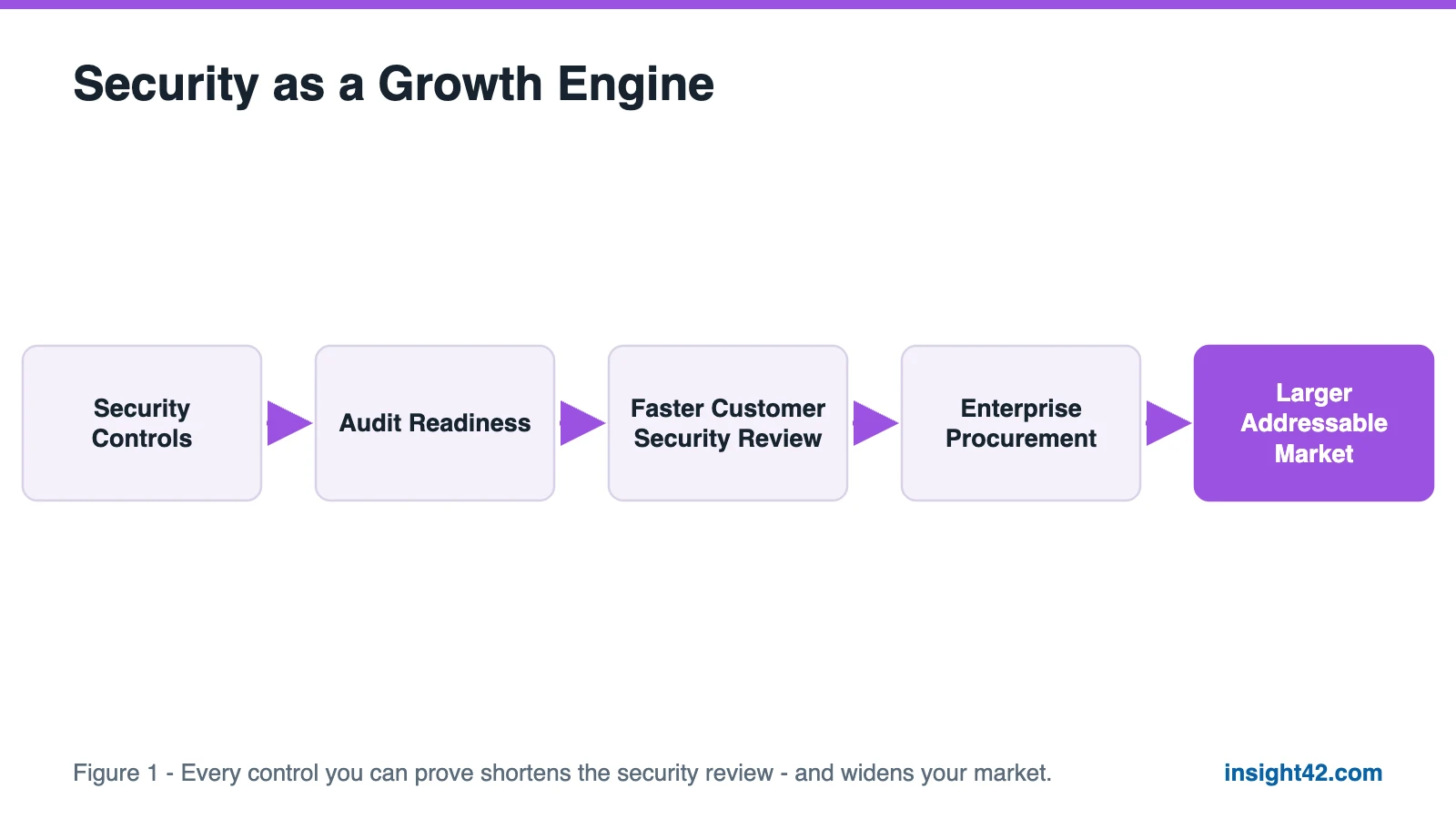
That changes the economics. Every control you can prove shortens the buyer’s review, and every shortened review compounds into pipeline velocity and market access. Here is the growth chain, and how to build it deliberately.
Key takeaways
- Enterprise buyers evaluate security before price: the questionnaire decides the shortlist.
- The growth chain runs: security controls → audit readiness → faster customer security reviews → enterprise procurement → larger addressable market.
- Attestations (BSI C5, ISO 27001) act as review accelerators — one document replaces two hundred answers.
- Evidence-as-code beats evidence-by-panic: controls that generate their own proof keep review answers current at zero marginal cost.
The chain from controls to market
Security controls — built once, sold many times
Zero-trust access, MFA and PAM for privileged accounts, encryption with governed keys, immutable logging, tested restores. These are the same controls that appear — verbatim — in every serious vendor questionnaire. Building them properly once (see our cloud & IT security services and encryption & key management) is cheaper than answering for their absence in every deal.
Audit readiness — controls with receipts
A control without evidence is an opinion. Readiness means each control is mapped (BSI C5, ISO 27001, NIS2), owned, and produces its proof automatically — access reviews exported, restore tests logged, configurations attested. Teams that adopt evidence-as-code answer security reviews from a library instead of a scramble. If C5 is your target, start with our practical notes on preparing for a BSI C5 audit.
Faster reviews — the hidden sales metric
Measure the time from “here is our security questionnaire” to “security approved”. In many companies it is four to ten weeks and nobody owns it. Cutting it to days does more for quarterly revenue than most marketing spend — and it is entirely an engineering-plus-evidence problem. Controls like conditional access and MFA are not just protections; they are answers.
Enterprise procurement → a larger market
Passing reviews reliably qualifies you for frameworks and tenders you previously watched from outside: public administration, KRITIS operators, regulated finance. Each attestation is a market key. That is the honest way to read compliance spend: not insurance, but distribution.
Build the chain: a pragmatic sequence
- Collect the last five security questionnaires you received. They are your requirements document — free market research.
- Gap-map against BSI C5 / NIS2. Prioritize controls that appear in questionnaires and frameworks.
- Close the veto controls first: MFA/PAM coverage, encryption & key custody, logging, tested restores.
- Automate the evidence. Every control ships with its proof; reviews get answered from the library.
- Instrument the metric: review turnaround time, tracked like pipeline — because it is.
Turn your security posture into pipeline
Insight42 builds security architectures that pass audits and win deals — zero trust, key management, BSI C5 and NIS2 readiness, and evidence that renews itself. Request a security & compliance assessment and we will show you which controls unlock which markets.
How we turn NIS2 obligations into actionable measures and evidence is described in our NIS2 consulting.
Related reading
- Preparing for a BSI C5 Audit: Practical Tips
- Cloud Key Management: BYOK vs. HYOK
- IT Baseline Protection in the Cloud: Shared Responsibility in Practice
More insights like this in our Growth, Innovation & Digital Strategy hub.