Microsoft Fabric: (Part 5 of 5)
An insight 42 Technical Deep Dive Series
The Horizon: Fabric’s Future Trajectory and the Universal Data Hub
Over the past four parts of this series, we have taken a deep and critical journey through the world of Microsoft Fabric. We’ve explored its evolutionary roots, dissected its architecture, confronted its security and compliance challenges, and navigated the pragmatic realities of multi-tenancy and licensing. Now, in our final installment, we turn our gaze to the horizon and explore the future of Fabric. What is Microsoft’s long-term vision for this ambitious platform, and what does it mean for the future of data and analytics?
This post will examine the future trajectory of Microsoft Fabric, with a particular focus on its most innovative and forward-looking feature: shortcuts. We will explore how shortcuts are enabling a new era of cross-cloud data integration and positioning Fabric to become the central hub for the entire modern data estate.
Shortcuts: The Gateway to a Multi-Cloud World
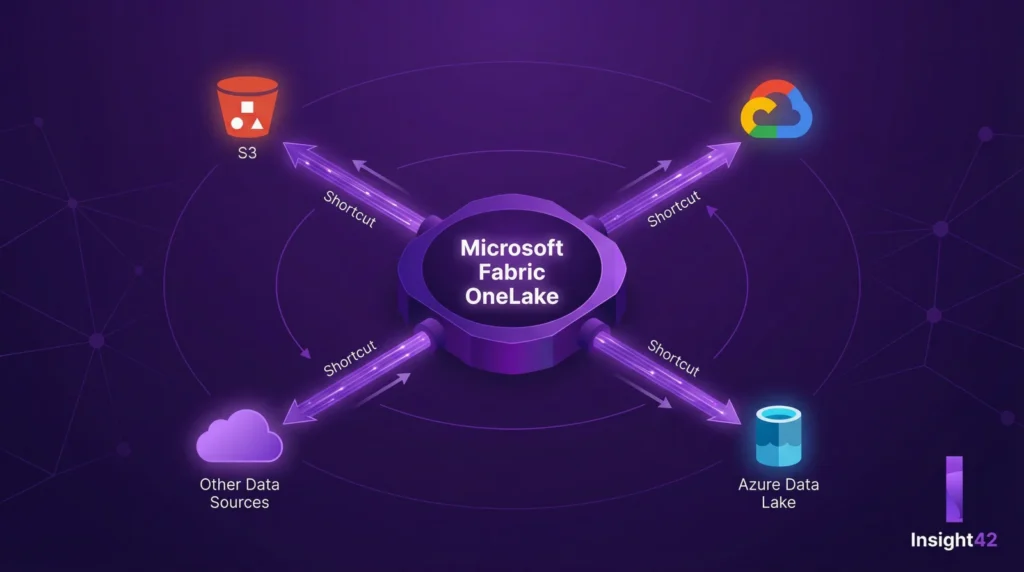
Perhaps the most groundbreaking feature in Microsoft Fabric is the concept of shortcuts. A shortcut is a symbolic link that allows you to access data in external storage locations—including other clouds like Amazon S3 and Google Cloud Storage—as if it were stored locally in OneLake. This simple but powerful idea has profound implications for the future of data architecture.
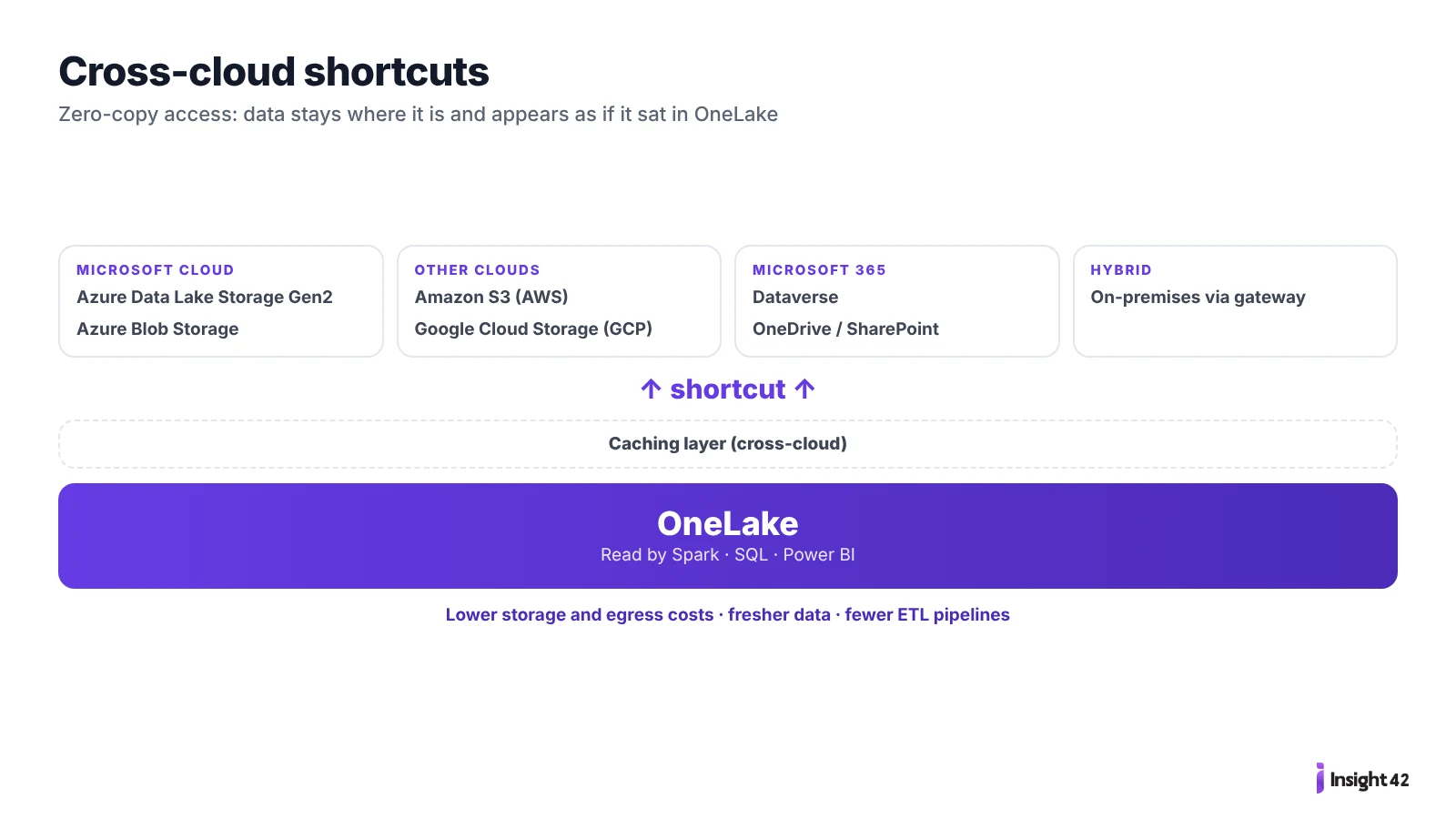
Figure 1: The cross-cloud shortcut architecture in Microsoft Fabric, enabling zero-copy data access across hyperscalers through a caching layer.
The Power of Zero-Copy Integration
For years, multi-cloud data integration has been a complex and expensive endeavor, requiring organizations to build and maintain fragile ETL pipelines to copy and move data between clouds. Shortcuts eliminate this complexity by enabling zero-copy integration. Instead of moving data, you simply create a shortcut to it, and Fabric’s query engines can access it directly in its original location [1].
This approach offers several key benefits:
| Benefit | Description |
|---|---|
| Reduced Costs | Eliminates the need to copy and store data in multiple locations, significantly reducing storage and egress costs. |
| Improved Data Freshness | Access data directly at its source, always working with the most up-to-date information. |
| Simplified Architecture | Eliminates complex ETL pipelines, simplifying the data landscape and reducing maintenance overhead. |
| Unified Access | Query data from multiple clouds using familiar tools like Spark, SQL, and Power BI. |
Supported Shortcut Sources
Fabric shortcuts support a growing list of external data sources:
| Source | Type | Key Features |
|---|---|---|
| Azure Data Lake Storage Gen2 | Microsoft Cloud | Native integration, optimal performance |
| Azure Blob Storage | Microsoft Cloud | Legacy storage support |
| Amazon S3 | AWS | Cross-cloud integration |
| Google Cloud Storage | GCP | Cross-cloud integration |
| Dataverse | Microsoft 365 | Business application data |
| On-Premises | Gateway | Hybrid cloud scenarios |
| OneDrive/SharePoint | Microsoft 365 | Collaboration data |
A Truly Multi-Cloud Data Platform
With shortcuts, Microsoft Fabric is not just a Microsoft-centric data platform; it is a truly multi-cloud data platform. It allows you to unify your entire data estate, regardless of where it resides, under a single, logical data lake. This is a major step towards breaking down the data silos that have plagued organizations for years and creating a single pane of glass for all data and analytics.
The Hub Vision: Fabric as the Universal Data Hub
The long-term vision for Microsoft Fabric is to become the central hub for the modern data estate—a single, unified platform that can connect to any data source, power any analytics workload, and serve any user. This “hub and spoke” model, with OneLake at the center and shortcuts as the spokes, has the potential to fundamentally reshape the way we think about data architecture.
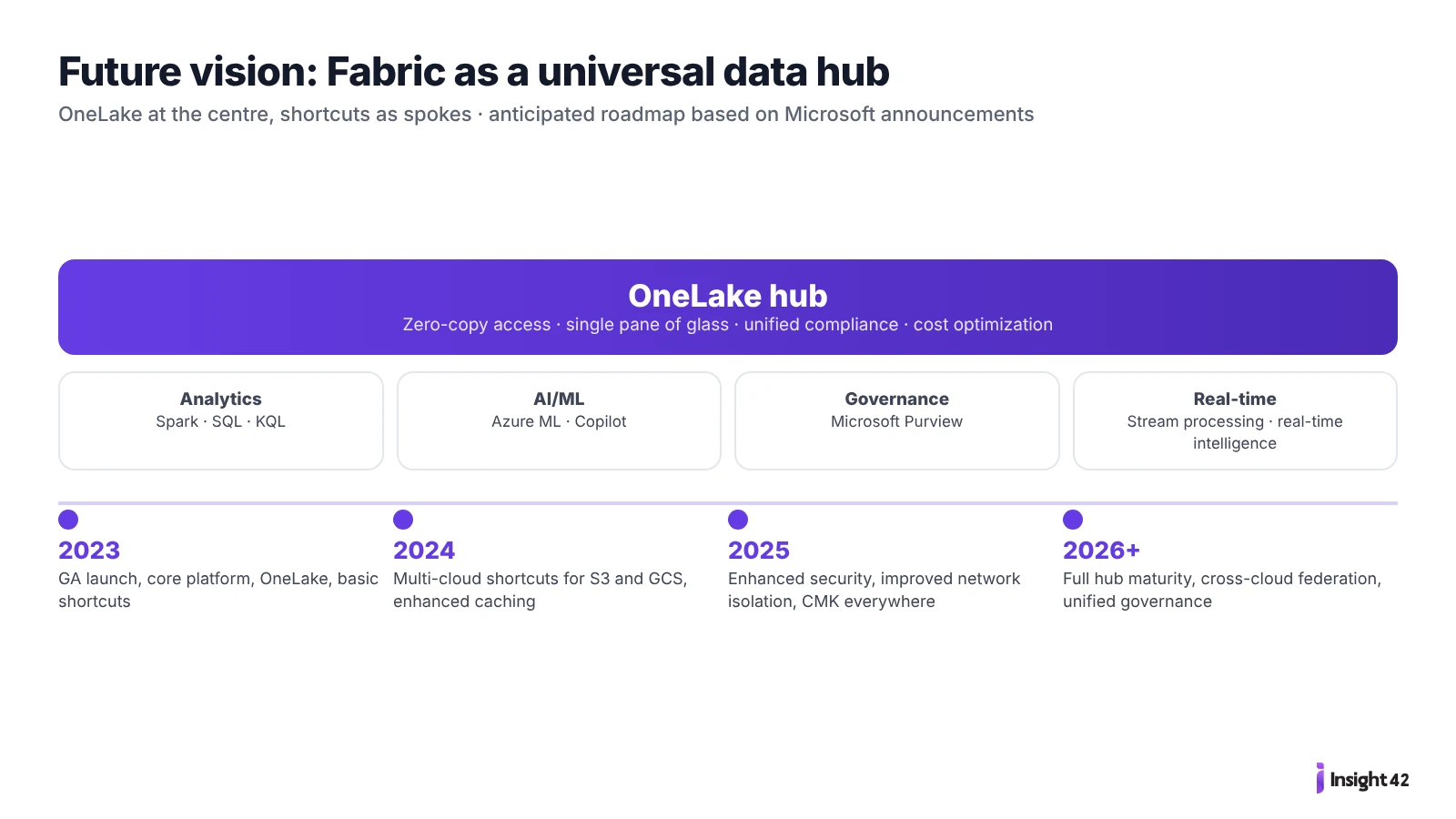
Figure 2: The future vision of Microsoft Fabric as a universal data hub, connecting to all major hyperscalers and data sources with a clear evolution roadmap.
Unified Capabilities
The hub vision brings together several critical capabilities under one roof:
| Capability | Description |
|---|---|
| Analytics | Unified analytics across all data sources with Spark, SQL, and KQL |
| AI/ML | Integrated machine learning with Azure ML and Copilot |
| Governance | Centralized governance through Microsoft Purview |
| Real-Time | Stream processing and real-time intelligence |
Enterprise Benefits
For organizations that embrace the hub model, the benefits are substantial:
| Benefit | Impact |
|---|---|
| Zero-Copy Access | Eliminate data duplication and reduce storage costs |
| Single Pane of Glass | Unified view of all data assets across clouds |
| Unified Compliance | Consistent governance and security policies |
| Cost Optimization | Reduced data movement and simplified architecture |
The Road to the Hub
While the vision is compelling, the road to becoming a true universal data hub is still a long one. Microsoft is rapidly adding new features and capabilities to Fabric, but there are still several key areas that need to be addressed:
| Area | Current State | Future Need |
|---|---|---|
| Security & Governance | Maturing, some gaps | Enterprise-grade isolation and compliance |
| Multi-Tenancy | Workspace-based, limited | Simplified licensing, better cost management |
| Cross-Cloud Integration | Shortcuts available | Query federation, unified governance |
| Performance | Good for most workloads | Optimized caching, predictable latency |
Evolution Roadmap
Based on Microsoft’s announcements and the trajectory of the platform, we can anticipate the following evolution:
| Year | Milestone | Expected Capabilities |
|---|---|---|
| 2023 | GA Launch | Core platform, OneLake, basic shortcuts |
| 2024 | Multi-Cloud Shortcuts | S3, GCS integration, enhanced caching |
| 2025 | Enhanced Security | Improved network isolation, CMK everywhere |
| 2026+ | Full Hub Maturity | Cross-cloud federation, unified governance |
Conclusion: A Paradigm Shift in the Making
Microsoft Fabric is more than just a new product; it is a paradigm shift in the way we think about data and analytics. It represents a bold and ambitious attempt to solve some of the most complex and long-standing challenges in the data industry. While the platform is still in its early days and has its share of shortcomings, its core principles—a unified experience, a central data lake, and open data formats—are sound.
Key Insight: The journey to a truly unified data platform is far from over, but Microsoft Fabric has laid a strong foundation. Its innovative shortcut feature has opened the door to a new era of multi-cloud data integration, and its long-term vision of becoming a universal data hub has the potential to reshape the industry for years to come.
As data professionals, it is our responsibility to understand the implications of this shift and to be prepared to adapt to the new world that Fabric is creating. The future of data is unified, it is multi-cloud, and it is happening now.
Series Summary
Throughout this 5-part series, we have explored:
| Part | Topic | Key Takeaway |
|---|---|---|
| Part 1 | Introduction & Evolution | Fabric represents the next step in the data platform evolution |
| Part 2 | Architecture & Medallion | The lakehouse and medallion architecture are the new standard |
| Part 3 | Security & Compliance | SaaS trade-offs require careful consideration for enterprise adoption |
| Part 4 | Multi-Tenancy & Licensing | Practical workarounds are needed for complex scenarios |
| Part 5 | Future & Hub Vision | Shortcuts and the hub model are the future of data architecture |
Thank you for joining us on this deep dive into Microsoft Fabric. We hope this series has provided you with the insights you need to navigate this exciting and rapidly evolving landscape.
How shortcuts fit into your migration strategy is something we clarify in our Microsoft Fabric consulting.
References
[1] Unify data sources with OneLake shortcuts – Microsoft Fabric
← Previous: Part 4: Multi-Tenant Architecture and Licensing | Return to Series Index
#FabricShortcuts #MultiCloudData #UniversalDataHub #ZeroCopyIntegration #OneLake #CrossCloudAccess #FabricS3 #FabricGCS #DataFederation #UnifiedDataHub #CloudDataIntegration #FabricFuture #DataArchitecture #HubAndSpoke #MultiCloudPlatform